West Germany 1980

The new European champions were different matter – they had established and new stars, very able team, which was also young and not quite at its peak, and most importantly West Germany returned to the right track. The changes after the 1978 fiasco seemingly brought back the Germans to exciting total football and they had a team playing like the fantastic team of the first half of the 1970s. And this team was most certainly to stay on top for many years. There were similarities with the the great team of the early 70s and tradition was seemingly at work. Of course, the coach was credited for that.
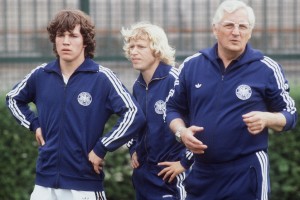
Lothar Matthaus, Calle Del’Haye, and Jup Derwall – a picture of optimism.

German tradition was the key to success – Derwall, after years as an assistant to Schon, replaced him in 1978, just like Schon replaced Sepp Heberger in 1964, after working as Herberger’s assistant for years. Stability was obviously the key – Derwall was only the 4th manager of the German national team in history. Helmut Schon was assistant coach for 8 years and Derwall was his assistant 8 years too. Like Schon, he experienced success first as an assistant. He knew very well the ins and outs of working with the national team. Continuation of the line was fruitful – if Herberger waited almost 20 years for his success, Schon achieved it in less then 10. Derwall won a title after only 2 years at the helm. It was the first major tournament West Germany played under his guidance – another optimistic sign. Herberger made West Germany world champions, Schon doubled the success if his teacher, winning the European and the world titles – Derwall, like Schon, won the European championship first, and since he was expected to stay as long as those before him, he was expected to outdo them after such a start. Tradition certainly was bringing results. Tradition is conservative, however. Derwall was no innovator, he made no radical change of a team which obviously needed that in 1978 – instead, he lamely continued the approach of Helmut Schon. The picture above is a bit misleading: Derwall had the guts to include young players – Matthaus was only 19 years old – but his exciting new team was also a result of circumstances. In West Germany Derwall was observed critically and rightly so: facing the need to start from scratch, he chose to continue Schon’s approach, which obviously reached a dead end. Nigbur, Fischer, Bonhof, and Cullmann were key players for Derwall – the survivors of Schon’s team. Three 1974 world champions… but what kind? Only Bonhof was a starter and not right away back in 1974. Cullmann was the eternal back up player. Nigbur hardly ever played for the national team – a total of 6 matches during the 6 years he was included in the national team. Fischer was not a stable first choice either. Bonhof was the prime star and also the youngest of the quartet, but he was also part of the team which lost the 1976 European final and crushed so badly in 1978. There is little doubt that Derwall insisted on these players – injuries of Nigbur and Fischer made him look for other options. Bonhof and Cullmann were in the 1980 squad… Bonhof was out because of late injury, Cullmann was obviously insufficient, yet, Derwall played him as much as possible. The new team happened because Derwall did not have his chosen stars… and he had to give up on Cullmann. Reluctantly at that. Derwall clearly had no guts to get rid of Schon’s reserves, of second-rate players, stigmatized by staying in the shadows of great players for many years – he was intending to continue the line of Schon going down. It is no wonder that the big discoveries in 1980 were exactly of players replacing the injured ‘stars’. Even the only innovation Derwall made was a copy of Schon’s and it was made out of desperation. Doubts about Derwall’s qualities can be summed like this: the new German team looked like a copy of the great West Germany of early 1970s, the team was finally shaped at the end of Euro 1980 – a copy of the 1974 World Cup team, and Derwall made it only because he had no other option. On the positive side – he had the guts to select young players, his team returned to the kind of football the Germans abandoned after 1974 – both successful and exciting to watch, and it was team for the future, given the age of the players. After all, the new European champions were the only really balanced team at the finals, with plenty of strong replacements, and the new stars – most of them defining the 1980s – came from it. Thus, unlike Belgium, the whole German team needs closer scrutiny.
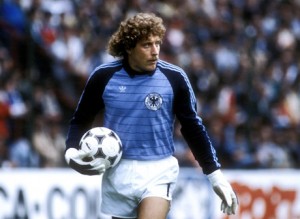
Tony Schumacher. 26 years old rival of the other discovery that year – Pfaff. Five years ago he was almost without future, but perseverance and character elevated him to first choice at 1. FC Koln. He won the Bundesliga first and eventually was invited to the national team. Becoming a starter was a bit chancy – if Nigbur was healthy, Schumacher was to warm the bench – but he really jumped on his chance and was one of the big discoveries at the European finals. One big plus was that he was not stigmatized like the unfortunate keepers, who spent most of their careers in the shadow of Sepp Maier – Nigbur, Kleff, Kargus, Franke grew old playing rarely for the national team and always found deficient, for they were compared to Maier. Schumacher came in view after Mayer retired and was much younger than the already mentioned, who were pushing 30. The future was clearly his, he arrived – like Pfaff – at age, when goalkeepers usually start to mature. He filled the gap left by Maier for many years to come – it was easy to envision West Germany with a great goalkeeper for the next 10 years. Problem solved.

Manfred Kaltz. Already a star, considered one of the top full backs in the world. At 27, he was at his peak. A modern full back, reminding a bit of Breitner between 1972 and 1974. Energetic, covering large space, instrumental in attacks, scoring, and not exactly pinned to the right side of field. He was part of rapidly rising Hamburger SV, which was very helpful too, for other HSV players were included in the national team and teammates knew each other in and out. Versatile defender – he was used as a stopper by Schon in 1978. Of course, he was a copy of Breitner – his creativity was limited, he was not great in his essential job – strikers often outwitted him, and he was space-limited – unlike Breitner, roving everywhere, Kaltz largely occupied the right side of the field. He was also more defensive player – unlike Breitner, who rapidly evolved into playmaker.

Uli Stielike. Derwall moved him back to be a libero – a great move, even when commanded by necessity. The skills of Stielike were well known and he was the mover and shaker of Real Madrid. He was also exactly what the prophets of total football preached – versatile player, comfortable at any position: so far, Stielike played at almost every post in attack and midfield. Moving him back as a libero repeated the great move of Beckenbauer years before – space was opened for Stielike to conduct the team’s play. Essentially, Derwall did what Schon did years earlier and it was the right move. Stielike was not as ellegant as Beckenbauer, not he was so imaginative, but he was reliable and creative. Perhaps a bit poorer version of Beckenbauer, but only a bit – with Stielike, German defense remained iron strong, increasing the attacking strength in the same time. 25 years old – coming to his peak and having many years ahead of him.

Karl-Heinz Forster. 21 years old, coming from rising VfB Stuttgart. May be he needed some time to build chemistry with Stielike to the point Schwarzenbeck had with Beckenbauer, but Forster seemed better player than Schwarzenbeck already. He was more versatile, capable of playing not only as a sweeper and stopper, but as a left full back too. He also went into attacks more frequently than Schwarzenbeck and, most importantly, he was not just addition to a great and particular libero, but stand on his own. With him, the German team had not to worry for central defender for the next ten years. At least.

Bernard Dietz. The oldest and most experienced player in the squad. At 32, he was not yet showing decline. Spirited and modest left full back and captain of the team. A modest player, never considered a big star and playing for modest MSV Duisburg for years, Dietz was something between his predecessors Hottges and Vogts: very stable and spirited full back. He was less given to attack than Vogts, but more than Hottges. Disciplined player, willing to follow coach’s demands, but more conservative than both Hottges and Vogts, who on occasion played at different side of the pitch, and Vogts even in midfield. The age was the only problem – he was not going to last for long and seemingly there was no other strong enough left full back in West Germany, but either one of the Forster brothers or Briegel were capable of playing at the left side of defense, so the problem was not big.


Hans-Peter Briegel. 24 years old player of 1. FC Kaiserslautern, listed as defender. He played as full-back and at the end of the tournament he was voted in the top eleven as a left full-back, but his proper place was more like defensive midfielder. Difficult to pin down to particular post really. Briegel was especially strong even for a German and players of this kind tend to be brutes on pitch, but he was not. Of course, he intimidated the opposition, too powerfully build to push down, too fit to outrun him, too determined to brake him down emotionally, but he was good player, not just a tower of muscle without skills. Briegel solved the problem with defensive midfielder – a long lasting one, which always called for improvisation (Wimmer, Bonhof, Flohe, Cullmann – none of them played at this position in his club, or, if he did, eventually moved to another role). Briegel was particularly important discovery because he would cover either full-back, if needed – as he did, when Dietz was injured.


Bernd Schuster. Only 20 years old talent, playing for 1. FC Koln. Some specialists knew him already, but Ron Greenwood was lone and even eccentric voice when he named him one of the best before the finals started – Schuster was not a starter: he seemed to be back-up of Bonhof. That is, essentially defensive midfielder with play-making abilities, who, like Bonhof, would conduct the game from deeper back, and may be even restricted to more traditional role in the presence of Stielike. But the team had to be reshaped during the finals and Schuster not only became a starter, but was moved to a central paly-making role. Thus, the big problem existing since Overath and Netzer retired was finally solved – West Germany found at last great playmaker. Skillful, imaginative, with great leadership qualities. With Schuster the Germans seized to be boring marathon runners – the team suddenly had a flair. His age brought great confidence – this guy was almost a teenager yet. His best days were still in the future, he was surely to be the key player of the team for the next 10 years.

Hansi Muller. 22 years old and already a star – a young star, but a star. With Forster brothers, part of the rising VfB Stuttgart. An attacking midfielder with strong play-making inclination, he took the place of Uli Hoeness from the great old West Germany. However, Muller was heavily criticized and never fully accepted by German media: he was too technical for a German and tended to keep the ball too long. Like Hoeness before, Muller was a bit moody and unpredictable – often he underperformed or at least media thought so. The last negative side, also copying the situation of the early 1970s, was the rivalry with Felix Magath. Helmut Schon had a problem with Overath and Netzer – there was no way to play them both. Same was with Muller and Magath – which lead to tensions immediately: Magath was left on the bench and he complained to the media. Although Derwall did not give up on Muller, he was leaning towards plainer, but more reliable Magath – just like Schon preferred Overath over Netzer. Yet, for the moment the midfield was completed and given the age of the regulars – it was fantastic middle line not just for the moment, but for a long, long time.

Compared to the other lines, attack was shaky and unfinished – a promising, but momentary solution. The positive outweighted the negative, though: the line needed improvement, but it worked and given a little time will improve and settle.

Karl-Heinz Rummenigge. At 24 already an European star, one of the very best continental strikers at the moment. And for the future too. Starting professional football at the time when great Gerd Muller was still the king, relegated Rummenigge to the right wing – to a point, it was unfortunate and may be crippled a bit his development, but on the other hand, this development solved problems of the national team – back in 1974 Grabowski was placed as right winger as an emergency measure. In 1980 there was no great right winger in West Germany and Rummenigge was covering the gap. So far, so good – because of the nature of the center-forwards at the time. The question was how long such arrangement would work, because a player of Rummenigge’s caliber would hardly keep supportive or secondary role for long. Partly, the answer to the question depended on the construction of the whole team and on available strikers. Partly, it depended on personal ego and willingness to sacrifice stardom for team success. Partly, it depended on the authority of the coach. In real terms, the question was simplified to decision to base a team on Hamburger SV or Bayern. Eventually Rummenigge won – and West Germany lost – but in 1980 things looked fine. And there were options for variety precisely because Rummenigge was not a typical winger, but a center-forward capable of playing at the wing too.

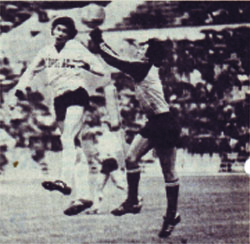
Horst Hrubesch. The picture is symbolic one – Keegan needed a leather to get above Hrubesch. The top European player was a pale shadow of himself and England – a mediocrity at the European finals, when his ugly teammate became a star and won the title. A Cindarella story really – Hrubesch was included in the national team lately and reluctantly. He was not originally a starter. If Fischer was healthy, Hrubesch may not have been even in the squad. He was 29, he spent years playing second division football, and although he scored a lot, he was not a star, but rather one among similar big centers at the time, lacking great skills and even individuality – a tank. Of course, the problem was the shadow of Gerd Muller… since nobody could be Gerd Muller, his replacements were always found insufficient. Dieter Muller was the best promise, but he faded quickly. A string of heavy ‘tanks’ were used – Seel, Fischer… They were good, but on club level – in the national team they scored little and were blocked quite easily, for their game was predictable for modern defenders. The search continued. In itself, Hrubesch was not the solution – he was not better or different than Fischer. The solution was in the shaping of the new team – more creative wingers and midfielders. Defenses were busy preventing attacks form Hansi Muller, Rummenigge, Stielike, and were not able to read the creative directions of Schuster. Thus, attention was not focused on Hrubesch all the time, he had more freedom, and also he was not expected to be the sole finisher of attacks. The other great thing was that Kaltz – and eventually Magath – were accustomed to play with Hrubesch in front and to create opportunities for him. Better utilization. Hrubesch scored both German goals at the final and instantly became a hero – he delivered when it was most important. His rapport with the wingers was good, particularly with Rummenigge – the big forward served as a cover for sneaking from the back Rummenigge, keeping defenders busy with himself. At the moment, Hrubesch was the needed center-forward and since Hamburger SV was reaching its peak, it looked like he was a solution for the national team too – at least for the near future. Like the other new stars, he was not stigmatized player – Fischer was, for he was second or even third fiddle during the days of Gerd Muller.


Klaus Allofs. The 23-years old left winger of Fortuna Dusseldorf ended as the top scorer of European finals, but he was also the most criticized striker of the champions. Coming from a club which reached its peak at this time, Allofs was considered very promising, high scoring, somewhat typical winger. To a point, repeating Erwin Kremers of the 1972 team – limited to the left wing, he was practically unmovable to another post. Like Kremers, he was not always up to great performance, so looking for another option had to continue. But he was young and there were big hopes that he will mature in not so distant future. Scoring goals was expected of him and he scored when it mattered – a hat-trick against Holland. But that was all… leaving mixed feelings. In favour of him was the realization that modern football provided few opportunities for strikers – regular scoring was unlikely, but scoring at particular important match was most important. Allofs scored all goals in the difficult match with Holland – Hrubesch was dry until the final, when he scored all German goals. Allofs did not satisfy everybody, but was expected to develop further and as a whole – to stay in the national team for years to come, getting better. His moody play also helped, as strange as it may be – because Allofs was not entirely reliable yet, other tactical options had to be tried: using only 2 strikers, for instance. By default, West Germany had to use different tactical variety.


Exciting European champions – West Germany did not only come back, but had a team promising great future. The decline was over, new stars emerged, and Derwall seemingly had the mind and the skill to shape great team. And it was not a team limited to handful of players either – Bernd Forster, Felix Magath, Karl Del’Haye were eager to get a regular place. Lothar Matthaus, only 19-years old, made his debut. Eike Immel, also 19-years old, was in the team. Not included, but expected to be were other young talents, like Thomas Allofs. The new West Germany did not make revolution, but returned to the abandoned track of total football – and this was very optimistic sign, for already there was the strong feeling that total football was perverted into physical battle before its great possibilities were explored. West Germany killed total football, but now West Germany restored it – there was light again.
Debut

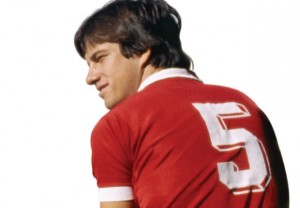
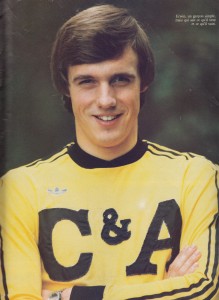
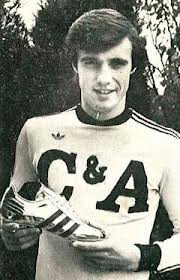
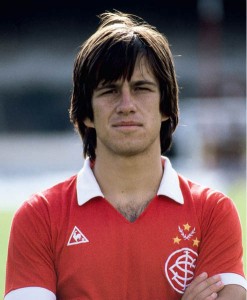
Quiet exit of big star, but also a quiet beginning of new star: Dunga debuted in 1980 for Inernacional (Porto Alegre). Everybody knows him today – nobody knew him then, so his early photos may not even ring a bell for most football aficionados:

Nothing like the familiar picture of the captain of 1994 World champions

Dunga was 17-years old talent in 1980, but he did not start with a bang – nothing like Maradona, who was famous even before making his professional debut. On the contrary – Dunga was not heard of before 1983, the first year the spirited and gritty defensive midfielder became a regular for Internacional, wearing number 5.

There was nothing in his humble beginning suggesting that Carlos Caetano Bledom Verri will be one of the only two men (the other is Spanish star Xavi) to play in World Cup, Olympic games, Confederations Cup, and continental championships. But he debuted in that year and slowly climbed to the very top of world football.

Retirement

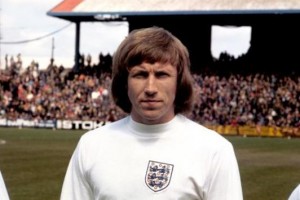
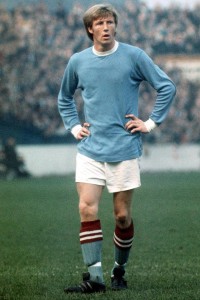
Retirement. Colin Bell played his last season and quit the game at 34.

During his last year, he played just 5 games for NASL team San Jose Earthquakes. Even today his retirement is lamented as premature, but effectively Colin Bell was out of big football since 1975 – his career was cut short by heavy knee injury, from which he never recovered and by 1980 even easy NASL football was way too much. By this time Bell was rarely mentioned and his retirement went unnoticed.

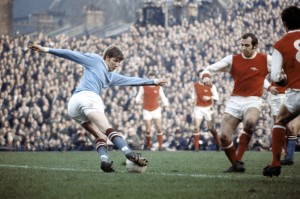
Bad luck for arguably the greatest player Manchester City ever had. Colin Bell, born in 1946, started with Bury in 1963 and stayed with the small club until 1966, appearing in 82 games and scoring 25 goals. Manchester City signed him them and quickly he became a big star – and club legend. Between 1966 and 1979 he played 394 matches for City and scored 117 goals.

In England, Bell is considered the best box-to-box player of his day – a midfielder, roaming the whole field, which in British football was called ‘central halfback’. That is, bell was considered more defensive midfielder than constructive or attacking one, and that was why his scoring ability was thought amazing. His skills were not missed by the English national team coaches – Bell played regularly for England between 1968 and 1975 – 48 matches in which he scored 9 goals.

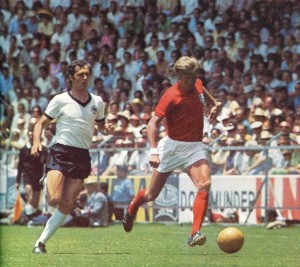
A key player of the national team, he played at the 1970 World Cup: here Franz Beckenbauer tries to catch him in Mexico. Unfortunately, he played at the time when England missed the big changes in football, especially after 1972, but whether Bell was the man to keep England afloat or not is academic – everything stopped in 1975, when he was injured. After that, he never came close to his earlier form and may be even stayed active too stubbornly too long: he slipped out of sight and his last effort to come back by going to USA did not work – he was unable to play and finally had to give up. A sad end of wonderful player, but Colin Bell is remembered fondly by those lucky to see him play before 1975.

The Golden Shoe


Golden Shoe – it all depended on numbers. No wonder weaker championships usually propelled strikers to the award, but there was a sense of coming 1980s in it too – a very young guy was the highest scorer in Europe: only 21 years old, clearly a player to blossom in the new decade. He was also impressed at the European championship finals with team Belgium. Walter Schachner (Austria Vienna, Austria) was 3rd with 34 goals. The Hungarian winger Laszlo Fazekas (Ujpesti Dosza) was 2nd with 36 goals.

Erwin Vandenbergh netted 39 for his Lierse and got the Golden Shoe.

It was not just accidental season for the youngster – Vandenbergh was often heard of during the 1980s, one more new star.

European Player of the Year

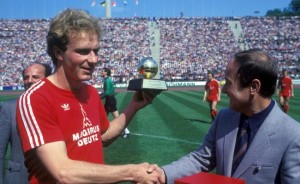
In Europe Karl-Heinz Rummenigge was voted player of the year. Bayern was winning again, West Germany was winning, Rummenigge was at top form – perhaps his finest. He was 25.

It was almost total victory – practically all voting journalists placed him first. And considering the competition, it was hardly a hand out, as the award appeared to be given in the few previous years – very distant 2nd was Bernd Schuster (1. FC Koln – Barcelona) and 3rd – Michel Platini (St. Etienne). No more old stars – this were the new ones, the key figures of the 1980s. The next generation was coming finally strong. Rummenigge got 122 points, Schuster – 34, Platini – 33.

South American Player of the Year

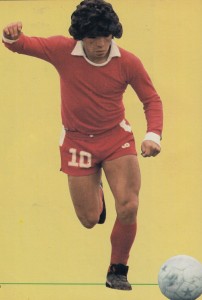
South American player of the year was voted Diego Maradona – like in the year before. Perhaps now there was no doubt – Diego was already around for awhile and truly established star – not just a promising talent credited more for the future than for the present. Waldemar Victorino (Nacional,Uruguay) was 3rd and his case was clear – great year for him, but largely because of Nacional’s international victories. Zico (Flamengo) was 2nd – he was ranked high for consistent strong playing, not that much for any outstanding international game or two. Maradona was like Zico – Argentinos Juniors became familiar name outside Argentina not because they were great team, but because of Maradona – and largely thanks to him they became a strong factor in Argentine football, however, unable to win a title.

African Player of the Year


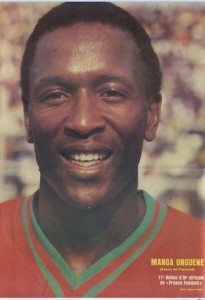
African Player of the year was voted Jean Manga-Onguene. Second was Segun Odegbami (Shooting Stars, Nigeria) and third -one more Cameroonian, Theophile Abega (Canon). Tradition was continued – except Salif Keita in 1970, no European based player appeared among the top 3 of Africa. Domestic players and even more – only Abega of the top 3 this year eventually played in Europe. The top spent their entire careers at home. Technically, playing amateur football. As ever, international results mattered most – Manga-Onguene and Abega won the African Champions Cup, Odegbami became champion of Africa with Nigeria and played at the Olympic games in Moscow too. There will be always the question were journalists more impressed by one or two important matches than from a whole regular season? Odegbami at least was Nigerian legend, but Abega? Considering that his teammate Thomas N’Kono was out of the top 3 for the first time in three years. Anyhow, those were voted the best and in the case of the winner it was well-deserved first place.

Jean Manga-Onguene was born in 1946, debuted in 1966, and played his whole career for Canon (Yaounde). Eventually, he became one of the best know African players, which was particularly important recognition since he never played in Europe. Prolific striker and key figure for both his club and the national team of Cameroon for 15 years – a true star. A star on continental scale. And it was not a case of just a recognizable player – Manga-Onguene was already 5 times champion of Cameroon, 6 times cup winner, had 3 African Champions Cups and 1 Cup Winners Cup. He was more than instrumental for the success of Canon in the 1970s. Was 1980 – when he was 34 – his best year is questionable, but he was still a winner and a key player. If anything, he deserved to be voted number 1 in Africa more than some other guys crowned earlier. The only thing missing in his impressive career was a World Cup – unfortunately, Cameroon qualified only in 1982 and Manga-Onguene was no longer playing then. But even this success happened – to a point – because of him: he was still a national team player in 1980: the heroes of 1982 grew up along him and inspired by him.

African Cup Winners Cup

The Cup Winners Cup had a bit more incidences than the Champions Cup – two clubs withdrew without playing at all: Ader Club (Niger) and Dingareh (Gambia). Strangely, the club benefiting from Ader Club’s withdrawal did the same in the next round – Esperance (Tunisia) left the tournament without playing a single match. No luck for the Cameroonian represent: Dynamo (Douala) qualified directly to the second round, thanks to a bye, but there they faced Eleven Wise of Ghana. More or less, Ghana was one of the consistently strong African nations and Eleven Wise prevailed over the Cameroonians 2-1 and 1-1. Meantime, the Zairian representative, TP Mazembe, was going as well as their compatriots in the Champions Cup – the first loss and first difficulties they had in the ¼ finals. Shooting Stars of Ibadan, Nigeria, was traditionally strong opponent and perhaps even more so in the year of rising Nigerian football. TP Mazembe still won the penalty shoot-out, though. They had easy – on paper – opponent at the semi-finals: Kadiogo (Upper Volta, today – Burkina Faso). It should have been a walk in the park, but it was not – Mazembe won only 1-0 at home and extracted a 2-2 tie away. The other semi-final was tough: Africa Sports (Cote d’Ivoire) vs MA Hussain-Dey (Algeria), two of the better African clubs. Africa Sports won 1-0 at home and survived Algerian assault in the second leg, tying the match 2-2. Africa Sports and TP Mazembe contested the Cup Winners Cup. The winner was really decided in the first leg in Algeria – Mazembe won 3-1, making the second match a mere formality. They won it too, only the result was minimal – 1-0. TP Mazembe won their first Cup Winners Cup!

Africa Sports of Abidjan are one of the two strongest Cote d’Ivoirean clubs, but internationally they did not win anything for a long time. 1980 was perhaps their first real attempt to conquer Africa, but they failed. Reaching the final was great, though.

TP Mazembe won their first Cup Winners Cup, but it was just one trophy to them – back in 1960s they won the Champions Cup twice: 1966 and 1967. Back then they were named Englebert – named after their sponsor, a tire brand. The original name of the club was Saint Georges – since the club was founded by Benedictine monks. After the Ravens (as the club is nicknamed) won 3 consecutive titles, in the 1966 Tout Puissant (Almighty) was added to the official name. By 1980 the name was TP Mazembe – today more history is recognized, so the current name includes Englebert too. As for the team hailing from Lubumbashi… hard to tell.

TP Mazembe 1980 – is there a goalkeeper at all?

Or may be these are our boys? Nice and rare kit – the picture very likely is not from the final against Africa Sports, but it is worthy showing just for the design. The Ravens excelled not only by playing – their kits are great.

African Champions Cup

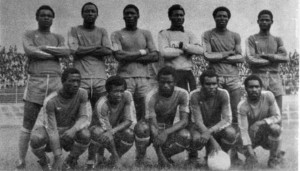
Africa was almost unnoticed in 1980, but football was played, of course. At a glance, international football was less disorganized and chaotic than before. Only 2 clubs withdrew from the African Champions Cup – Limbe Leaf Wanderers (Malawi) and Comercial Bank (Uganda). All other participants played and the tournament was played without visible scandals. Cameroon was represented by 2 teams – Union (Douala) as African Cup holders and Canon (Yaounde) as champion of the country. Both reached the semi-finals, proving once again the superiority of Cameroonian club football. The other two semi-finalists represented old power and emerging new one: AS Bilima (Zaire) and Bendel Insurance (Nigeria). AS Bilima eliminated Union (Douala) – 0-1 and 5-1 at home, but Bendel Insurance was unsuccessful against Canon – they managed a 0-0 tie in Yaounde, but were destroyed 2-4 in front of their home crowd. So, the final was between Canon and AS Bilima. On November 30 Canon struggled, hosting the first leg of the final – 2-2 at their stadium Militaire Garoua, Yaounde. Like in the semi-final, Canon was stronger visitor than host – on December 14 AS Bilima had no chance at 20th May Stadium in Kinshasa. Canon destroyed them 3-0! And won their 3rd African Champions Cup!

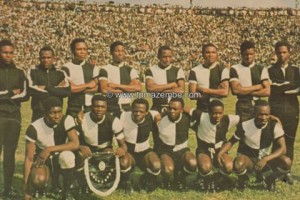
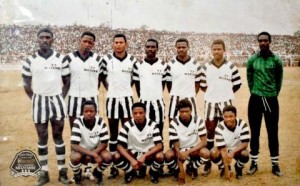
AS Bilima is a bit of a mystery – the club is old by African standards, but finding information about them is very difficult. They were found as AS Dragons and most of the time used the original name. But a few years in the second half of the 1970s the club was known as AS Bilima. Bilima left practically no information, not even a crest of its own. However, this was excellent season for them – they lost only 2 matches in the tournament: one in the semi-final and one in the final. Unfortunately, the second loss was crucial one – the Cup went elsewhere.

Arguably, Canon was the strongest African club at the time – their rival was Hafnia (Conakry), but it looked like the Guineans were fading away already. Canon, however, was getting only better.

As for the team, the world knew only one player of the African champions – Jean Manga-Oungene. He was already 34 years old – too old to attract the interest of any European club, but he perhaps had the respected career on the African continent: this was his 4th international cup won with Canon. It was another player of this team to become a household name around the world – but in 1982. Canon was doing really well since 1970: 5 Cameroonian titles, 5 Cameroonian Cups, 3 times African club champions, one African Cup Winners Cup – and three continental cups in succession: Champions Cup in 1978, Cup Winners Cup in 1979, and again Champions Cup in 1980. Excellent record.

USA-Canada


USA – Canada: North American football was separable only at lower local levels. These championships were outside international interest and who played there is difficult to say. One may argue that popularity of football was gradually increasing. May be.

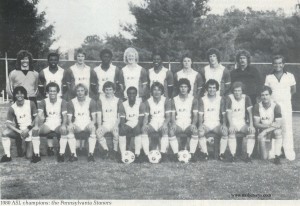
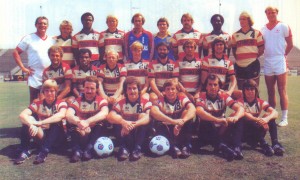
Pennsylvania Stoners – 1980 ASL champions. American Soccer League… in another country this league would have been second division. In USA/Canada it was separate entity of professional football and could be seen as second level only if money were better than in other leagues. Champions, indeed, but only NASL attracted interest.

NASL was at very interesting point of its existence: there was illusion of stability. No new teams, no teams folding, no teams moving to another city. Foreign players were moving in – the biggest names of world football were playing in North America.

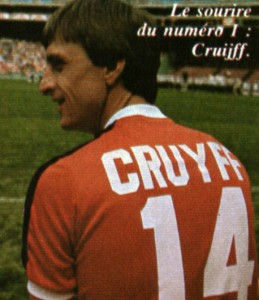
Johann Cruijff joined Washington Diplomats – after he ‘retired’ not long ago. Everybody was here – old veterans, current stars, second-raters, unknown players, touring players, loaned players, temporary players, Europeans, Central and South Americans, Africans, Asians… and some North Americans. Under regulations, the teams had to field 3 domestic players in every match – the number was increased from the previous year by one. Care for local boys… many of them were naturalized, though. And North American clubs were never like the clubs anywhere else: they had only one professional team – no youth system. No wonder North American players were few and hardly good. Building a team was hardly a priority in NASL – although great coaches were hired as well as players, the emphasis was on individual names, so North American teams continued to be bizarre formations, mixing great stars with virtually anonymous teammates. The league and the franchise owners still believed that pouring money would eventually establish football as big North American sport – but it remained a novelty for most Americans and, most importantly, for the media, especially television. A crisis was already settling: the clubs spent too much without returns. Cruijff was not coming cheap – but in order to get crowds, tickets had to be cheap… forget about profit. NASL started the new decade optimistically on the surface, but the future was really bleak. Nothing helped – even the weird rules, which still gave 6 points for a win, 1 point for shoot-out win (there were no ties inNASL), and 1 point for each goal scored during regulation time up to 3 points per match. Foreign players new very well that North American football was not serious – they came for money and fun. Some, like George Best, loved the easy life, some ruined their careers, like Romero, some came to get some extra cash between seasons at home and were smart enough to look elsewhere for serious football, like Hugo Sanchez and Ruud Kroll. Even coaches had lazy view on North American football – Rinus Michels, for instance, was nothing like the severe and stubborn disciplinarian he was in Europe.

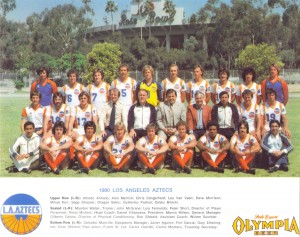
Rinus Michels at the helm of Los Angeles Aztecs – one look at the squad tells it all: hardly a team to his liking. So why bother? The rules practically qualified the team to the second stage anyway. In the next stage – direct eliminations – one may argue that Michels had to stand up, for Aztecs played against Washington Diplomats – Michels vs Cruijff, that is – but the argument is lame.

Washington Diplomats with Cruijff. So what? Aztecs eventually prevailed and Cruijff started a vacation. The Aztecs continued ahead and eliminated Seattle Sounders in the next round – only in North America a team can go ahead after winning 3-0 the first leg and losing 0-4 the second… but then Michels faced New York Cosmos and Hennes Weiswailer. The leading coaches of the 1970s, both lead Barcelona, blah, blah… Cosmos had the biggest names in NASL and Michels lost both legs. Vacation.

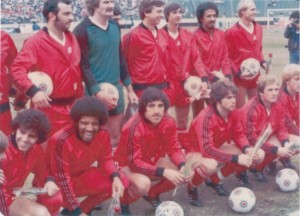
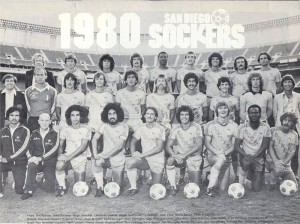
San Diego Sockers lost the other semi-final – or Conference championship, in NASL terms – to Fort Lauderdale Strikers. The Mexican stars Hugo Sanchez and Leonardo Cuellar played for the team a bit – both played in the Mexican championship in the same year, so it was a brief spell – get the cash and go back to Mexico. Some of their teammates were more involved with NASL – Volkmar Gross, who played UEFA Cup final a few years back, had no illusions about playing in Europe: too old by now and not a strong enough player anyway – North America was great. The Turk Yilmaz Orhan had no chance of playing for serious team in Europe. NASL was largely made of players like these two. Fort Lauderdale was not much different:

Take away Gerd Muller, Francisco Marinho, and Teofilo Cubillas and there would be nothing. Well, Francisco Marinho did not play at the big final – Jan van Beveren was the third big name by then, showing the handicaps of NASL vision fully: depending on few veterans was just enough to go all the way.

Soccer Bowl – the great trophy, the real trophy in the land,where virtually no team was left without winning something. But this was the championship duel – played in Washington, DC, on September 21 in front of 50, 768… fans? Observers? The number is misleading – great crowd, for sure, but accidental one. As for the date – it also spells out another chronic problem of North American football: the season ended just at the beginning of the season in Europe. The flock of part-timers hurried back to real football. Generously paid vacation was over until next year. The final opposed – on paper – the leaders of world football as known by then: Cosmos was coached by German – Hennes Weisweiler – and Strikers by Dutch – Cor van der Hart. A replay of 1974 World Cup final? You wish… there was obvious difference in class. Cosmos was if not he most professional team in the league, at least the richest and having the most famous squad as a result. Which made possible to field a decent team – there were enough players for that. Strikers mainly depended on old stars and enthusiasm. Not exactly a contest… Cosmos scored 3 in the second half of the final, Strikers – nil. To a point, it was World Cup 1974 showcase: Beckenbauer, Rijsbergen, Bogicevic, Chinaglia (Cosmos) and Muller and Auguste (Strikers). Eskandarian played at the 1978 World Cup. Cubillas – 1970 and 1978 World Cup. Two more former Dutch national team players for Strikers – Jan van Beveren and Lex Schoenmaker. Cosmos had much more to offer: the Paraguayan star Julio Cesar Romero, who was considered more talented than Maradona just a year ago, the Belgian star Francois van der Elst, who was instrumental for Anderlecht’s European conquests, and Roberto Cabanas, South American champion with Paraguay. Even the rule requiring 3 North Americans on the pitch did not bother Weisweiler – his were better than those playing for Fort Lauderdale. There were some people sitting on the bench – the 1970 World champion Carlos Alberto, Johan Neeskens… Cosmos won easily.

Fort Lauderdale Strikers – technically, 2nd in the 1980 NASL championship. May be disappointed, but considering the squad – a good season. May be not for some of the players, used to success, but what the hell. May be not so great for Gerd Muller – it was not exactly losing the championship to his buddy Franz Beckenbauer, but the boredom of easy American life in the South: Gerd Muller turned to drinking. Following George Best… but not Johan Neeskens, who turned to drugs.

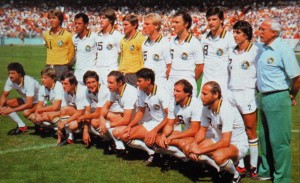
Cosmos – 4th title for them. The most successful NASL team and rightly so. Standing from left: David Brcic, Carlos Alberto, Jeff Durgan, Hubert Bierkenmeier, Wim Rijsbergen, Franz Beckenbauer, Vladislav Bogicevic, Andranik Eskandarian, Hennes Weisweiler – coach.

Crouching: Seninho, Rick Davies, François Van der Elst, Julio Cesar Romero, Giorgio Chinaglia, Roberto Cabanas, Angelo Di Bernardo, Bruce Wilson.

This is not even half the squad here – Cosmos clearly had the best players year in and year out. Actually, every next year the roster was getting more famous. New York Cosmos easily became famous outside North America, they toured a lot, and they built stable fan-base. But it was not enough… the club was losing money, like the rest of NASL clubs. Outside New York there was no much paying audience. The roster was very expensive. But it was perhaps the only NASL club managing to stay consistently strong. Franz Beckenbauer played his last North American season and Carlos Alberto decided to move to California, but new players were signed quickly to keep Cosmos at the top. However, this squad was perhaps the most famous team Cosmos had.