Greece Second Division

Greek football had old problems, not really addressed, but covered instead. Corruption was perhaps the biggest problem, never really talked about and addressed properly. Evidence of it was largely found in the lower leagues… 7 clubs from the 2 Second Division groups had points deducted in 1978-79 – and points are deducted as penalties for infringement. But what the clubs were guilty of? Hard to tell… Pierikos had two points deducted for fixing games. Nothing is said about the rest of the penalized clubs, but A.O. Panarkadikos Tripolis ended with 6 points deducted. If 2 points were taken for fixing games, one wonders what this club did to be penalized three times the bribers. Except Pierikos, all clubs were lowly, 5 in the relegation zone – and relegated after all. On the surface, acceptable: trying to escape relegation, the clubs tried everything, but… practically all were still to be relegated even without penalties. Only A.O. Panarkadikos Tripolis would have been safe if 6 points were not deducted from their record. If match fixing was so wide spread, then the clubs involved must have been more – especially mid-table clubs, not worrying about anything and therefore ready to get some extra cash in exchange for the odd point. There was only one such club – Trikala. What made almost no sense at all was the penalty of the only club accused of fixing games: Pierikos finished third in the Northern Group . Looked like they tried to won promotion by illegal means. The problem is they were not in the race for the first place at all – even with full points, they were not only to finish third, but still 9 points behind the 3nd placed Olympiakos (Volos). Most likely, they decided to earn some money and offered their ‘services’ to the willing parties – but it was unlikely they were the only club: 5 clubs were penalized in the Northern Group, so match fixing appeared wide spread. But only the relegated were punished – a cover-up more than real effort to clean the game. And only second division teams were penalized – First Division was apparently ‘clean’. Was it? Most likely all depended on pulling strings, clout, scheming, and may be political influence.

Clean or not, the second division had its season – a massive affair, involving 40 clubs. 20 in each sub-division.

AO Korinthos won the Southern Group – 4 points ahead of the nearest pursuer and with excellent record – +55 goals testified for their superiority. They were going up, a rather rare achievement of the club. The real test for them was still in the future – the next year they had to try to survive among the big boys.

Similarly strong were the winners of the Northern Group – 4 points ahead of the 2nd placed, +41 goal-difference, only 4 lost matches during the season.

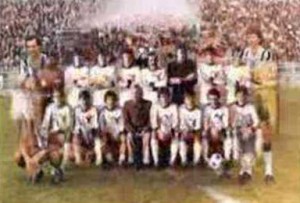
Doxa (Drama), established in 1918, was similar to Korinthos – they still had to prove themselves in First Division, where they played previously, but without any success. The champions left misty image of themselves.


Greece – season notes

An interesting Greek season – seemingly, the steady improvement of the country’s football reached a point of relative stagnation. Change of generations was a possible reason – the country’s pool of players was not very big and finding new talent was not easy. Veterans reached their peaks years ago and at least in their original clubs they were not contributing enough. Big and disturbing transfers were the news before the season started. Internal shuffling of players, not new imports. Three players were the big controversy:

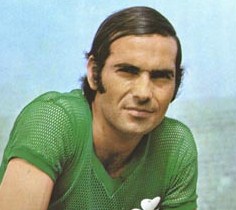
Antonis Antoniadis, the legendary striker of Panathinaikos moved to the arch-enemy Olympiakos. The need was obvious – Antoniadis was already 33 years old. In a new club perhaps he was to be useful… but he was Panathinaikos’ legend and fans do not take easily such transfers. Perhaps Antoniadis did not really like playing for Olympiakos; perhaps he was no longer capable of playing for big clubs – he did not really shine in Olympiakos and did not last longer than an year.

The other big transfer involved even bigger star:

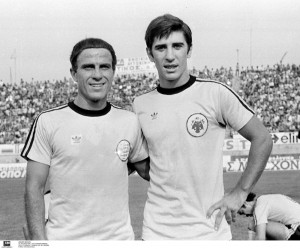
Mimis Domazos, on the left of Mavros, moved to AEK. Bigger legend than Antoniadis and captain of Panathinaikos for many years, he went to another big rival. Difficult move for both camps – Panathinaikos’ fans were not happy to see their hero playing for big rivals, but the fans of AEK had their own dilemma: not only Domazos was old, not only he was associated with the enemy camp, but he took the place of their own hero Mimis Papaioannou. Both stars were 36 years old… it was not a promising change, for there was not young and coming player coming… Papaioannou was captaining AEK for ages, he lead them to the title in 1977-78 – and suddenly he became a reserve of thye captain of Panathinaikos.

Losing two legends needed immediate compensation and Panathinaikos was involved with the third big transfer of the season: they got Giorgios (or Jiorgos) Delikaris from Olympiakos. On the surface – the most promising transfer, for Delikaris was at his prime at 27. Adored by Olympiakos’ fans, already a legend in Pireaus… going to the arch-enemy… and didn’t liking the transfer at all. Delikaris never warmed the hearts of Panathinaikos – he was quite open about not liking the transfer. He asked not to play against his former club. He greeted and chatted with Olympiakos’ fans before and after games. He was telling them that he belonged to them.

Delikaris never became a true star of Panathinaikos and even did not last long. An enigmatic person, he suddenly retired from football in 1981 and enveloped himself in silence, staying outside public eye as well.

The second compensation was a German striker, who was playing in Greece since 1974. Walter Wagner was well known name in Greek football, 29 years old at the time. Previously, he played for AEK and in 1977 was transferred to Aris (Thesaloniki). Panathinaikos got him from there, obviously to replace Antoniadis. Looked like a good deal – Wagner and Delikaris were much younger than Antoniadis and Domazos. Panathinaikos was trying to build a new team gradually replacing the old stars with… younger stars, well established, experienced, dependable… but were they really better than the old horses? Wagner joined another foreigner in attack – Oscar Alvarez, who built his reputation entirely in Greece, playing for PAS Giannina. He arrived in Panathinaikos in 1977. Just in case, a third Latin American was added – Benitez Gomez, who never played before in Greece. He did not make waves… played only in 9 games this season, scoring a single goal. Wagner did not live to expectations either – he played 17 matches, scoring three times. Alvarez on the other hand performed well – 15 goals in 33 matches. Delikaris spent the season mostly on the bench… 6 matches and 1 goal… some superstar. Panathinaikos’ scheme misfired. So did Olympiakos’: Antoniadis was a far cry from the menace he used to be – he played in only 13 matches, however his scoring abilities apparently remained intact – 7 goals. The big reshuffling worked only for AEK.

Of course there were many other transfers, but nothing so big, including the new imports, who were largely anonymous players and some of them hardly even played during the season. Like Antonio Gomez Benitez who signed with Panathinaikos. Apparently, he came from Colombia… well, at least he played there in 1975 for Deportivo Cucuta. Panathinaikos paid 2 500 000 drachmas a 26-years old striker, who appeared in 9 matches and scored 1 goal. Nobody even learned his nationality… in Greece, he was – and is – considered Argentine, Uruguayan, and Brazilian. He did not last in Athens, moving to Rodos for the next season, which was his last in Greece. He was the only mysterious flop: Panionios signed two Peruvian, whose names were misspelled – Nuniez and Ohieda. No reason to get the names right… Carlos Felipe Nunez played 13 matches and scored a single goal. Santiago Ojeda registered 14 appearances, also scoring once. The only club which managed to get good performance from previously unknown players was PAS Giannina – the club recruited a whole bunch of South Americans a few years back, played them by hook or crook – some under new Greek names, some because of real or faked Greek roots, some as foreigners – and they not only helped the small club to stay in First Division, but established themselves firmly, becoming valuable commodity – the key striker of Panathinaikos, Oscar Alvarez, was one of the first crop. PAS Giannina continued to dig their gold mine – they introduced two newcomers in 1978: called Correa and Ruiz. Added to their existing 4 Latinos, the club again a total of 6 foreigners… and played them all under rules permitting only 2 foreign players on the pitch.

It was not just foreign players, but also foreign coaches. An old practice… 13 out of 18 first league clubs had foreign coaches in 1978-79. English, Italian, Yugoslav, Polish, Bulgarian… some famous, like Kazimierz Gorski (Panathinaikos), Frantisek Fadrhonc (Panachaiki), Ferenc Puskas (AEK), some not so. AEK (Athens) did not employ a Greek coach since 1965. To a point, foreigners helped Greek football, but it also hit and miss approach – Gorski, for instance, did not achieve anything with Panathinaikos. Was it just bad luck – he coached the team during frustrating time of generational change – or was it his own mistakes – the club seemingly did not recruit really strong players during his spell – is hard to say. Foreigners were expected to win and the quick tempered Greek hardly waited longer than a season. Ferenc Puskas did not last even a season – and AEK were leading! To a point, the Greek football was slowly improving for the most of the 1970s, but reached a point of stagnation in 1978 – largely because the pool of local talent was small. Reshuffling of established players was more a necessity than a whim. The real improvement affected the national team more than the clubs – about 20-25 strong players existed, enough for the national team, but not for the whole of Greek football. And may be the national team prevented a major slump back into obscurity – the stagnation did not last long .

Poland Championship and Cup

Fairly equal league or typically Polish championship – the intrigue of the unknown to the end. No visibly dominant team, no hopeless outsiders. Anything possible. The champions of 1977-78 were not a factor at all.
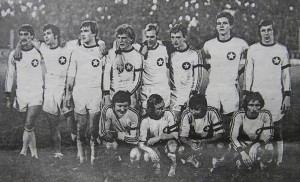

Wisla (Krakow) dropped so low, they actually fought to avoid relegation. 13th this year, ahead of only 3 clubs… and it was quite strange, because it was not only the same squad which won the championship the year before, but they were perhaps the strongest Polish squad, judging by the names of the players.

But they survived.
Gwardia (Warszawa) finished last with 19 points. The clubs was unable to re-establish itself in the top league and down they went.
Pogon (Szczecin) were 15th, also going down.

Another of the recent champions also had miserable season – Slask (Wroclaw) ended 10th. LKS (Lodz) were 11th – they also knew better days no long ago. Legia (Warszawa) was pretty much the same – the 1970s were not successful years for the club, but the club did not suffer from the absence of Deyna. They were 6th – more or less, their usual position in those years. Odra (Opole) and Szombierki (Bytom) climbed up – 5th and 4th – but, just like with the clubs who sunk, it was not sure was it a reshuffling with some permanence or just momentary good or bad season.
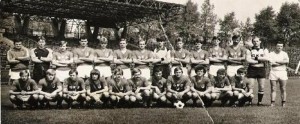
Szombierki (Bytom), a mid-table club at best, were a surprise, considered temporary – they had very modest squad. But they had a much bigger surprise hidden in their sleeves. Strange days for Polish football – Wisla, with their at least 7 national team players, near relegation zone and anonymous Szombierki up and going to make a real sensation soon.

The best three were also a mix – two of the best Polish clubs of the decade and a newcomer, known as a modest club so far.
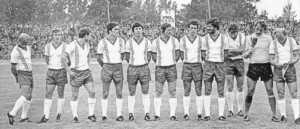
Stal (Mielec) were still among the best – they finished with bronze medals. Lato, Szarmach, and the national team goalkeeper Kukla were seemingly enough to keep Stal at the top. To a point, it was even unusual – five years back, when Stal suddenly became a force, they had promising squad. Yet, they did not added a few more strong players, but it was rather the opposite. Typically, such a team should have been going down… but in Polish football 3 classy players were capable of keeping a team among the best. Stal were still a force – as long as Lato and Szarmach stayed, which was unlikely. Stal were contenders this season, but eventually dropped to third place, 3 points behind the champions.

The championship was decided by goal-difference, a tight race, exciting because of that, and also strange. Widzew (Lodz), a club similar to Odra and Szombierki so far, suddenly run for the title. Another Sinderella story… but with a difference: Odra and Szombierki had no great players and no up and coming youngsters. Widzew had Zbigniew Boniek. And a few other still unknown, but talented boys. If there was a club with potential to become a major force, it was them. They were elbowing their way up, claiming a place for themselves. Widzew were not very strong in attack, but had the best defensive record this season. They lost the least matches too – only 5. They lost the title on worse goal-difference, perhaps a sign that they were not ready yet, but clearly it was the team going to win soon. The team of the future and the positive change.

Experience won the title. Like Stal, Ruch (Chorzow) were one of the leading clubs of the 1970s. The question facing them was aging – were they able to rebuild quickly enough to maintain their strong position. Compared to their winning team of three-four years ago, change of generation was not successful… no great new player emerged and the old stars were gone abroad or into retirement. Yet, tradition, winning spirit, may be the way the club was run kept them atop. The nature of the Polish league helped that too – small things made the difference in the equal league. Wisla and Slask out of the way this year, Legia not a factor for a long time, Stal having a short team, Widzew still immature… and here it was Ruch, not overwhelming, but not giving up either. May be a bit lucky, but champions.
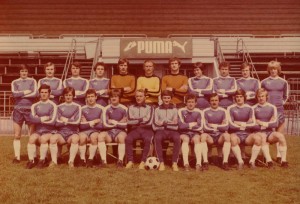
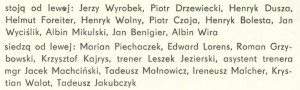
It was not a great squad, it was not promising either. It was not even a team able to keep good players – the young and very promising goalkeeper Henryk Bolesta, who easily edged Piotr Czaja, the last star of the earlier squad of champions, soon left Ruch and joined Widzew. This vintage was perhaps solid, but certainly not starry. However, it was enough for the moment.

The championship was not flashy, but it was dramatic – fans love close pursuits to the very end. But drama itself is not enough… Polish football was not in great shape at the end of the 1970s. None of the best teams of the championship reached the Cup final – the finalists were still a strange mix, though. Wisla (Krakow) reached the final – seemingly normal for such strong squad. Perhaps they just had a bad year, but class was class, and they were determined to save face by winning the other trophy. Considering their opponents, it should have been a child’s game… Arka (Gdynia) were one of the run-of-the-mill clubs, normally associated with the relegation zone. Nothing special this season year – they finished 11th in the championship, a bit above Wisla, but it was not because they had strong season – it was largely because Wisla had a very weak one. The final should have restored the obvious: easy victory for Wisla, spurred by wounded pride and the much stronger team anyway.

It was not to be – Arka won 2-1. Another Sinderella story.
The club with difficult full name – Morski Związkowy Klub Sportowy Arka Gdynia – hails from the ship-building city on the Baltic sea coast. Not an young club, it was founded in 1929, but had modest existence. Their best ever league achievement was 7th place in 1977-78 – it is still the their best today. The Cup was their first trophy – and so far, their only trophy. One can imagine the joy of the underdog.
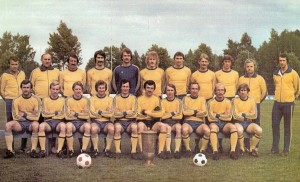

Well, this must be the best ever squad of Arka… since they won the only trophy in the club’s history. Local heroes, but they had two well known names: Adam Musial, a regular in the exciting 1974 World Cup Polish squad, and the member of the 1978 World Cup squad Janusz Kupcewicz. Hardly the making of a great team, but two stars were quite enough to make a difference in Polish football. The success may have been also dangerous for a modest club: very likely they attracted the interest of financially better clubs and players were lured elsewhere. The gray Baltic sea and industrial town were hardly attractive even when winning the Cup. Musial and Kupcewicz eventually left – Musial, who came from… Wisla (Krakow) in 1978, joined Hereford United (England) in 1980; Kupcewicz moved to Lech (Poznan) in 1982. Unfortunately, the destiny of Arka was to remain a modest club.
Poland II Division

Poland had competitive, yet, strange season. Something like mild decline was noticeable – Polish clubs were never very strong, but now they seemed a bit weaker than usual. Change of generations may have been the reason – the old heroes stepping down, or rather going abroad, and the new ones not yet fully blooming. Since they were dispersed in many clubs, the absence of one or two key players often spelled out disaster. But in the same time there was international recognition of the quality of the Polish players, thanks to the great generation of 1972-74. And the biggest recognition came with the transfer of Kazimierz Deyna – Manchester City took him and he became one of the first wave of foreigners going to try their luck in England. Perhaps the biggest transfer of Polish player in history – so far, Polish stars went largely to smaller French and Belgian clubs. Now a 31-years old and no longer a national team player went to mighty England. Not bad? Depends… struggling with injuries, Deyna never really shined and played rarely, but still Manchester City kept him for three years. On the other hand, he was one of the many Polish stars who may have been more needed at home… hard to tell. Season proceeded anyway.

Deep down in lower levels it was business as usual – various clubs were either down on their luck or not.

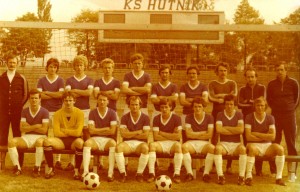
Huthik (Krakow), for instance, won promotion to yet again reorganized Second Division. They were one of somewhat known clubs, who plummeted to the bottom at one point and eventually were pulling themselves up – a frequent change of fate.

The Second Division, divided somewhat geographically into 2 groups, was also divided by performance. The Eastern group had a club with great past now a hopeless outsider – Polonia (Warszawa) ended last, with 5 points less than the nearest and also relegated opponent. Third division was was their immediate future. The other big name in the league had entirely different destiny.

Gornik (Zabrze) were relegated the previous year, and the bad luck obviously spurred them to action. Not a club to really sink into sedimentary existence, they were determined to return to top flight. Gornik had no rivals this season, leaving the second placed Star (Starachowice) 13 points behind.

The Western group was another story. Some better known clubs were among the relegated – Warta (Poznan) and Zaglebie (Lubin) – but more important was the tight race for the first, promotional, place. Four clubs participated in that, none famous or really strong, but the battle was fierce nonetheless. Goal-difference decided the championship – Baltyk (Gdynia) had the tough luck, they were +11, but the opposition ended with +16.

Zawisza (Bydgoszcz) won promotion, thus climbing again to first division, where they played now and then without any success. May be this time? Unlikely, but at least they won a dramatic season.

The lower divisions may have been fun, but nothing like top flight.


Sweden

Sweden – modest as ever. It was a season of great international triumph and also an end of an era for Malmo FF. It was also an year confirming the rise of a famous coach – still unknown, but already showing his talents away from home. The rest was perhaps typical.

Mjallby AIF confidently won the South Second Division with a lead of 5 points.

Similar were the winners of the Northern Second Division – they won by 4 points, but had the best record in both second level leagues.
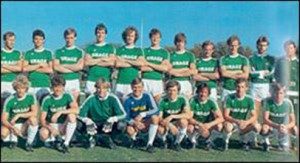
IK Brage finished with 43 points – Mjallby AIF had 38 – and won 20 of their 26 seasonal games.
Both winners had played in the top league before, but modestly and no one expected big surprises from them. The newly promoted mostly hoped to stay among the best.
The fairly equal Swedish football changed the fate of clubs on yearly basis – depending on who they had at particular moment. An old and generally successful club going down would be a big and may be upsetting news elsewhere, but not in Sweden.

AIK had a weak season and although they tried to escape, they failed and finished next to last. The fatal 13th place was theirs at the end, a point short of safety.

The dead last – and the real outsiders this year – was a club interesting as novelty.

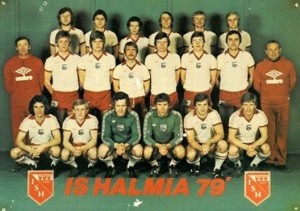
IS Halmia were not really competing, so weak they were. 2 wins and 5 ties left them not only last, but last by far – AIK finished with 11 points more. Perhaps the poor losers should be left in peace, but still it was curious moment – they were the second club representing the city of Halmstad in the top division. Halmia was last and their city rivals… first.

More or less, five clubs tried to win the title – the group was somewhat reduced to two at the end. Perhaps giving too much attention to the European Champions Cup and suffering fatigue, but Malmo FF dropped from the race for the title and finished unusually low – at 4th place.

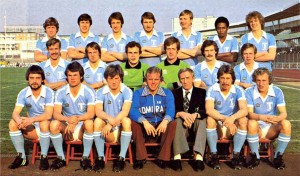
In Europe, Malmo FF had fantastic year, yet, so-so one at home. There were changes in the familiar squad – some may have said ‘changes at last’ – noticeably, the emergence of new star, Robert Prytz. The other interesting news was the very rare for the time appearance of Brazilian player in Sweden: some guy called… well, his name was and is often misspelled. Edson Rodrigues Monteiro. The confusion with his name is understandable – he was not only unknown player, but also failed to make impression and did not play much. He was not a starter at all. Either not good or adaptation to cold and snowy Sweden was difficult for him. The last news sad one: the maker of the excellent Malmo FF, who coached them steadily during the whole 1970s left this year – Bob Houghton went back to England to manage Bristol City. He had long and wonderful spell with Malmo FF, he led them to European final. Perhaps it was natural to look for new opportunity… yet, going to Bristol was hardly a recognition of great talent. It was an end of an era – for almost ten years Houghton and Malmo FF were one and the same.

IF Elfsborg (Boras) edged Malmo FF and finished 3rd.

An excellent season for Eleganterna (The Elegants), who hardly had anything good since 1961.

Second place for IFK Goteborg. They had the best goal-difference in the league and the second-best strikers (mid-table Hammarby IF were the top scorers), but a single point decided gold and silver.

IFK Goteborg was in the shadow of Malmo FF during the 1970s, but this year perhaps marked the beginning of the successful 1980s team. Young Dan Corneliusson was only a promising player and the name of also young coach Sven-Goran Eriksson was noticed only in Sweden. Yet.

The battle for the title was won by another young and not famous yet coach at the helm of the 1977 champions, Halmstads BK. Roy Hodgson was hired by the club in 1976 after recommendation from Houghton and already made the previously modest club champions twice in three years.

Third row, from left: Rutger Backe, Olle Sjödahl, Hans Selander, Lennart Ljung, Alf Peterson, Bo Mattsson.

Middle row: Stig Nilsson, Bertil Andersson, Stefan Larsson, Anders Westergren, Roland Johansson, Roy Hodgson – coach.

First row: Bengt Sjöholm, Peder Amberntsson, Claes Karlsson, Mats Jingblad, Sigge Johansson.

No famous players here and may be a bit conservative team – 12 wins, 12 ties, and 2 losses – but points count for everything and Halmstads BK had one more than IFK Goteborg. Champions for a second time and proving that young English coaches delivered in Sweden. But, following Houghton’s steps again, Hodgson left after winning the title. In 1980 he went to Bristol City as assistant of his friend Bob Houghton. As for the city of Halmstad, a strange years ended – pathetic Halmia was last, but Halmstads BK were champions.

Perhaps it was difficult to compete with the two Englishmen, but Sven-Goran Eriksson was determined to overcome them. IFK Goteborg reached the Cup final.

Atvidabergs FF were the other finalists. By 1979 the sensations of the early 1970s were already forgotten. They barely maintained a place in First Division, finishing 11th. The Cup final was more or less their last gasp before plunging into oblivion. As opposition, they were nothing… IFK Goteborg thrashed them 6-1!

Happy Cup winners and clearly a rising team. The world was yet to hear about them – and about their coach. In an ironic twist, Sweden depended on English coaches during the 1970s, but years later it was England hiring Sven-Goran Eriksson a national team manager.

Denmark Championship and Cup

First division had its own intrigue – second season of professional football. Perhaps it was not that much a period of adaptation, but a period of sifting out – which clubs were able to find enough money for the new reality. Especially money for long-term stability in a country with no big clubs and small pool of supporters. Copenhagen had too many clubs for professional era, smaller towns with more than one club had perhaps bigger problem. May be that was the reason for rather divided league this season – the outsiders were clear, so were two separate groups of mid-table teams. Looked like a 16-team league was too big for professional football.

Slagelse BI finished last with 16 points.

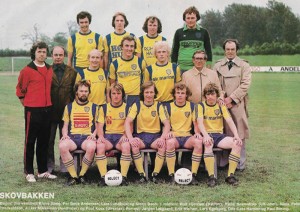
IK Skovbakken ended 15th with 19 points. The curious ‘personal’ adds on the team’s shirts continued – 9 different firms placed adds, but 4 players apparently nobody wanted… and they were with plain shirts. An illustration of the difficulties Danish clubs were facing – how to run professional club without cash. The previous year all players had adds at least… seemingly, things were not going better and so the fate of the club.

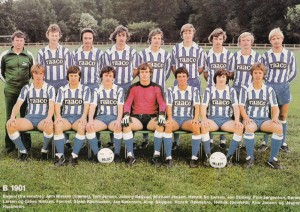
B 1901 was the third club in dire straits – 20 points and out of the league. One of the clubs not able to survive in the new reality, as it turned out. For the moment, only relegated…

Seven so-so clubs were much stronger than the relegated, but nothing more otherwise. Among them was Vejle – one of the strongest Danish clubs a few years back, when football was still amateur. BK Frem topped this group with 30 points, ending at 7th place with 10 wins, 10 ties, and 10 losses. Five other clubs soared high above the bulk of the league – Naestved, the lowest of them, was 6th with 6 points more than BK Frem. None of them contested the title, though. The championship was comfortably won by Esbjerg fB.

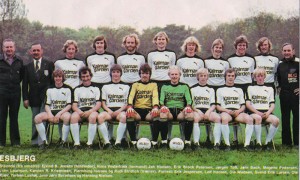
A great year for the champions – they finished 6 points ahead of the closest pursuer, naturally with the best scoring and defensive records in the league. They lost only 2 matches and won 18. And it was their 5th title, a nice round number. They had to wait almost 15 years for this one, though – their last title was won in 1965. The long wait perhaps made victory even sweeter.

The new champions of Denmark – perhaps a positive sign that professionalism worked for those quick to adapt: suddenly, new heroes. May be so, may be not – after all, the champions still had the typical Danish squad: mostly anonymous, one or two rising stars. Esbjerg depended on their goalkeeper Ole Kjaer, 25 years old and Danish player of the year in 1978. He also became national team regular after Piontek dismissed Birger Jensen. The other star was the 26-year old Jens Jørn Haahr Bertelsen, voted the player of the year in 1979. The defensive midfielder eventually became much better knwon than Kjaer – but only after 1980, when Piontek’s ‘Danish dynamite’ exploded and the player moved to Italy. Two stars… well, may be three, if Ole Madsen is added – more than enough for winning the Danish championship. And not surprising at all – good players were still dispersed in many clubs of first and second division, there was no consolidation. No trully dominant clubs and hardly a chance for ‘doubles’ – Esbjerg were supreme in the league, but the Cup was entirely out of their reach. And, as a passing note, they should have celebrated harder perhaps: this was the last championship the club won. Of only they knew it…

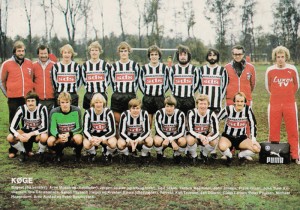
The Cup final opposed Koge BK to B 1903.

To a point, and excellent season for Koge – winning promotion to first division and also reaching the Cup final: not bad for a second division club? Koge rising again? Evidently.

Of course, they came out on the filed determined to win. And came close… in front of 9800 fans, they scored the only goal of the final. Unfortunately, Peter Poulsen put the ball in the wrong net… Koge lost 0-1.

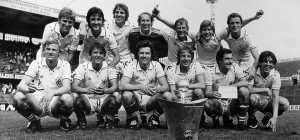
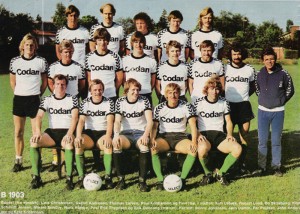
May be lucky winners, but still winners – the Cup stayed in Copenhagen, firmly in he hands of B 1903. Looked like the club was adapting well to professionalism – they had good league season, finishing with bronze medals. They won the Cup. It was important for survival, especially in the capital city with its many clubs, all competing for money. Winners have best chances?

Helped by Koge’s player, happy Cup winners. Sponsored by Codan, perhaps the most important sponsor in Denmark – trophies ensured future sponsorship as well. Yet, the squad was not all that great… trophies, attracting sponsors, were the key… get the cash, get the money, win again, get more cash, get more players… simple, right? There is no B 1903 today…

Denmark II Division

The second professional season of Danish football. No visible results yet, if not counting the measures taken by the national team coach Sepp Piontek – he introduced discipline, something disliked by the Danish players. Strange for a Northern nation, but the Danes disliked authority and generally disregarded it. So far, Piontek’s requirements produced one result: the best Danish goalkeeper, Birger Jensen (FC Brugge, Belgium) was out of the national team and never called again. A risky move, but in the long run, a healthy one. With or without Jensen, Denmark was still among the European outsiders. So were the clubs.

The Second Division ended with three more or less familiar winners:

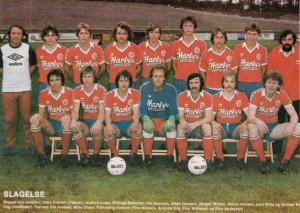
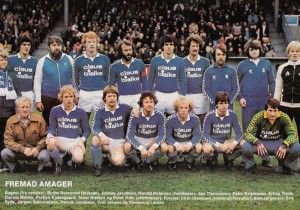
Standing, from left: Kresten Bjerre – coach, Claus Larsen, Søren Grenå Larsen, Ole Christiansen, John Tune Kristiansen, Peter Rasmussen, Kim Truesen, Michael Haagensen.

Crouching: John Jensen, Torben Bastholm, Peter Poulsen, Jan Olesen, Frank Olsen, Arne Rastad.

Koge BK, a really wild club – unpredictable up and downs. Champions just a couple of years back, then relegated, now going up again and quite impressively too.

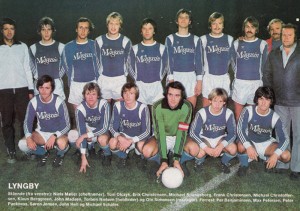
Lyngby BK were also frequent members of first division. Rather modest, but more likely to play in top flight than in second division.

Lyngby also had at least one player who became well known in Europe – Klaus Berggreen. 21-years old promise, just called to the national team.

Fremad Amager, one of the many – at the time – Copenhagen’s clubs. Founded in 1910, but with modest history. Playing sometimes in first division was just about the best they ever achieved.

The boys were unknown. So were their aims.

Turkey I Division

The First Division, the only fully professional Turkish league, was divided into three sections during the 1978-79 season – two outsiders at the bottom, three favourites at the top, and 11 more or less equal teams. The surprise was Besiktas (Istanbul), one of the traditional favourites, which sunk down, and ended 9th with 29 points. Izmir, one of the cradles of the Turkish football, lost its leading position years ago – this was no longer news. Goztepe and Altay were mid-table clubs by now. Goztepe, which played in the second level just the previous year had a relatively good season – they finished 10th. Lat in the table was the other newcomer for the season:

First division football was too much for Kirikkalespor – they finished last, earning 18 points. An incidental club.

Samsunspor was the other outsider with 20 points. It was not surprising to see them relegated – it was surprising to see them really weak.

The third relegated club was rather unlucky.

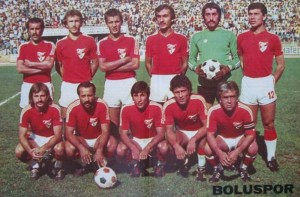
Boluspor was a likely candidate for relegation, but they put the good fight and even finished with positive goal-difference – 33:32. They won 9 matches – another 4 clubs had the same or smaller number of wins – but the at the end Boluspor had 26 points and these four clubs finished with 27 and 28 points. Small, but fatal difference. Boluspor took the dreaded 14th place.

The pleasant surprise of the year was a club similar to Boluspor – relatively new member of the league, modest and expected to be at the bottom or near bottom.

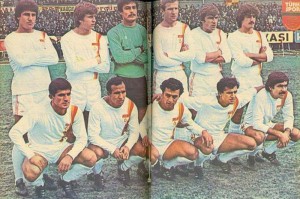
But Orduspor did contrary to expectations – they had a wonderful season, winning 13 and tying 8 games and finishing 4th with 34 points – 2 more than the 5th, Diyarbakirspor. They were not title contenders, but earned a UEFA Cup spot.

The favourites were the usual suspects – Galatasaray, Fenerbahce, and the new powerhouse Trabzonspor. Fenerbahce eventually slipped down – they ended at 3rd place with 38 points, but the title was decided by a single point. It was a battle of attacking vs defensive football. Galatasaray won 17 matches, the most in the league. However, they lost 6. Winning and scoring goals – 47 was also the best league record this season – was not enough. Trabzonspor won only 13 matches – less than Galatasaray and Fenerbahce – but they lost only one. As for ties, they had 16 – more than half of the games they played. Their striking power was nothing to brag about – 34 goals in 30 matches – but their defense was impenetrable – the ball visited their net only 7 times this season. One of the best records not only in Turkey. The careful, defensive, and point oriented approach paid off – at the end Trabzonspor had 42 points and Galatasaray – 41.

Second consecutive year without a title for Galatasaray. Fatih Terim lost again to Senol Güneş on the pitch.

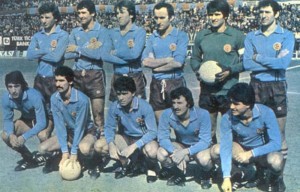
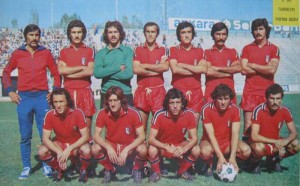
Standing, from left: Güngör, Mehmet Ekşi, Tuncay, Hüseyin, Şenol, Necati

Crouching : Mustafa, Ahmet Ceylan, Serdar, Turgay, Necdet

Trabzonspor were not overwhelming champions, but one thing was made sure – they were not just an accident. 3 titles and 2 Cups in four years firmly established them among the best Turkish clubs and now there were no longer 3 big clubs, but 4.

The Cup was contested by Altay (Izmir) and Fenerbahce (Istanbul). Old rivalry and an attempt of Izmir to restore its leading place in Turkish football. For some reason the two-legged final left little memories… Altay won 2-1 at home, but lost 0-2 in Istanbul.

Fenerbahce won their 3rd Cup – the number strikes as very low. Yet.


Turkey Second Level

Turkey still obscure, slowly building, unnoticeable. Entirely outside foreign attention, especially those not in the top league. Clubs like

Karabukspor

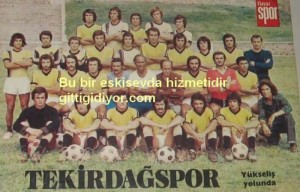
Tekirdagspor

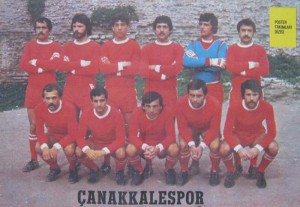
Canakkalespor were unheard of.

Genclerbirligispor was one of better known clubs playing second division this year – curiously, like any other club of Ankara.

But such clubs were really the future of Turkish football – making the game more and more popular, training youngsters. Real results were to come years later, but from the bulk of unknown clubs the new members of the top league arrived. Amateur and semi-professional clubs and leagues. From them came the promoted to First Division:

Gaziantepspor

Kayserispor

Caikur Rizespor.

The three were little known at the time.


Wales

International rules vs tradition – Wales, of course. The Cup final opposed English to Welsh club, both playing in the English championship. Shrewsbury against Wrexham. It was not for the first time, of course – few English clubs participated in the tournament almost from the beginning of the challenge in the19th century. Two-legged final, competitive as ever, if not particularly exciting. The first leg ended 1-1. In the second the English prevailed 1-0.

Shrewsbury won their 4th Welsh Cup. The last time they won it before was in 1977. For lowly Shrewsbury it was just the biggest achievement possible and the only trophy they were ever able to win. And as Welsh Cup holders they were bound to play in the European Cup Winners Cup? Would have been nice, ironic, even a mockery – a never even playing in the first English division popping up in the European tournament when mighty English clubs were left out. But rules are rules… Shrewsbury were not Welsh and they would not represent Wales. Which begs the question what could happen if, say, Cardiff City won the English title? Academic question really, but if English club cannot represent Wales, then Welsh clubs cannot represent England – and leave England without representation in the European Champions Cup? The case was never put to the test. As for Shrewsbury, they were to be satisfied with the Cup. Europe was for others.

The losers got Europe.

Wrexham came close to winning the Cup, but did not. The irony continued – they were going to represent Wales as losing finalist just because they were Welsh club. Instead of English Third Division club – Shrewsbury – Europe got a Second Division one – Wrexham. Go figure.