Second Division. Apart from the punishment of Shumen and Pirin (Gotze Delchev), the second level perhaps suffered less than the other divisions the changes ordered by the Communist Party. As it happened, there were no clubs with suspect names at the moment, so nobody was renamed. The reduction of the league after Shumen and Pirin were expelled was perhaps more positive than negative, for 22 teams was still too many for relatively competitive championship and breeding opportunities for match-fixing. So, 20 teams now – still too many, but better than 22. Two were going to be relegated this year instead of 4, which was not good really. The recent structural reforms of the Second Division greatly reduced the number of former top league members: now they were 8 – 10 such teams were in Third Division this season, trying to climb back at least to second level. Was Second Division somewhat stronger than before is doubtful – a look at the final table tells that more than half the league really tried to avoid relegation, a battle between fairly equal teams, none strong. Even the usual ‘comfort’ zone, occupied by ‘eternal’ members, was more in danger of going down than usual. Four team – more or less – fought for top positions, all former First Division members, but two of them were just promoted from Third Division. None was really impressive and at least one of final winners was caught by surprise from its own success. Everthing was ‘normal’ this season, but years later some former players spoke of bribes – and top teams were mentioned. Depending on who was speaking… the truth will never be known. What is known, however, is that reforms or no reforms, there was no really strong team. Even the champions.
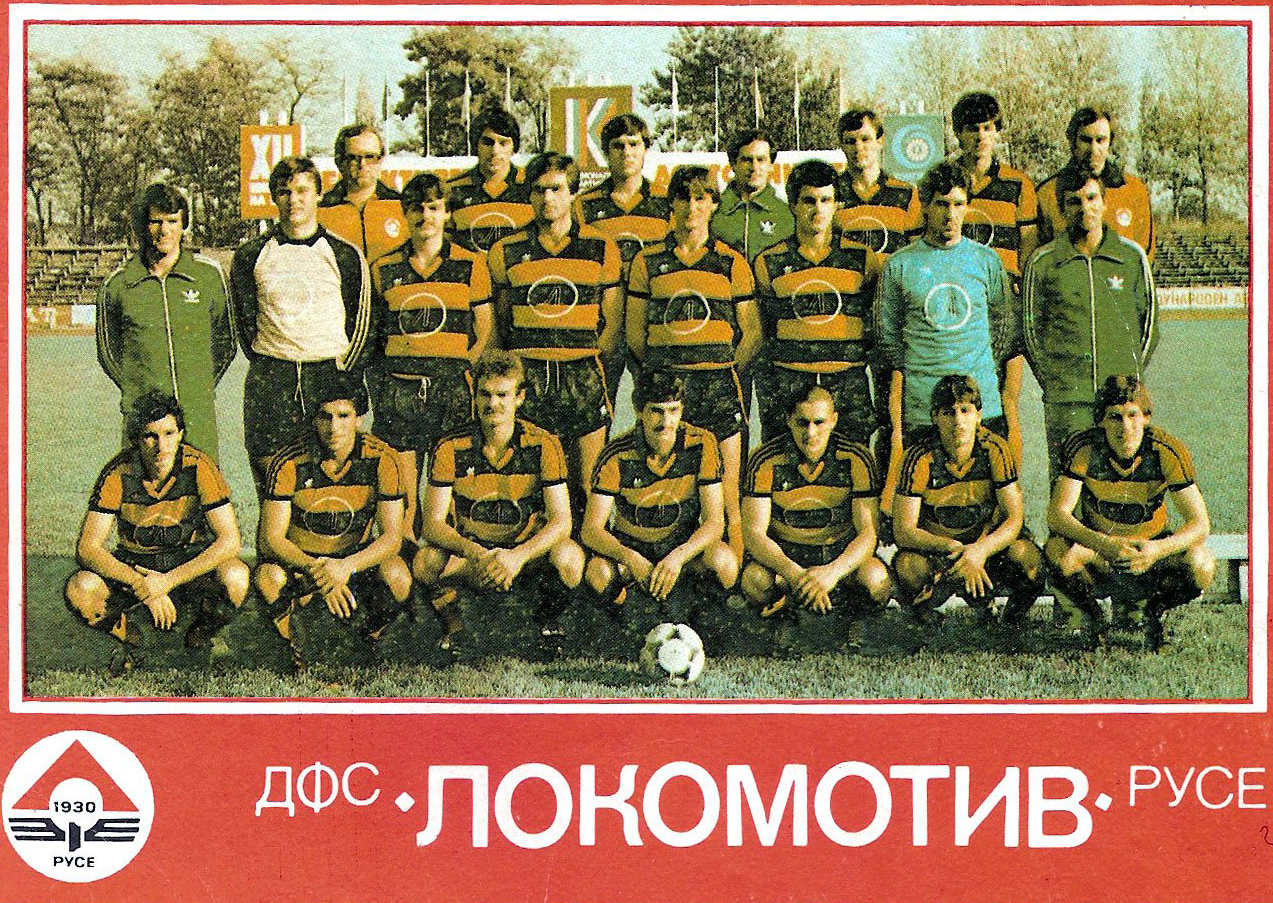 Lokomotiv (Rousse) finished last with 29 points. Crouching from left: Bobby Stoyanov, Illian Minchev, Evgeny Ignatov, Tayfun Mehmedov, Sasho Todorov, Blagovest Georgiev, Roumen Monev.
Middle row: Pavel Malinov – assistant coach, Toma Filipov, Stanislav Pashev, Kosta Avramov, Iliya Yankov, Krassimir Kolev, Petko Tzirkov, Todor Todorov – coach.
Top row: masseur, Kolyo Chizmarov, Plamen Petkov, Tzonyo Kyuranov- administrator, Plamen Dobchev, Stoyan Pumpalov, team doctor.
Weaker than the rest and no surprise: football was ailing in Rousse during the 1980s. Normally, both city clubs were feeding each other – new talent moving from Lokomotiv to Dunav and experienced veterans taking the opposite way. But now… Dunav was weak and so Lokomotiv as well. Both teams were relegated this season – Dunav from top flight and Lokomotiv from second level. From this squad only Stoyan Pumpalov eventually made a name for himself, but with another club from another city.
Dorostol (Silistra) ended 19th with 33 points and was the second rekegated team. One of the longest members of Second Division was a bit unfortunate, for they were relegated on goal-difference, but that was the new reality: for years they kept mediocre, but secure existence. However, the Second Division was reduced by half recently… and Dorostol apparently did not take care or was unable to take care for the reality in a smaller league.
Rilski sportist (Samokov) escaped relegation – 18th with 33 points, but they lost 3 points on scoreless ties. They were just promoted, so the finish was fine, but that was also part of the new reality for clubs like Dorostol: Rilski spotist belonged to small town, but a town close to Sofia. They were quite likely to get players from Sofia unlike far away Dorostol. True, Silistra was a district capital, but playing for Rilski sportist did not mean living in Samokov – one could easily live in Sofia and commute for training and games. The end result was that Dorostol had it tough to compete with small Rilski sportist.
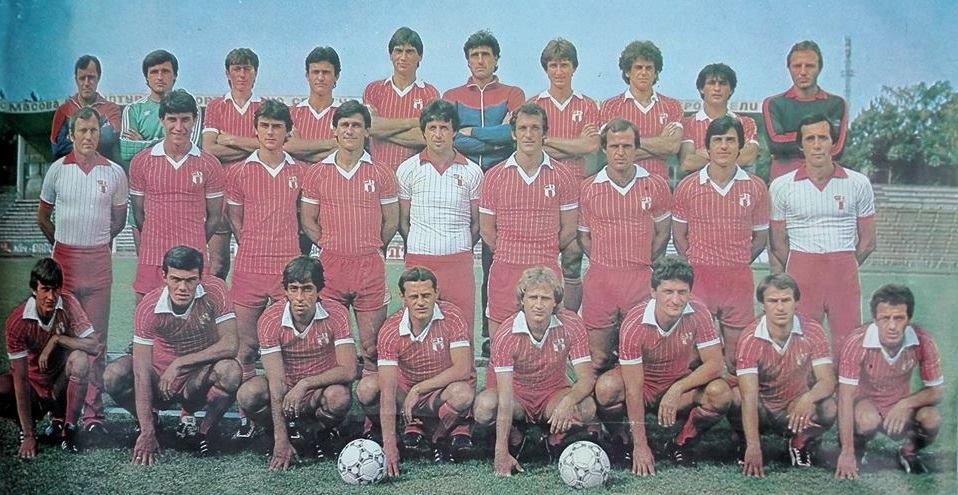 Haskovo (Haskovo) barely escaped relegation: 17th with 34 points. They lost 2 points on scoreless ties, but the season was terrible – only recently they played First Division football and now were almost relegated to third level. Locally, club policy was blamed – coaches from outside were hired way too often and when the team earned promotion such coaches brought veterans from Sofia. Once the team went down all outsiders disappeared, leaving the club in worse shape than it shoud have been, Yet, the practice was not changed – Vassil Metodiev was hired to coach them the next season. A great coach, but often punished… lastly, expelled from coaching for he was the coach of Levski in the scandalous Cup final with CSKA in 1985. With him various plyers arrived from Sofia and Plovdiv – players no longer needed by their original clubs. To loacl eyes, club Haskovo was determined to repeat the same mistake forever.
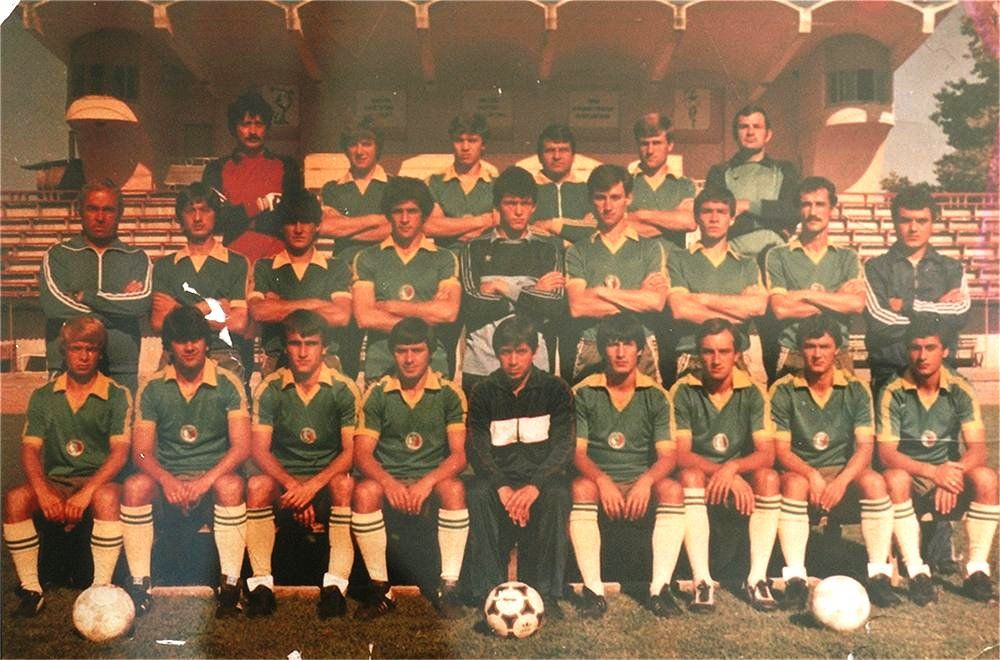 Dobrudzha (Tolbukhin – today Dobrich). 16th with 34 points. Lost 1 point on scoreless tie, but pretty much in situation similar to their neigbours Dorostol: secure second-level existence was shaken by the reduction of the division. At least they survived.
Chirpan (Chirpan) – 15th with 35 points. No scoreless ties, so they got all possible points and survived. Nothing special, of course, and no way to be something special, for they represented small town.
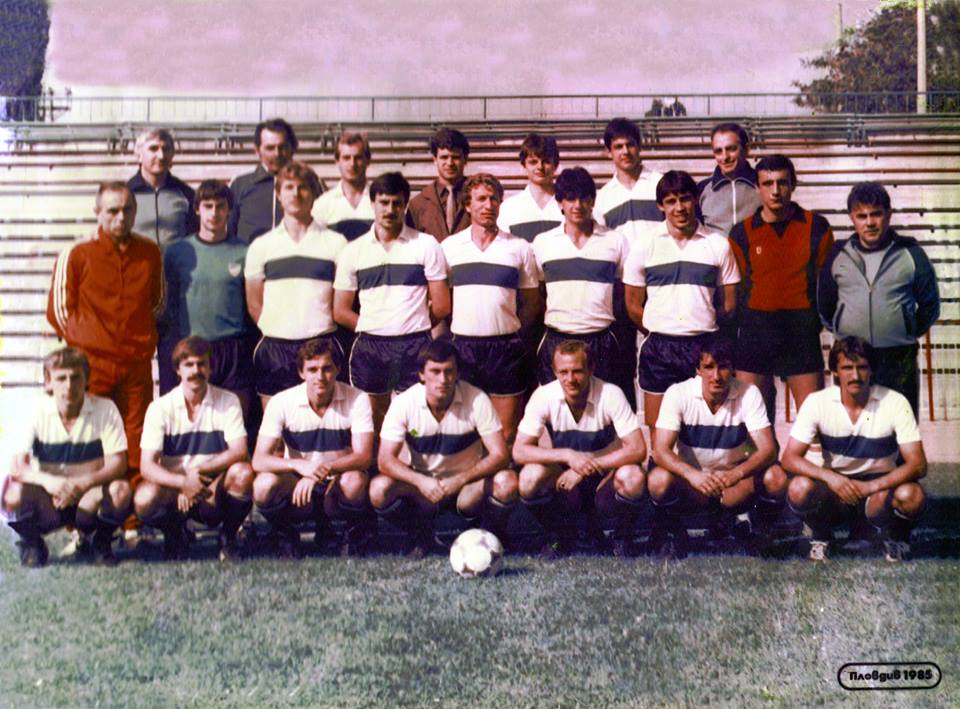 Spartak (Plovdiv) – 14th with 35 points. Like Chirpan, they had no scoreless tie. Once upon a time Bulgarian champions, but can’t blame them for current mediocrity – Spartak was forcefully merged with Botev in the second half of the 1960s to form Trakia. But Botev – and the Army – took the upper hand and Trakia was effectively Botev in everybody’s mind. Spartak disappeared.. and was revamped only recently, starting from the bottom of the football pyramid. This was their only 2nd secon in Second Division after restoration and they were still new, shaky, mostly trying to survive and build a team. Survival was the prime concern.
Arda (Kradzali) – 13th with 35 points. Like Dorostol and Dobrudzha, they played second division football for years, a typical mid-table club. Now they had to fight for survival.
Septemvriyska slava (Mikhailovgrad – today Montana) – same as Arda, Dobridzha… hence, 12th with 35 points.
Rozova dolina (Kazanlik) – 11th with 36 points.
Vihren (Sandaski) – 10th with 36 points.
Balkan (Botevgrad) – 9th with 36 points.
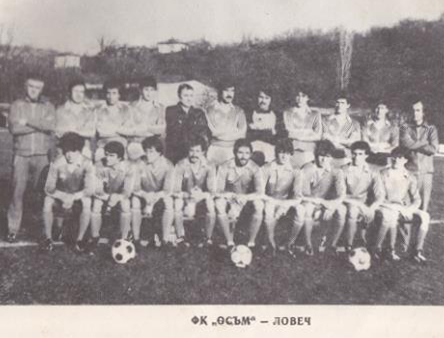 Osam (Lovech) – 8th with 37 points. Well… just ever. Mid-table and no more? May be less, for like pretty much all traditional mid-table clubs, they were now closer to relegation and no longer secure. All depended on ability to get some well-known veterans – if you do, survival was possible. If you don’t… third level. Osam was able – former national team goalkeeper Stefan Staykov, for example. And a great future star was at hand – Petar Houbchev, still unknown, but already with over 100 second-division games. Osam apparently was coping with the new second division reality and going down was unlikely. But so was unlikely going up.
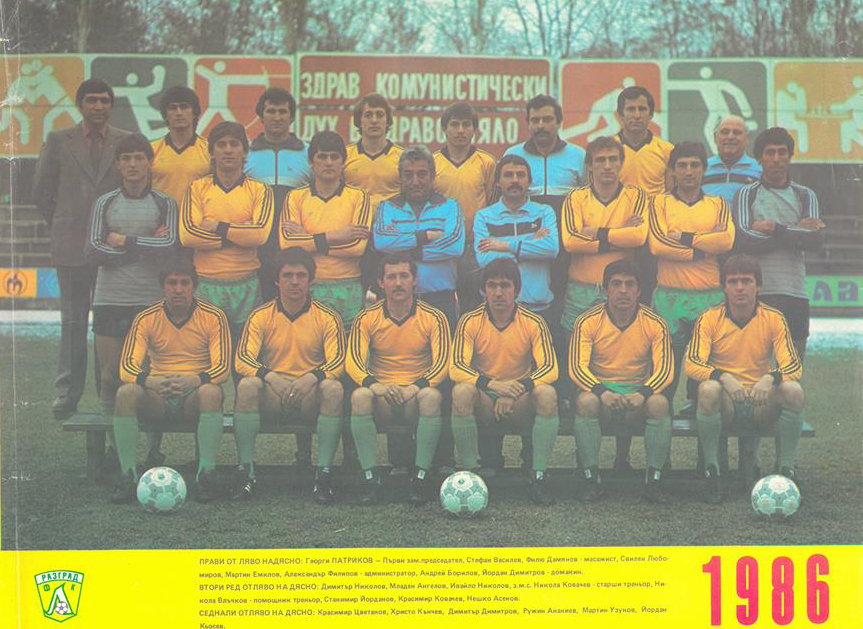 Ludogoretz (Razgrad) – 7th with 38 points. Oh, this was not the well known name playing regularly in the group phase of the European tournaments and collecting Bulgarian titles of today – back than it was small club quite happy to play in Second Division, which was not granted at all. Thus, this season was rather strong and successful for them. Especially because they had rather anonymous squad even for second division team.
Svetkavitza (Targovishte) – 6th with 38 points. Same as ever… no bite for climbing higher and no ambitions eather. Only… relegation zone was closer now than it used to be.
Neftokhimik (Bourgas) – 5th with 40 points. Strong in recent years, but aiming higher was so far impossible – as second team in Bourgas, they somewaht depended on the whims of Chernomoretz.
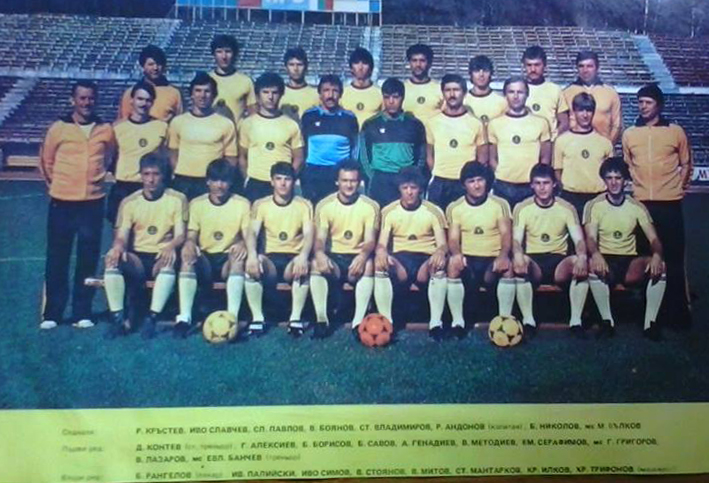 Minyor (Pernik) – 4th with 41 points. Freshly relegated and failing to climb back. Sitting from left: Krastev, Ivo Slavchev, Boyanov, St. Vladimirov. R. Andonov, B. Nikolov, M. Valkov.
Middle row: D. Kontev – coach, G. Aleksiev, Borissov, B. Savov, A. Genadiev, V. Metodiev, Em. Serafimov, G. Grigorov. Lazarov, Evl. Banchev – assistant coach.
Third row: Rangelov – doctor, Iv. Paliyski, Ivo Simov, Stoyanov, Mitov, St. Mantarkov, Kr. Ilkov, Chr. Trifonov – masseur.
Hard to tell why Minyor was failing year after year – one possible reason was their close proximity to Sofia. Often players came from there – and they did not have Minyor on their mind, but to go back to Sofia. Local talent was also hoping to play in Sofia. With such hopes and priorities, motivation was low and distractions too many.
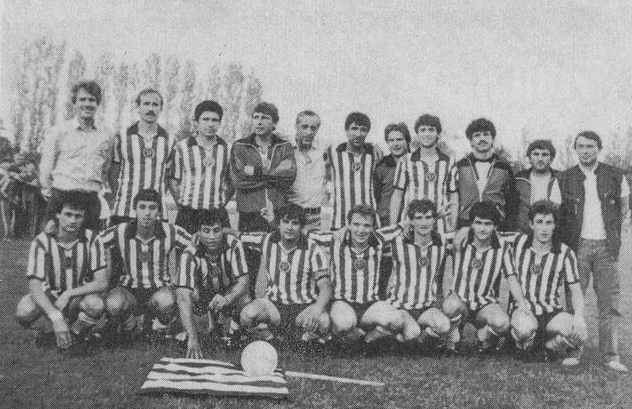 Lokomotiv (Gorna Oryahovitza) – 3rd with 44 points. Great season – they just came back from exile in Third Division. Perhaps the most promising team this season – coached by ambitious Dobromir Zhechev, they were a team with some vision for the future. Building process started and was going well. They were not ready yet to push for promotion, but seemingly they were going to be a force. First Division was coming into focus and a dream to return to it – where they played briefly in the arly 1960s – was forming.
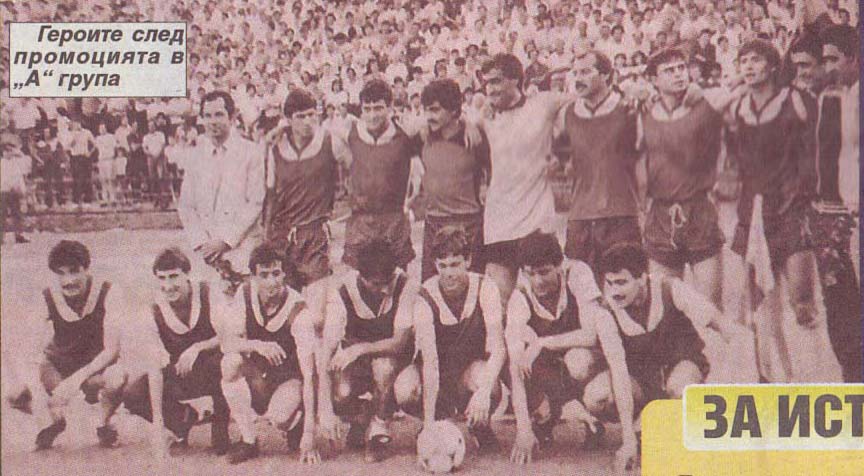 Dimitrovgrad (Dimitrovgrad) – 2nd with 47 points. They won most games this season – 22. Promoted, of course, and it was fantastic, for theirs was real Cinderella story. Like Lokomotiv (Gorna Oryahovitza), they played briefly top-league football once upon a time, but were mostly associated with Second Division. Recently relegated, though, and just coming back. Unlike Lokomotiv (GO), they had modest squad and even they did not expect to do more than reestablishing themselves in the league. But they well, collected point after point, eventually finding themselves at the top. Promotion, however, was a surprise more to them than to anybody else – now it was realised that they had no team for the top division and probably would be even unable to patch something. What happened after the success was comic – looking for and trying to lure players on the beaches, where they were taking vacation. The former Slavia and national team defender Ivan Illiev was their greatest name and he was over 30 now, doing a favour for the club more than anything. Great success, but hardly ever there was a team so unprepared for playing in First Division. Instead of happiness, promotion created worries and uneasiness, almost a panic.
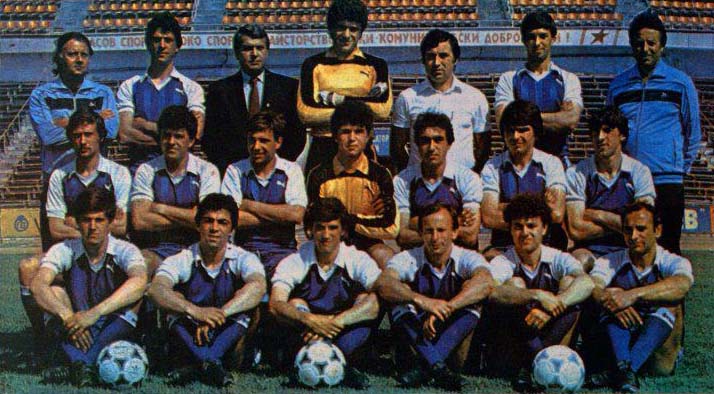 Chernomoretz (Bourgas) won the championship with 48 points from 21 wins, 7 ties, 10 losses, 81-42 goal-difference. Just relegated from First Division, they managed to keep pretty much their top-league squad and clearly were the strongest team in second division. But.., and it was rather big ‘but’. This was a squad which somewhat stopped developing without reaching its potential – mostly players coming from the club’s youth system, praised for their talent 5-6 years ago, selected for various junior national teams, expected to become real stars. With years going one after another the talented hopefuls were only getting older and their experience eventually led them to arrogance – which was more or less present this season: obviously the best team, they did not dominate the league, but came barely ahead of extremely modest Dimitrovgrad squad. No wonder they were relegated in the first place… looked like they don’t play seriously enough and had no ambitions. Talent was good enoug to win Second Division, but it was more than doubtful they will excell back in First Division. A sad story, really.
Front row from left: Miroslav Kralev, Zhelyazko Markov, Ivan Yovchev, Valentin Peev, Ivan Aleksandrov, Georgy Illiev.
Middle row: Christo Gotzkov, Dimitar Stoychev, Nikolay Russev, Konstantin Kostenski, Ivaylo Kotzev, Aleksi Zhelyazkov, Todor Raykov.
Top row: Lyubomir Borissov – assistant coach, Valentin Deliminkov, Georgy Stanchev – club’s chairman, Lyubomir Sheytanov, Toma Tomov – club’s vice-chairman, Vladimir Stoyanov, Vassil Zhelev – coach.
Well, no matter what – good luck to the newly promoted Chernomoretz and Dimitrovgrad in the next season.
Bulgaria III Division
Bulgaria. This season was one of the most extraordinary championships. All goes back to the severe punishment the ruling Communist Party slapped after the violent cup final in the 1985 spring. As all Communist orders, it was unreasonable and almost at the moment it was published schemes started to undermind it. On the surface, the punishment was related only to the biggest clubs, CSKA and Levski. They were expelled from the 1984-85 championship, their records stricken, and disbanded. On the surface, such clubs no longer existed. But they were not just football clubs, so… both clubs continued to be, belonging like before to the Army and the Police. The football sections were really disbanded, but out of the blue new clubs were formed in their place – the football section of CSKA was named Sredetz and Levski’s – Vitosha. Brand new clubs… playing with the same colours and using the same players and stadiums the ‘disbanded’ clubs had. And they were included in the First Division for the 1985-86 season – incredible decision, for expelled teams normally go down. Ties with Army and Police were severed and prohibited, but were they really? Well, both clubs quickly restored their previous ties, but not in 1985-86 season or at least not openly. As it used to be for years, if CSKA had to receive some punishment, it was enlarged to affect other clubs as well – this time the punishment of CSKA and Levski was eventually formulated in general terms: clubs were forbiden from using names of histroic figures – this really was a second blow on Levski, for CSKA had no such name, but it dragged along many other clubs, they were all renamed, and for that reason new and old names in brackets will be given here. By the summer of 1986 nobody really believed there was more to the big ‘reform’ than renaming – suspended players one after another were coming back, ecven those banished for life. So suspended coaches. Those, making the yearly statistical almanach decided to adress the situation with unceratinty, hinting of only temporary limbo: players’ records for both Sredetz (CSKA) and Vitosha (Levski) were doubled – a separate registering records for the ‘new’ clubs and second section, giving complete records for CSKA and Levski. Yet, there confusion was great and lasted the whole season, first affecting the transfer period in the summer of 1985. Now football sections were ruled to be somewhat independent entities, not attached to the original multisport clubs. This brought the question of financing and really shook CSKA – they fell victims of their own mythology, which trumpeted for decades that the best players were CSKA-istas at heart, loved to play for the club, had fantastic loyalty to it, and every talented youngster dreamed to play for CSKA. Stripped from power and perks, CSKA suddenly faced reality: some players immediately chose to go elsewhere and provincial talent did not want to join the club. No wonder in the history of CSKA and in the memories of those involved with the change this is the most painful event – Dimitar Penev, for insyance, laments ever since the terrible situation to be hired to coach a team withous players, forcing him to include juniors.
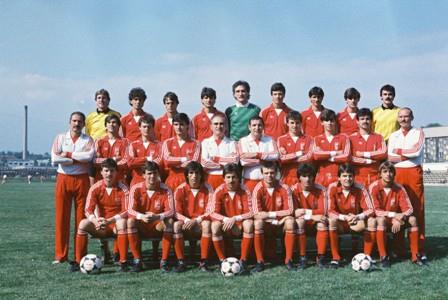 That is a version of Sredetz 1985-86, which is not ‘right’ – in the middle with green jersey is the goalkeeper Thomas Lafchis, back from Greece. Well, he never played for Sredetz even one official match and a picture only few months later shows a team not only without him, but without the second goallie, Dossev, the last on the right. The veteran Yordan Filipov was back-up goalkeeper instead. Apparently, Sredetz had little to offer – Vitosha suffered the same, but to lesser degree: it had more suspended players, so it was weakened too, but most of the others chose to stay with the ‘new’ club.
Outside Sofia feelings were mixed – on one hand, names were changed ‘thanks’ to the punishment of CSKA and Levski, which was not liked. On the other hand, it was great, because the iron grip of Army and Police was disliked – now, the yoke was over and the provincials for the first time felt they were on equal footing with the big two. It proved to be only illusion of freedom and equality, but at least in the 1985-86 the big two were sufficiently shaken and lost their grip. Provincial clubs, at least at first, did not suffer all that much from the separation of the football sections from the local multisport clubs: it was easier to channel money into those ‘new’ clubs, which was not the case in Sofia – everbody was watching at the moment and no powerful Party boss was going to risk his career with financial and other support of Sredetz or Vitosha. In terms of football, the provincial clubs took advantage of the situation and it was their championship – their only one, for everthing rapidly went back to the familair after that.
Yet, grieve was quite present – 2 teams from Second Division were also punished right after the big scandal of 1985: Shumen (Shumen) and Pirin (Gotze Delchev) were expelled for violation of the ‘rules of financing, spiritual and moral stimulation’. Under such formulation it is difficult to tell what exactly they did – probably a combination of paying their players under the table, bribing or trying to bribe other teams and match fixing. All that crimes were rampant for years, so why now and why only those two clubs? Well… more or less, they were dragged dwon along with CSKA and Levski, but there was a difference: the powerful clubs were expelled, records stricken, disbanded, and still included in the First Division. Small provincial Shumen and Pirin were relegated to Third Division, which reduced Second Division from 22 to 20 teams.
There was more, but slightly different: because the Communist government already renamed all those with Turkish names, some players have to be written with two versions now if wanting to keep track of them. Since 1985-86 was unusual, one player is of real importance, for he had a great season as a member of the new champion. Meantime, this new champion is considered practically illegal by at least one football faction: Botev (Plovdiv), then Trakia, never really accepted this champion, maintaining always that one match at least was fixed. According to Botev’s version, they were the rightful champions, but Vitosha deliberately lost their match in Stara Zagora to give the title to Beroe. Well, there was never love lost between Levski (Vitosha) and Botev (Trakia) on one hand and on the other Trakia destroyed Beroe 8-1, which is hardly a result champions should get. The Botevistas never accepted the awarded out of the blue title for 1984-85 season – they really finished 3rd – but took pride from their duel with Bayern in the European Champions Cup and really aimed at the title in 1985-86. At the end, they were 2nd and felt robbed. Were they robbed? Nobody can ever tell for sure.
Some new rules were introduced: scoreless ties brought no points in First and Second divisions. Meantime, Third Division had it differently: 3 points for win, 1 for a tie was introduced in the usual hope that reforms could better the level of the game. Third Division was pain in the ass for years and restructured often as a result. Now it was made of 4 groups of 16 teams. But since Shumen and Pirin were expelled from Second Division after the end of 1984-85 season, the groups they were now included in had 17 teams. But unlike previous years not all winners were promoted – only 2 teams were promoted to Second Division, so the group winners went to promotion play-offs. All tremors brought by experiments and punishments somewhat sifted in the Third Division – some strange teams played in South-Western Third Division: Minyor (Sofia), for example. Who were they, how they came into existence, and why played in Third Division? A short-lived mystery, for soon they vanished.
Third Division clearly belonged to former Second and First division members. Bdin (Vidin) won the North-Western group, trailed by former First-division member Yantra (Gabrovo). Madara (Shumen) – the freshly expelled from Second Division Shumen (Shumen) was renamed to Madara – won the North-Eastern group, far ahead of the nearest rival Sportist (General Toshevo). Rila (Stanke Dimitrov) clinched top place in South-Western group, prevailing over Velbazhd (Kyustendil) by a point. Rila… well, it was Marek before. And Marek was the conspiratorial name of the Communist ‘hero’ Stanke Dimitrov, after whom both town and club were named. But the team finished the 1984-85 season under the name Dupnitza – which probably was seen as some anti-Communist attempt to ignore the Communist hero Stanke Dimitrov by using the original name of the town and the club became Rila. Today both town and club have their original names restored, so it is Marek (Dupnitza). Tundzha (Yambol) won the South-Eastern group, after a long battle with Assenovetz (Assenovgrad). How far the rule against using names of historic persons went? The city of Assenovgrad was renamed from its original name long time ago, taking the name of medievil king Assen. The club was named after the city… somewhat, for it means ‘Assenovite’, reffereing to both city and king. Marek was renamed, although the name was nickname, not real name. Yet, many clubs playing in the 4th and 5th divisions named after historic figures preserved their names – but nobody was looking deep down. Why Shumen was renamed is perhaps more complicated: in 1984-85 the club used the name of the home city. It was changed to the medievil name of nearby casttle, from which the city emerged. That is, the club did not have a name of historic person and very likely the original club was ‘disbanded’ after it was expelled for financial violations and ‘reformed’ under new name. A thin disgaise to show authorities that ‘lesson was learned, and they will never do anything wrong again.
But back to the game. The four winners went to the promtional play-offs and Rila (Marek) won over Tundzha (Yambol) 3-1 and 1-2. Bdin prevailed over Madara 2-0 and 1-2.
Rila (Stanke Dimitrov) and Bdin (Vidin) were promoted to Second Division for 1986-87 season. For both clubs it was a return to familiar level after brief exile. Rila still had a few players remaining from the great squad Marek had at its glorious days in the second half of the 1970s, players who played againt Bayern in the European tournaments and also for the Bulgarian national team.
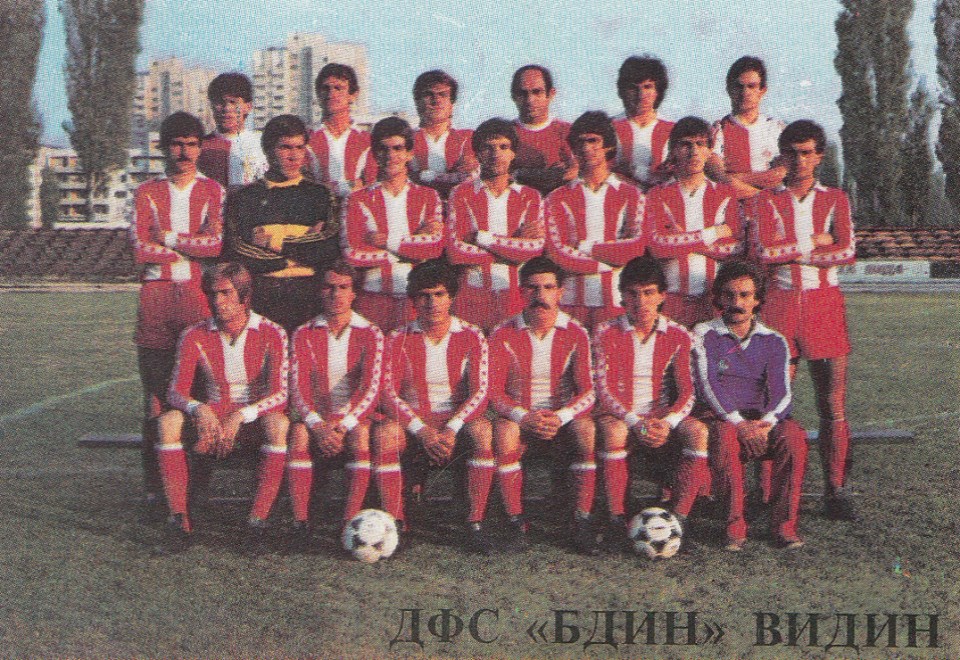 Bdin (Vidin) was perhaps even happier than Rila (Marek) to go back to Second Division – they were one of the longest-lasting members of it and going down to third level was absolutely abnormal. Well, they were back.
DDR the Cup
The Cup. 1.FC Locomotive (Leipzig) and 1.FC Union (East Berlin) met at the final. It was unequal clash and the result is practically commenting on the game: 5-1 Locomotive.
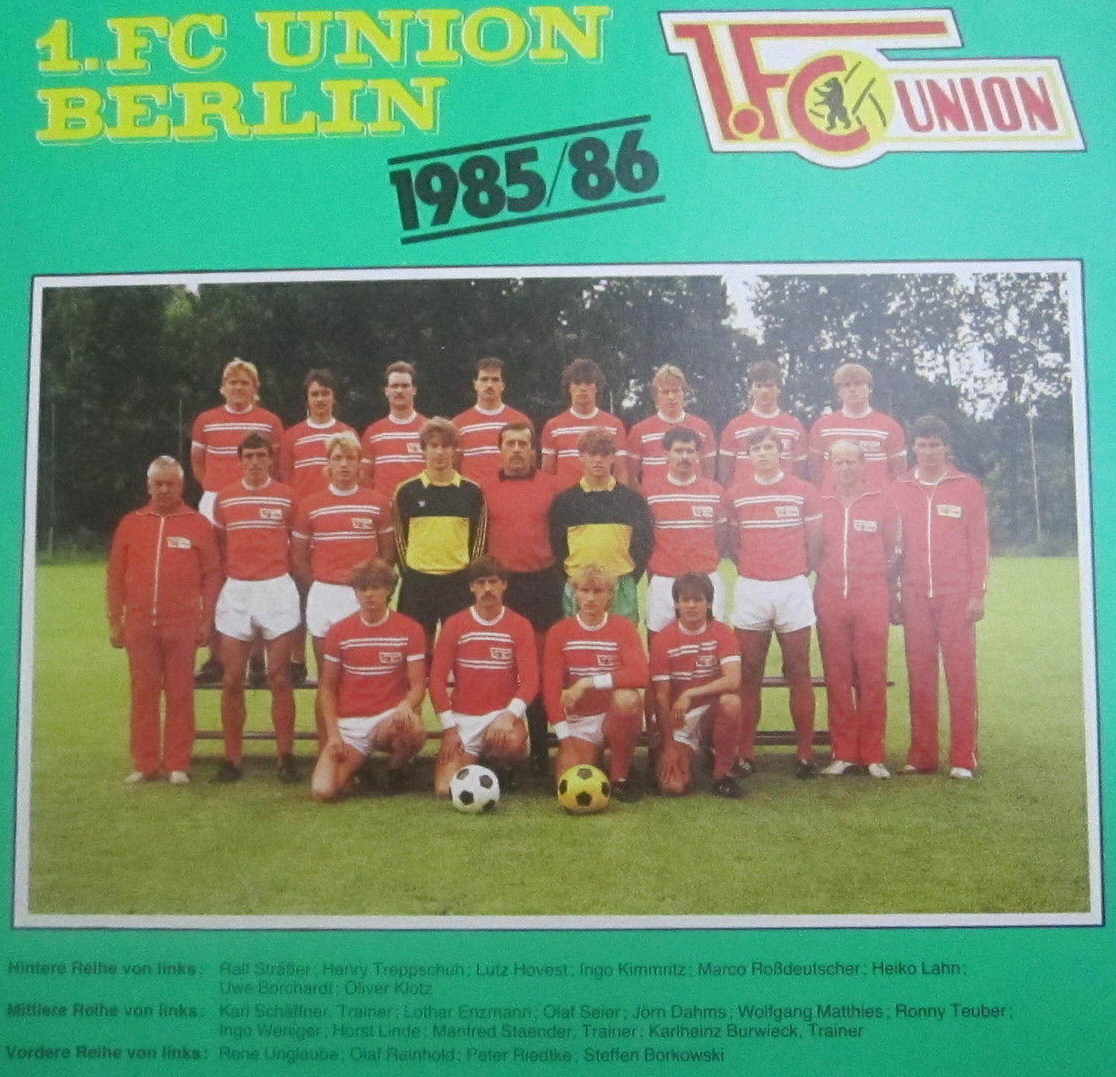 1.FC Union had wonderful season, but they mostly run on the excitement from winning promotion the previous year. They went far, very far, but when they faced superior squad at its peak… the difference in class was too much.
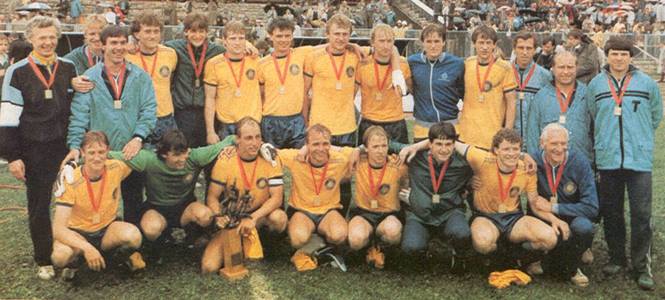 1.FC Lokomotive were at their peak presently and no wonder the season was great. Winning the Cup was no big deal really. It was their 4th Cup.
DDR I Division
First Division. At the very top – the same as ever. Dynamo (East Berlin) won as expected, although they were not dominant as usual. Whatever new happened, happened a bit down the table – this season the league was not sharply divided into 3 or 4 separate groups, but was fairly equal. Yet, FC Vorwaerts (Frankfurt/Oder) was in obvious decline and it was clear that the Army club was not going to restore its leading position in East German football. In the same time two smallish and traditionally weaker clubs pushed up – BSG Stahl (Brandenburg) and 1. FC Union (East Berlin). It may have been just an accidental strong performance, but the challenge to the status quo was refreshing.
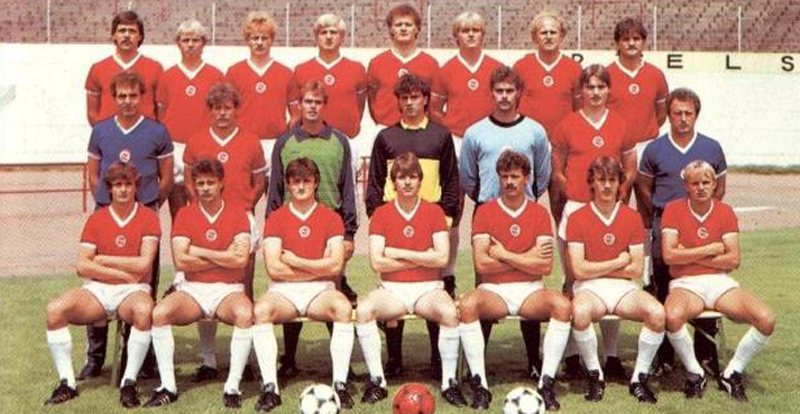
 BSG Sachsenring (Zwickau) continued old tradition – newly promoted teams immediately were relegated back to Second Division. They were sorry outsiders, earned 13 points and won just 2 matches. Interestingly, they had a national team striker in the squad: Martin Trocha.
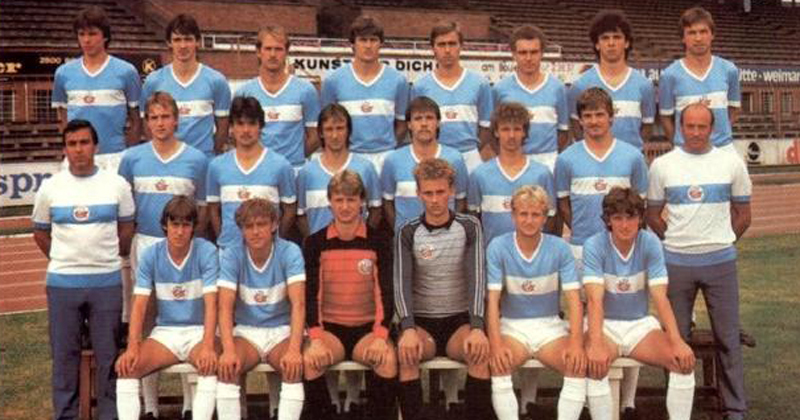
 FC Hansa (Rostock) lost the battle for survivel and finished 13th with 20 points. Well, a major star of the next decade played for them, but still young and unknown – and going to second level prsently.
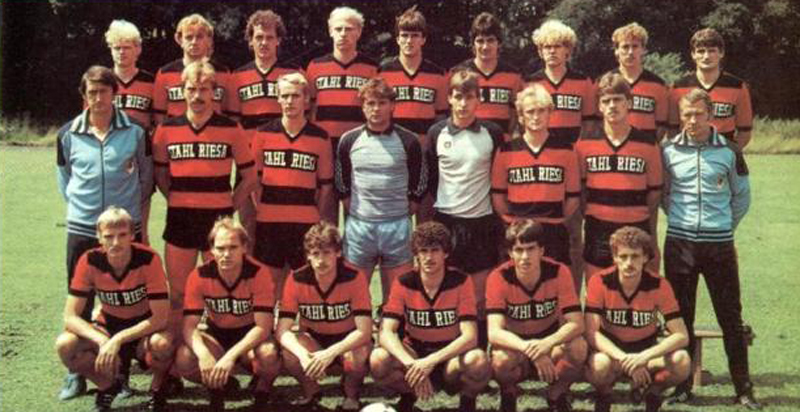
 With 22 points, BSG Stahl (Riesa) managed to survive. Which was pretty much all they could achieve. As long as they were not going down, it was great.
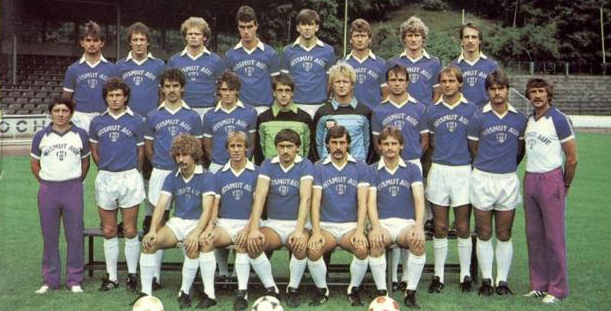
 BSG Wismut (Aue) – 11th with 24 points.
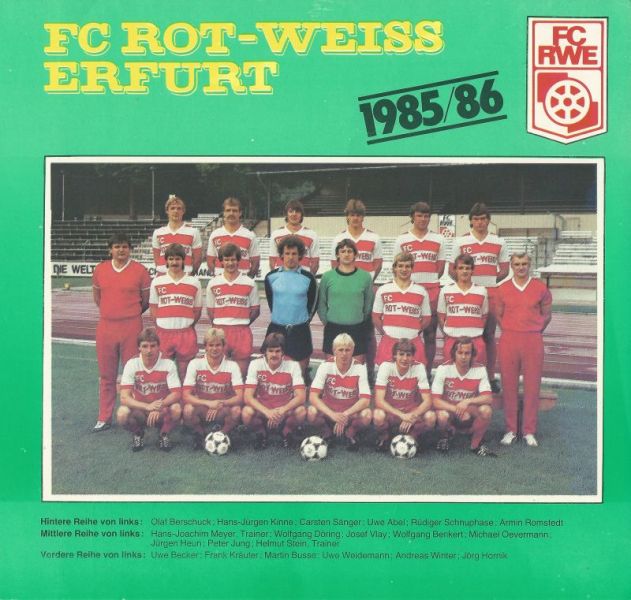 FC Rot-Weiss (Erfurt) – 10th with 24 points.
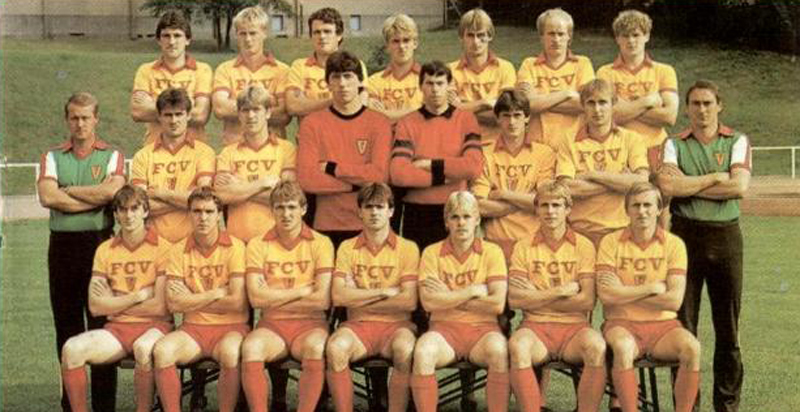
 FC Vorwaerts (Frankfurt/Oder) – quietly slipping down. 9th with 25 points.
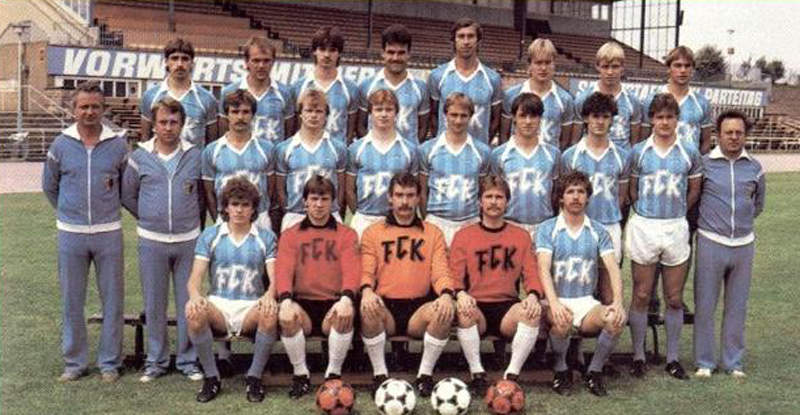
 FC Karl-Marx-Stadt (Karl-Marx-Stadt) – same as ever. 8th with 26 points.
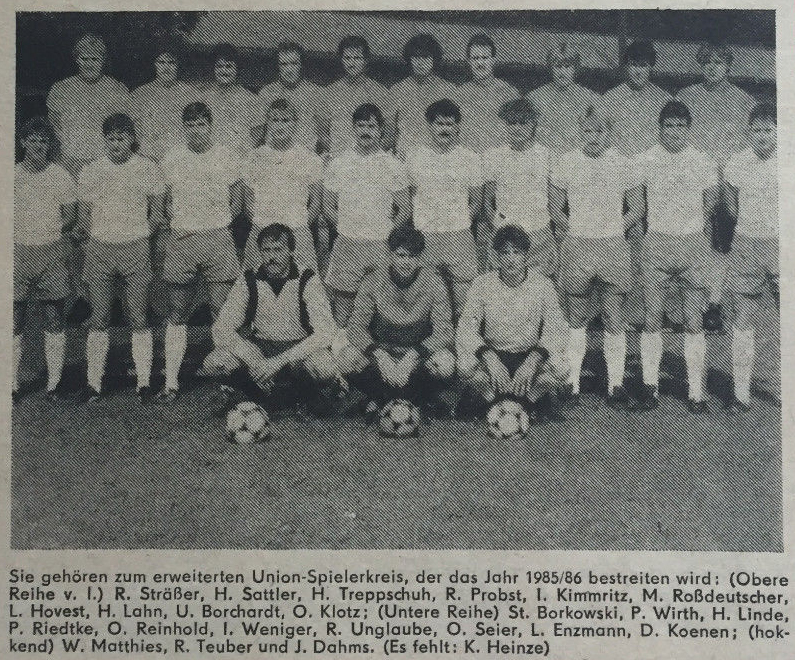 1.FC Union (East Berlin) – wonderful season for the newcomers: 7th with 27 points.
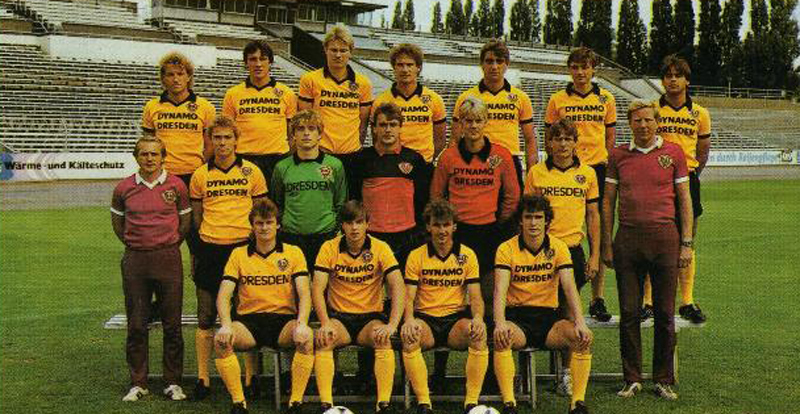
 SG Dynamo (Dresden) – 6th with 28 points. Surely an accidental slip, but still weak performance for a team with national team players.
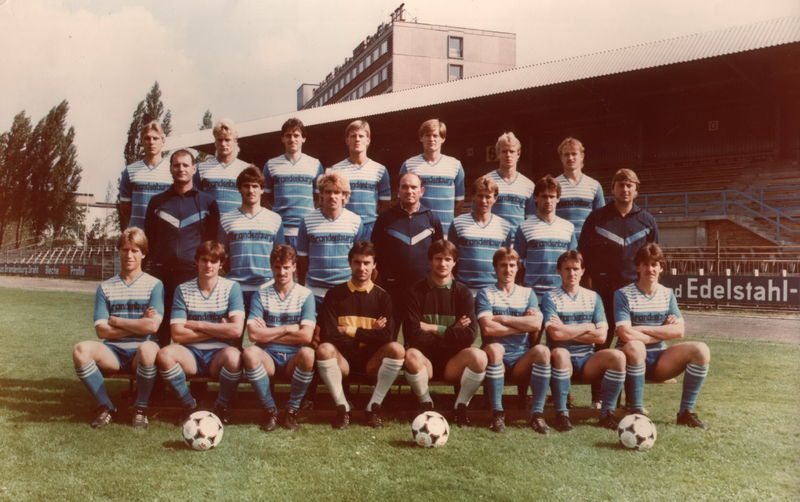 BSG Stahl (Brandenburg) – 5th with 29 points. Arguably, the biggest pleasant surprise this season. Top row from left: Frank Jeske, Michael Schulz, Peter Schoknecht, Jens Pahlke, Winfried Kräuter, Mike Wangerin, Holger Döbbel .
Middle row : Trainer Peter Kohl, Andreas Lindner, Ingo Nachtigall, Mannschaftsleiter Günter Boede, Roland Gumtz, Silvio Demuth, Co-Trainer Eckhard Düwiger.
Sitting: Eberhard Janotta, Uwe Kirchner, Frank Schulz, Detlef Zimmer, Hubert Gebhardt, Gerhard Kraschina, Eckart Märzke, Christoph Ringk,
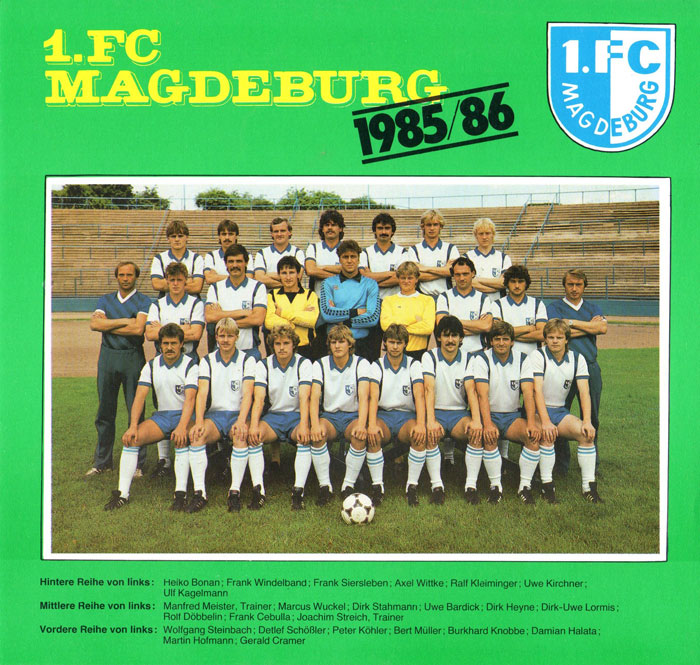 1.FC Magdeburg – 4th with 29 points. Important season for them – 3 key players retired, but the team dod not decline. The biggest loss was the all-time goalscorer of DDR Joachim Streich. Now the star was coaching them, which also seemed to be fine.
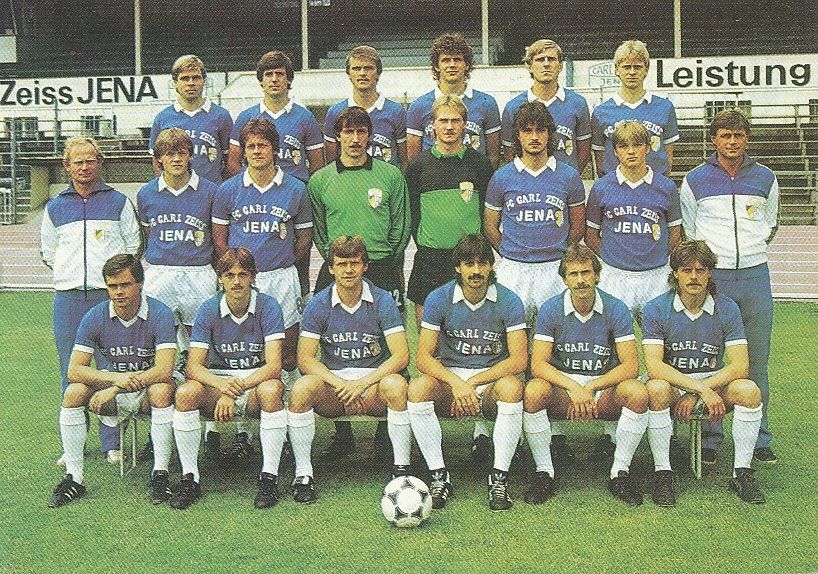 FC Carl Zeiss (Jena) – 3rd with 31 points. Coming back from brief decline and aiming for the title for the first time after 1980-81. Third row from left: Mathias Pittelkow, Jurgen Raab, Thomas Ludwig, Heiko Peschke, Andreas Bielau, Roeser.
Middle row: Jurgen Werner – assistant coach, Volker Probst, Henry Lesser, Karsten Hartel, Meixner, Srefan Boger, Lothar Kurbjuweit – coach.
Sitting: Wolfgang Schilling, Robby Zimmermann, Konrad Weise, Jorg Burow, Andreas Krause, Brauer.
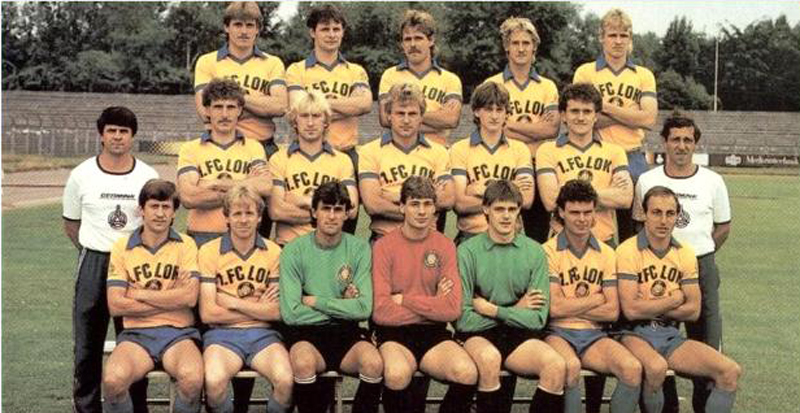
 1.FC Lokomotive (Leipzig) – 2nd with 32 points. One of their finest seasons, coming very close to winning the title. Yet, it was impossible task – and the familiar champions prevailed in the head-to head meets: 1-1 and 0-1.

BFC Dynamo (East Berlin) won its 8th consecutive title. It was not an easy victory this time, but they came on top of their opponents. 12 wins, 10 ties, 4 losses, and 46-31 goal-difference gave them 2 points more than the rivals from Leipzig – 34 points. Everything appeared to be fine – their second team won Group A of Second Division as well, but in the same time this was the title won with least points earned . They were unable to beat Carl Zeiss at all. But the team had 11 players with national team appearances, so nothing to worry about… with the mighty help of Stasi.
DDR II Division
DDR. In the UEFA club ranking of the year, East Germany was 12th, a high place not really corresponding to the general level of this country’s football. But it was also confirmation of the internal divides – 2 or 3 clubs were able to concentrate the best players in their squads and perform well on international stage. That has been for years and nothing changed, inlcluding the champion. But at lower level the season was quite extraordinary: the newcomers to the top division played unusually well and there was brand new second division champion – a club which never played top league football before. Meantime, the other second division group was won by a team, which could not be promoted – the second team of Dynamo (Berlin) – so the second-placed team was promoted instead.
Second Division, Group A. TSG Bau (Rostock) was last,
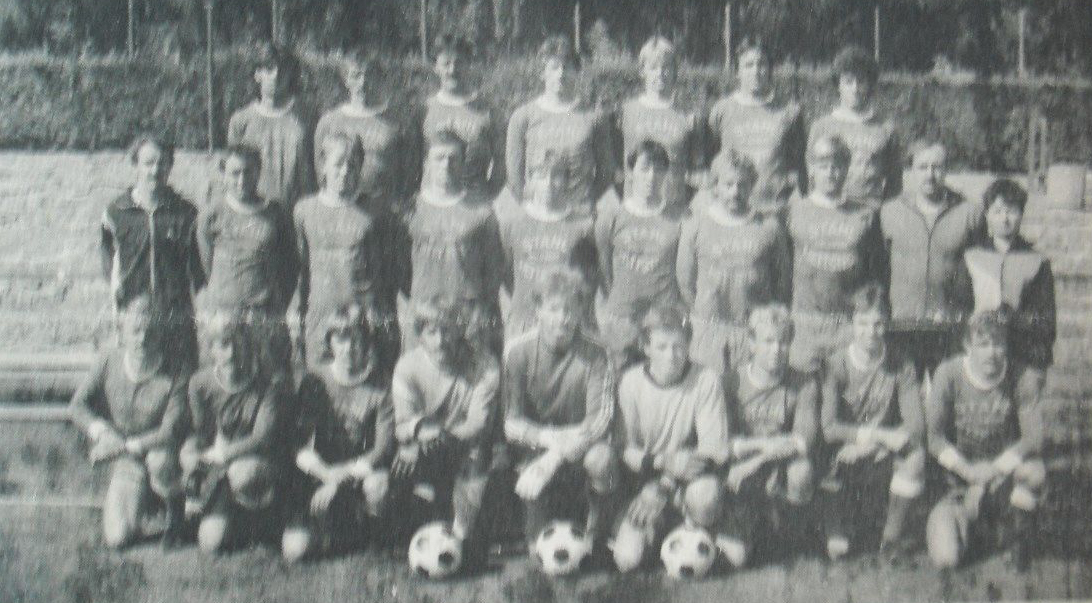 Stahl Walzwerk (Hettstedt) – 17th, and BSG Aktivist (Brieske-Senftenberg) – 16th. These were the relegated teams. Fairly gradual and equal situation up the table to the very top.
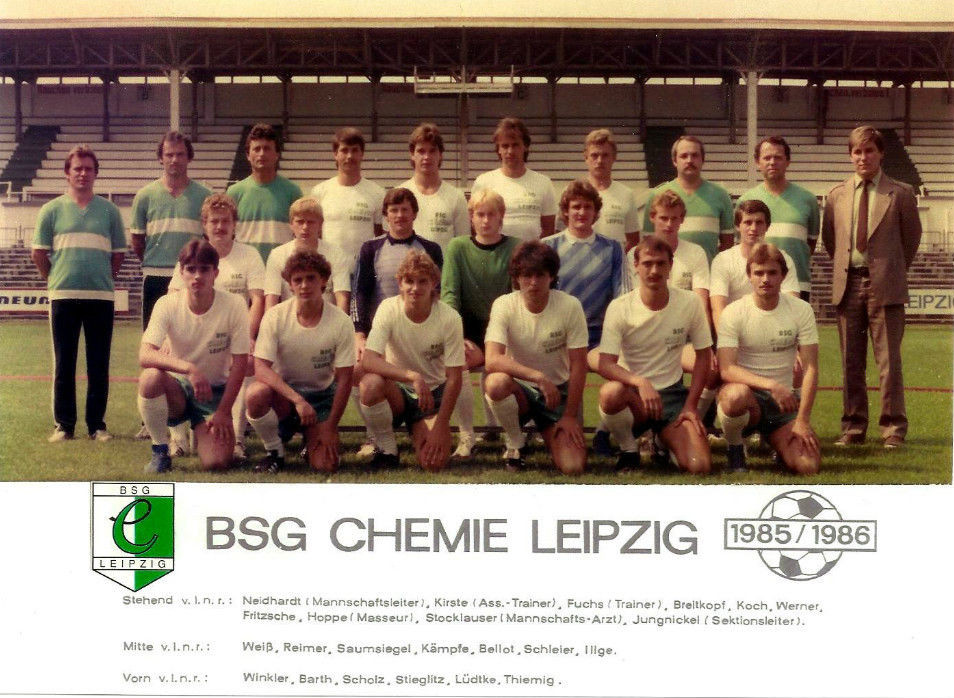 BSG Chemie (Leipzig) ended 3rd with 43 points. BFC Dynamo II (East Berlin) won the championship wiyh 46 points – but as a second team, they were ineligible for promotion.
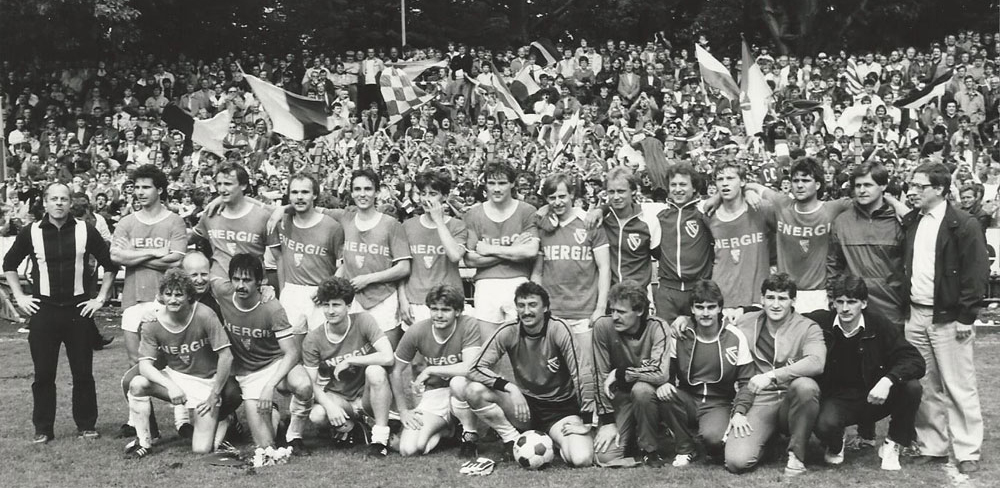 Which was great for BSG Energie (Cottbus) – they lost the batle for 1st place by one point, finished 2nd and were promoted. It was strong season for them anyway: they won most games in the league – 20 – and also finished with best defensive record, allowing only 30 goals in 34 games. Going back to top flight after their relegation in 1981-82.
Second Division, Group B. No drama here – one team was clearly stronger than the rest. Freshly relegated BSG Motor (Suhl) continued to be weak and finished 14th, nearly relegated even further down. Still, they survived – down to third level went BSG Wismut II (Aue) – last, Motor F.H. (Karl-Marx-Stadt) – 17th, and FC Rot-Weiss II (Erfurt) – 16th. The second team of Rot-Weiss lost its second division place on worse goal-difference.
At the top, BSG Chemie (Bohlen) was very distant 3rd with 39 points.
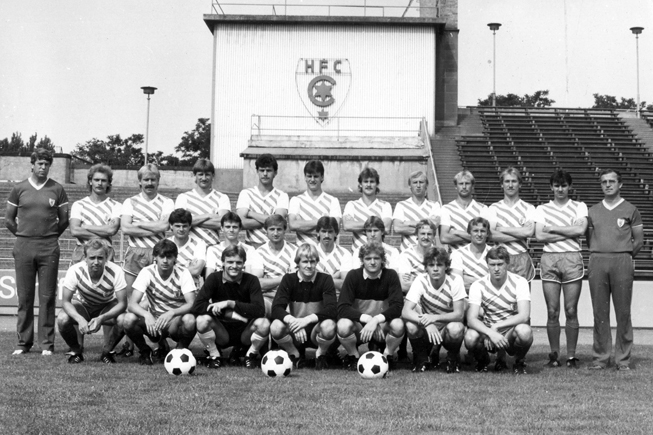 HFC Chemie (Halle) was comfortable 2nd with 47 points. But they did not challenge the leader.
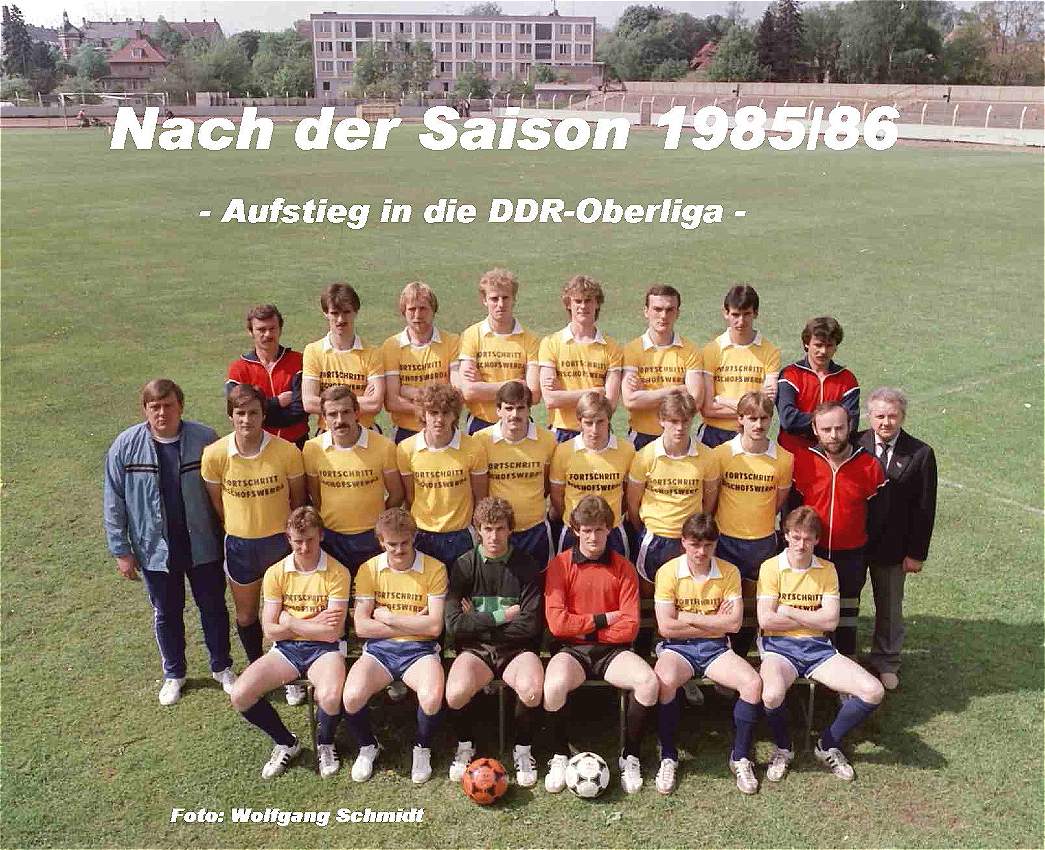 The group winner was a surprise – traditionally, freshly relegated from First Division teams got quick promotion back to top flight, but this season was different: BSG Fortschritt (Bischofswerda) dominated the championship and winning it with 52 points from 23 wins, 6 ties, 5 losses, and 61-23 goal-difference. The team attached to and named after tractor-making factory never played in the First Division. So far, they had been stable second-division team – most often finishing in the upper half of the table, but never among the best. It was great for them, of course, to go up. And their victory completed unusual second-division season – both groups had new winners and they were not former top-league members. Of course, the second team of Dynamo (East Berlin) could not be promoted, so by default Fortschritt was to be the only debutante in top flight next season.
Switzerland the Cup
The Cup final was both a reminder that there was no really strong team in Switzerland and success of the underdog. FC Sion and Servette reached the final, mid-table neigbours and nothing special this season, but ambition was not absent.
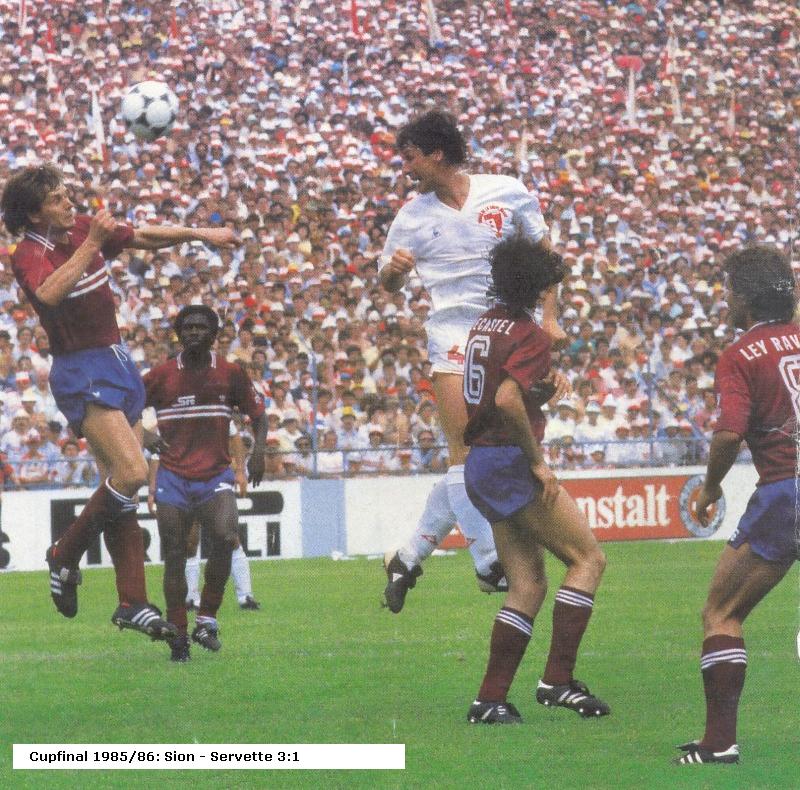 Servette wanted at least to save disastrous season, but it was not to be – they lost 1-3.
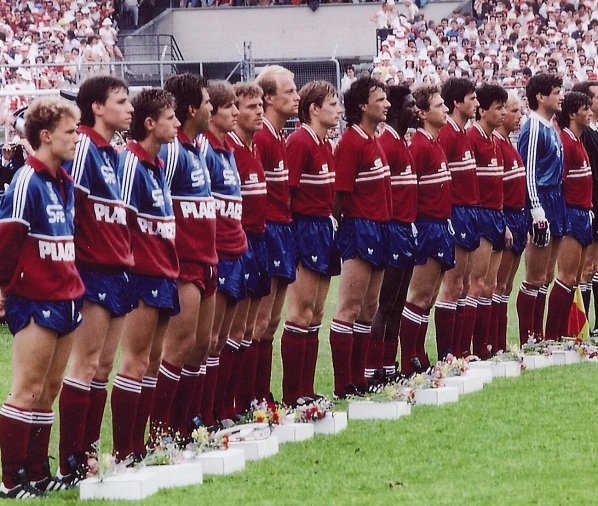 Frankly, Servette’s loss was not a great surprise – Swiss teams were always pretty equal, so it was difficult to speak of favourites and predict ‘sure’ outcomes. Yet, Servette won the title in the previous year and the squad was pretty much the same – thus, supposed to run for the Cup to safe its pride, if for no other reason. Given the squad, Servette should have been the winner – they had a handful strong players, perhaps more than any other Swiss club and certainly more than FC Sion, but… names do not win games.
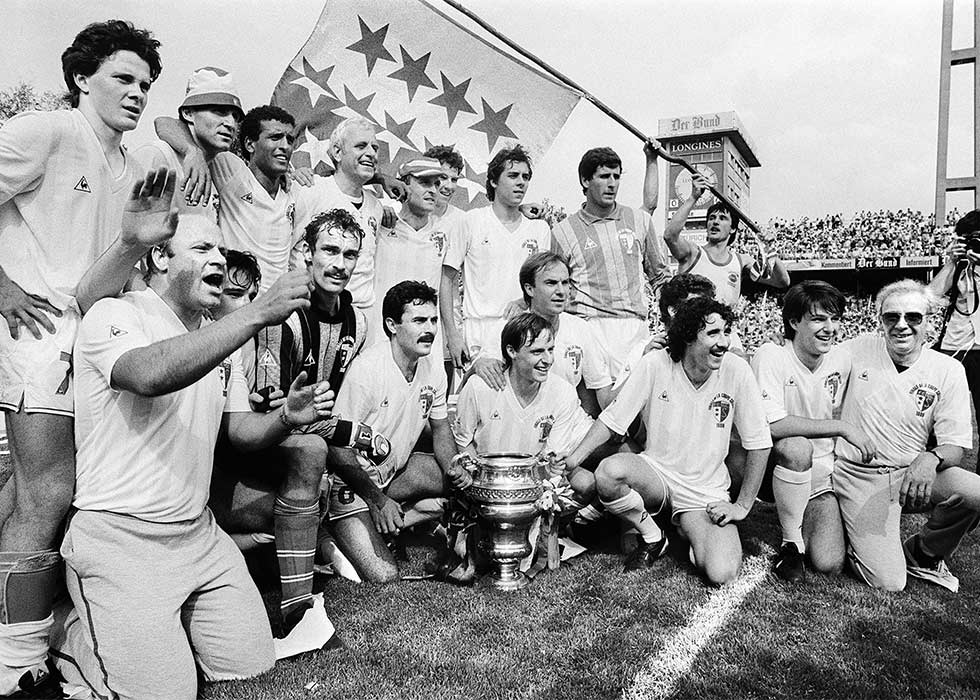 A great moment for FC Sion – and no surprise. A modest club, but a Cup specialist in recent years – this was their 5th Cup and third won in the 1980s, beginning in 1980. Lovely victory and more than enjoyable moment.
Switzerland I Division
First Division. Too many outsiders, but at the top it was a battle between equals and no favourites. Thus, to some extend, the winner was a surprise.
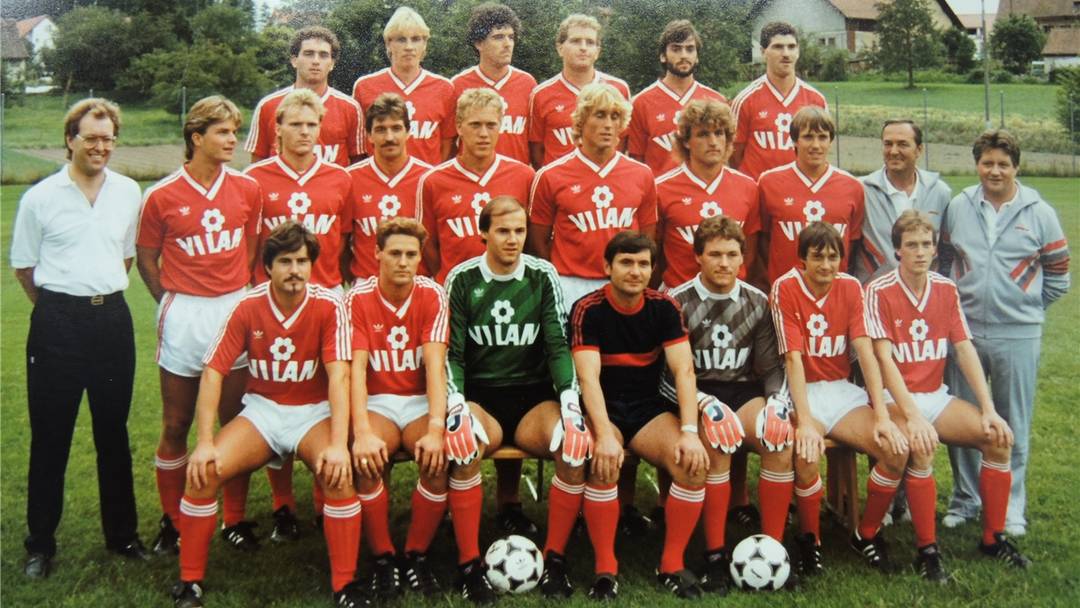 FC Baden – not just an outsider, but an outsider compared to the other outsider. They earned only 8 points and won just 1 match! Last and relegated, of course.
FC Grenchen – 15th with 16 points, relegated.
Vevey-Sports – 14th with 17 points.
FC La Chaux-de-Fonds - 13th with 18 points.
FC Wettingen - 12th with 24 points.
FC St.-Gallen - 11th with 30 points. Way above the last 5 teams – that was the sad reality in the Swiss league.
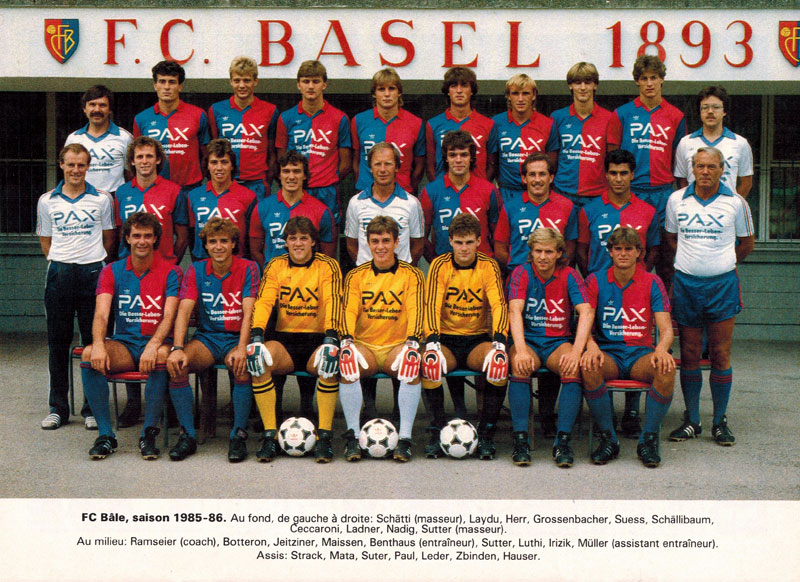 Miserable season for FC Basel - 10th with 30 points. Never even in theoretical danger of relegation, but maybe their worst season in the last 20 years.
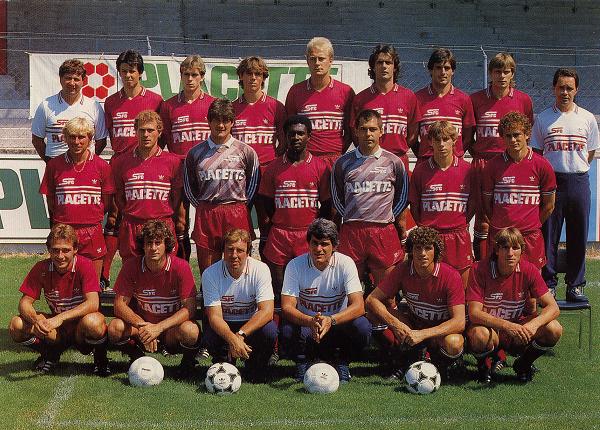 Servette FC – 9th with 31 points. Considering they won the 1984-85 championship... what a drop down.
Top row from left: Charles Andre, Lucien Favre, Laurent Jaccard, Alexandre Stefanovic, Mats Magnusson, Michel Decsatel, Silvano Bianchi, Alain Geiger, Eric Burri.
Middle row: Robert Kok, Rainer Hasler, Erich Burgener, Samuel Opoku N`Ti, Philippe de Choudens, Pascal Besnard, Bent Christensen.
Front: Robert Ley-Ravello, Michel Renquin, Paul Garbani, Jean-Marc Guillou, Marc Schnyder, Gilbert Castella.
Servette FC – 9th with 31 points. Considering they won the 1984-85 championship... what a drop down.
Top row from left: Charles Andre, Lucien Favre, Laurent Jaccard, Alexandre Stefanovic, Mats Magnusson, Michel Decsatel, Silvano Bianchi, Alain Geiger, Eric Burri.
Middle row: Robert Kok, Rainer Hasler, Erich Burgener, Samuel Opoku N`Ti, Philippe de Choudens, Pascal Besnard, Bent Christensen.
Front: Robert Ley-Ravello, Michel Renquin, Paul Garbani, Jean-Marc Guillou, Marc Schnyder, Gilbert Castella.
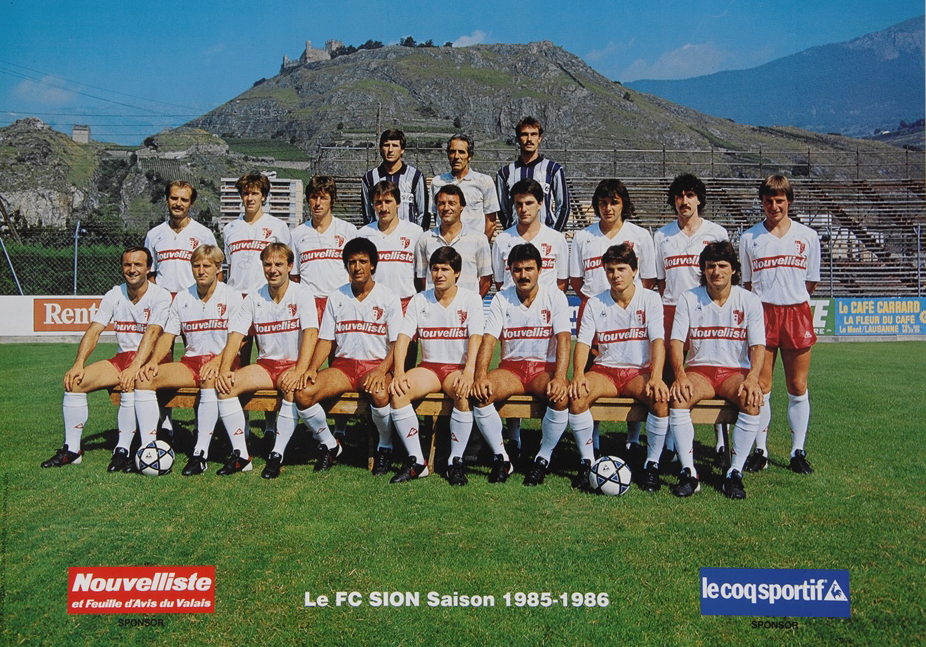 FC Sion - 8th with 33 points.
FC Aarau - 7th with 34 points.
Lausanne-Sports - 6th with 35 points.
Grasshopper - 5th with 38 points.
FC Zürich - 4th with 39 points.
FC Sion - 8th with 33 points.
FC Aarau - 7th with 34 points.
Lausanne-Sports - 6th with 35 points.
Grasshopper - 5th with 38 points.
FC Zürich - 4th with 39 points.
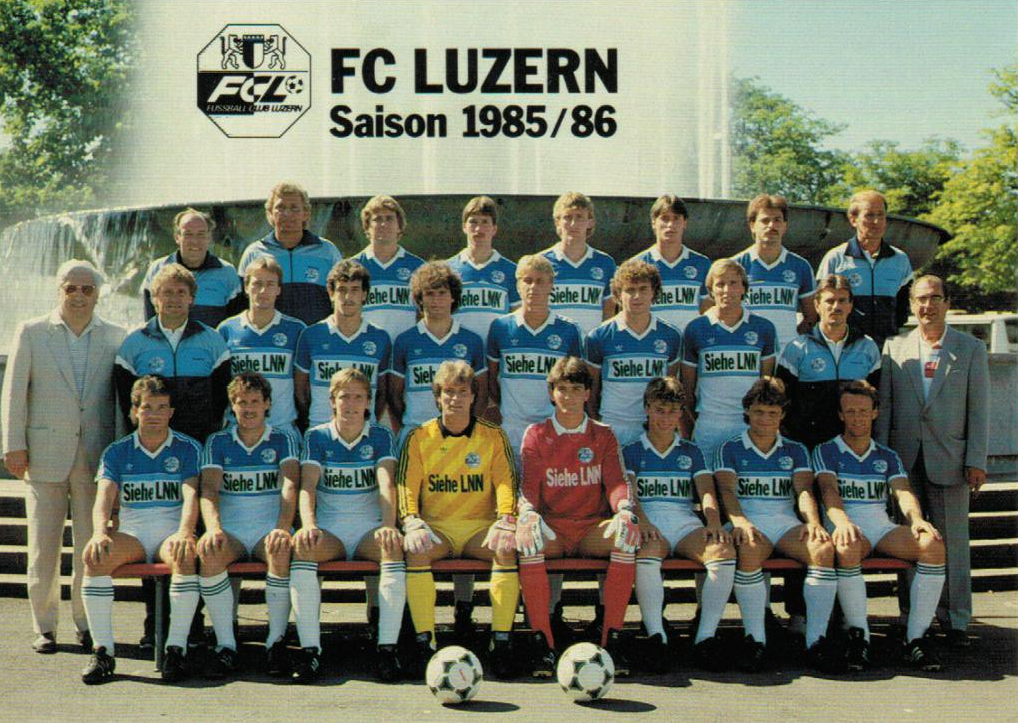 FC Luzern – 3rd with 41 points.
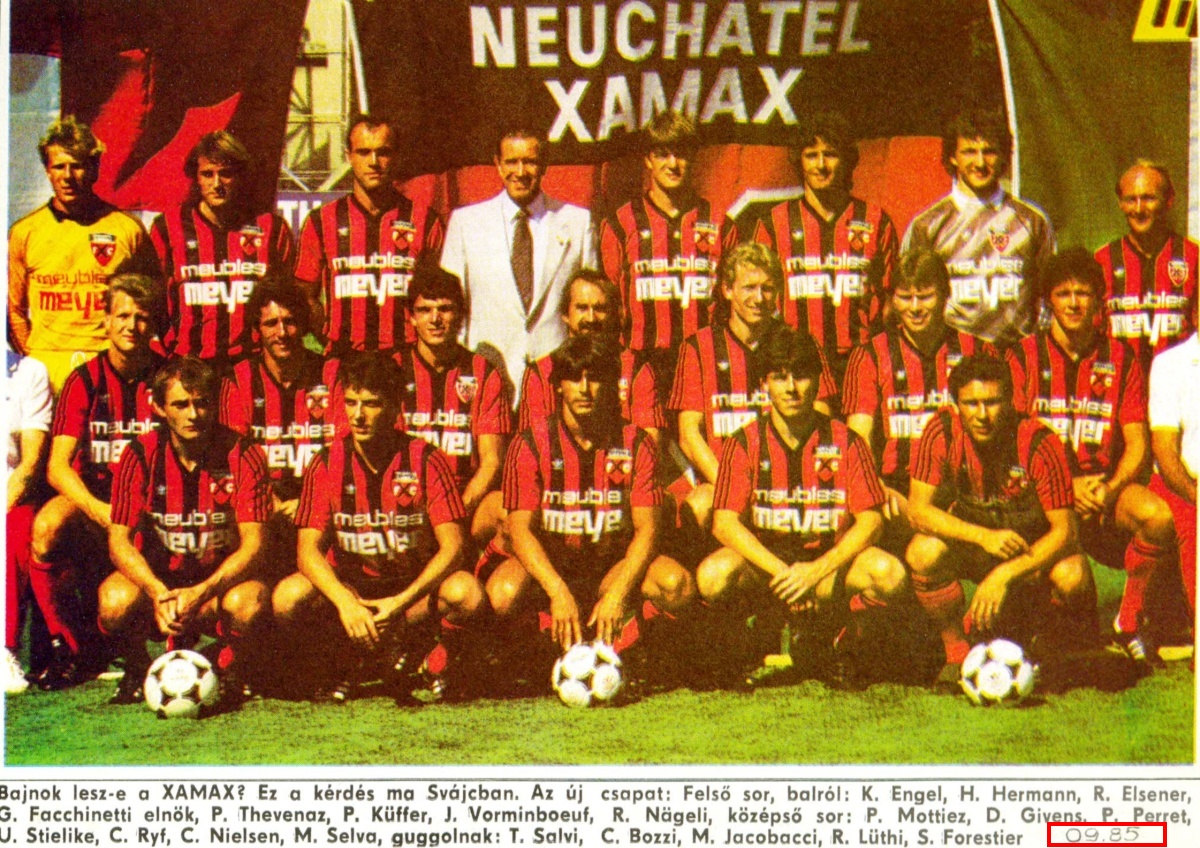 Xamax - 2nd with 42 points. Perhaps the only club ascending in the last 2-3 years and now a title contender.
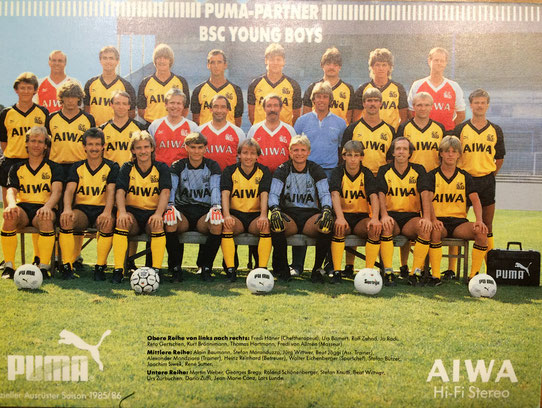 BSC Young Boys (Berne) somewhat surprisingly won the championship with 44 points from 18 wins, 8 ties, and 4 losses. 72-28 goal-difference - 2nd best strikers, best defenders. To a point, Young Boys took advantage from the current weakness of Grasshopper, Basel, Servette, and even FC Zürich and won a race between more or less equals, which is alwaysa bit chancy. But they were persistent and consistent, so nothing to be said against them – the team was winning and not losing. A modest team... few players appeared briefly for Switzerland (Bregy, Weber), Polish striker Joachim Siwek had long, but not for big clubs, career in the West, The Egyptian midfielder Youssef Radi was naver called to play for his country, the young Danish striker Lars Lunde called attention to himself exactly this season – and went to play briefly for Bayern thanks to that. The only big name in the team was the Swedish midfielder Robert Prytz, who joined Young Boys in the beginning of 1986 and played in the spring half of the season. Success was achieved with remarkably modest squad.
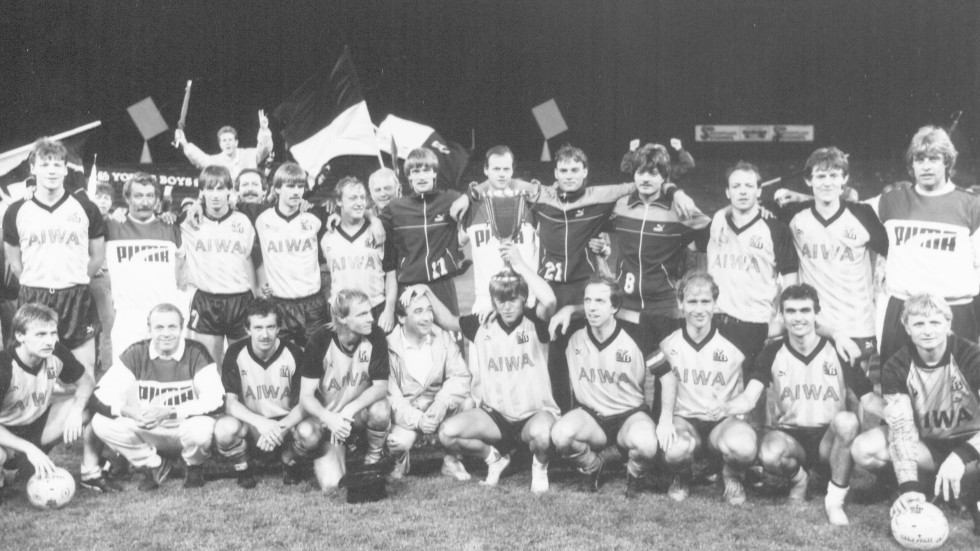 It was a grand moment for the club and its supporters – Young Boys won its 11th title, but had to wait for it a quarter of a century! The 10th title came in 1960 and they were without a trophy for almost 10 years, lastly winning the Cup in 1977. Still, Young Boys was the third most successful club in Switzerland behind Grasshopper and Servette and the victory was perhaps a beginning of golden period - nothing like that was going to happen, but it was still wonderful to have a cuurent victory and not to be some old, but faded glory.
Switzerland II Division:
Switzerland. Domestic concerns, primeraly: it was difficult to adjust to harsh reality. The country would not support demands of modern football. It was plain to see in the championship: perhaps only 11 clubs in the top league were relatively fine, the rest were clearly weaker. And among the better ones there was rather weakening of the usual top clubs. Since there was no limitless cash and the national pool of players was small, no club was actually able to build truly great squad. Experiments with the championship structure were already tried and did not work. Return to traditional leagues was not working either… impasse. In the past the limited domestic pool was helped by imports – never great, but at least Swiss clubs were able to get good players in good numbers. Now even this sourse was cut short – other countries offered better prospects to foreign players, so options shrunk and what was left was mostly veterans – Xamax went up partly thanks to his foreign imports, but Stielike was here only to play his last games in peace and Don Givens was practically forgotten now, having his best time a good 10 years earlier. It was a sad comment on the state of Swiss football that Xamax went to the top with such help.
It was worse in the second level: only 4 teams were quite decent and the rest… just made the numbers.
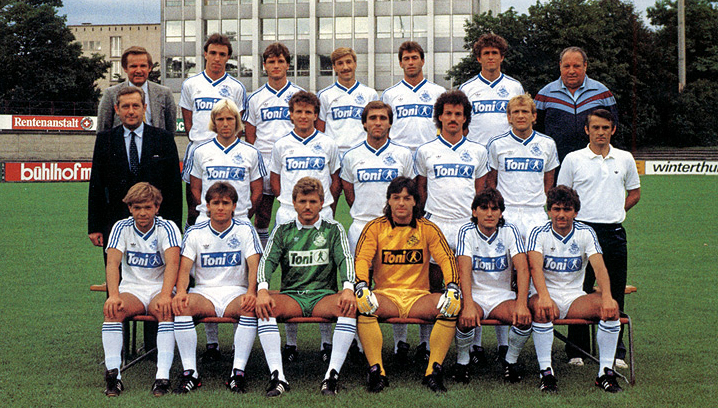 Winterthur was one of those making the numbers – once upon a time a solid top-league member, now – 6th with 31 points in Second Division. Top row from left: Viktor Frank (President), Thomas Unseld, Reto Arrigoni, M. Haller, Mauro Bunkofer, Ulrich Tschanz, Ernst Rief (Masseur).
Middle row: Dr. Bruno Peter (doctor), Thomas Staub, Urs Egli, Hans Franz, Daniel Haefeli, Christian Schleiffer, Hans Kodric (coach).
Sitting: Vladimir Jakovljev, Kevin Streule, Walter Christinger, Stephan Lehmann, Rafael Chèlos, Rolf Müller.
Chiaso was above them – 5th with 35 points – but they were not match to the leaders either. Only 4 teams were really stronger and possibly near the first division teams. Chenois ended 4th with 41 points.
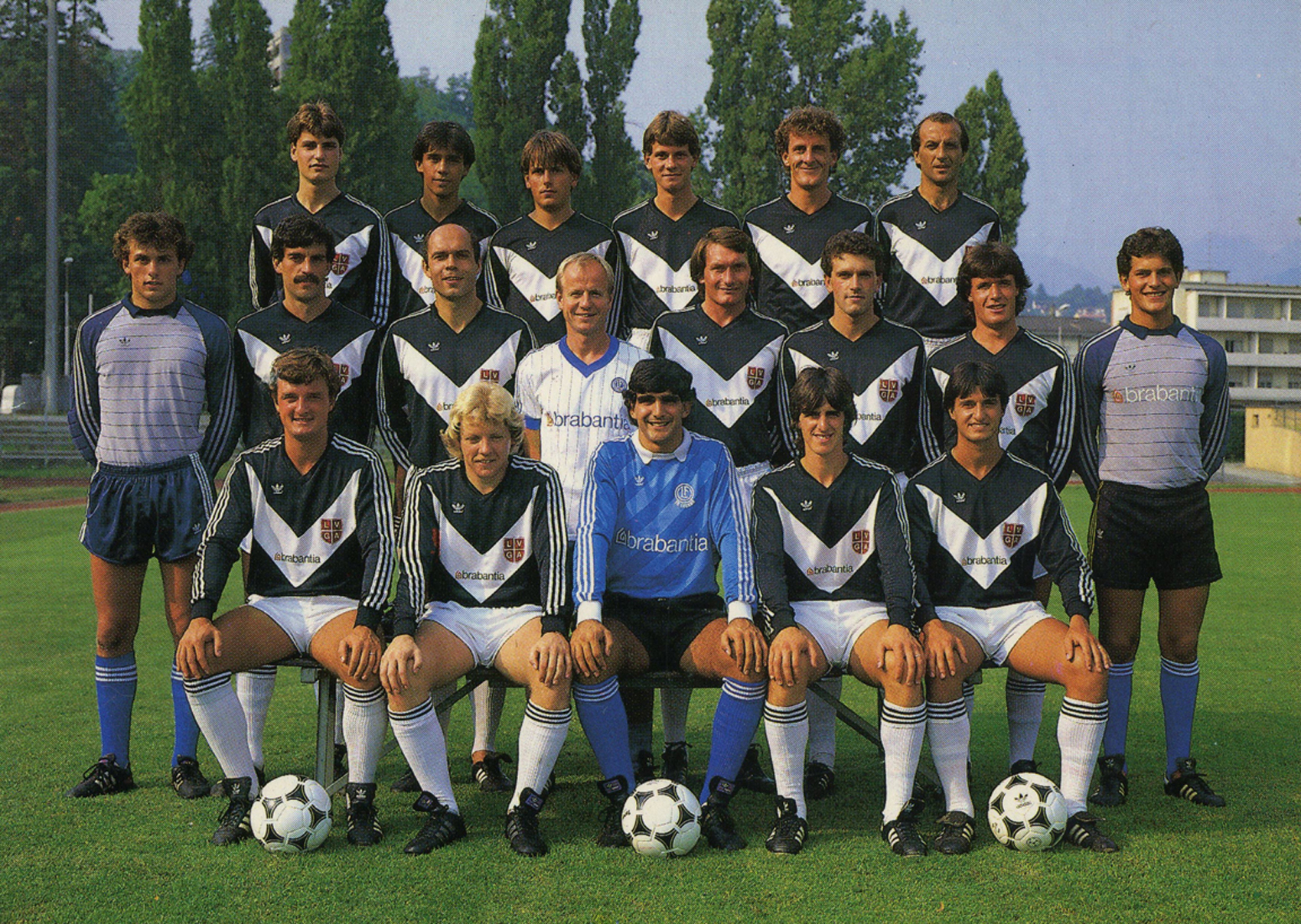
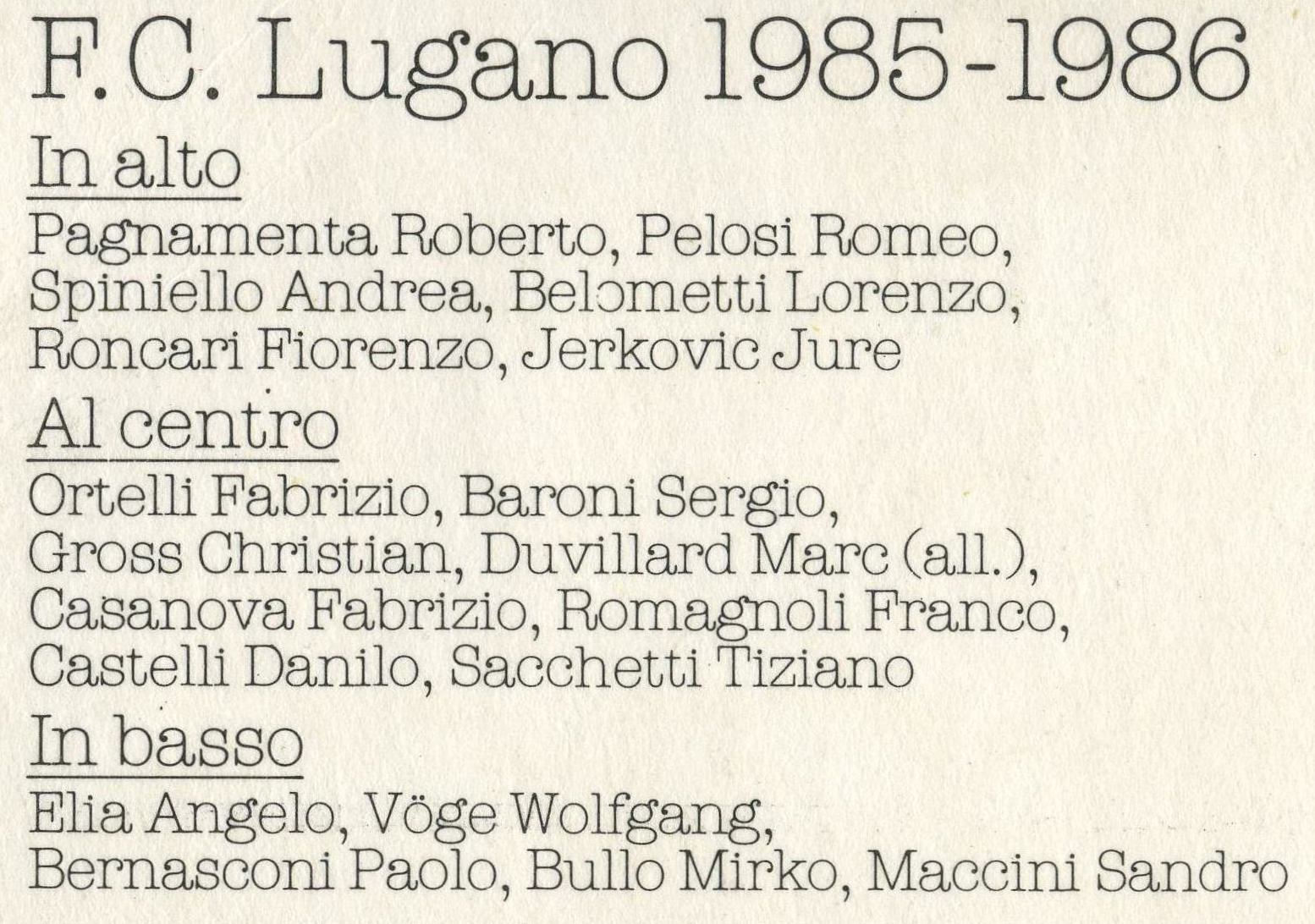 FC Lugano ended 3rd with 43 points. Jure Jerkovic was playing his last days in it – arguably, the only well known name in the league this season.
 AC Bellinzona lost the battle for first place on worse goal-difference, finishing with 45 points.
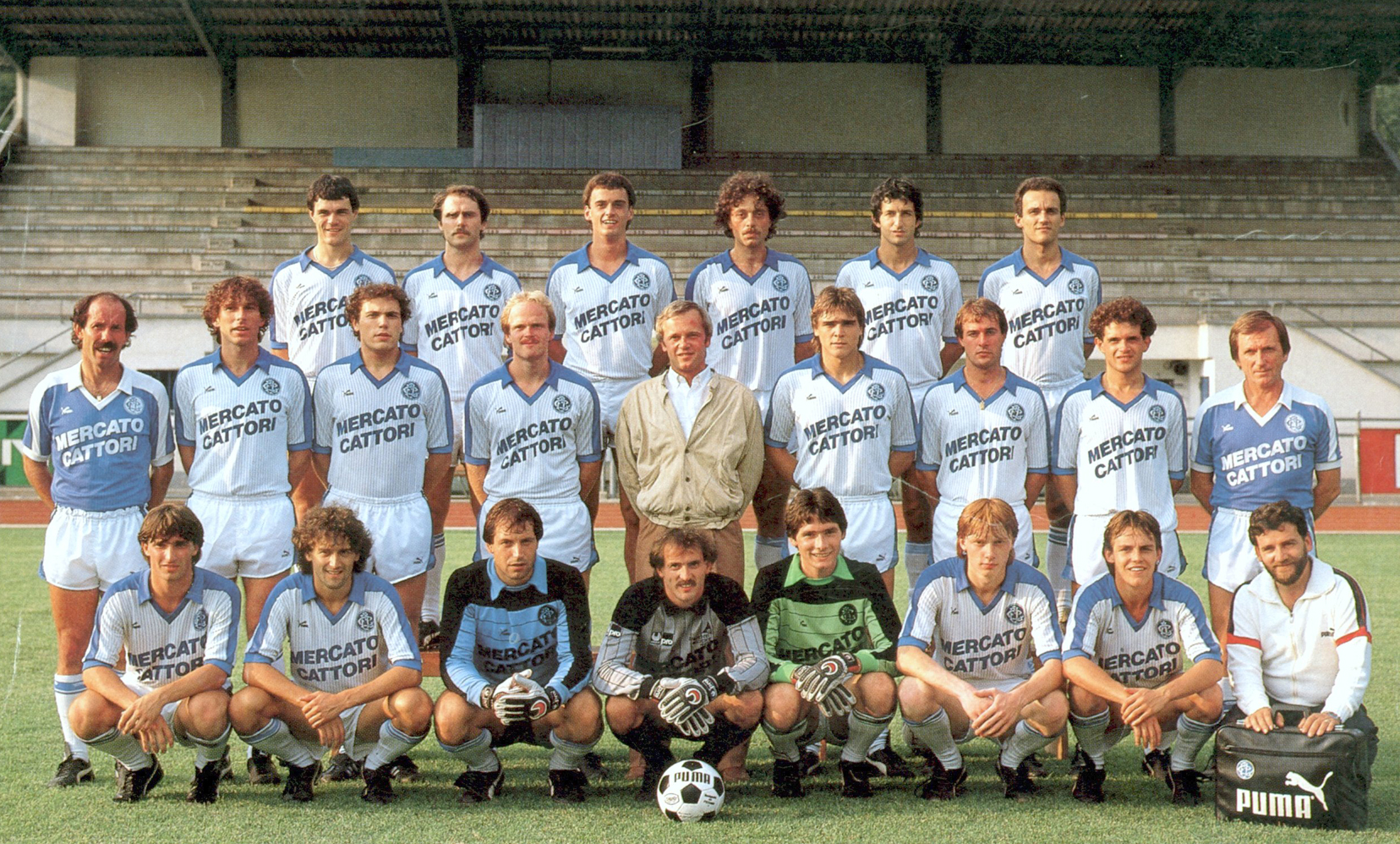 FC Locarno clinched the Second Division title thanks to better goal-difference: they had 45 points like Bellinzona – 20 wins, 5 ties, 5 losses, 96-33. Great scorers, no doubt about it, and they provided the club with +63, twice better than Bellinzona’s +34. Crouching from left: Michele Volentik, Enrico Giani, Mauro Benzoni, Armando Rossi, Michele Nicora, William Fornera, Thomas Bachofner, Carlo Bianchi – masseur.
Middle row: Antonio Chiandussi – coach, Claudio Gilardi, Jean-Jacques Frutiger, Winfried Kurz, Michele Pedrazzini – president, Caryl Facchinetti, Nazzareno Zanoli, Augusto Favero, Sandro Molnar – assistant coach.
Top row: Pierluigi Tami, Fabio Chiappa, Bertrand de Coulon, Mauro Alini, Michel Guillaume, Bruno Abaecherli.
In general terms, the final standing was a trimph of attacking football over defensive one – Bellinzona excelled in cautious, defensive-minded game and lost only 3 games, but they scored rarely as a consequence – but it hardly mattered. The important thing was promotion and both Bellinzona and Locarno went up.
Greece the Cup
The Cup final was the classic derby – Olympiakos vs Panathinaikos – but rather on paper only. Panathinaikos was too strong and won 4-0.
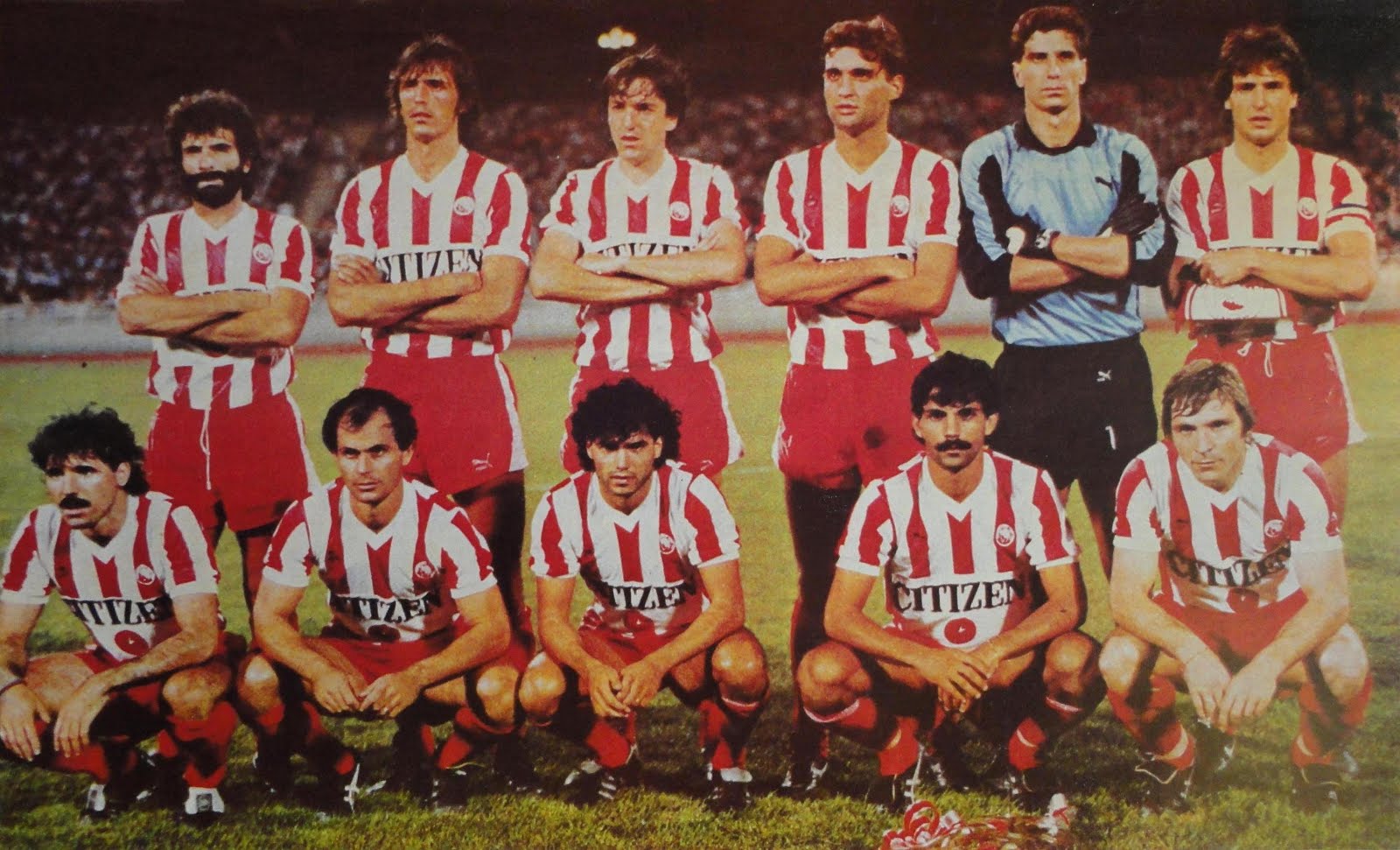
 Disappointing season for Olympiakos, but they had only themselves to blame for the failure to win anything. For some reason, the squad was not very good and really needed urgent reinforcement. And they were going to be done, for Olympiakos without trophies… it was a hard slap on the face.
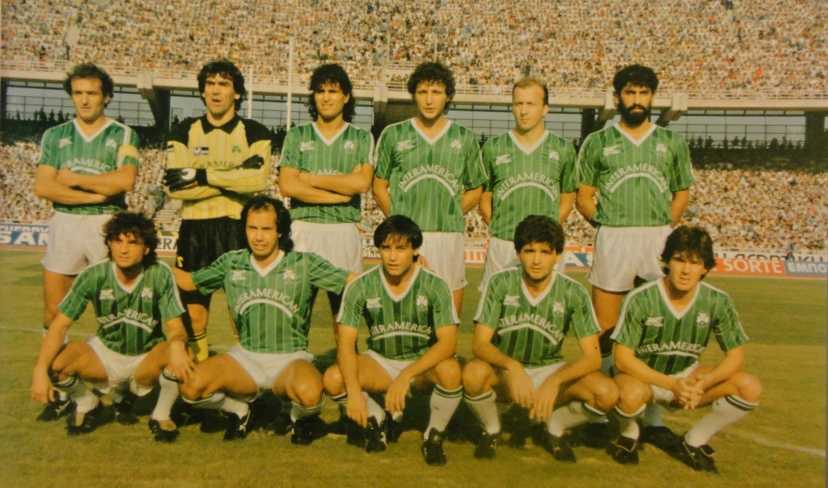
 Excellent season, finished with a double, but there was much to be desired – this team had only 2 great stars: Saravakos and the Yugoslav former national team star Zajec. Not enough for a club with Panathinaikos’ pretencions. Especially on the international level. But this was concern for the summer transger period. Presently, 14th title and 9th Cup were collected.
Greece I Division
First Division. With first place ‘reserved’ for dominant Panathinaikos, the battles for 2nd place and escaping relegation were the thrill.
Panachaiki (Patras) – last with 20 points and relegated.
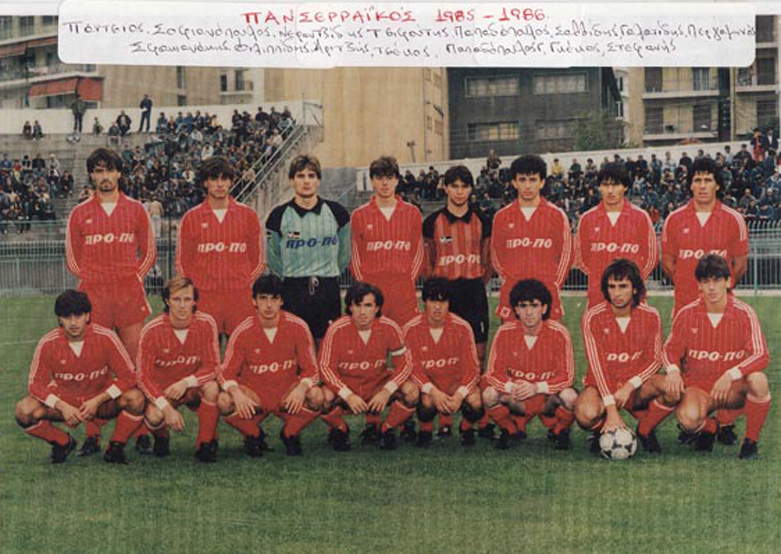 Panserraikos (Serres) – 15th with 24 points. Lost a battle between 5 teams on worst head-to-head record and relegated.
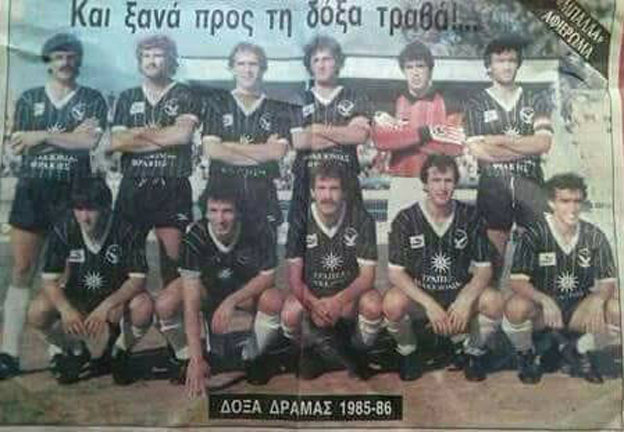 Doxa (Drama) – barely escaped relegation: 14th with 24 points.
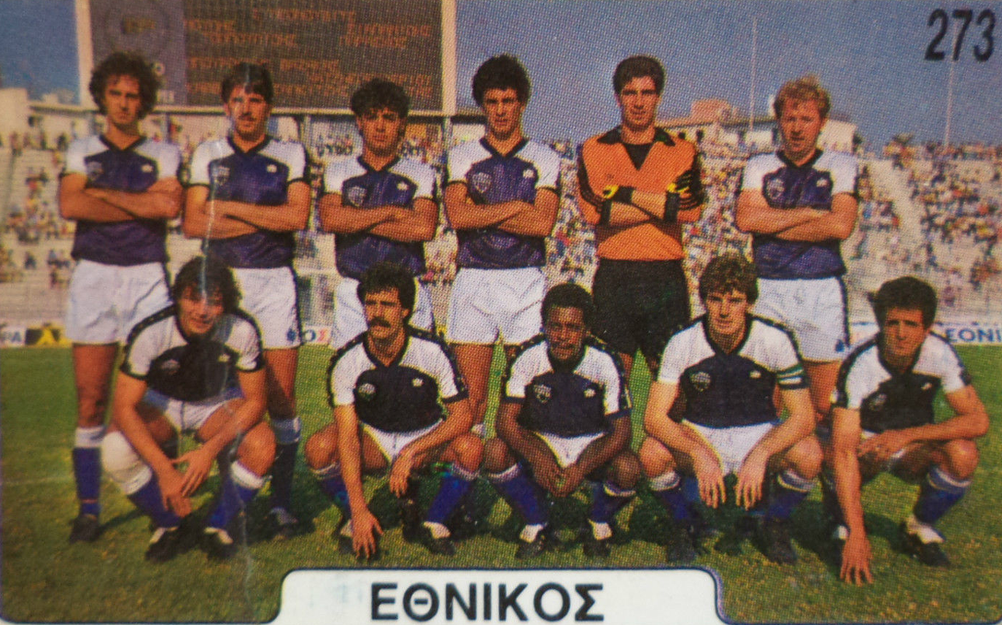 Ethnikos (Piraeus) – also lucky survivor: 13th with 24 points.
Apollon (Athens) – 12th with 24 points.
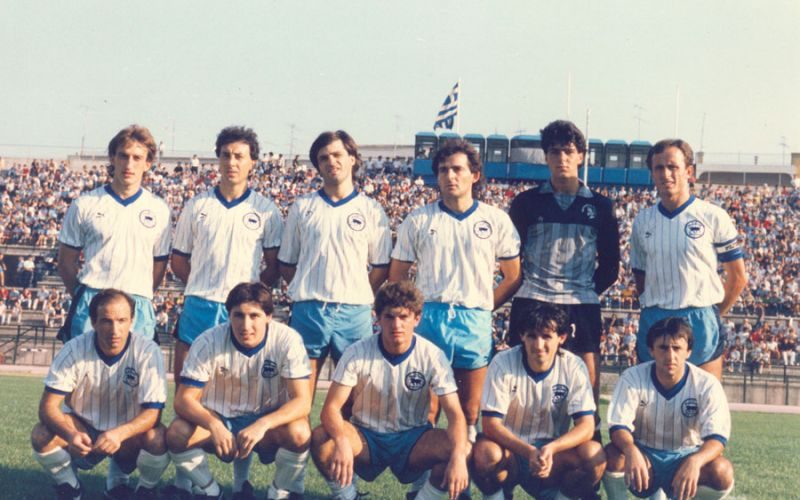 PAS Ioannina (or Giannina, depending on sourse) – 11th with 24 points.
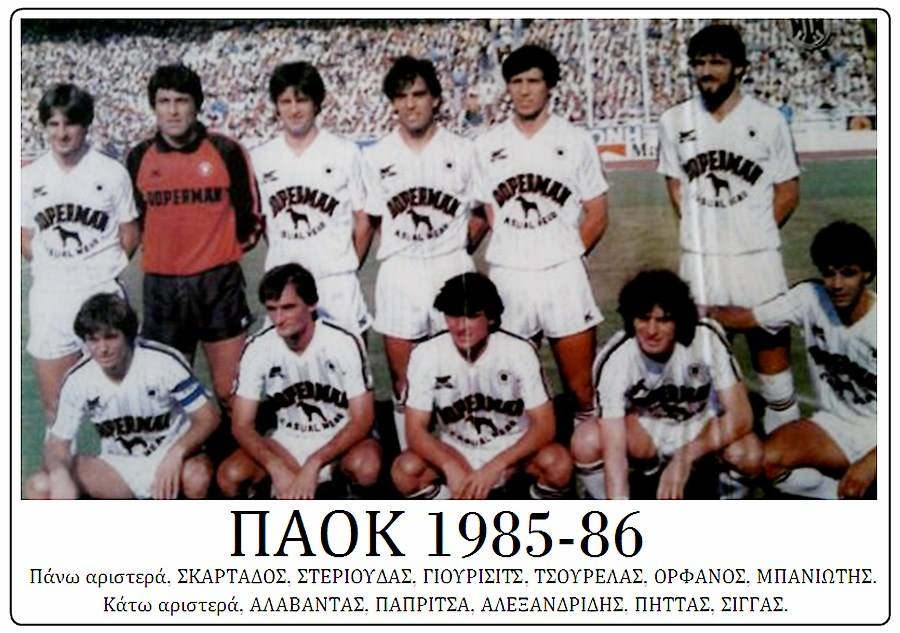 PAOK (Thesaloniki) – waht a plunge. The champions of the previous year were not 10th with 27 points.
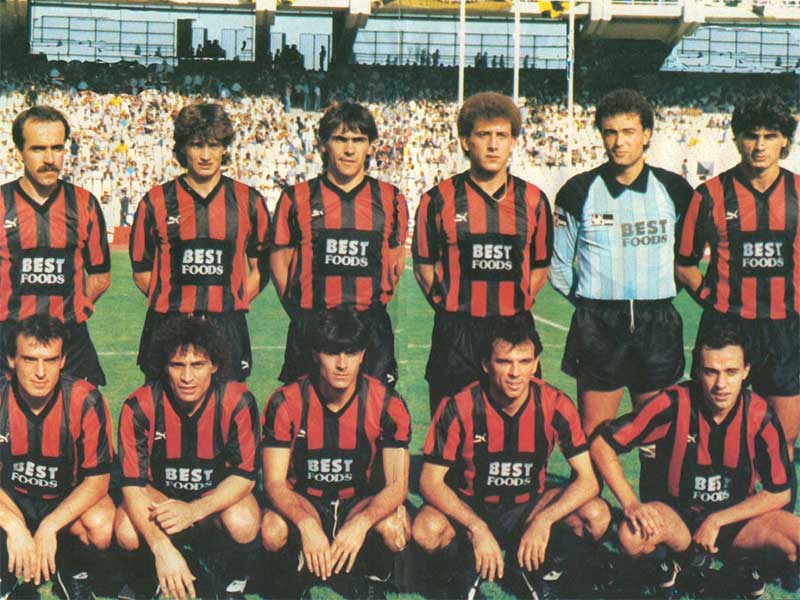 Apollon Kalamarias (Thesaloniki) – 9th with 28 points.
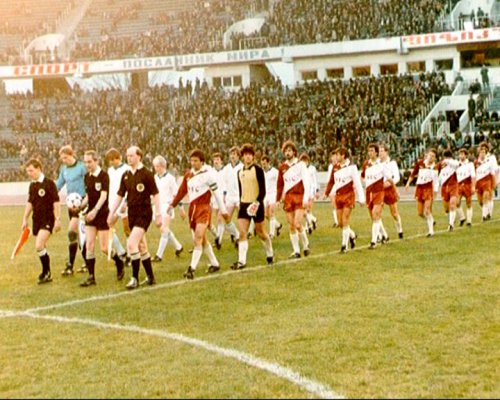 AE Larissa – in moave kit – 8th with 30 points.
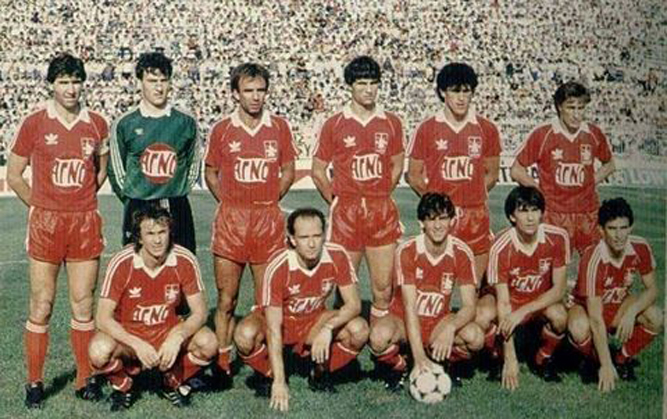 Aris (Thesaloniki) – in their reserve colours – 7th with 33 points.
Panionios (Athens) – 6th with 34 points. One of the teams which lost the race for 2nd place.
Olympiakos (Piraeus) – miserable season. 5th with 34 points.
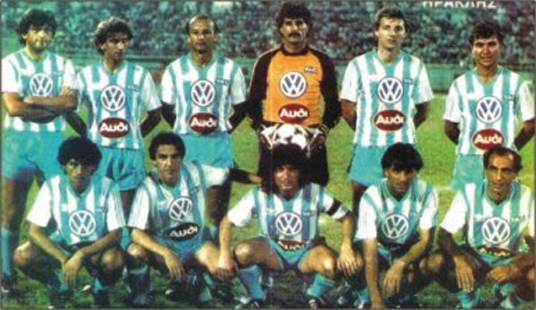 Iraklis (Thesaloniki) – one of their strongest seasons, but only 4th with 36 points at the end.
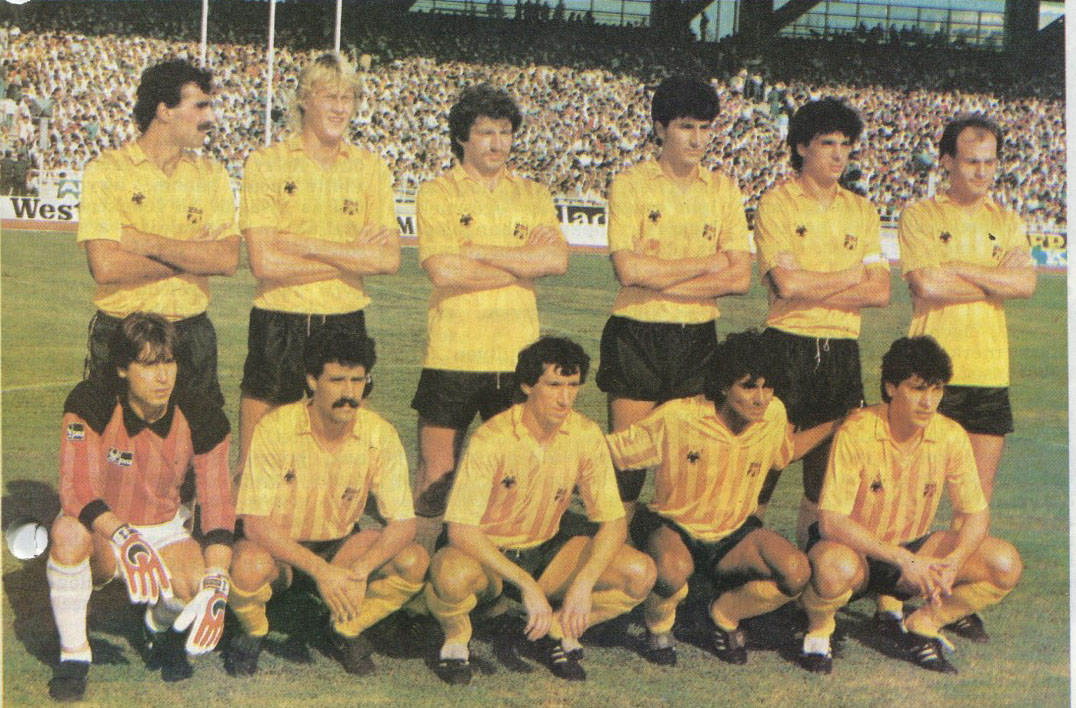 AEK (Athens) – clinched 3rd place with 36 points and thus secured UEFA Cup spot.
OFI (Iraklion) – 2nd with 38 points. Arguably, their best season ever. They were ascending for quite some time and that was pretty much their peak – bested more illustrios team in the race for 2nd position, but unable to challenge the leaders.
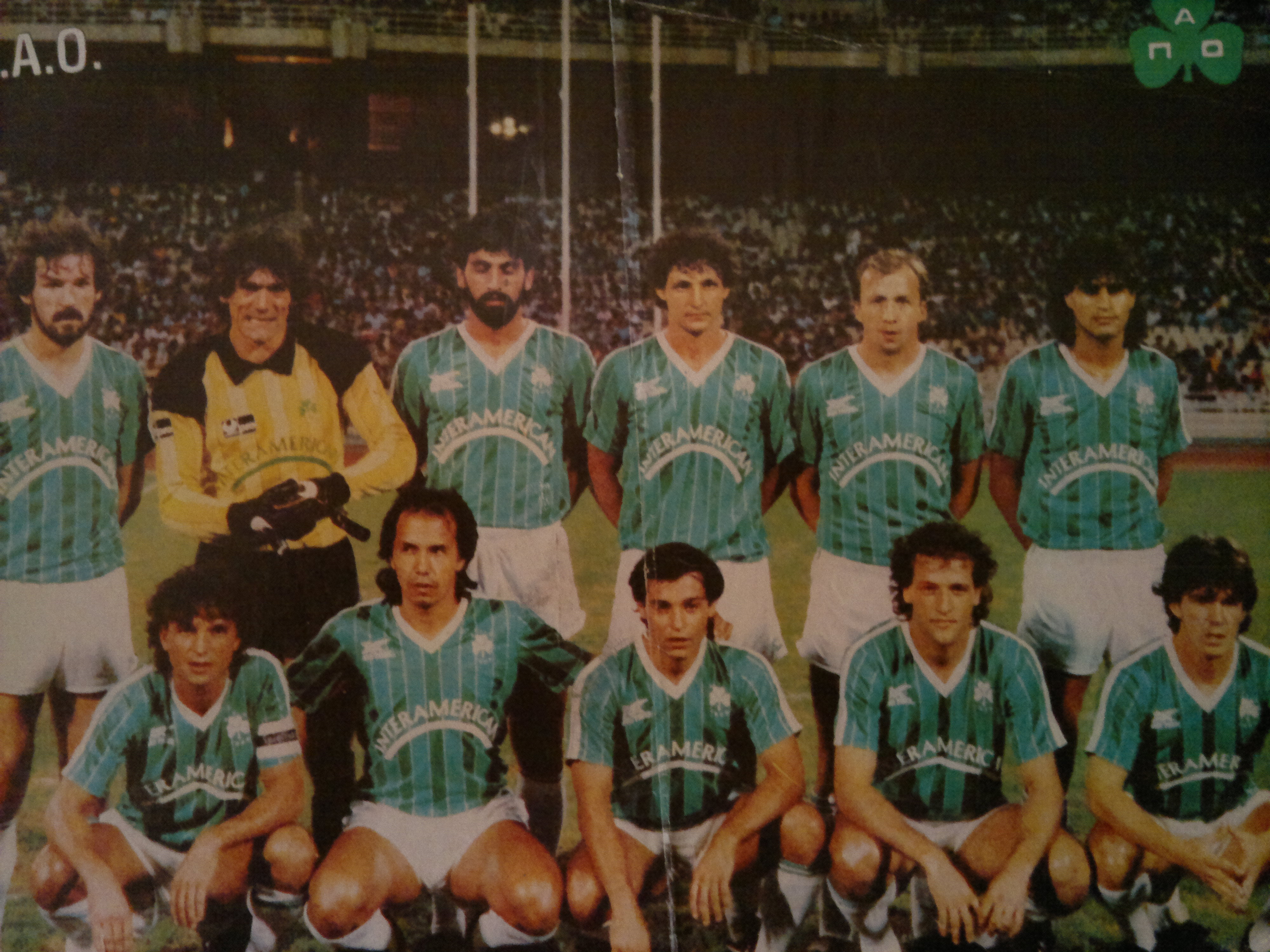 anathinaikos (Athens) was unriveled and easily won the title with 43 points from 18 wins, 7 ties, 5 losses, and 58-26 goal-difference. Perhaps not the best squad in the history of the club, but still having stars in top form and collecting one more title.