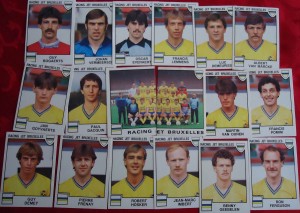
England the Cups

The Cups – one final was pleasant contest between underdogs and the other simply continued the Liverpool rivalry. The Football League Cup final opposed Queen’s Park Rangers to Oxford United. QPR eliminated Liverpool at the semi-finals and overall was the likelier winner, having tradition and stronger squad in its favour. But this is England… In front of more than 90 000 fans, little Oxford practically destroyed QPR: 3-0!

QPR had stronger squad and desperately needed trophies, but trophies are to be won and winners score goals. Let say, it was wonderful achievement reaching the final.
Oxford was a pure delight – may be they did not play great football, may be they had rather anonymous squad, but victory of the underdog is always delightful. And it was very confident victory, nothing chancy – a triumph of commitment and desire.

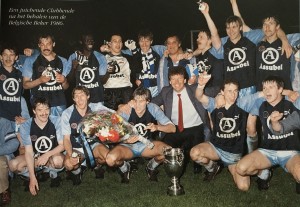
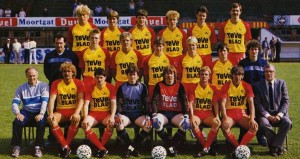
Of course, Oxford was not going to win any more trophies, so the winners deserve a second look – the great team Oxford United ever had. The best moment in their history.

The FA Cup opposed Liverpool to Everton. Never-ending battle… Perhaps here the whole difference between the two rival clubs was fully displayed: Liverpool won 3-1. No matter how hungry Everton was, Liverpool was hungrier. And, overall, classier…

Everton lost twice to Liverpool this year and finished the season emptyhanded. However, it was not that much the lost tournaments, but the perspective – what works against Everton’s myth of stunted development is the fact that Liverpool usually prevailed over this very vintage of Everton: Liverpool prevailed in the 1983-84 League Cup final, they prevailed in this final, they prevailed in the championship. That is, Liverpool was getting the upper hand against this excellent Everton’s squad. Everton was a bit weaker…

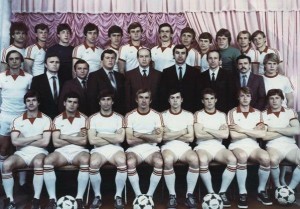
Liverpool with double this season. Beating Everton twice. Simply great. Standing from left: Kenny Dalglish, Bruce Grobelaar, Alan Hansen, Mark Lawrenson, Gary Gillespie, Ian Rush, Kevin McDonald. First row: Jim Beglin, Steve Nicol, Craig Johnston, Ronnie Whelan, Steve McMahon. It is always good to see who was sitting on the bench – otherwise the might of Liverpool could not be truly grasped. And that was the big difference between them and Everton… Liverpool was much deeper, had very strong and experienced players in the back. Even banished from European football Liverpool was not slowing down. On the other hand… it was quite boring to see Liverpool win year after year.

England I Division

First Division. At the bottom, two teams were quite inferior to the league in general. At the top a battle between 3 clubs for the title, one of them quite surprising and perhaps incidental. The real battle was in Liverpool and was exciting to the very end of the season.
West Bromwich Albion – last and relegated with 24 points. Good times were over, downhill now.

Birmingham City – 21st with 29 points. Quite the expected – relegation was traditionally the likelier outcome.

Ipswich Town – lost the battle for survival between 7 teams and was relegated: 20th with 41 points. Like WBA, their strong period ended and now was going down fast.

Leicester City – barely survived: 19th with 42 points.

Oxford United – 18th with 42 points. Mere survival could be end of terrible season for another club, but for Oxford it was wonderful result – after all, they were modest club, playing for the first time among the best. It was not only that, though – this season was the best ever!

Coventry City – the eternal survivors. 17th with 43 points.

Aston Villa – 16th with 44 points. Their success a few years back was pretty much accidental one-time affair, it was quite clear at the time, so going down was hardly a surprise. They were losing players, not piling up talent: the predicament of poorer clubs.

Manchester City – 15th with 45 points. The prime goal – to stay in the league after their fresh return – was achieved, but building formidable team and restoring the leading position they had about 15 years ago was unlikely to happen. It was a matter of life or death only.

Southampton – 14th with 46 points. Their strange approach of getting few big-name veterans every year sooner or later was going to misfire. And it did – after few seasons in the top of the league they found themselves trying to avoid relegation.

Queen’s Park Rangers – 13th with 52 points. Not worried by possible relegation and even having good season, but the team was a bit uneven and hardly able for something better than midtable existence.

Watford – 12th with 59 points. Doing well actually, for a small club like them would not challenge the leading clubs for long. Now the surprise was gone and they settled in the middle of the league. It was great.

Newcastle United – 11th with 63 points. No miracles were expected from them and no miracles happened, but here was the future, already protruding in the grim present of the mid-80s: Paul Gascoigne and Peter Beardsley. A club like Newcastle cannot be blamed for having two vastly talented strikers and nothing else, though.

Tottenham Horspur – 10th with 65 points. Perhaps they were praised too much in the recent years and that somewhat blinded management: the squad was not truly great, it needed additional strong players, but remained unfinished. It reached its peak already, it was not going to go higher. The Spurs were not going to win a championship, that was certain.

Great season for Luton Town, perhaps their best ever – 9th with 66 points. But it was also an accidental one. Unfortunately, Luton was modest club.

Looking at the names here, this squad should have been able to do much better than 8th place and 68 points. Clough may have been a genius, but his much repeated excuse – that the team won everything and lost motivation for there was nothing else to concur – was lame: he had very strong squad and to end a bit ahead of Luton Town was not even routine, but a disaster. But Nottingham Forest did not have money, traditionally was a modest club, thus even the fans easily forgave. Too bad, really – the slow decline already started.

Arsenal – 7th with 69 points. Underachievers, that was what they were for many, many years.

Chelsea had second consecutive strong season after coming back from second division darkness – again 6th, but this time with 5 points more than the previous year: 71. However, it did not look like real comeback and even less like rapidly developing club – the squad was ordinary at best and running on adrenalin. Unlikely to stay among the top clubs for long.

Sheffield Wednesday – 5th with 73 points. Now, this was a team in good shape and having strong period. Perhaps not expected to become a title contender, but nearing its peak and bright.

Manchester United – 4th with 76 points. One looks at this squad and wants to cry – so much talent and not even a title contender. Year after year – nothing. Ron Atkinson must go…

Surprising and wonderful – West Ham United run for the title and came close to winning it. 3rd with 84 points at the end. Looking at the squad and one understand why they lost the title race: inferior squad compared to the other candidates. A freak accident at best, one time wonder. It was so nice the Hammers challenged the mighty, but… they did not have the real power.

With West Ham short on great talent, the real battle for the title happened in Liverpool – a clash between old local rivals, one at its peak and the other… well, the other was on its peak for something like 25 years.

Eventually, Everton lost the race by 2 points and finished 2nd with 86 points. Naturally, club and fans were more than disappointed, but with time excuse was found: Liverpool was blamed for stunting their development. Sky was the limit, goes the story, often repeated to this very day, and Everton was on the road to concur the world, but because of the Liverpool’s fans English clubs were banished from international football and thus Everton’s wings were viciously clipped off. Speculations cannot be proved with fact, though… as good as this Everton vintage was, the club historically had only sporadic strong periods. It is also questionable how would Everton fare in the changing reality of football – to keep and improve a strong squad… it was a big matter of policy, money, and competing with rich Italian and Spanish sharks. Liverpool had great tradition built already, almost uncanny ability to sell and buy at the right moment and very successful string of home grown managers – Everton did not have anything similar at its hands, so it was not that much a minute matter of who won or lose one championship, but long-term vision and ability to put it to practice. However, Everton was here to stay – they had great team, they worked on reinforcement.

It was not easy, but the end was… routine: one more title for Liverpool. 26 wins, 10 ties, 6 losses, 89-37 goal-difference. A little ahead of Everton in every department – a little, but ahead. The squad was the typically great squad, most names already more than well known. The biggest change this season was their new manager – Kenny Dalglish, a player-manager at first. Bob Paisley was returned as a consultant, given the unusual for Liverpool position and the lack of experience of Dalglish, but there was no problem. Liverpool continued its own tradition: change one great manager with another, coming from ranks, just like his predecessor. It was seamless and smooth transition as it was before.

England II Division

Division 2. One dominating team and one outsider. Bigger fight for escaping relegation than for promotion. Apart from the leader, only other teams competed for the remaining 2 promotional spots. The agony of Leeds United continued without a sign of recovery, it was painful to watch it. That for sympathetic hearts, of course. And one pleasant promotion, although not suggesting things to come. Yet.

Fulham – terrible this season: last with 36 points an out.

Middlesbrough – put some fight, but also inferior and joining Fulham in exile: 21st with 45 points.

Carlisle United – the third relegated team: 20 the with 46 points.

Blackburn Rovers – 19th with 49 points. It was becoming almost unbelievable that once upon a time they played in the top division.

Sunderland – down on their luck and perhaps happy to escape relegation. 18th with 50 points.

Shrewsbury Town – 17th with 51 points.

Huddersfield Town – 16th with 52 points.

Grimsby Town – 15th with 52 points.

Leeds United – 14th with 53 points. One can really pity Peter Lorimer…

Bradford City – 13th with 54 points.

Barnsley – 12th with 56 points.

Brighton & Hove Albion – 11th with 56 points.

Stoke City – 10th with 59 points.

Millwall – 9th with 59 points.

Oldham Athletic – 8th with 60 points.

Sheffield United – 7th with 62 points. Considering they were in Third Division only recently, not bad.

Hull City – 6th with 64 points. Nice achievement – they were just promoted.

Crystal Palace – 5th with 66 points. A prove of rarely fancied norm: if you stay long enough, you become a minor legend – Micky Droy was considered hopeless once upon a time. Now, after many years with Chelsea, he was the veteran star of Palace. Tradition works, though… a team with Droy was never a winning team.

Portsmouth – strong season, battling for promotion, but failing short at the end: 4th with 73 points.

Wimbledon was on focus in recent years and the season was sensational, but they were still a minor sensation: 3rd with 76 points. Overcoming Portsmouth and missing 2nd place by a point – and promoted to the top league. What a joy – in 1982-83 they were still playing in Forth Division and now were going to the First, practically repeating the amazing climb of Watford. But they were less spectacular than Watford and surviving among the best was questionable.

Charlton Athletic clinched 2nd place with 77 points. The trend, started in the second half of the 1970s, of smallish clubs climbing and sometimes even playing for a few season in the First Division was still going on.

Norwich City had no real rival and won the championship with 84 points. 25 wins, 9 ties, 8 losses, 84-39 goal-difference. Comfortable victory, which in a way was a commentary of sudden decline of second level standards: Norwich was just relegated and immediately they were going back to top football. But they were relegated largely for having inferior squad and this one was similar – experience helped, but… it was a team with much promise. The problem was not Norwich itself – they hardly could afford big names – but clubs like Leeds, Middlesbrough, Sunderland, Sheffield, Stoke, which were in dire straits and unable to gather even a squad similar to Norwich’s. As for the winners – they deserved their triumph, their second division title and their return to top flight.

England III Division

Division 3. English football could be best appreciated in the lower divisions – former champions would descent there, strong clubs just a few years ago, famous clubs… and relatively unknown clubs could go up in the same time. It was still that time, it was still not just possible, but regularly happening. And everything was still the same – 4 teams relegated, 3 teams promoted.

Swansea City – last and out with 43 points. Just for the perspective: in 1981-82 ‘The Swans” were 6th in First Division. In the same year Jimmy Rimmer won the European Champions Cup with Aston Villa. Now it was going to Forth Division.

Wolverhampton Wanderers – 23rd with 43 points. Well, that was a real shame. In 1983-84 they were still in the First Division – but will play Forth Division in 1986-87.

Cardiff City – 22nd with 45 points and relegated. Cardiff mostly played second division football in the last ten years, dropping to the third occasionally, but Forth Division? Well, there they went.

Lincoln City – 21st with 46 points. The best among the relegated and the only modest name among the unfortunate.

Bury – lucky 20th with 49 points. Good for another season.

Newport County – 19th with 51 points.

Bolton Wanderers – 18th with 53 points. England was perhaps the only country in Europe where one can see famous names playing in the lower divisions: Asa Hartford here, for example. True, they were veterans, but elsewhere big names hardly ever played lower than second level, even at their last legs.

Chesterfield – 17th with 53 points.

Bristol Rovers – 16th with 54 points.

Bournemouth – 15th with 54 points.

Darlington – 14th with 58 points.

Rotherham United – 13th with 57 points.

Blackpool – 12th with 63 points.

Doncaster Rovers – 11th with 64 points.

Brentford – 10th with 66 points.

Bristol City – 9th with 68 points. At least ahead of city rivals Bristol Rovers.

Notts County – 8th with 71 points.

York City – 7th with 71 points.

Walsall – 6th with75 points.

Gillingham – 5th with 79 points. The best of the bulk of the league, but short of aiming at promotion.

Wigan Athletic – 4th with 83 points. Unlucky – they tried hard, but missed promotion by a point.

Derby County – clinched 3rd place with 84 points and achieved their aim to climb up to Second Division. However… one can laugh: ‘spending spree pays off’ with clinching third place. A project for going back to top flight? Strangely, it was.

Now, Plymouth Argyle harboured no similar to Derby’s ambitions and certainly had no money or mind for ‘spending spree’, but they finished comfortably 2nd with 87 points. They spent the last 10 years in Third Division, seemingly glued to it, but finally managed to climb up and were going to play second level football for the first time since their relegation in 1976-77.

Reading had fantastic season and won the championship with 94 points. 29 wins, 7 ties, 10 losses, 67-50 goal-difference. Hard to recall what exactly made them ‘record breakers’ – possibly something counted only in their own minds – but it was nice victory. They were going back to Second Division for the first time since their relegation in 1930-31 and won Third Division for the first time since 1925-26.

England IV Division

England. With no European football to be played after UEFA suspended English teams from participating, the country returned to its preferred insular game. Not everybody was happy, but for the most clubs there was no loss.

Division 4. A record was made here – the winner finished with 102 points. That was because England adapted 3-points for a win in 1981-82. Down in the lowest professional league only promotion really mattered – 4 teams going up, as ever.

Torquay United – last with 37 points and the only team winning less than 10 fixtures this season.

Preston North End – 23rd with 43 points.

Cambridge United – 22nd with 54 points.

Exeter City – 21st with 54 points.

Halifax Town – 20th with 54 points.

Tranmere Rovers – 19th with 54 points.

Rochdale – 18th with 55 points.

Peterborough United – 17th with 56 points.

Aldershot – 16th with 58 points.

Scunthorpe United – 15th with 59 points.

Burnley – 14th with 59 points.

Wrexham – 13th with 60 points.

Crewe Alexandra – 12th with 63 points.

Stockport County – 11th with 64 points.

Hereford United – 10th with 64 points.

Southend United – 9th with 64 points.

Northampton Town – 8th with 64 points.

Hartlepool United – 7th with 70 points.

Colchester United – 6th with 70 points.

Orient – 5th with 72 points.

Port Vale – 4th with 79 points. Fought for promotion and got it. Well done.

Mansfield Town – 3rd with 81 points. Going back to III Division after their 1971-72 relegation.

Chester City – 2nd with 84 points. Promoted, but not a title contender.

Swindon Town dominated the championship and won it with record 102 points from 32 wins, 6 ties, and 8 losses. 82-43 goal-difference. Wonderful season, much applauded. The former Manchester United star Lou Macari did excellent job.

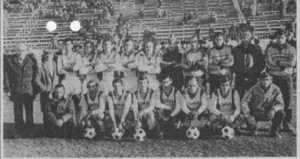
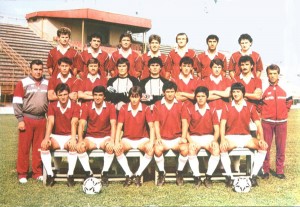
One more look at the champions in the their happiest moment.

West Germany the Cup

The Cup final opposed Bayern to VfB Stuttgart. Frankly, the final was a statement of the current state of West German football – Bayern played against one the best teams, recent champion, still in great shape, 5th in the championship this year. And the result was 5-2 Bayern… The results almost spells out the current reality – West Germany was pretty much reduced to one club of great class.

If Stuttgart lost in overtime or at least lost by a goal or two, one could be sorry for them and blame bad luck. But receiving 5 goals… too many for excuses. Well, nothing to be done – Stuttgart for some reasons failed to add quality to their champion team, the development was stunted as result and now was running already on inertia.

Bayern with the Cup and with a double this year. Well, that was and is Bayern – winners.

West Germany I Division

Bundesliga. Competitive championship as ever, with dramatic finish – 2 teams with same points and goal-difference determined the winner. At the opposite end of the table – 2 outsiders, but almost half the league was preoccupied with efforts to avoid 16th place and thus the risk of relegation. However, Bundesliga lost its edge – there was no truly exciting team and apart from Bayern, no really classy and well-rounded squads. In part, the new reality was due to the changes in football development – physical , but not imaginative players were the norm, so there was higher general level of players, but few exceptional ones. In part, the strong foreign competition – most visible in the case of foreign players: by now, top talent, including German, was going to play for higher paying Italian, Spanish, and English clubs. The result was weaker and bland German teams, decline of some formidable clubs, and narrower group of classy teams – perhaps only 3 at the moment: Bayern, which maintained high level all the time, Werder, which was up and own club, but in good shape currently, and the only steadily developing club – Bayer Leverkusen.

Hannover 96 – last with 18 points. Up and down, up and down, up and down – playing in the Bundesliga meant relegation, so consistent with its own history, Hannover was relegated.

1.FC Saarbrucken – 17th with 21 points. Relegated as well and little surprise in that.

Borussia Dorlmund – 16th with 28 points. Now, this was quite a drop – just a few years back Borussia was climbing up and was one of the more promising teams. Now it looked like they were going terribly back to old ways and second0level football. And a look at the squad was telling why – Immel was the only rising star. Only two well-known players, but both getting old – Hrubesch, back from Belgium, and Raducanu, not so famous, but a Romanian national team regular for years. Yet, Borussia was not an outsider – they generally lost the fight with equal teams : the difference between them and the 8th-placed team was 5 points. And not relegated yet – they went to the promotion/relegation play-off against the 3rd team in the Second Division, Fortuna Koln, and managed to keep their place in top flight at the end.

Eintracht Frankfurt lost so much ground in after 1976, that they now were among the outsiders. They survived only on better goal-difference this season, ending with 28 points like Borussia Dortmund.

Fortuna Dusseldorf – another formerly strong club in decline. 14th with 29 points.

Yes, 1. FC Koln reached the UEFA Cup final, but the performance in the Bundesliga was the true story: they were going down fast. 13th with 29 points.

1. FC Nurnberg – familiar performance: escaping relegation equaled good season. If not relegated, they were among those barely escaping, so nothing new here – 1th with 29 points.

1.FC Kaiserslautern – 11th with 30 points.

Schalke 04 – 10th with 30 points.

VfL Bochum – amazing survivors: always with a squad suggesting immediate relegation, but managing good position at the end of the season. 9th with 32 points.

SV 07 Waldhof Mannheim – 8th with 33 points. The highest-placed team among those concerned with avoiding relegation. Well done, but more importantly was that if their squad was a bit poor, it was not very different from the squads Schalke, Koln, Dortmund, Frankfurt, and Dusseldorf had.

The next 4 teams were way above the lower part of the league, but not title contenders either.

Hamburger SV – 7th with 39 points. Still led by Happel, but a far cry from the team were only a few years earlier. The key stars, starting with Kaltz and Magath, were getting old and very old, but there was not single new name of great talent popping up. HSV was slowly sinking.

Bayer 04 Leverkusen – 6th with 40 points. Frankly, the only up and coming team at this time and that with certain doubts and cautions: yes, it was improving team and it was certain they were not one-time wonder, but it was also a team without remarkable stars. Even their foreigners – the South Korean legend Cha and the Polish national team player Wojtowicz – were second-rate. But ‘the Aspirins’ were also a prime example of the current football – a sturdy collective was a winning one and not one with few great flashy stars. Just look at 1. FC Koln and compare…

VfB Stuttgart – 5th with 41 points. Still strong, but one thing was already clear: Stuttgart did not add to the champion team they built a few years back – what they had was equal or slightly weaker than the team of very recent past. Not a title contender as a result and possibly going down in the future.

Borussia Moenchengladbach – 4th with 42 points. The strongest finisher among those much better than most of the league, but weaker than the leading teams. To see Moenchengladbach among the top teams looked both familiar a reassuring: so impressive was the great team from the 1970s, that for many this season refreshed the memories and hopes for coming back. But there was no coming back… there was no player of caliber similar to Netzer and company. Mill was perhaps the greatest player of the current squad and he was never a regular player of the national team. And it was crystal-clear that Enevoldsen and Herlovsen could be number one players of Europe or transferred to Barcelona and Real Madrid, like the imports in the 1970s Simonsen and Jensen were. May be the most accurate explanation of the good performance is Heynckes – the former great player was rapidly becoming a great coach. And he was a true child of Borussia, knowing perfectly what to do: more with little. But for how long?

The top three teams competed for the title.

Bayer 05 Uerdingen – 3rd with 45 points. Their best season, the closest they came to winning a title, but having lesser team than the competition made them losing a bit of steam and ending third. Well… even at the time of collective anonymity class was prevailing. Ambition, motivation, and soldiering are rarely enough for winning. But it was great season nevertheless.

How was Werder better than Uerdingen? Well, it had higher-class players – Pezzey, Okudera, Ordenewitz, Votava, Burdenski, Sidka, Wolter, and the rapidly becoming a superstar Voller. National team players, champions with other clubs, used to both domestic and international football – that was a big difference. And having top coach was another difference – Rehhagel. Werder was up and down club, true – they even played in Second Division no long ago – but they had occasional bursts leading them to the top and this season was one of those. They run for the title and did not give up for a second – at the end, they lost the title only on goal-difference, what a misfortune. And coming to tiny details as well – compared to Bayern, Werder was older and not deep squad. That affected scoring – yes, they scored a lot, but not as much as their younger rivals. Yes, they lost only 5 games, but they won one less game than Bayern. Tiny details… and second.

This was one of the most difficulty won titles in Bayern’s history – and, frankly, it would have been better if Werder won. But it was Bayern, so never giving up and getting victorious in any possible way. Of course, this was the strongest squad in West Germany – not very exciting and not even as strong as some older versions, but still far stronger than whatever was around. 8 West German national team players plus 1 Danish and 1 Belgian national team stars, and one unfortunate refugee – if he was not East German Junior-national team member in the past, Nachtweih would have been in the West German national team. Lattek was Lattek – a great coach always aiming at victory. Even facing tough opposition and under great pressure, at the end Bayern clinched the title.

One more for the trophy room.

West Germany II Division

Second Division. Competitive season with surprising outcome – one expects familiar from years in the Bundesliga clubs to go up, but it was different. Upside-down, in a way.

MSV Duisburg was only last, but was hopeless outsider as well, ending with only 15 points. Such sharp decline…

Tennis Borussia (West Berlin) finished 19th with 29 points. Just came back from the regional leagues and relegated right away.

SpVgg Bayreuth – 18th with 31 points and out of second level again.

Hertha BSC (West Berlin) – 17th with 31 points. Another disaster… May be that was the way to build character – a future national team goalkeeper was going to taste regional football. The horrors of the 1960s came back, but this time there was a barrier between regional leagues and Bundesliga: now Hertha had first to try a return to second level.

SC Freiburg survived – 16th with 33 points.

SG Union Solingen – 15th with 34 points.

VfL Osnabruck – 14th with 35 points.

Viktoria Aschaffenburg – 13th with 35 points. May be nothing for other clubs, but for this one – a great season: Hertha and Duisburg relegated and Viktoria safe.

Miserable season for Eintracht Braunschweig – 12th with 36 points.

Rot-Weiss Oberhausen – Bundesliga was clearly out of reach for years already, now avoiding relegation to the regional leagues was prime concern. 11th with 37 points.

SV Darmstadt 98 – 10th with 41 points.

SG Wattenscheid 09 – 9th with 43 points. With them ends – or begins the groups of teams trying to reach promotion. 6 points was the final difference between Wattenscheid and the league champion and they won as many games as the 2nd placed in the final table – 17.

Alemannia Aachen – 8th with 43 points, ahead of Wattenscheid on better goal-difference.

Karlsruher SC – 7th with 43 points.

Stuttgarter Kickers – 6th with 43 points. The best goal-difference among those with 43 points placed them the highest.

KSV Hessen Kassel – 5th with 44 points. There was always something preventing them from getting promotion – coming close, but unable to reach the top.

Arminia Bielefeld – 4th with 45 points. Return to Bundesliga was postponed.

Fortuna Koln – one of the most stable members of Second Division, which seemingly had particularly good period and thus really aiming to get promoted up. Not easy in tough and relatively equal league, but they clinched 3rd place with 46 points. Which was not enough for direct promotion, but for a promotion/relegation play-off against the 16th in the Bundesliga. A good chance.

Now, that was a big surprise – Blau-Weiss 90 (West Berlin) was historically well bellow Hertha and even Tennis Borussia, but those two were relegated and the brave Blau-Weiss, quite a newcomer to second-level football, was suddenly going even higher – 2nd with 47 points. True, it was a bit chancy success, given the tough race, but Blau-Weiss earned its promotion. Going to play in the mighty Bundesliga – what fantastic success!

FC Homburg 08 – winners of the championship with 49 points. 20 wins, 9 ties, 9 losses and 75-42 goal-difference gave them the title. Hardly dominating – rather more determined than the competition – but they won. Not an expected winner, though, and the reason for the success not just of them, but of those immediately bellow them may have been the absence of well-known names in the whole league. Famous players were always few in the second level, but this season was very dry, which made various teams similarly strong or weak. Even for a second division champions, Homburg had quite an anonymous squad – the American Dooley will make his name in the future and that was everything. But it was sweet to win even like that, for after all, the competition was similar and that did not make it easy. After all, it only matters who would finish first – Homburg did it, who could blame them for getting promoted?

After the end of the regular championship Fortuna Koln went to the promotion/relegation play-off against Borussia Dortmund. They won their home leg 2-0, but in Dortmund the hosts came back with 3-1 win and a third match was scheduled. And in it, unfortunately, Fortuna collapsed… they lost 0-8! Too bad.

Thus, only 2 clubs got promoted to the Bundesliga: Blau-Weiss and Homburg. Great for them, but the terrible loss of Fortuna in the play-off was ominous sign… looked like the gap between first and second division teams was too wide at the moment.

West Germany III Division

West Germany. Dramatic championship – goal-difference decided the title. Decline of some clubs of prominence and relegation to the regional leagues of 2 formative members of the Bundesliga.

Qualifications for promotion to II Division: the champions of the regional leagues went to their final tournament, competing for 4 promotions. 9 teams, divided into 2 groups – Northern and Southern. That was the formula for many, many years now. However, one regional league champion was not permitted to compete for promotion – most likely for financial reasons.

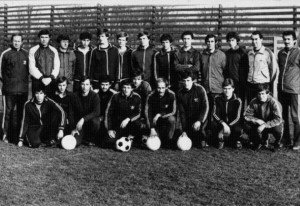
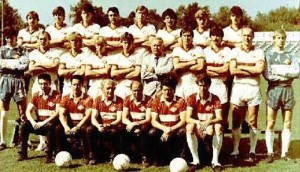
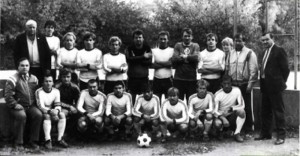
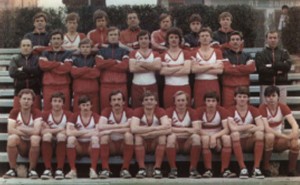
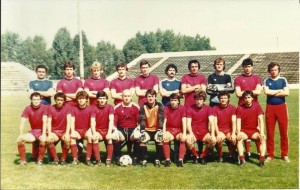
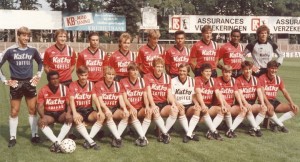
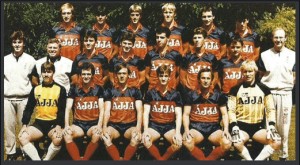
Wormatia (Worms) was not allowed. Top row from left: Alfred Oehrlein, Ralf Karb, Jozef Adamiec, Heinz Lubanski, Jurgen Klotz, Gunther Birkle – assistant coach, Heiner Ueberle – coach. Middle row: Gunter Reinhardt, Walfried Gunther, Gunter Braun, Michael Wolsiffer, Peter Ritzheim, Bernhard Schwank, Stefan Steinmetz, Heinz-Jurgen Schlosser, Dr. Priester. Sitting: Jurgen Fischer, Lutz Hofmann, Georg Muller, Stephan Kuhnert, Ralph Pfirrmann, Martin Simonis, Dieter Gutzler, Helmut Wagner.

Wormatia was replaced by the 2nd-placed ASC Schöppingen.

Gruppe Nord:

1.  FC St.Pauli   8  5  2 1  16:8  12:4

2. Rot-Weiß Essen 8  5  1  2  16:12 11:5

3. SC Charlottenburg  8  3  3  2  16:9  9:7

4.  VfB Oldenburg  8  2  1  5  12:18  5:11

5.  ASC Schöppingen  8  1  1  6  8:21  3:13

ASC Schöppingen clearly was not up to the task, but the former Bundesliga members were:

Rot Weiss (Essen) and

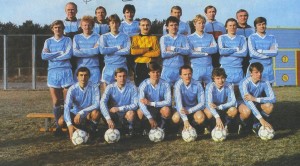
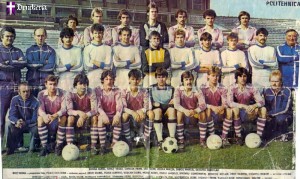
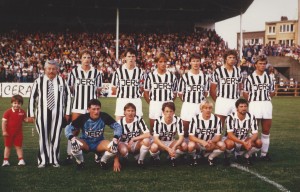
FC St. Pauli (Hamdurg) were promoted to Second Division. This photo of St Pauli may not be correct, but is from that period at least.

Gruppe Süd:

1.  SSV Ulm 1846  6  3  2  1  11:7  8:4

2. FSV Salmrohr  6  3  2  1  10:7  8:4

3. Kickers Offenbach  6  1  5  0  11:8  7:5

4. 1860 München  6  0  1  5  4:14  1:11

Different story here – the former Bundesliga members failed.

TSV Munchen 1860 was particularly bad and had to return to Bayernliga for at least one more season. How to measure the relative strength of the teams playing in the regional league? Netolicka not long ago played for the national team of Czechoslovakia…

FSV Salmrohr had no well-known players, but achieved great success and was going to debut in the Second Division.

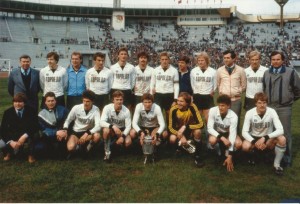
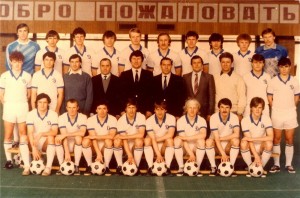
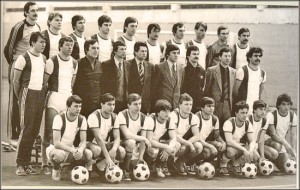
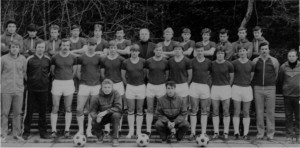
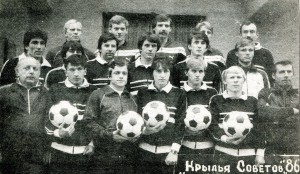
SSV Ulm 1846 won the qualification group and was promoted – great success for them. Top row from left: Thomas Schmidt, Hannes Schuler, Harald Hage, Wolfgang Neipp, Peter Steck, Dieter Simon. Middle row: Kneer – masseur, Gunnar Weiss, Peter Assion, Robert Birner, Peter Kempa, Marcus Kohnle, Werner Nickel – coach. Front row: Hildebrandt, Wolfgang Riecker, Raimund Muller, Frank Ahrens, Christoph Weber, Thomas Richter, Kurt Kalchschmidt, Gunter Berti, Joachim Zeller, Walter Kubanczyk – assistant coach.

SSV Ulm returning to familiar grounds.

Good luck to the winners in the next season.

Spain the Cup

The Cup final opposed Barcelona to Real Zaragoza. Naturally, Barcelona was seen as the obvious favourite and even playing the final in Madrid was not going to be big problem – at least in imagination. In reality, the tough final produced one goal only – Sosa scored it in the 35th minute and he was not playing for Barcelona. At the end, Real Zaragoza lifted the Cup.

For another club finishing 2nd in championship and playing 2 cup finals – one domestic and one European – would be a great season. For Barcelona was a disaster… ending a season empty-handed, beaten in every tournament and it was hard to tell which loss was the worst. Perhaps the realization that once again Real Madrid superior squad – Barcelona’s somewhat did not measure when compared to the new Real. It was thinner, somewhat older, and there were problems – Venables was somewhat not right and his English inclinations did not work. Schuster was becoming more of a problem than a valuable contributor, Archibald clearly was not going to be a superstar. Relatively small things, but things making sturdy enough squad like Zaragoza not just able to hold its ground, but even prevail.

May be Real Zaragoza would have been satisfied even if they lost the final – they were still the underdog, although having great season. It was a triumph of the working man in a sense, because Real had no famous stars and perhaps was even wise enough to build relatively anonymous squad instead to hire some big names and thus attract the unhealthy interest of Real Madrid and Barcelona. Winning the Cup was fantastic – and even better: the team remained relatively uninteresting and no players were going to the big clubs. Positive final of the season in every aspect, the future was secured. And winning a trophy was priceless: this was the first trophy they won since 1966 in the first final they played since 1976. Altogether, their 3rd Cup.