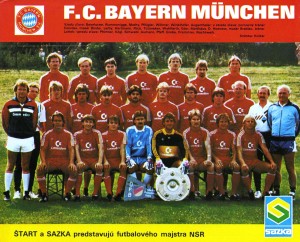
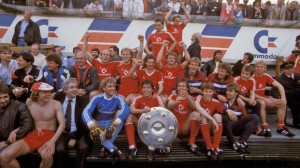
Copa Interamericana.

It was played this season, opposing the champions of CONCACAF to the winners of Copa Libertadores, but it was clear why this tournament never really established itself and eventually died. Thanks to the River Plate Museum, the first leg can be seen today on Youtube – mostly to provide additional explanation why Copa Interamericana died. This issue was played in July and August 1987 – no wonder why many consider it 1987 issue, not 1986. Well, first problem was different schedules: Copa Libertadores usually finished by July, but CONCACAF Champions Cup ended at the end of the year and even later: the 1986 final was played in January 1987. At that time it was practically impossible to stage the Interamerican final, because the South American domestic championships were going on. And there was little chances for the next months, for by then Copa Libertadores started. Pushing the final further and further away clearly suggested diminishing importance and interest, which was true for the South Americans – they had to find time, to travel to some more or less obscure place, losing money all the way. The clash was not even remotely equal, as the footage of this final makes painfully clear: LD Alajuelense (Costa Rica) vs River Plate (Argentina).

First Leg [Jul 21, 1987]: Asociación Liga Deportiva Alajuelense 0-0 Club Atlético River Plate

ALD Alajuelense: Alejandro González; Hernán Sosa, Chávez; Vargas (Benavídez 35), Juan Cayasso, Montero; Ulate, Mora, Arias, Solano, Ramírez. Unused substitutes: Porras, Guardia, J. M. Rodríguez, Chacón. Coach: Josepf Bouska.

CA River Plate: Sergio Javier Goycochea; Nelson Daniel Gutiérrez, Alejandro Alfredo Montenegro; Jorge Horacio Borelli, Américo Rubén Gallego, Oscar Alfredo Ruggeri; Claudio Paul Caniggia, Néstor Raúl Gorosito, Juan Gilberto Funes, Omar Arnaldo Palma, Raúl Roque Alfaro. Unused substitutes: Alberto Pedro Vivalda, Enrique Ernesto Corti, Héctor Alberto Enrique, Claudio Alberto Morresi, Ramón Miguel Centurión. Coach: Carlos Timoteo Griguol.

Referee: José Antonio Garza. Venue: Alajuela. Field: Alejandro Morera Soto.

It was Gulliver and the Lilliputians…

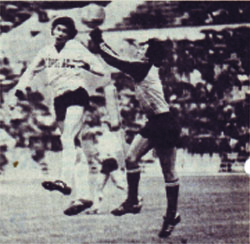
Captains Juan Cayasson and Americo Gallego. One is a World champion and the other is… who? River Plate already lost ‘the Prince’ – Francescoli – but had a squad of enormous talent nevertheless. Some big names did not even play – River had 2 1978 World champions: Gallego and Alonso, 3 fresh 1986 World champions: Ruggeri, Pumpido, and Enrique, two future big stars, just starting to get notice – Caniggia and Goycochea, Caniggia only 19 years old. Three Uruguayan national team players, also fresh from the 1986 World Cup – Gutierrez, Saralegui, and Alzamendi. There was one more Uuruguayn – Rubens Navarro – and an Ecuadorian – Diego Cordova – plus plenty of Argentine talent, which is difficult to dissmisss – Gorosito, Borelli, Alfaro, Funes, Palma… It was obvious even before the start of the match that Alajuelense had no chance – they knew it, their fans knew it. River Plate knew it just as well, so it played leisurely, even making a conscious effort not to tackle very hard their opponents. The Costaricans reacted in humble and somewhat amusing way: the players displayed techical skills and got huge applause, but it was in jest, for they had nothing else to do, all possible ways for building attacks closed. The fans booed River Plate not on principle hostility, but only in protest – when they wasted time or carelessly kicked the ball out of target. There was no hurry, the Argentinians preferred to walk and even did not simulate, but when pushed down, they gave the impression that it was much to sit than to stand, and, if stretched on the ground, it was better to lay down and perhaps take a nap than to sit. Tackling was another matter – trying as they could not to be hard, instincts prevailed now and then and Costa Ricans… died. Clearly, River Plate made an effort not to hard, but almost every touch led to great pain and injuries – Costa Ricans apparently were not used to real professional football and got easily injured. At one moment there were three needing medical help and Vargas was unable to continue the game. River Plate’s superiority was enormous and they even did not make any effort to play seriously. Alajuelense had one or two chances, which were not a result of some built up, but just came about, surprising them more than their opponents. Both teams hit the bars and Goycochea had to make two saves. River Plate missed more chances and Gonzales made a few wonderful saves until the match ended 0-0. It could have been 1-1, but more likely 3-0 River Plate – it looked like River Plate did not want really to score, played benevolent game, tried not to shame Alajuelense in front of their own fans. The hosts bravely tried to do whatever they can, which was not much, and were generously permitted to finish honourably.

Here is Alajuelense in the opening leg – heroes at the end, for they were not beaten by River Plate and even had some scoring opportunities.

The second leg was another matter. At home and with trophy to win, River Plate had no option but destroy the lowly opposition. Which they thoroughly did – the fans needed to see the new coach was a winner, so… River Plate had to play more serious football in Buenos Aires. And a trophy is a trophy, no jokes when it comes to adding one more to the vast collection. The opening leg was just a leisurely polite stroll, not hearting feelings was the general aim, but the second leg was no contest.

Second Leg [Aug 16, 1987]: Club Atlético River Plate 3-0 Asociación Liga Deportiva Alajuelense [Villazán 16, Funes 60, Enrique 67]

CA River Plate: Sergio Javier Goycochea; Nelson Daniel Gutiérrez, Oscar Alfredo Ruggeri; Rubén Darío Gómez, Américo Rubén Gallego, Jorge Horacio Borelli; Ramón Miguel Centurión, Héctor Alberto Enrique, Juan Gilberto Funes, Omar Arnaldo Palma, Jorge Villazán (Antonio Alzamendi 66). Unused substitutes: Alberto Pedro Vivalda, Enrique Ernesto Corti, Raúl Roque Alfaro, Claudio Paul Caniggia. Coach: Carlos Timoteo Griguol.

ALD Alajuelense: Alejandro González; Hernán Sosa, Chávez; Vargas, Mora, Montero; Ulate, Ramírez, Arias, Solano, Juan Cayasso. Unused substitutes: Porras, Benavídez, Chacón, Rodríguez, Guardia. Coach: Josepf Bouska.

Referees: Juan Escobar; Asterio Martínez, Lucio González. Venue: Buenos Aires. Field: Monumental Antonio Vespucio Liberti Predictably, River Plate won Copa Interamericana.

Always great to lift a cup, but this one was particularly easy to get.

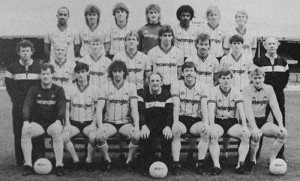
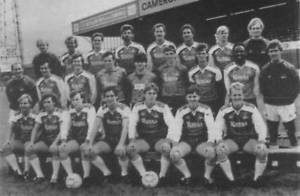
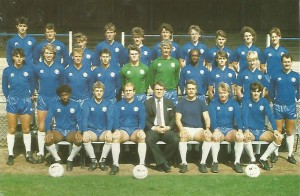
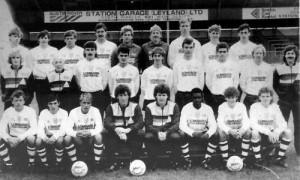
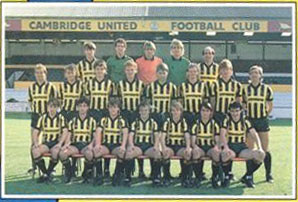
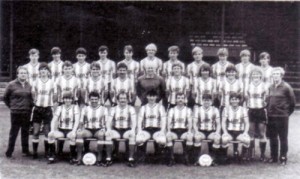
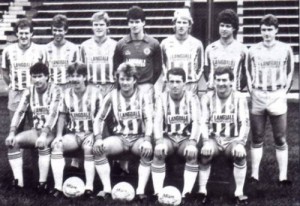
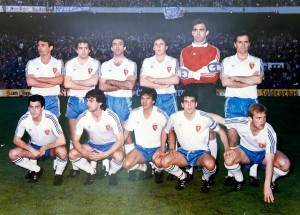
LD Alajuelense made the best they could, but the difference in class was so great, they hardly entertained some hopes even for a moment. Standing from left: Ronald Mora, Alvaro Solano, Hernán Sosa, Franco Benavídes, Jorge Ulate, Alejandro González. Front row: Juan Cayasso, Elías Arias, José Chávez, Oscar Ramírez, Mauricio Montero.

Brave as they were, Alajuelense only proved the obvious – apart from Mexico, there was no even remotely decent football in the CONCACAF region, so Interamerican cup was meaninless tournament from any point of view.

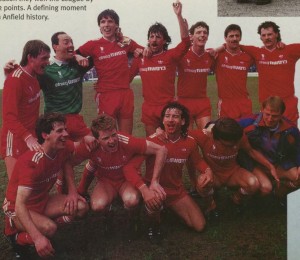
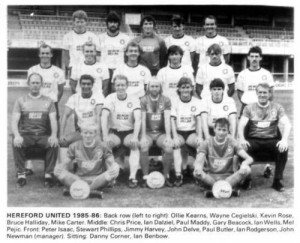
River Plate won the trophy easily and probably just as easily forgot about it. This is the squad which played the second leg, actually winning Copa Interamericana.

Costa Rica

Costa Rica. Entirely off the radar, as most small football were at the time. Thus, it may be surpirsing to see that this country run championship for than 70 years by 1986. However, it was in some dire straits and reduced to 6 teams playing in the 1985-86 season. The formula of the championship was also mysterious: every team played 36 games, which is impossible number, but still a fact. At the end there was a big surprise – instead of the usual names, a relative newcomer to the top league won. Here is the final table, just because this championship is a rarity:

1.Municipal Puntarenas 36 17 11 8 45-25 45

2.Alajuelense 36 19 6 11 46-32 44

3.Guanacaste 36 12 16 8 44-38 40

4.Saprissa 36 14 11 11 52-37 39

5.Herediano 36 14 11 11 44-38 39

6.Cartaginés 36 15 9 12 41-38 39

Noticeable low place for Herediano, one of the traditional leading and successful clubs.

Well, all depends on who one listens to: there is also such picture in circulation. The international association of football statisticians does not recognize Herediano – the final table above is taken from their site.

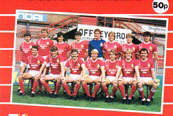
As for the champions, they need a few words. This club was usually listed as Municipal Puntarenas or simply Puntarenas, which today leads to confusion, for there is a club with the same name playing, but it has nothing to do with the champions of 1986. The full name of the old club was Asociacion Deportiva Municipal Puntarenas and was founded in 1952, but is defunct since 2014. Today’s club with the similar name was founded recently and is entirely different – old supporters of Municipal Puntarenas make explicit difference between the two, cherishing the old club. The club really came to some prominence after 1975, when finally established itself in the First Division abd running 2nd twice – in 1978 and 1983. 1985-86 was their golden season, but confusion still remains, for different sources state alternative seasons: sometimes champio of 1985-86, sometimes 1986-87.

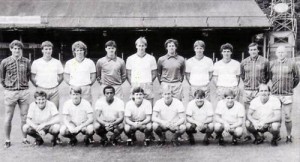
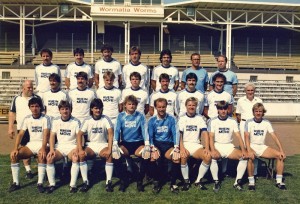
Everything is confused now – a photo of the champions could be found at the site of Puntarenas FC, the currently existing club, which has nothing to do with the original club. It is also not entirely certian that this photo is from the actual season – it may be from the next one, but then different sources give different seasons, so who cares about precision.

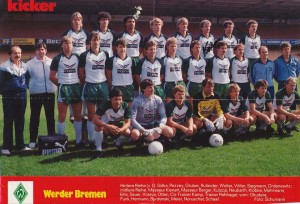
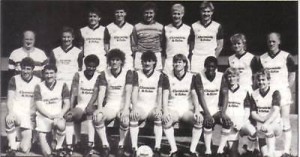
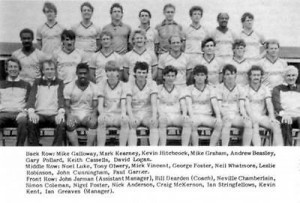
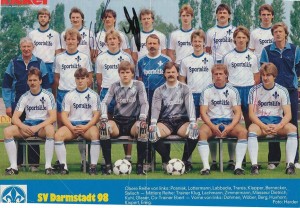
Pictorial material is extremely difficult to sort out, but this seems to be the team. The players are obscure in any case, even the two Brazilian imports. At least the names exist, as long as one can clarify the season: Wikipedia insists on 1986-87… Goalkeepers: Jorge Arturo Hidalgo, Carlos Bismarck Duarte, Hermidio Barrantes. Defenders: Alfredo “Diablo” Contreras, Jorge Badilla, Ricardo ‘Sardina’ Garcia, Marvin Bustos, Carlos Morales, , Sergio Angulo, Adolfo “El Coyolito” Rojas, Carlos Nikanor |Toppings, Marvin Huertas, Carlo Iranil Carvalho Do Nascimento (Brazil). Midfielders: Sandro Alfaro, Carlos Alberto “El Pistoncillo” Velásquez, Luis Enrique Galagarza, Juan Carlos Aguirre, Rodolfo Ramírez Binns, Francisco Arias, Juan Carlos Díaz, Tomás Eduardo “El Pistón” Velásquez, Kleber Ponce (Brazil). Strikers: Leonidas “Leoni” Flores, Gilberto Rhoden, Didier Morales, Roberto Stevanovich, Danilo Anderson, Donaldo Vega, Franklin “El Chino” Vargas.

Coach: Marvin Rodríguez.

But no matter confusion, champions they were.

For the first and last time – Municipal Puntarenas never won the title before and never win it again, so it was unique achievement still remembered and celebrated in the community.

Mexico I Division

First Division. The short championship was called ‘Mexico 86’ and had the following structure: the league was divided into two groups of 10 teams each. The teams played only against the teams of the same group, the top 4 teams of each group proceeded to quarterfinals, semifinals, and final. It can be argued that some leading clubs, especially those with national team players, were affected and weakened by the coming World Cup, but a championship is a championship and excuses are only for whiners. Of course, some traditionally strong teams were down – particularly UNAM, which ended 9th in Group II with 13 points. Only one team played worse than them. No matter, rules are rules and some were eliminated in the group stage:

CD Neza was 5th in Group I and out,

Necaxa – 7th in Group II.

In the quarterfinals more casualties fell down: Atlante lost to Monterrey 0-0 and 0-6.

Atletico Morelia lost to Tampico-Madero 2-2 and 0-2.

Cruz Azul – to America 0-1 and 0-1.

Puebla – to CD Guadalajara 2-3 and 1-1.

In the semi-finals, CD Guadalajara was gone, losing twice to Monterrey 0-1 and 0-1. America also lost – Tampico-Madero almost survived the first leg, losing only 2-3, but got big revenge at home: 4-0.

Thus, Monterrey and Tampico-Madero met to decide the 1986 champion of the country. In the first leg Tampico-Madero prevailed 2-1, but the result benefited Monterrey – they were hosting to second leg. And made the best of it, winning 2-0. Monterrey was the stronger finalist – they opened the result in Tampico with a goal by Hector Beccera and Tampico-Madero struggled to prevail: thanks to own goal scored by unfortunate Rito Luna, they equalized, but managed to score the winning goal only in the 79th minute, thanks to Eduardo Rergis. Monterrey’s victory was not easy at all – Reynaldo Gualdini gave them the lead in the 30th minute, but only from a penalty. The winning goal was scored in the 93th minute by Francisco Javier Cruz. Difficult or not, victory was theirs.

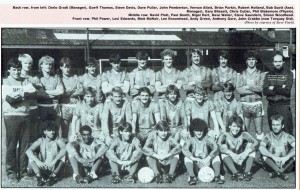
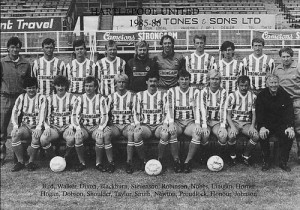
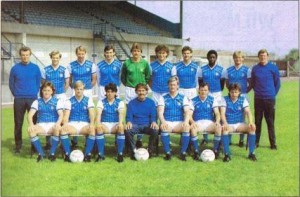
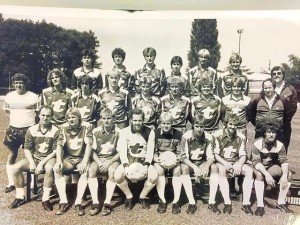
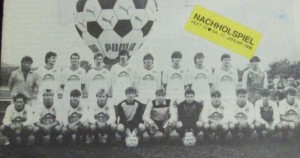
This may be a picture of Tampico-Madero from 1986 – certainly it is from their ‘Brio’ period, named after their sponsor. It was bitter-sweet time, though: succesful, but not entirely succesful – they finished second in the short 1985 championship, then second in 1986, both times beaten at the final. Sure, they took revenge for their first loss by thrashing America in the 1986 semi-finals, but still failed to win at the end. Came close, yet – second best.

Monterrey was most deserving champion, for they were consistently strong during the whole championship: they ended with the best record in both groups at the end of the opening stage. Back then they lost only two games, got wonderful +25 goal-difference – five goals better than second-best, Tampico-Madero’s, which trailed them in Group II also by 5 points. Monterrey proceeded unbeaten to the final, producing the biggest victory at the direct elimination rounds – 6-0. They lost minimally the first leg of the final, then won the second by the nececarry margin. Certainly better than Tampico-Madero overall.

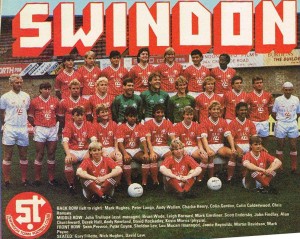
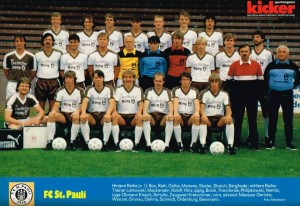
One more look at the champion squad. Difficult to tell who is who, but here are the names of the winners: Gueldini, Gamboa, Campa, Contreras, Bahia, Garcia, Munoz, Ortega, Becerra, Cruz, Luna.

Mexico II Division

Mexico. Hosting the 1986 World Cup led to changes in the domestic championship – the top league played two short championships, one counted in the 1985, and the other – in the spring of 1986, counted for the same year. Second Division, though, was not affected and played its normal 1985-86 season. Thus, there was no promotion-relegation in the 1985 short championship of the First Division, the same teams appeared in the short 1986 championship, and only then a team was relegated. Meantime Second Division went through its own season and the winner was promoted to the top league for the 1986-87 normal season. How much attention the Second Division got this season is hard to tell, for the whole interest was focused on the World Cup, so it would suffice to say that at the end Cordoba and San Mateo Atenco were relegated to Segunda Division ‘B’, the third level. As for the winner of the championship, Cobras (Queretaro) and Pachuca reached the final. Cobras won 2-0 at home and managed a 1-1 tie in Pachuca.
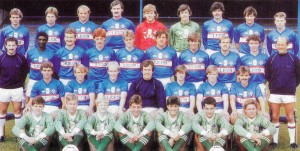
Pachuca tried to climb back to first division, but was unable at the end. Most unfortunate, for they were the strongest team during the season.

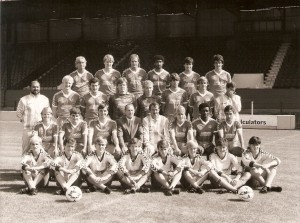
Cobras played their best when mattered most and triumphed with promotion – their first! In the Mexican context, their victory was easily understood: it was a new club – or franchise – founded in 1983. That meant there was solid financial back-up and clear aim to go higher. For the moment, at least. As long as money was plentiful, success was guaranteed. Long-term existence was another matter – Queretaro did not have top league team at the moment, but had older club playing in the second division: UA Queretaro. It was not bad – for a second division team – and chances were locals preferred the long established team to the newcomers. As many newly created clubs, Cobras tried to attract fans – not only with the name, thought attractive, but also with their uniforms, which were noted for provocative and avantgarde designs. But it was not enough and eventually the franchise had to relocate to another city – but this happened in the future. Presently, the plan worked fine: the new club won the Second Division championship and was going to debut in the Primera Division in the 1986-87 championship.

CONCACAF Cup

Copa de Campeones y Subcampeones CONCACAF 1986. 21 teams participated, but not every country from the region – Mexico, Canada and Cuba, for instance. USA was represented by New York Greek-Americans. Hardly a competition attracting big interest and given the teams involvod, practically unnoticed outside CONCACAF. No team wihtdrew, but statistics are unreliable, as they always were: results were different, depending on the sourse – for example, Marathon (Honduras) and Alianza (El Salvador) ended either 0-1, 1-0 and 2-4 in the penalty shoot-out, or 0-1 and 3-2. The second version exists on the CONCACAF website, failing to explain why Alianza qualified to the next round, since Marathon would have be the winner thanks to more away goals. But the complicated structure of the tournament went ahead round after round, including the weirs Intermediate round, in which only one pair played and three teams qualified directly. All until the semifinals were reached and in them LD Alajuelense (Costa Rica) eliminated Pembroke Hamilton Club (Bermuda) 4-0 and 0-1 and Transvaal (Surinam) beat Trintoc (Trinidad and Tobago) in penalty shoot-out 4-3, after the legs ended 4-2 and 0-2, away goals apparently did not count. At last the final was played – in February the next year, 1987.

At home, LD Alajuelense secured solid lead: 4-1. Four days later they won again – 2-1. Both legs were played in Alajuela, another almost constant feature of this competition: small teams from empoverihsed and difficult to reach countries often prefered to play both legs at one plce, usualy in the slighlt richer country. This, to a point, pre-decided the outcome of the finals. At least the scorers of this final were preserved: Luis Fernandez, Jorge Ulate, Jose Chavez, and Juan Cayasso scored for the hosts in the first leg. Eric Gotlieb scored for Transvaal. In the second leg Regillio Doest scored for Transvaal and Luis Fernandez and Juan Cayasso for the winners.

SV Transvaal, although a recent winner of the tournament, was clearly the weaker side.

Liga Deportiva Alajuelense (Alajuela) was clearly the stronger side and triumphed with the CONCACAF trophy. Home turf undoubtably helped, but even if the final was played normally or on neutral ground, most likely the Costa Ricans would have been comfortable winners. It was important victory for the club: ‘Los Leones’, founded in 1919, are one of the most successful clubs not just in Costa Rica, but in the whole Central America, but domestic success was not enough – international victories were also craved. Mind, their opponents at the final already won CONCACAF’s Cup, lowly as they were. As for LD Alajuelense… it all depend: they won one of the first CONCACAF tournaments, in 1961, but at that time it was unofficial competition. If counted, ‘Los Leones’ won their second Cup. But even if it was counted, they lacked victory in the proper official tournaments and at last they got one. The satisfaction was full, even if most of the world turned its back to the success.

African Player Of The Year

African Player of the Year. Professionalism – that was the word coming to mind when looking at the vote. African football was getting stronger, no doubt, and quality was getting associated with professionalism. Hence, European-based players occupied the top positions no matter how strong continental football was becoming: Egypt ruled continental football in 1986, but the top three players were all based in Europe. World Cup counted most, as usual, so no surprise two of the best were Moroccon. Cameroonian Roger Milla (Montpellier, France) was 3rd with 80 points. Azis Bouderbala (FC Sion, Switzerland and Morocco) – second with 88 points.

Ezzaki Badou was voted best player of Africa, getting 125 points. Written like that, the name may sound unfamiliar – popularly, that was Zaki, the goalkeeper and the captain of the Moroccan national team.

Naturally, the Moroccan performance at the 1986 World Cup was instrumental, but Zaki was well known in Africa for quite some time and his qualities were recognized elsewhere during the World Cup finals.

Recognition moved him from Widad (Casablanca) to Spanish side Mallorca after the end of the World Cup, so he also was European based professional at the time of the voting.

Zaki was 27 years old at the time with plenty of experience on both club and national team level – he already played at the 1984 Olympic games and twice at the African Cup of Nations and, as a whole, had 10 years of top level football – he debuted in 1976 for Association Sale (Morocco), moved to the leading club Widad in 1978, and eventually found himself in Spain. Already he was voted among the top three players in Africa – 3rd. His World Cup performance was remarkable and he pretty much deserved to be voted number one African player. He also got most points in the history of voting the top continental player to date, but this is not all that important: with time, more journalists were involved, so more points was inevitable occurance.

African Cup Winners Cup

African Cup Winners Cup. One team withdrew befroe playing a match in the preliminary round: AS Police (Mauritania). The club benefiting from this withdrawl – Kamboi Eagles (Sierra Leone) – withdrew before playing a match in the first round. It was almost comic… teams going ahead without playing only to be eliminated without playing. Why did they bother to enlist in the tournaments? But there was more: the first leg between Dragons de l’Oueme (Benin) and Abiola Babes (Nigeria) was abandoned, although the result – 2-0 Dragons – stayed. Both clubs were disqualified immediately: Dragons for fielding 2 ineligible players; Abiola for pitch invasion by its supporters. After this scandalous event another one followed: just before the start of the 1/8 finals, Al-Ahly (Tripoli) was disqualified – that followed the suspencion of the Lybian Federation by CAF for not paying its subscription dues. Thus, AS Sogara (Gabon) and DHJ El-Jadida (Morocco) reached the ¼ finals without playing, their opponents dusqualified. DHJ El-Jadida had it tough in the quarter finals against CS Hammam-Lif (Tunisia) – two scoreless draws, scoreless overtime, penalty shoot-out, and only at this points CS Hammam-Lif was a bit luckier, extracting 4-3 victory. But that was the most the Tunisians could do – they were unable to beat AS Sogara at home and lost the away leg without scoring a goal: 0-0 and 0-3. The other semifinal was Egyptian affair – Al-Ahly vs Ismaili – and produced no winner: 0-0 and 1-1. But Al-Ahly scored away goal and qualified to the final. Which looked unusual – Benin was hardly famed for its football, so it was strange to see a team from this country playing a final. Al-Ahly was the obvious favourite and after the opening leg on home turf everything seemed done and finished: Al-Ahly won comfident 3-0. At Gabon, though, the sure victory evaporated – the hosts recovered sufficiently and Al-Ahly had to battle to the end to keep some lead. They succeeded – AS Sogara won only 2-0.

How good or bad AS Sogara was is hard to tell – first, Benin neither then, nor now is in the vanguard of African football. Second, AS Sogara folded many years ago (1995), giving the impression it had been some over-ambitious special project, which quickly run out of money and support. This final was their best achievement, although a bit lucky, for they did not have opponent in the 1/8 finals. But they eliminated serious teams on the way to the final: Secondi Hasaacas (Ghana) in the first round and CS Hammam-Lif (Tunisia) in the semifinals. They came close to at least reaching ovetime at the final. A team of mystery, really, and given their disapperance in the 1990s, too bad they did not win.

Al-Ahly was the favourite of the final and they did not disappoint. Their road to the final did not look like overwhelming success, but they scored just enough to eliminate every opponent, to prevail by a goal, or, in the semifinal, by away goal. It could be said this was mature team, experienced, knowing what is needed and how to get it, without flair, but business-like. No wonder why: Al-Ahly just won its 3rd consecutive Cup Winners Cup. No other African club won three times in a row ever before. It was not the end of their successful run either – this very likely was the greatest African team ever. And more : Egypt did not qualify to the World Cup finals, but seemingly was the strongest African country at this time. 1986 was a great peak – the national team won the African championship, the clubs – both African club tournaments. All trophies were in Egyptian hands – or feet. The total success spoke of serious development on every level, not at all of some accidental lucky strike. Professional development is murky histroic topic in the realm of African football, but foreign players were playing in Egypt, so professionalism took stable roots in the country – hence, the results.

African Champions’ Cup

African Champions' Cup. Nothing new... UDIB (Guinea Bissau) did not play a single game – it qualified to the first round because East End Lions (Sierra Leone) withdrew before the first leg and then withdrew itself before playing the first leg against FAR Rabat (Morocco) in the first round. ASC Ksar (Mauritania) also withdrew in the preliminary round. Maji Maji (Tanzania) withdrew as well in the first round, but they at least played one match, losing 1-5 to Dynamos (Harrare, Zimbabwe). After that there were no more withdrawels, eliminatios rounds went one after another and in the semifinals Canon Yaounde (Cameroon) lost to Zamalek (Egypt) 2-1 and 0-2. In the other semifinal away goal decided the outcome: Nkana Red Devils (Zambia) fatally tied its home leg against Africa Sports (Cote d'Ivoire) 1-1. The second match ended 0-0 and Africa Sports reached the final.
 The final was real drama, as football should be. In Cairo, Zamalek won 2-0, but in Abijan Africa Sports won with the same result. 
Overtime did not change anything, so it came to penalty shoot-out. 
Lottery or not, Africa Sports was in better position, for they were playing in front of home crowd. But it was not to be their day: the Egyptians prevailed 4-2. 
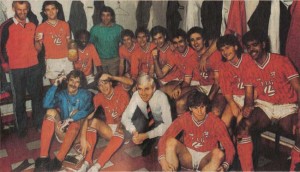
Zamalek triumphed with the Cup and looks like not only shirts were exchanged after the end of the game, but also shorts – two Egyptian players here sport Africa Sports' shorts. Strange, but there was a brief fad in changing shorts in the middle of the 1980s. 
Unlucky Africa Sports – they did everything they could, but lost. Depending on point of view, they either had tough opponents on the road to the final, or were a bit shaky team, especially when it came to scoring. They qualified to the second round after penalty shoot out and twice qualified thanks to away goals. Only in the 1/8 finals they had a big victory – 5-0 against New Nigeria Bank (Nigeria), but lost the second leg 0-2. Seemingly, there was little something missing – perhaps that was why they did not win the trophy. 
Zamalek had wonderful campaign and no problems until the semifinals – but they played admirably against one of the tradtional African powers, Canon (Yaounde), reached the final, and managed to prevail over Africa Sports on their home turf. Zamalek won its second Champions' Cup, all in three years time. 

African Cup Of Nations

The African Cup of Nations. It was the 15th African championship – may be strange, but only South America had more tournaments. Not the World Cup, not Europe. Anyhow, the championship was going through qualifying stage and final stage, hosted by Egypt. The host nation qualified directly to the finals, as well as reigning continental champion Cameroon. The qualifications went as ever before: nobody withdrew in the preliminary round, but in the next round Sudan, Sierra Leone, Ethiopia, and Tanzania decided not to play. In the second round there were no withdrawals.

Mali was eliminated in the first round by Cote d’Ivoire 0-6 and 1-1, just to give you a taste of the early phases. There were no surprise results – Zaire, Tunisia, and Nigeria were eliminated, but they faced equally strong opponents, so nothing out of ordinary. The last 8 were divided into two groups for the finals in Egypt.

Group 1 was played in Cairo.

1.EGYPT 3 2 0 1 4- 1 4

 2.IVORY COAST 3 2 0 1 4- 2 4
 3.Senegal 3 2 0 1 3- 1 4
 4.Mozambique 3 0 0 3 0- 7 0
Mozambique finished last, losing all games and scoring no goals – really weak. 
 Senegal was most unlucky – eliminated not even on goal-difference, but because they lost the match against Cote d'Ivoire. Minimal loss, but fatal – 0-1 in the last group round. 
Group B played in Alexandria. 

1.CAMEROON 3 2 1 0 7- 5 5

 2.MOROCCO 3 1 2 0 2- 1 4
 3.Algeria 3 0 2 1 2- 3 2
 4.Zambia 3 0 1 2 2- 4 1
Zambia finished last with 1 point from the 0-0 tie against Algeria. 
Algeria did not go ahead either – two ties and a loss was rather weak performance. 
 In the semi-finals Cameroon prevailed over Cote d'Ivoire 1-0, thanks to Roger Milla. Egypt also came with a 1-0 win over Morocco – late goal by Abouzid decided the fixture. 
The match for 3rd place was played in Cairo and Cote d'Ivoire took solid 3-1 lead by the 68th minute. Sahli managed to score second goal for Morocco, but after that only 5 minutes remained and there was no time for anything better than minimal loss.
Morocco finished 4th and their final place, as well as the early elimination of Algeria, perhaps spoke the best of rapidly improving African football: both World Cup finalists did not succeed. The competition was getting tougher and by no means a team qualifying to the World Cup finals was the obvious leader of the continents, as it was during the 1970s. 
Cote d'Ivoire did very well, ending with bronze medals. May be Morocco was not pushing all that hard, having in mind the coming World Cup, but even if so, Cote d'Ivoire played with heart and deserved its triumph. 
The final, also played in Caire, was major drama: Egypt heavily supported by home crowd and craving victory at home versus Cameroon, which was going strong despite failing to reach the World Cup. The heroes of the Spain'82 were determined to repeat their continental success from 1984 and also the take revenge for missing World Cup finals. The clash of equal ambition and may be skill produced no winner – after overtime, the result was 0-0. Penalty shoot-out... And only now Egypt prevailed – or was luckier: 5-4. 

It was difficult and long game, as one can see on the Cameroonian faces. 
Cameroon finished second, but unbeaten. No shame in losing penalty shoot-out, but the disappointment was perhaps huge – Cameroon was doing well, yet, no success this year. No consecutive African trophy, no World Cup... no fun.
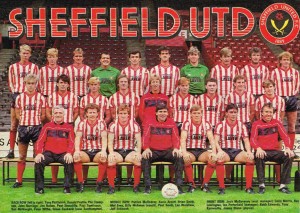
 Egypt took full advantage of hosting the finals and won the championship, if only on penalty shoot-out – the team made the whole country happy. 
Since the champions were quite anonymous outside Africa, here is a picture with names – this is the squad which faced Morocco, but no matter. Top, left to right: Al-Khatib, Ashraf Kassem, Magdi Abdelgani, Mohamed Yasin, Thabet Al-Batal, Mostafa Abdou, Gamal Abdelhamid.
Bottom, left to right: Ali Shehata, Mohamed Omar, Hamada Sedki, Taher Abouzaid 
Egypt won the African championship for a third time, but had to wait awfully long time for that – since 1959! At last they were on top – imagine the joy! 

Aftermath

Aftermath. It may be risky claiming that, but the 1986 World Cup was the last satisfying tournament. In general, everybody was pleased at the end. Apart from the general impression, the details were less pleasing and there were important negative and alarming conclusions. So, point by point without pretense for completeness.

Mexico was graceful host just like in 1970. Considering the short notice for getting ready, the Mexicans did very good job and, most important, the whole atmosphere was festive and friendly. It may have been the distance helping to that, but there were hardly any confrontations between fans of different countries – the only noticeable accident was the brief fight on the stands between English and Argentinian fans. On the negative side were: the lingering questions about how exactly Mexico got the hosting of the finals – suspicions remained, but the truth was not established. Also, there were large protests of angry Mexicans going on during the whole tournament – it was also an open and unanswered question: why Mexico spent money on the World Cup instead of using that money to help the victims of the devastating 1985 earthquake.

Players without shadows. This was more important problem: FIFA was getting more and more commercialized. In the oppressive Mexican heat, the games were played in midday – because of TV, especially European TV. There was no way – because of the time differences – to broadcast live games in the early evening across the ocean. Late night or early morning broadcast meant little audience and because of that – little revenue from advertisers for both FIFA and TV companies. Thus, the games were schedule at noon… at the worst heat. It is a miracle that the players endured and actually played quite fast football. But it was absolutely clear after this World Cup that revenue is the prime motivation and everything else only had to comply with commercial demands – money first, game just a lure, players’ health – private business. Socrates directly accused FIFA for pushing Mexico and Brazil ahead for profit. FIFA retaliated after the finals and in arrogant manner: Sep Blatter expressed concerns about the way many country conducted their preparatory friendlies – national teams played many meaningless games, often against clubs, and only for profit. FIFA, of course, was not to order countries how to prepare their teams for World Cup finals, but the appalling practice depreciating the sport had to stop. It was easier for Blatter than for Socrates to prove his point: Bilardo, for instance, used only local junior teams for sparring partners and absolutely refused to play a friendly with Poland, touring Argentina for some obscure reason. It was easy for FIFA officials to blame individual countries – Blatter did not say anything how exactly a team should be prepared for Mexican conditions: high altitude, scorching summer heat, and games scheduled at noon, for FIFA was very much concerned for the profits from TV and other sponsors.

The end of the beautiful football. It was clear in 1982, now it was confirmed – Brazil, France, Denmark, USSR achieved nothing. It was particularly painful to see Brazil and France out, for it repeated 1982, firmly establishing the brutal truth: those playing artistic football and pleasing the eye were the losers. They were never going to win and the lesson was easy to learn: play brutal rational game and you may triumph at the end. West Germany was the strongest argument.

Yet, the 1986 World Cup satisfied both fans and specialists because of good number high quality dramatic matches. Almost all of them happened after the group phase, rising the problem of numbers. Arguably, the memorable extraordinary matches were pretty much the same number as in the past, say, about 10. But in 1974 the total of games played was 38. Now there were 52, 36 of them in the low-quality group phase. It was clear that great football could be expected only after the group phase, teams too careful and not in top gear at first. It was becoming too much for the fans, though – they watched what used to be the whole tournament before the real fun began, gradually becoming saturated with football, spent there excitement in empty expectation something great to happen, and too picky and easily irritated later. One reason the match for the third place attracted smaller and smaller interest. The combination worked negatively: the great matches were as in the past, the number of dull games increased, endangering overall assessment of the tournament. Low scoring did not help either – the 1986 World Cup had the lowest scoring in all finals played so far. The biggest reason was the modern way football was played.
As a whole, the quality of the teams increased and there were practically no outsiders, but it was the lower level of the football pyramid getting closer to the leading nations and also the leaders going down a bit. Practically everybody was capable of strong physical football, thus, it was difficult to score goals. Looking from this perspective, perhaps the worst team in 1986 was Bulgaria and not because they too bad, but because it was the team leaving no memories at all. There was certain irony in that: Bulgaria played a fifth World Cup without winning even one match. And in the same time this tournament was Bulgarian best ever, for the first time the team went beyond the group phase. Not an encouraging sign – you have never winning dull team climbing up and unable to imprint any memory of itself. However, they were not a team easily destroyed by others – if they lose, it was by small difference. Modern football dangerously oscillated between 0-0 and 0-1, winning was increasingly becoming a matter of lucky goal scored.

The game was generally physical and rough, no team shying away from brutality. Uruguay was the chosen scapegoat and behind its back hided all others – they played ‘manly’ football, the Uruguayans were the beasts. Convenient, but hardly true… Uruguay may have been more open about it, but hacking, kicking, punching was the norm. It was casual, cynical, going on constantly and everywhere on the field. It was professional… even the term ‘professional foul’ was already firmly established, it was normal, a matter of preventing the opposition from scoring. With that booking was no longer real punishment shaming the perpetrator and bringing him in line – getting yellow card was now part of the game, a normal risk, made no impression on anybody. With the mentality that football is a war, gentlemanly approach was thrown to the garbage – cheating, simulating, diving, everything was alright.

Wide spread brutality taxed referees to the limit and sometime beyond – they were under heavy scrutiny and harsh criticism in 1986. In general, refereeing was found appalling and incompetent. In part, it was because of higher number of finalists, so more referees were needed, but also the FIFA policy of including more of the ‘third world’ in the important phases of the sport. Competence was lacking, there were many mistakes. Of course, the most scandalous offense was the goal scored by ‘the hand of God’ – ultimately, the referees were guilty for that, especially the lineman Bogdan Dotchev. Let’s face it: if Maradona did the right thing and went to the ref to tell him he played with hand, then what? Dotchev did not signal that, the ref signaled goal scored… a reverse? Since when referees reverse decision made? And what kind of referee could be the one who has to be instructed by players on what happened during the match? Impasse… The referees were caught by the transformation of the game into a war and had no tools to function – vicious kicking started with the first whistle and ended only with the last. Let it go unpunished and everybody was accusing the ref for the ugliness. Be stern, register and punish every foul and everybody was accusing the ref of pettiness, too happy to be in the center of the things and flash cards, and not letting players play. The original outcry about brutal play in 1986 was quickly reversed – just as soon as the yellow cards piled up – into accusation that the referees were excessive, it was not right to show so many cards. Five yellow cards were shown at the final and it was laughable: 3 of them were for arguing and obstruction, but vicious deliberate tackles were left unpunished at all.

here were no complaints against Arppi Filho, he was found sound and good, and it was true – he did whatever possible to let the game flow uninterrupted, but still had to break the game almost every minute because the hacking started from the first minute and never stopped. Not even counting all other dirty tricks both teams employed. The Brazilian tried as much as possible, even closing his eyes for quite a lot, and yet he had to show 5 cards and blow the whistle almost every minute. What really can be done to satisfaction when the whole game is like the moment above? What a referee could do if the players do not even react to his instruction? FIFA was also very inconsistent in its own instructions to the referees: tackles from the back were to be booked, but the referees did not follow that – and how could they, when there were so many such tackles? In the middle of the tournament, when the cards became too many, FIFA quietly insisted that referees restrict bookings. It was neither here, neither there – clearly, there was no available way to fight brutality, for it was the norm, a key ingredient of modern football.

No new tactics were observed – the norm was already familiar: the key battle was going in midfield, players had to be physically conditioned to press anywhere on the pitch and endure high tempo more than 90 minutes, team work and universality were a must, the preferable scheme was 4-4-2, with slight variations. Ideally, a team should be flexible enough to change on occasion to 3-5-2 or 4-5-1. Thus, most valuable players were those able to change position easily and prime examples were West Germany, where essentially midfielders were used as full backs – Brehme on the right and Briegel on the left, Argentina, where midfielder Olarticoechea was used as left full back, Brazil using Junior as pivotal midfielder, but ready to cover his original position – left full back. However, constructive playmakers were getting fewer and fewer and most teams were becoming similar – fast, tough, but lacking imagination. With the exception of Josimar, there were no new bright players discovered at the 1986 finals. Similar teams galloping 90 minutes most often canceled each other and scoring was getting very difficult and scarce. Artistic football was proved to be the loser, but impoverished skills severely limited the options for beating tough opposition: the example of Morocco against West Germany was not explored by any other team, except Argentina – it was simple concept, but needed skillful playmaker, who could slow or increase the tempo at will and thus frustrate one-speed teams. Denmark was prime example of team unable, no matter what, to change their approach when the game was going wrong: it did not work, yet, Denmark run and attacked and attacked Spain, remaining to the last minute the more attractive and dangerous team, but lost 1-5. The same problem had USSR and England was hopelessly outdated, stubbornly using line defense and reluctantly giving up typical center-forward on occasion. In general, nothing new was displayed, but there were some different nuances, which were employed and they alarmingly old, giving the impression that the development of the game was going backwards. The best examples were Argentina and West Germany and their coaches.

This time even the Germans did not expect their team to go far, so bad it was, so ridden with scandals, and so impoverished on skills, imagination, and creativity. It was also the prime example of modern football and thus soldiered to the final. The success should be credited almost entirely to Franz Beckenbauer – he managed somehow to keep constantly quarreling squad ready to play, overcoming all kind of disasters – from Schuster’s refusal to play to the deliberate injury Schumacher delivered to the defender he did not want to play with. West Germany only run, producing nothing and seemingly incapable of creating anything, but triumphed at the end, thanks to will and taking whatever chance popped up. Beckenbauer simply had no options for changing anything at all – so dull was his team and Schuster was absolutely right to say that whether he played or not makes no difference, for there is nobody to play with. As a last resort, Beckenbauer only increased the number of strikers in the second half, fielding Hoeness and Voeler. But he was clever to take advantage of whatever available – finishing second in the group phase, West Germany had open road practically to the semi-finals, for it was going to meet the weakest possible opponents. There was a way to beat the Germans, but hardly any team was smart enough to try it: Morocco showed it – playing slow, possessing the ball in the middle of the pitch, destroyed the fast physical Germans – they were easily outplayed by technical opponents and were uncomfortable with slow tempo. Unfortunately, Morocco did not have good enough strikers and was a team still not experienced enough, so they lost. West Germany was deadly opponent, no doubt about it, but beatable – if one knew what to do. It was one-track team and Beckenbauer knew it best: he said after the lost final that if he had to play it again will play it excatly the same way. That is, he had nothing else, no players to change anything at all. Yet, ugly as they were, the Germans were winners at the end and with some weird good luck could have been even world champions. That was their lesson and unfortunately football in the 1980s came to that – field 11 soldiers, let them run and battle, and will win the war.
Bilardo used slightly different approach – yes, what he was saying was in line with predominant wisdom: collectivity, alertness, perfect physical condition, coverage of the whole field. But he insisted on intelligence. And on defensive approach. His model was Estudiantes (La Plata) of the late 1960s, the team he played. On the surface, Bilardo was introducing some outdated kind of football – 10 defenders and 1 free roaming star, left to do whatever he wants. But this approach not only did not look very different from the prevailing norms, but provided an edge to beat those very norms – Argentina run as the Germans did, fought opponents everywhere on the field, as the Germans did, saturated the midfield with players as the Germans did, but was flexible enough to move into fully attacking football when the opposition was weaker, to slow the tempo to make one-track speedy teams uncomfortable, to switch from slow tempo to fast one, to move its defensive line from way back to the center of the field, and back, depending on demands of the moment or particular opponent. It was intelligent, if not very attractive play, play and Bilardo had not only players willing to execute his requirements, but the right kind of players – not just willing, but actually capable to think on the field, able to do what the coach wanted. The notion of having a star, free to do whatever he sees fit, with the whole team just supporting him, was lifted right from the 1960s, but it worked, for it was terribly confusing for robotic opponents, used only to matching, marking and fighting equal numbers.
Of course, Maradona was supreme. It was said that the 1986 World Cup was one-man show, but it was not entirely correct. True, Maradona shined and made enormous difference, but he was also unselfish – taking the brutality of opponents on himself, taking their attention, so the ball can dangerously go to some empty zone, where free team-mate could score, giving great passes, acting as playmaker, controlling the pace and the flow of the game. Maradona was also the prime example of the football of the 1980s – a villain and a hero at once, good, bad, and ugly in the same time, but unstoppable. He was not alone too – there was excellent Batista in midfield and defense, Burruchaga ready to take over from Maradona when the occasion needed it, Valdano tormenting opposing defenders just with his presense, Olarticoechea, roaming on the whole left side of the field, selfless working man Enrique, fearless burly defenders. The Argentines destroyed West Germany, proved it was beatable team, what was needed was equal physical toughness and endurance, but having technical skills and intelligence to make full use of them. Good reading of the game and ability to control and change the tempo; flexibility to make slight changes in approach depending on specific opponent and concrete moments of the match. Strange as it was, generally defensive concept was the best tool to beat rapid warrior football. But it was not up to everybody… to make use of Bilardo’s idea, one needed a player like Maradona and there was only one Maradona. Collective football in want of universal soldiers reduced skillful visionary midfielders to almost endangered species. Platini, Socrates, Zico, Junior were too old by now and there was nobody young coming in. Compared to Netzer, Overath, Beckenbauer, Matthaus was pathetic and he was not just the best West German football had, but almost the whole world had to offer now. That was the sad part of Argentinian example – without great midfielder like Maradona, Bilardo’s concept was useless, impossible. Again, West Germany was the prime example: Beckenbauer used not one, but two midfield conductors – Matthaus and Magath – in hope that they could do something creative. It was desperation… and did not work, the two of them were unable to match even a quarter of Maradona’s play and creativity. The future of the game did not look very bright and time proved it – this was the last really entertaining World Cup.