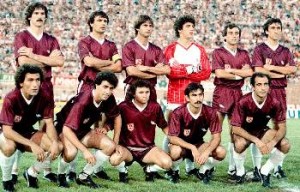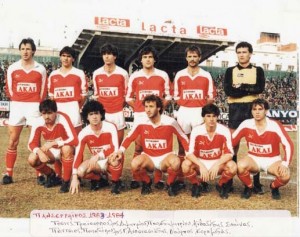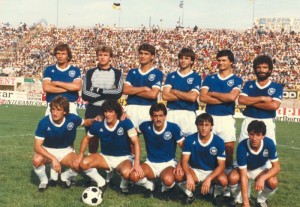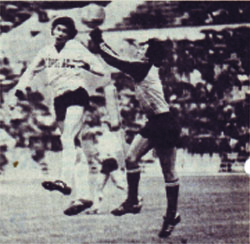
Bulgaria. The 1983-84 season started with a scandal and ended scandalously. The scandal before the championship started concerned the previous season and, on the surface, was simple enough: bribery and match fixing are classic plagues of the sport everywhere. But in the Bulgarian case, as in every Communist country, there was a specific twist. Underground, there was grumbling and murmuring about the big reason for illegal schemes: the sport had to be made officially professional. Effectively, it was, but since it was officially amateur, many clubs had tremendous difficulties to pay their players. Big clubs, especially CSKA and Levski-Spartak, had an easy way to solve the problem with salaries – they made their players Army and Police officers and paid them by the rank rates. But small provincial clubs had no such options and, as a result, had difficulties making strong teams and keeping good players. Often, they had no other way, but to create ‘black accounts’ and pay under the table. But once they had such a scheme, bribing other teams was obvious next step. For it was not just finding a way to pay players – sport, as everything else, was ideological. Failure was judged differently than mere weakness on pitch: it was ideological failure, bringing criticism and punishments for failing to contribute to the development of Socialist sport, which in turn was almost a sabotage, for, internationally, Socialist sport had to be superior. However, small clubs had no desire to develop largely because whatever talent they discovered and developed would be snatched immediately by the big clubs with the same excuse – to push further the glory of ‘our way of life’. State did not just put a blind eye to such things, but was active participant. There was nobody to complain, so the small clubs were practically doomed always to have weak teams and be blamed for that. Wise officials of smaller clubs, particularly in the Second and Third Divisions, chose safe path: they kept good enough teams to stay in the upper half of the table, not only not aiming higher, but taking measures never to be in danger of getting promoted. Yes, they were criticized for lack of ambition and stagnation, but that was easily countered: officials had to point at the table – not so bad – shrug their shoulders, what can we do with such players as ours, and promise to do better in the future. Really dangerous was relegation and that had to be avoided by any means. But such a situation only encouraged bribes and match fixing and nobody felt guilty, because the state, the Communist Party, the Football Federation, the referees actively helped the big clubs and what a small victim could do? Fix a few games just to survive. And that even without counting local pride and ambitions. The state was aware of course, but generally addressed the problem differently: as a general conclusion, the state pointed its finger at the lack of high class football and made administrative changes as if new rules could improve the game. The newest such rule concerned Third Division: the top league clubs had to have B teams, playing in Third Division. The idea was that such teams would be developing young talent – they were not to have more than a handful players over 23 years old. The rule was general, though – no third level team would have oldish squads. This was, as most invented rules are, short sighted rule, not taking into account many sporting things: the top league clubs obeyed just because they had no other chance, but the brains who invented the rule did not look further than one season… so, with relegation and promotion, some Second Division clubs had to follow the rule, but some of those going up were not affected, since the rule officially did not apply to them. But all B teams had little relation to the first squads from start: they were not made of reserves getting opportunity to play, but were hastily made from scratch full teams, generally of players the A team had no intention to use at all. It was just obeying stupid rule from the point of view of the clubs and the smaller the club was, the bigger hassle: they had neither money, nor players to keep such B teams, it was just a burden. The Federation suspected that many would just make the motions and nothing more, so there was addition to this rule: in case a B team was relegated, points would be deducted from the record of the A team. Effectively, that meant only one thing: a final table of First Division would not be final at the end of the season, but will depend on Third Division final tables and adjusted after the season’s end. If relegation was half-baked, promotion was not considered at all. The age-restriction governing Third Division made if unsuitable for promotion: Forth Division clubs were mostly village clubs and there was no way such clubs can find 20 under-23 players. They had to replace whole squads, if going to play in the Third Division. So, some teams simply refused to go up. The same problem faced promoted Third Division clubs as well – there was no age restriction in the Second Division and it was easy to see that very young squads would be simply trampled over – whoever got promoted practically had to make new team of experineced players just to stay barely competitive and that was the end of the grand aim of development: it was meaningless. But the cherry on the cake was that no B team was envisioned going up – in fact, B teams could not play in Second Division. And the B team of CSKA won its Third Division group… in order to play in the Second Division, this team had to be renamed and further separated from the CSKA. Thus, a new club emerged out of the blue, perhaps to the relieve of CSKA, for they no longer had to be bothered with some useless squad, but still able to use it as an excuse – simultaneously, they had and not had a B team. The new team, named Armeetz, had to take care of itself. Since it was based in Sofia, it had no trouble finding players – some veterans, including the former national team central defender Angel Rangelov, back from his spell in Greece, some discarded former juniors of CSKA and other clubs, nothing much, nothing special, and especially nothing promising exactly in terms of ‘development’. Going in length about this rule has only one purpose: it fostered corruption. The top leagues clubs went only through the motions. It produced no positive results, as originally imagined, and it was quickly realized that nothing good comes out of it. Instead, it made Second Division teams weaker, for thanks to this rule, players who would be playing in second division were kept at home by the first division clubs to make their B teams. This rule may have been the key reason for the decision to rearrange the Second Division at the end of 1983-84 – so far, the Second Division had two groups, Northern and Southern, currently of 18 teams each. For the next season there was to be only one Second Division league of 22 teams. Many had to be relegated to Third Division. But that was in the future – before the season started a bribing scandal was uncovered. A match at the late stages of 1982-83 was fixed: Spartak (Pleven) bribed 6 regulars of Cherno more (Varna) to win the match. They did – 2-0. The reason was that Spartak feared relegation – not because they were low at the table, but the championship developed in a way more than half the league members were in danger of relegation almost to the final round, having quite equal points. At the end, Spartak finished 5th! And, funny enough, they had one of their strongest squads ever! How the bribe was uncovered was never made clear, so from the start to this very day the story is largely rumours and myths. The most persistent and convenient one is that papers laying down the plan and sums involved was discovered during examination of the car which the coach of Spartak (Pleven) crushed and died on the spot. Discovery and investigation came late after the end of the season, when the beginning of the 1983-84 was approaching. The accidental death of the coach was most convenient, for he was made the key culprit. Penalties followed: Spartak (Pleven) was expelled from First Division for fixing the match and having ‘black account’ for that purpose, and the 6 players of Cherno more were banished. In theory, according to the level of their crimes… two were suspended for 2 years (one of them, the centre-forward Rafi Rafiev, debuted for the national team almost at the time when the match-fixing occured). Two other were banished from playing for life (note that they were less important than those suspended for 2 years). And two, presumably the most guilty, were not directly punished by the Football Federation, but were passed to the higher state body governing the whole Bulgarian sport, the Bulgarian Counsel of Physical Culture and Sports, with recommendation to exclude them any sporting activity for life. Technically, that means banishment from any relation with sports, which could be realistically translated into banishment from coaching. That concerned the goalkeeper Boris Manolkov and the team captain Ivan Ivanov – both aging players, near retirement. But their club, Cherno more (Varna), was ‘commended for its strong principled position’. And since such moral club lost half team just before the start of the new season, it was permitted to recruit 6 new players after the end of the transfer period. Those players, the permission stipulated, should be taken from Second Division clubs ‘from which players were not taken illegally during the transfer window’. Very interesting ruling… Practically spelling out that illegal practices are fine, for this ruling actually gives the right to take players without their original club’s agreement: it is just enough that no other club did the same before Cherno more to them. And finally – a play-off was staged for the place Spartak’s expulsion left free in the First Division. Another ill-considered decision… According to original rules, a promotion/relegation play-offs were played between the 13th and the 14th placed in the top league and the 2nd placed teams in the two groups of Second Division. In them the top league teams won against second division Lokomotiv (Plovdid) and Osam (Lovech). Purely from the sporting point of view, the second division teams lost their chance to get promoted. Since the new season was approaching – even the schedule was already made and published – it made sense either to leave the top league with 15 teams or to replace Spartak (Pleven) with the 15th placed team in the previous season. But it was decided that Lokomotiv (Plovdiv) and Osam (Lovech) go to another play-off and the winner take the place of Spartak. It was just swell… both teams had hastily to call back players from vacations to play this game. Neither was prepared for the match and even less so for possible playing in the top league – the transfer period already ended, all teams had their new selections registered. Both Lokomotiv and Osam had selections for second division season and had no way to reinforce their squads, if going to play in the top league. Stupid and meaningless decision, but what can you do? Two squads were pulled back from sea resorts and played something approximating football.
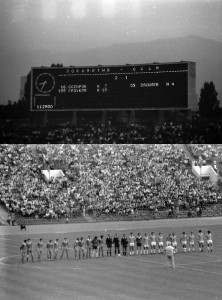
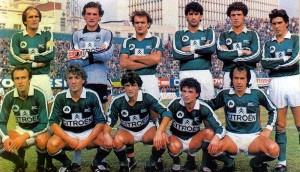
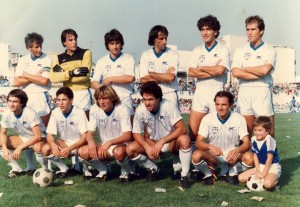
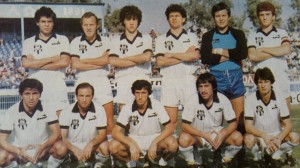
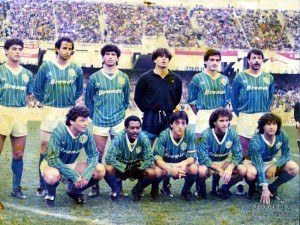
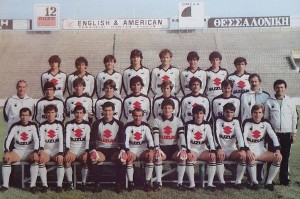
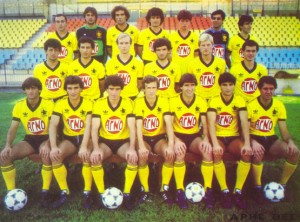
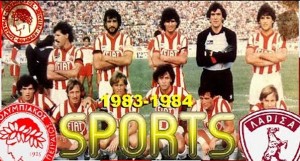
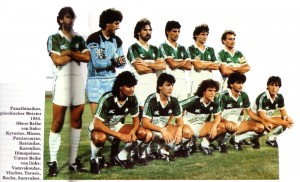
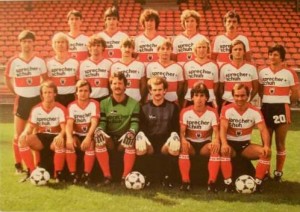
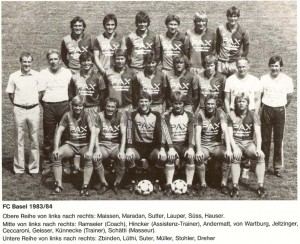
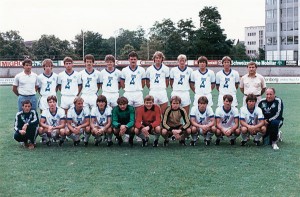
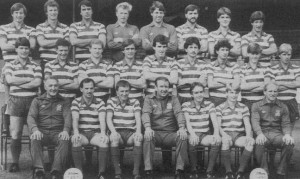
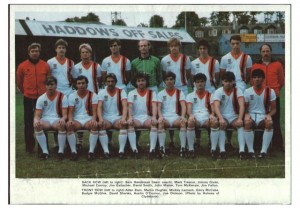
Here they are – just for completion of the circus, the match was played at the National Stadium in Sofia – after the match finished: Osam on the left, Lokomotiv on the right. Lokomotiv extracted victory in the extra-time 2-1. Lokomotiv was the strongest team anyway: it had aging former national team stars – Bonev, Staykov, Kurbanov, and current national players Sadakov and Eranosian. Osam had only one future star – young Petar Hubchev, one of the heroes of the 1994 World Cup, played right full back. Well, Lokomotiv returned to the top division, but they were not ready to play there. Full forward to the end of 1983-84 season: Lokomotiv finished next to last and was relegated. Bribing, match-fixing, and other tricks were not annihilated at all: Botev (Vratza) was found guilty of using illegible player in their away match against Sliven AFTER the end of 1983-84. Their punishment was annulling the result of the game and giving the victory to Sliven. Sliven gained 2 points and suddenly finished 3rd to the great irritation of ZSK Spartak (Varna), which already got the bronze medals. Botev lost 2 points, but that was not all – their B team was relegated from Third Division this season and Botev was penalized for that with deduction of one more point. They slipped down the table after the end of the season, finally taking 10th place. Weakened Cherno more (Varna), which was unable to find classy enough replacements for the half-team they lost after the bribing scandal, finished 13th and had to play promotion/relegation play-off. But Slavia (Sofia) finished 14th! And ‘high principles’ and ‘Socialist morality’ were abandoned entirely – hastily rules were changed: promotion/relegation was made more complicated and two more teams were included: there was first stage in which the 13th and 14th played against the 11th and the 12th . The winners kept their places in the top league. The losers went to play next round against the second-placed Second Division teams. It was not fair, but Slavia was saved – they prevailed against Shumen (11th in the final table) by a single goal. For that matter, Cherno more also survived, beating twice Belasitza (Petrich). Shumen and Belasitza, quite surprised by the new rule, lost spirit and were beaten in the next round as well and relegated. The whole thing had nothing to do with fairplay… but not a word was said. Officially, everything was fine. Not a single journalist dared to criticize – unlike the vitriol unleashed against Spartak (Pleven) affair before the start of the season. Whatever else happened in the Second Division specifically this season one can only imagine, suspect, and speculate: every club was aware of the danger ahead – 36 teams played in 1983-84, but the new amalgamated league had to be of 22 teams. 14 teams had to go down to weird Third Division with its age-restriction rule. Some were directly relegated, but 8 teams had to go to play-offs, winners keeping place in the new league, losers relegated. As for promotion from Third Division… currently, Third Division had 5 groups. The effort of reorganizing the Second Division had its limits: 5 newcomers would be stretching too far – very few current second division clubs could remain, so nobody was taking gladly such dangers: back room pressures certainly were applied, but even pure sporting reasons spoke against relegating so many teams. Newcomers form lower level, having to create new squads at top of everything, were not likely to be at the level of most current second division teams. Thus, it was decided that no direct promotion will be, but the 5 Third Division winners will play promotion play-offs. The odd number automatically made the play-offs unfair – the winner of one pair was directly promoted. The winner of the second pair went to second play-off against a team not playing originally. Lokomotiv (Russe) was the lucky team – they won against Parva Atomna (Kozloduy) and were promoted. They played two-legged play-off – a home and away game. The others, however, played one-leg play-offs on neutral ground. Akademik (Sofia) won against Tundzha (Yambol), but that was nothing… they only moved to the next play-off. And lost to Spartak (Plovdiv).
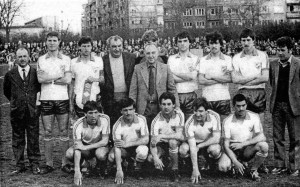
And just to finish the long saga of idiotism… Spartak (Plovdiv), freshly promoted to Second Division, was recreated back in the summer of 1983. Once upon a time they were Bulgarian champions… then they were amalgamated with Botev (Plovdiv), the new club named Trakia, but nobody considered it some new entity – in everybody’s mind it was Botev. Spartak seized to exist in the mid-60. It was recreated or restored in 1983, but contrary to every rule the new club was included directly in the Third Division. They won their Zone – the Southwestern Zone – more than confidently: 17 points ahead of the nearest pursuer, scoring 106 goals. And they played only a single match in the promotion play-offs, staged in the city of Kazanlik. Which is conveniently closer to Plovdiv than to Sofia. In fact, both neutral grounds for the Southern play-offs were in the vicinity of Plovdiv. Suspiciously near-by… Take it as you like – Spartak (Plovdiv) was promoted to Second Division. With single match played. The other newcomer played 2 matches. Both teams went through 1 stage. Akademik (Sofia) went through 2 stages.
Take it as you like… after the 1982-83 season Botev (Vtatza) had a point deducted, because its B team was relegated from Third Division. In the 1983-84 season the B teams of ZSK Spartak (Varna), Shumen (Shumen), Minyor (Pernik), Spartak (Pleven), Belasitza (Petrich), and possibly Chernomoretz (Burgas) and Pirin (Blagoevgrad) were relegated and no A team was penalized for that. Only First Division clubs had to have B teams, but… Minyor (Pernik), Pirin (Blagoevgrad), and Spartak (Pleven) were Second Division members and had to have B teams. In the same time Sliven (Sliven) had no B team at all – unless Dinamo (Sliven) was considered their B team. No B team could play in higher than Third Division, but the B team of CSKA, renamed Armeetz (Sofia), played in the Southern Second Division this season – they finished next to last. Under this name, they formally could not be CSKA B team… so, they were B team and not at the same time. Which may explain the case of Sliven and Dinamo too, but it was rotten rule only triggering schemes, corruption, and devious ways to accommodate uselessness without big spending. The stupid rule stated only Third Division and nothing else – it looked like that either promotion or relegation of such a team would effectively help getting rid of it. Clearly, the rule did not do anything positive and it was abandoned: for 1984-85 season instead of B teams playing in Third Division the old unofficial championship of reserve teams was restored – a classic practice used in many countries, from England to USSR, involving only current members of First Division. It was abandoned in Bulgaria around 1970, but now it came back with a twist: the Third Division age-restriction was preserved, but it looked possible that older players could be also used. It made most sense in its original form, though: when players recovering from after injury or not quite fit for the regular squad played in it. In its new version it was still dangerously close to ill-fated B teams: the age-cap at 23 meant largely players not to be used at all in the first squad, just teams made from leftovers and juniors to go through the motions. As for scandals… there was more to come, even worse than whatever happened in 1983-84.
But 1983-84… Second Division was rightly ripe for reform. Yes, it was typical season and yes, it was not. The reorganization of Second Division practically forced almost all current members to be concerned only with avoiding relegation. This was no new, for out of scare, this time there were no comfortably leaving mid-table ‘eternal’ members. But it did nothing in terms of quality of the game and race for top positions: as it had been for years, candidates for promotion were very few – in fact, only 4 teams. Two in Northern group and 2 in the Southern. The top team of each group was directly promoted, the second placed went to relegation/promotion play-off against those just above relegation zone in the First Division. And as practically always, the candidates for the top spots were former first division members: the freshly expelled from top flight Spartak (Pleven) and Dunav (Russe). In the South – freshly relegated Pirin (Blagoevgrad) and Lokomotiv (Plovdiv). It must be said right away that only Spartak (Pleven) had really good squad: since players were not involved in the bribing scandal and the said scandal was dealt with after the end of the transfer period, Spartak did not lose anybody of generally strong squad, having one of the brightest Bulgarian stars of the 1980s, Plamen Getov. Dunav, Lokomotiv, and Pirin had troubles for a few years already – in terms of second division football, they had strong enough teams, but not good enough for top league football. Shaky teams, unshaped and unbalanced, depending on core of great players, surrounded by third-raters. And such teams were vastly superior to the rest of second division members, so clearly things were not going as desired by the Federation and the political power – not at all in the direction of elevating the national football. Rather the other way… hence, the reform, leading to preoccupation with survival this season. Anybody bellow 8th place was either directly relegated or going to relegation play-off, which one may not survive. Risky business… Some gave up quickly: Metallurg (Pernik) earned just 8 points. Lokomotiv (Mezdra) – 11 points. Others tried hard to escape possible relegation and one can safely speculate that bribes flourished: teams, which accumulated enough points to be out of danger, but disinterested in promotion, more than likely sold games. Those, who gave up early, very likely sold games too. Goal-difference was decisive factor at the end at mid-table position: Dobrudhza (Tolbukhin, today Dobrich) ended safely 7th with 36 points in the North. Sportist (General Toshevo) also had 36 points, but ended in the danger zone – 9th. That was a sample from the North, but the same happened in the South – with 37 points Pirin (Gotze Delchev) was 7th and remained in Second Division. Their neighbours Vihren (Sandanski) was 9th with 37 points and went to the relegation play-offs.
To shorten the story: in the Northern Second Division Osam (Lovech), 3rd, Svetkavitza (Targovishte), 4th, Akademik (Svishtov), 5th, Septemvriiska slava (Mikhailovgrad, today Montana), 6th, Dobrudhza (Tolbukhin), 7th, and Yantra (Gabrovo), 8th, qualified for the new amalgamated Second Division. All of them were long-time members of second division, traditionally upper-half finishers, some of the kind never to try to get promoted.
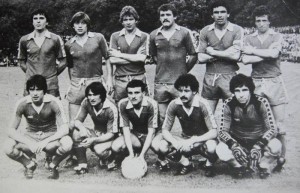
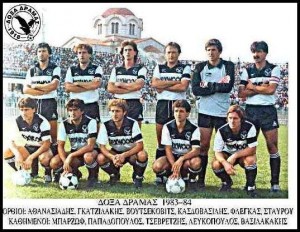
Osam (Lovech) – having a chance to debut in First Division just before the season’s start, but no such chance again – 3rd in 1983-84.
In the Southern Second Division the lucky guys were Rozova dolina (Kazanlik), 3rd, Neftohimik (Bourgas), 4th, Balkan (Botevgrad), 5th, Chirpan (Chirpan), 6th, Pirin (Gotze Delchev), 7th, and Marek (Stanke Dimitrov, today Dupnitza), 8th. 12 teams moved to the new Second Division. Direct and play-off relegations from the top league brought 4 more teams. Two teams were promoted from Third Division, making the total so far 18. The last four spots were decided in play-offs involving those who finished between 9th and 12th place in 1983-84. Directly relegated to Third Division were all teams bellow 12th place in both groups. They were: in the North – in the order of final position, starting with with the 13th, Bdin (Vidin), Chernolometz (Popovo), Beloslav (Beloslav), Lokomotiv (Gorna Oryahovitza), Hemous (Troyan), and Lokomotiv (Mezdra). In the South: Zagoretz (Nova Zagora), Hebar (Pazardzhik), Eledzhik (Ikhtiman), Maritza (Plovdiv), Armeetz (Sofia), and Metallurg (Pernik).
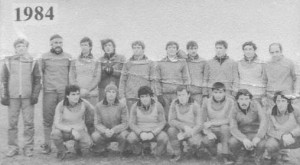
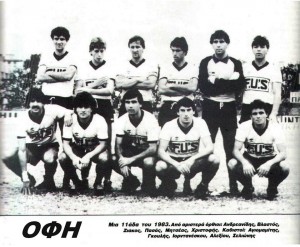
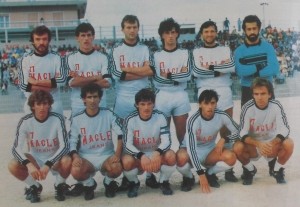
Bdin (Vidin) – one of the unlucky teams. Solid long-time member of Northern Second Division, they had relatively weak season, which under normal circumstances would not be trouble, but now they were relegated.
The play-offs for survival were between teams of the same group. In the South, Vihren (Sandanski), 9th, won over Rilski sportist (Samokov), 12th 0-0 and 2-0. Arda (Kardzhali), 11th, won over Assenovetz (Assenovgrad), 10th, 5-0 and 1-3. In the North, Sportist (General Toshevo), 9th, won over Dorostol (Silistra), 12th, 2-4 and 3-0. Ludogoretz (Razgrad), 11th, needed penalty shoot-out to win against Tryavna (Tryavna), 10th, 2-0 and 0-2, eventually 5-4 at the shoot-out. Vihren, Arda, Sportist, and Ludogoretz managed to join the new Second Division. The losers were relegated. Interestingly enough, Dorostol (Silistra) was relegated to the Third Division in their most successful season, a season to be remembered forever.
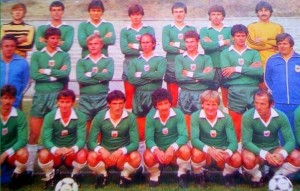
Lucky Vihren (Sandanski) – good for at least one more season in the second division.
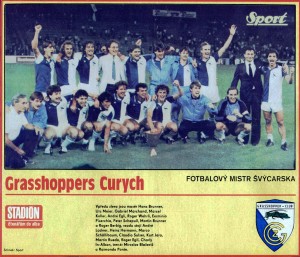
As for the top clubs, Spartak (Pleven) had strong opposition and managed to win the Northern Second Division just by a single point difference, having 49 points. Dunav (Russe) ended 2nd.
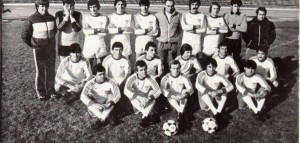
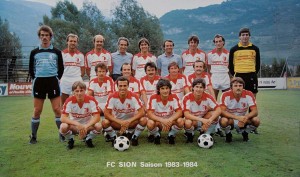
Spartak was directly promoted after a year in forced exile.
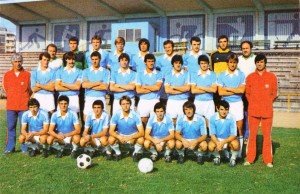
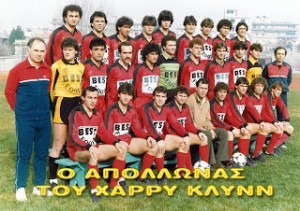
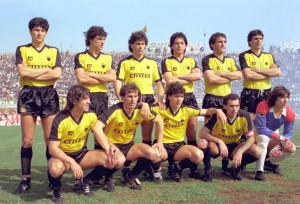
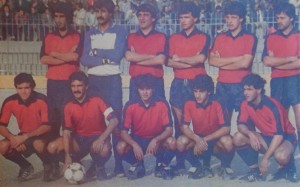
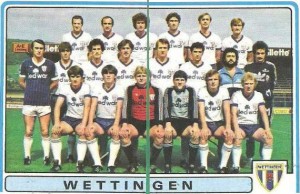
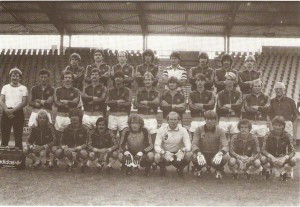
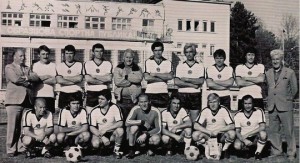
Dunav went to promotion/relegation play-off and won against Shumen after 1-1 and 3-2 home victory. Promoted as a result, so all finished swell. Also a testimony of another scandal: the coach Asparoukh Nikodimov, on the far left of middle row, made the very successful CSKA team, which eliminated reigning cup holders Liverpool and Nottingham Forest in two consecutive European Champions Cups. For this he was rewarded with having been kicked out of CSKA – and Dunav benefited imediately, although the squad was not all that strong.
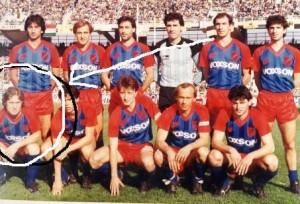
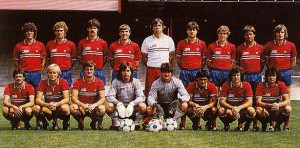
In the South Pirin (Blagoevgrad) won the championship with 49 points.
Minyor (Pernik) finished 4 points behind, but, like Dunav, took advantage from disheartened by misfortune Belasitza (Petrich) in the promotion/relegation play-off and prevailed after 2-4 and 3-0. Back to top flight, although they similar to Dunav, having no decent squad to play with the best.