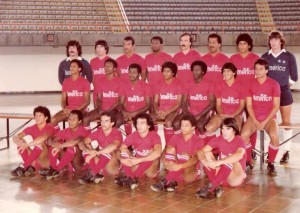
Mexico II Division

Mexico. Stable championship formula for years. Second Division had one promotional spot and that was all the lower level was about.

Santos Laguna, one of the better known clubs, had no luck.

The final was reached by Zamora and Union de Curtidores. At home, Zamora managed only a tie, 1-1, and in the second leg lost. It was tough and equal final between equally ambitious opponents, but Union de Curtidores extracted minimal 1-0 victory.

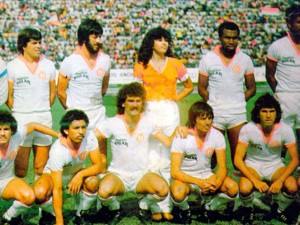
Union de Curtidores (Leon) – Second Division champions and moving up to play top league football in the next season.

South American Player Of The Year

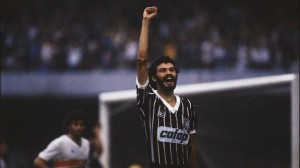
South American Player of the Year. At a glance – a bit unusual choice: no Maradona and no Zico. Eder (Atletico Mineiro and Brazil) was voted 3rd, Ubaldo Fillol (Argentinos Juniors and Argentina) – 2nd, and the big number one was Socrates (Corinthians and Brazil).

No surprise there – in general, South America had much more unquestionable individual stars than Europe and Socrates was one of the greatest among them. It was his time and since Maradona struggled in Europe with injuries and other problems and Zico was a bit down too, it was fair. Sorates was 29, he was world class and at top form. There were few other factors, tipping the scale in his favour – Corinthians was not at the top of South American, but had very strong period nevertheless. Brazil did not win the World Cup in 1982 and lost Copa America to Uruguay in 1983, but Socrates was not to blame (he played little at Copa America, appearing only in the second leg at the final). But the tall, thin as a rail, visibly lacking muscle bearded star was constantly talked about – and it was not just about his football. There was something romantic, something already gone, but something people missed badly – Socrates was so much loved because he was old-fashioned star, like he stepped out of the 1960s or earlier time. He was not a running and kicking robot, but elegant player with somewhat lazy moves and great reading of the game. He was able to produce magic with his passes, skills, goals. He was not arrogant egotist, like Maradona and provided different and more entertaining show – with Maradona it was largely hie individual brilliance; with Socrates it was the flow of the game, it was not sporadic moments of magic, but constantly entertaining game, for the bearded playmaker organized and involved the whole team . And Socrates was human, approachable, ordinary person, not a jaded star.

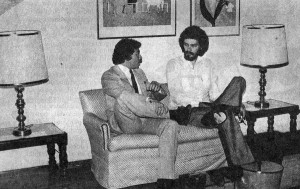
He did hide at all his human qualities or vices – here is, with his ever present cigarette in hand, talking with the Chilean great Carlos Caszeli. The glass with whiskey is missing, but it was always nearby. Just one of the neighbourhood boys, not a sparky clean professional… As for the talk, one can safely bet that it was about politics, not about new car, vacations, women. That was the other side of Socrates, also at its top at the moment – that was the time Socrates openly opposed the Brazilian military government.

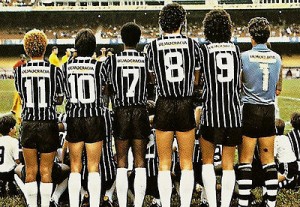
He organized his teammates and persuaded Corinthians to play with ‘Democracia’ (Democracy) written on their shirts – it was open defiance of the military rule, a political slogan bravely displayed to all to see. It was clever and effective political tool. The combination of purely football form, political stance, putting his name in everybody’s mouth, and nostalgia worked perfectly this year and Socrates got the continental award. Was it really his best playing year is somewhat beyond the point – he was one of the best players in the world, but South American competition was stiff at the moment and there was huge risk of someone left out. And many, especially Brazilians of this time, were left out – Maradona and Zico were simply on different plane. Socrates was on their level, but the award was singular… It was more than fair he won it. Yet, it was also another triumph, going against the usual – it was victory of romantic old values, victory of the anti-football in a way, at least as a perception: a player not looking like professional player (stepping out of the pre-Second World War football of ‘unfit’ stars); bohemian, smoking and drinking, as opposite to the image of hard training current professional; intellectual, as if stepping out from already very distant pre-professional days of the game; politically involved, as if it was the early 1970s, not the 80s. Socrates appeared to be odd anomaly – but produced magic on the pitch, thus defying the current notions of the game. The combination worked best in 1982-83, even in that that the other big stars played in Europe, when Socrates was still at home and everybody could see him live.

Venezuela

Venezuela. There was no Second Division championship this year, so the 10 members of the top league did not have to worry about relegation. Mineros Guayana did not for sure – they won only 1 match and finished last with 6 points. The three teams above them did not put much effort either:

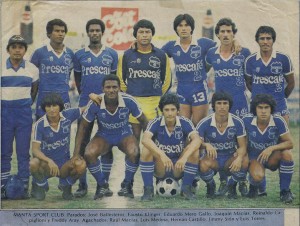
Estudiantes finished 8th with 14 points.

Deportivo Tachira – 7th with 15 points, and Atletico San Cristobal, which played very well in the previous season, was 6th with 16 points.

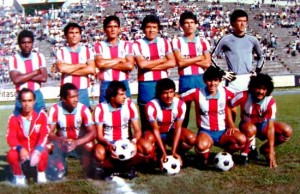
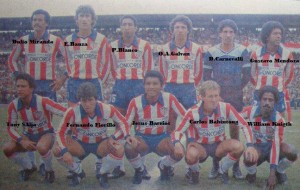
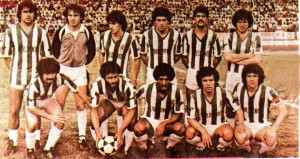
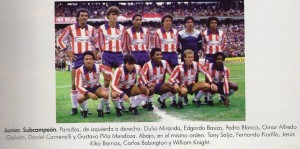
Atletico San Cristobal, posing here with a fake goalkeeper – one of the cheerleaders. In the spirit of beauty or carelessness, take your pick.

Atletico Zamora ended 5th with 20 points, Deportivo Lara was 4th with 21, and three teams competed for the title – 1 point separated them at the finish.

Deportivo Italia took the bronze with 24 points.

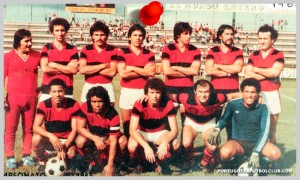
Portuguesa FC clinched 2nd place by a single goal better goal-difference – 24 points. Portuguesa lost only a single match this season.

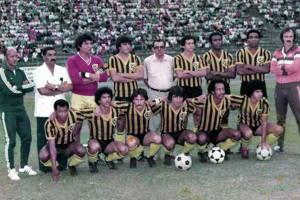
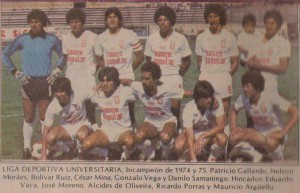
9 wins, 7 ties, and 2 losses gave 25 points to Unidersidad de Los Andes (Merida) – a point more than their rivals. So, they won the title – a difficult victory, thus sweeter. The new champions excelled in defense, allowing only 12 goals, but they won most matches as well – 9. Perhaps not attacking minded, but pragmatic team – Portuguesa, Deportivo Italia, and Atletico Zamora outscored them, but their scoring power was not matched by similarly strong defense. In the case of Portuguesa, too many ties – 10! Almost half of the total games played. ULA managed to extract wins and that made them champions at the end. Well done.

Bolivia


Bolivia. Magisterio Rural (Sucre) won promotion from the Second Level. In the First Division, there was dramatic battle of the weakest – in the 1st Phase of the championship two teams finished far bellow the other 12: Primero de Mayo (Potosi) and Independiente Petrolero (Sucre), both with 10 points. Goal-difference favoured Primero de Mayo, although they won only match. Independiente Petrolero was relegated. 8 of the 14 first division teams proceeded to the 2nd Phase and among those unable to qualify was J. Wilstermann (Cochabamba). Since the second team from the city – Petrolero – finished behind J. Wilstermann, Cochabamba had only single team having a go the title race – Aurora. La Paz proceeded with 3 out of 4 teams moving ahead, Santa Cruz also had 3 out of their 4 first division teams going ahead, and the single representative of Oruro also qualified.

4 teams were out after the second phase, in which the participants played in 2 round-robin groups: this phase was end of hopes for San Jose (Oruro),

Chaco Petrolero (La Paz), Guabira (Santa Cruz), and Aurora (Cochabamba).

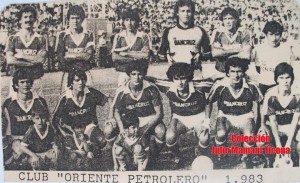
In the semi-finals Oriente Petrolero eliminated Blooming (Santa Cruz) – 0-0 and 1-0, and

The Strongest (La Paz) lost to Bolivar 0-1 and 3-3.

Thus, the final opposed Bolivar and Oriente Petrolero, a two-leg final. Bolivar won the home game in La Paz 2-1, but lost in hostile Santa Cruz 1-5. However, goal-difference was not a tie-breaker and third match was scheduled. Now Bolivar once again extracted minimal victory – 2-1 – but it was enough.

One may argue Oriente Petrolero (Santa Cruz) was unlucky. They finished 4th in the opening full-league phase (which was won by their city rivals Blooming), but stepped up in the 2nd phase, winning Group B – Bolivar was 2nd, although they were behind Oriente Petrolero only on worse goal-difference. It was the final, which was clearly unfair – Oriente Petrlolero simply destroyed their opponents in the second leg, but since they lost the first leg, there was one more match to be played – and they lost. So close, but not champions at the end.

Who would criticize winners? Bolivar (La Paz) won its 9th title – it was not easy season, but overall they were the most consistent team during the whole year – 2nd in the 1st Phase, 2nd in the 2nd Phase, reaching the final with least number of lost games – only 3. Oriente Petrolero, in a sharp contrast, lost 9 games so far – 8 in the 1st Phase. The only blemish came in the second leg of the final, where Bolivar lost 1-5 and looked like they lost the momentum and the title – but they came back in the third match and won the most important victory of the season. Not overwhelming, but steady and consistent – if one looks at the whole picture of the year, the most deserving team.

Ecuador

Ecuador – the usual South American complexity: the championship went through 3 different stages until the champion was proclaimed. And, similarly, the relegated. Small top division – 14 teams, largely concentrated in Quito (6 clubs) and Guayaquil (3 clubs). Those were the main powers and protagonists, however, times were changing – Everest was in decline and trouble and almost unknown club was moving up, Filanbanco.

Second level was hidden from sight, but there were clubs previously playing top level football.

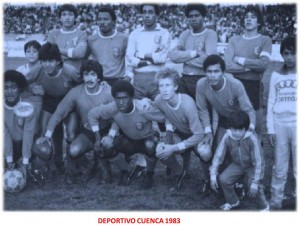
Deportivo Cuenca, for instance.

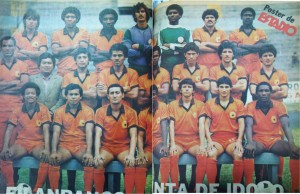
Filanbanco, however, won the Second Division championship – and moved up. But Filanbanco was to be heard of in South America, if nowhere else, later in the 1980s.

Everest (Guayaquil) was the big disappointment this year – they were consistently last. And relegated, as a result. One of the traditional leaders of Ecuadorian football.

Emelec (Quito) was the other disappointment – they were technically 8th at the end of the season .

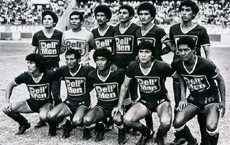
The third club in dire straits hailed from Manta – financial hardship was the likeliest reason. Formerly known as Delfin, now they played under the name Manta-Sport It was not so bad for the moment, but for how long? 6th in the final table.

LDU (Portoviejo) on the other hand was climbing up – they finished 4th, improving with every next stage of the championship. They did better than their traditionally stronger and much more famous namesakes LDU (Quito). However, it is difficult the figure out why… in the second stage Portoviejo finished bellow Quito. True, only on worse goal-difference, but bellow.

Yet, LDU (Quito) did not reach the third stage of the championship and technically took 7th place – or rather should have been 7th, if there was full final table. They were not a factor at any stage, so 7th was pretty much their objective finish.

Barcelona (Quito) did well as usual, yet, not exceptionally well – 4th in the opening stage, 1st in the second stage, but 3rd in the most important final stage – and 3rd overall.

Barcelona was left behind by a club hardly ever in leading position: 9 de Octubre (Milagro). One more provincial club disturbing the status quo. Wonderful season, except for the second stage, where they finished 7th – perhaps saving strength for the final round. But teams coming up from nowhere are rarely able to win – 9 de Octubre came close, but 2nd place was their proper position.

As for the champions, they were familiar name – more than familiar. El Nacional (Quito), one of the strongest traditional favourites was going solidly strong. 1st in the opening stage, 2nd in the second stage, and 1st again in the final stage, deciding the championship.

So, champions again. Standing from left: Orlando Narváez, Wilson Armas, José Jacinto Vega, Milton Rodriguez, Marcelo Proaño, Hans Maldonado, Manuel Ron (Utilero).

Front row: Carlos Ron, Gonzalo Cajas, Victor Mora, Fernando Baldeón, Fabián Paz, Miño.

The players hardly ring any bells outside Ecuador, but they won the title in 1982 and repeated the success in 1983. Their Brazilian coach Roberto Abruzzesse deserves the credit, naturally. So, El Nacional was staying strong to the envy of its declining rivals.

Paraguay

Mysterious – and simultaneously familiar – Paraguay. 1983 is particularly frustrating: scarce records. Atletico Colegiales and Oriental supposedly won the Second Division championship, but they also participated in the First Division. Little was known about Paraguayan football back than and litle is known now.

Clubs, like Sport Colombia, were unheard of – it was only sure that they were not members of the small top league.

Which played championship of stages, just to make the most of the small size – 10 participants, most of them from Asuncion and playing top league football practically forever. 6 teams reached the final stage, the final table had no clear winner and championship play-off between 3 teams followed.

Nacional, along with Cerro Porteno were not among of the favourites this year.

It may have been very frustrating for Cerro Porteno – without a victory since 1977 and seemingly getting worse.

The championship play-off was played between Libertad, Sportivo Luqueno, and Olimpia. Libertad finished 3rd.

Sportivo Luqueno ended 2nd – strong year, but unable to win the title. Julio Cesar Romero was the big figure, although another name would be instantly recognized today: Jose Luis Chilavert. However, in real time the famous goalkeeper was still young back-up goalkeeper and another Chilavert was regular – Rolando Marciano Chilavert, young and talented striker. In the long run, though… fame changed significantly.

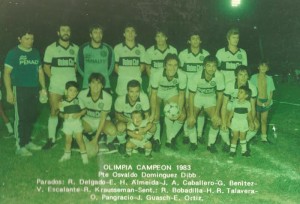
May be challenged and winning only after a play-off, but Olimpia won once again. The familiar name of Paraguayan football, perhaps the only familiar club. And the players were also familiar – the starters were practically the same for years. The incredible run of this squad continued – 6th consecutive title. It was never done before in Paraguay, but the team, unchanged since 1977, was getting old.

Peru I Division

First Division – one of the least complicated championships in South America. The league was going to be reduced again from 17 to 16 teams, so 2 teams were relegated. This was decided by the final table of the first stage of the championship – the Decentralised Tournament. After every team played 32 games there was final table – the lowest 2 were relegated, the top 6 proceeded to play the title decisive Championship Group tournament.

Leon De Huanuco was last with 20 points and relegated.

Juan Aurich was 16th with 22 points and also relegated.

Alfonso Ugarte survived – 15th with 23 points.

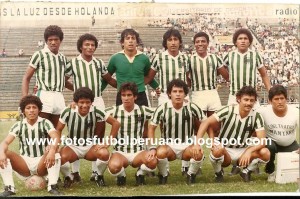
Huancayo FC – 14th with 24 points. Standing from left: Carlos Castro, Cisterna, Ernesto Herrera, Raul Torres, Orlando Mendoza, Arturo Garcia.

Crouching: José Pajuelo, Morales, Luis Servat, Jose Ocampo, Jorge Burger.

Union Huaral – 13th with 25 points. Standing from left: Cesar Carrillo, Adán Ciurlizza, Pedro Paredes, Hilario Bernaola, Victor Espinoza, Juan Caceres

Front row: Sergio Silva, Eloy Ortiz, Humberto Rey Muñoz, Luis Rehder, Enrique Camacho.

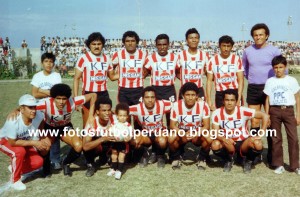
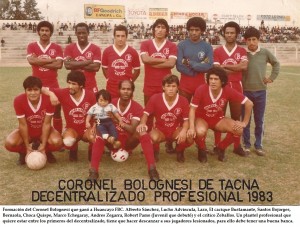
Coronel Bolognesi – 12th with 27 points.

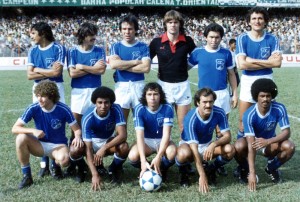
Atletico Chalaco – 11th with 28 points. Standing from left: Carlos “Sérpico” Rivas, Alberto Eugenio, Goyzueta, Eder Ríos, Aldo Dueñas, Oscar Peralta.

Front row: Alejandro Pozú, Percy Gómez, José Lavalle, Adhemir Arroé, Jesús Sabastizaga.

A. D. T. – 10th with 29 points. Standing from left: Rowland Chumpitaz, Rinaldo Quesada, Lizandro Navarro, Armando Carrizales, Alejandro Mujica, Roger Valdivia.

Front row: Víctor Barzola, César Aguilar, Peña, Rolando Echegara, Kiko Bendezú.

Terrible season for Alianza (Lima) – 9th with 31 points. Standing from left: Jaime Duarte, Pedro Belber, Tomás Farfán, Juan Illescas, Simón Olea, José Velásquez, José Gonzáles Ganoza.

Front row: William Huapaya, Jorge Olaechea, Guillermo La Rosa, Freddy Ravello.

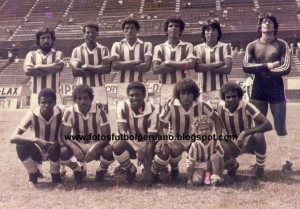
U.T.C. – 8th with 33 points.

Sport Boys – 7th with 28 points. Standing from left: Carlos Carbonell, Luis Cárdenas, Eusebio Salazar, César Guerrero, César Espino, Darío Herrera.

First row: Juan José Muñante, David Zuluaga, Héctor La Torre, Víctor Hurtado, Nalvarte.

And the top 6, qualifying to the final tournament: Atletico Torino – 6th with 39 points, Deportivo Municipal – 5th with 40 points, C.N.I. – 4th with 40 points, Universitario – 3rd with 40 points, Sporting Cristal – 2nd with 41 points, and FBC Melgar – first with 44 points.

The Championship Group was round-robin tournament, opponents meeting once. The teams started clean, no points were carried over from the Decentralised Tournament. And whoever managed to preserve strength earlier and to reach top form at this stage had the advantage.

Atletico Torino was the weakest and finished last with 1 point.

C.N.I. – 5th with 2 points. Standing from left: Víctor Vargas, Israel Quijandría, Freddy Cañamero, Florentino Bernaola, Mikel Ramírez Púa, César “Huevo” Adriazola, Oscar Vera.

Crouching: Roberto Arrelucea, Martín Gago, Mario Gutiérrez, Juan Rivero, Ernesto Guillén, Ernesto “Chivo” Neyra, Wilson “Calamina” Ramírez, Nehemías Mera, Ricardo Vinatea.

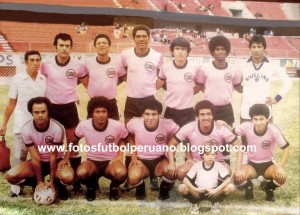
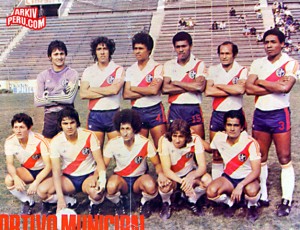
Deportivo Municipal – 4rd with 5 points. Standing from left: Gamarra, Malásquez, Mendoza, Garrido, Quintana, Manzo.

Front row: Zorrilla, Navarro, Gonzáles, Bonelli, Camacho.

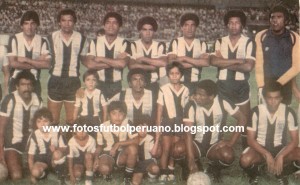
Universitario – 3rd with 7 points. Back row from left: Hugo Gastulo, Juan Carlos Jaime, Germán Leguía, Eduardo Aguilar, Raúl Garcia, Luis Gardella.

Front row: Carlos Espósito, Eduardo Rey Muñoz, Bira, Samuel Eugenio, José Cañamero.

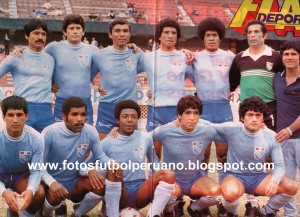
FBC Melgar – 2nd with 9 points. Unable to continue the strong performance in the first part of the championship, but still stronger than most, finishing second best and getting the second Peruvian spot in the Libertadores Cup. Standing from left: Jorge Ramirez, Jesús Oviedo, Julio Ramirez, Raúl Obando, Freddy Bustamante, Angel Gutiérrez.

Crouching: José Aguayo, Víctor Concha, Reynaldo  Jaime, Genaro Neyra, Víctor Gutiérrez.

Not only familiar, but truly supreme champions – Sporting Cristal (Lima) won every match they played in the Championship Group – a perfect record of 5 of 5, scoring 13 goals and receiving just 4. Nothing to compare with the second best – FBC Melgar ended with 11-11 goal difference. Sporting Cristal were the highest scorers all year long – they outscored FBC Melgar by 22 goals in the Decentralised Tournament. They lost only 5 games during the whole year – Universitario lost 6, FBC Melgar – 8. Only FBC Melgar won more games than them – 21; Sporting Cristal won 19. More than well done! And one more title. Here are the heroes: standing from left: Pedro Ruíz, Miguel Gutiérrez, Héctor Chumpitaz, Uculmana, César “Chalaca” Gonzáles, Humberto Valdettaro.

First row: Luis Reyna, Enrique Boné, Juan Caballero, Jorge Hirano,Julio Aliaga.

One must admire the seemingly eternal Hector Chumpitaz – still the champion, a guarantee for success.

Argentina Nacional

Campeonato Nacional – different formula, different clubs, different outcomes. Here various provincial clubs had their chance, here failures in Metropolitano tried to save face. Rather difficult for evaluation championship, but one thing was sure – very few Argentinian clubs had really strong teams, able to play well two championships in a single year. 36 teams were divided into 8 round-robin groups, the top three qualifying to the next round. Which was also made of 8 round-robin groups, but of 3 teams each – they played also three times against each other. The top two qualified for the 1/8 finals and the championship followed standard cup format to the end – direct eliminations to the final, played in two legs.

No surprises at first – almost every initial group had true outsider and there was chance for a big club to exit at this stage: 3 out of 4 were going ahead. All eliminated were anonymous teams:
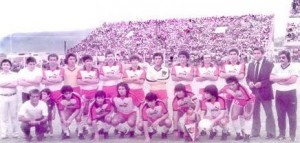
Andino (La Rioja) – Group A with 2 points,
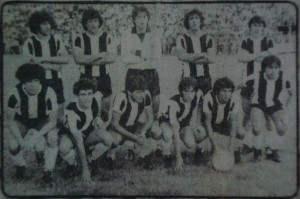
Chaco For Ever (Resistencia) – Group B with 3 points,
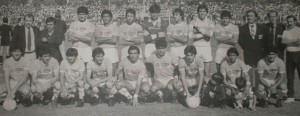
Atletico Santa Rosa (Santa Rosa) – Group C with 0 points, the only team unable to make even a tie,
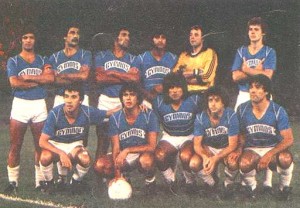
Estudiantes (Rio Cuarto) – Group D with 1 point, Union San Vicente (Cordoba) – Group E with 1 point,
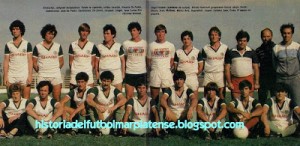
Kimberley (Mar del Plata) – Group F with 2 points, Atletico Concepcion (Banda del Rio Sali) – Group G with 4 points, and Gimnasia y Esgrima (Mendoza) – Group H with 4 points. Only the last two came close to a chance for qualifying to the next round.

Second step – 24 teams, divided into 8 3-team groups. The last in each group was eliminated after the teams played 3 games against each other. This stage was more intriguing. The end of hopes for: Instituto (Cordoba) – group A, Nueva Chicago (Buenos Aires) – group B,
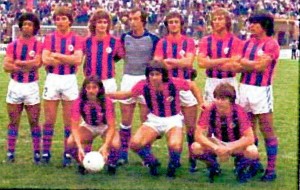
San Lorenzo de Almagro (Buenos Aires) – group C. Standing from left: Sosa, Videla, Insúa, Quiroga, Higuaín, Hrabina, Quinteros.

First row: Bueno, Coudannes, Rubens Navarro.

Huracan (Buenos Aires) – group D. But this was strange group – Huracan was eliminated only on worse goal-difference. They finished with 5 points and 2-2. Union (Santa Fe) was second with 5 points and 7-6. First in the group finished Platense (Vicente Lopez) with 6 points and negative goal-difference – 8-13! Apparently, they won their home matches and lost all away games – and 3 wins and 3 posses, no matter how bad, gave them not just qualifying spot, but the first place in the group. Amusing ending.
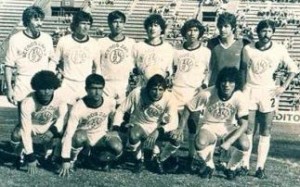
 

Altos Hornos Zapla (Ciudad de Palpala) was last in group E – they did well, reaching this round of the championship, but no more.

Juventud Antoniana (Salta) was last in group G, unable to get even a single point at this stage. In the same group another unheard of club reigned supreme – Loma Negra (Olavarria). They won their group in the first round, now they did it again, even more comfortably – 4 wins, 2 ties, 16-3.

In group H Renato Cesarini (Rosario) was also – like Juventud Antoniana, they lost all matches, only ending with slightly better goal-difference than Juventud Antoniana – it did no matter, they were out.

1/8 finals. Some statistic discrepancy – results given for Cordoba’s derby, Atletico Racing vs Talleres, are wrong: 2-2 and 0-5. Looks like easy win for Talleres? But Atletico Racing qualified to the ¼ finals… after extra time and penalty shoot out after the match statistically lost 0-5. Must have been a tie really and numbers mixed-up: Atletico Racing won 5-3 the penalty shoot-out.
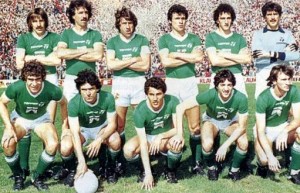
 

End of the line for Ferro Carril Oeste – they were eliminated by Estudiantes (La Plata): 0-1 and 2-2.

Independiente (Avellaneda) and Union (Santa Fe) exchanged away wins – in both legs the visiting team won 1-0, so there was extra time and penalty shoot-out. Only then Independiente prevailed – 6-5.
The Cinderella story of Loma Negra (Olavarria) ended here, but not before the second leg against Racing Club (Avellaneda). So far, lowly Loma Negra was great surprise – they won their qualifying groups in both early stages of the championship. They came to inhospitable stadium of Racing and won 2-1. With one match on home turf, Loma Negra seemed bound to play at the ¼ finals at least. But it was not to be – Racing Club arrived determined to win and they did it with powerful 4-0.
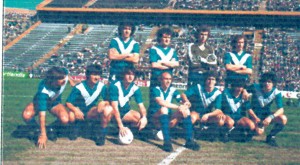
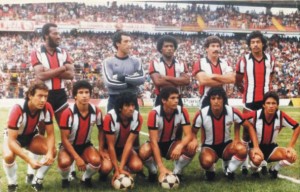
Velez Sarsfield (Buenos Aires) was eliminated by River Plate by a single goal – 0-1 and 0-0. Standing from left: Moralejo, Ciciuffo, Pumpido, Ischia.

First row: Bujedo, Vanemerak, Nannini, Bianchi, Alonso, Comas, Larraquy.
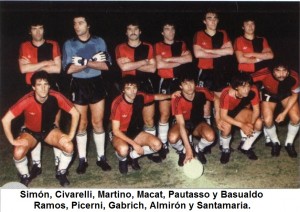
Newell’s Old Boys (Rosario) was beaten by city rivals Rosario Central 0-2 and 0-0.

Platense (Vicente Lopez) lost to Temperley – they managed a scoreless tie in the first leg, when the visited, but lost the home leg 1-2.
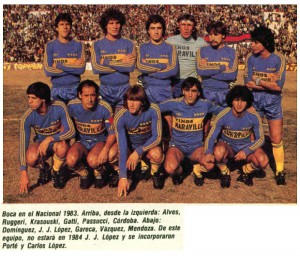
And Boca Juniors finished at this stage – they tied the away leg against Argentinos Juniors 1-1 and lost the home leg 2-3.

The ¼ finals were tough and there were more casualties:
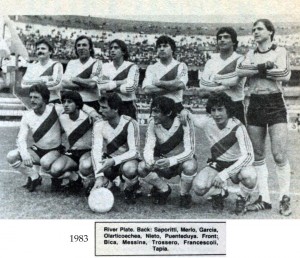
River Plate was out, losing to Argentinos Juniors – 0-0 and 0-1. Once again, the losing team did better in the opening leg, when they were visitors, and then lost at home.
Racing Club lost the first match in La Plata 1-3 and they won the home leg, but the victory was not enough – 2-1. Estudiantes qualified.

Atletico Racing tried their best to move ahead and almost succeeded – both games against Independiente ended 1-1. Extra time did not change the result and Atletico Racing stepped down after at the penalty shoot-out: 2-4. Independiente qualified again with more luck than skill.

Lastly, Rosario Central vs Temperley. Rosario Central was not exactly strong this year, but historically Temperley was never strong – under the circumstances, one rather strange team was going to the semi-finals. Temperley won their home leg 1-0 and managed to keep its fragile lead in the second match in Rosario – 1-1.

The semi-finals opposed Temperley to Estudiantes and Independiente to Argentinos Juniors.
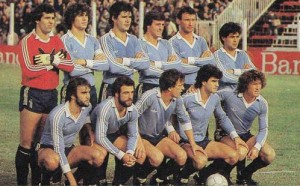
Temperley may have been the weakest semifinalist, statistically speaking, but they were not going to give up – far from it! They managed 1-1 tie visiting Estudiantes. The second leg also ended 1-1. But no miracle – Estudiantes, stronger and more experienced anyway, prevailed with 2 unanswered goals in the extra time. Still, it was wonderful season for Temperley – one to be remembered.
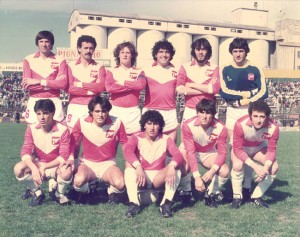
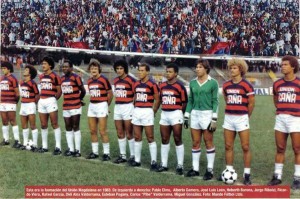
Argentinos Juniors was also looking like finalist after the first semi-final leg – they won 2-1 in Avellaneda. But Independiente came back in the second leg and won 2-0. Argentinos Juniors was out. Standing from left: Landucci, A. Herrera, Domenech, Pavoni, Batista, Fillol.

First row: Castro, Pasculli, S. Espindola, C. Villalba, R. Gallett.

Not a bad squad at all and too bad they were eliminated. And a curious touch: the add on Espindolla’s shirt is misplaced.

Finals at last. Estudiantes vs Independiente. Whatever unusual results appeared so far, no surprise teams at the final – two big names. Estiduantes took 2-0 lead in the first leg, played in front of home crowd. Independiente came back in the second match, but Estudiantes managed to score and the match ended 2-1. Goal-difference was in Estduiantes favour – they were the champions of the 1983 Campeonato Nacional.
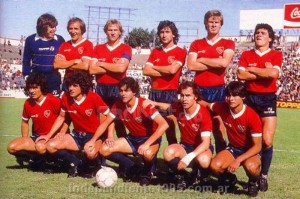
So close, but empty-handed at the end. Standing from left: Carlos Goyén, Zimmermann, Enzo Héctor Trossero, Hugo Villaverde, Claudio Oscar Marangoni, Carlos Enrique.

Crouching: Enrique Sánchez, Ricardo Giusti, Jorge Luis Burruchaga, Ricardo Enrique Bochini, José Alberto Percudani.

Independiente was unable to win a double this year – disappointing, of course, but not much. They were clearly the strongest Argentine team at the moment – champions of Metropolitano, second in Nacional, a good squad of largely new stars. Independiente was remarkably consistent – the most consistent club in the country, for all other big clubs fluctuated up and down – Independiente was evenly strong since the end of the 1960s.
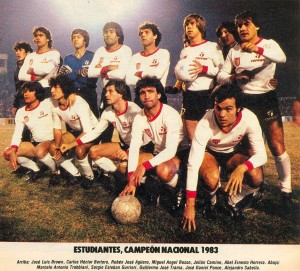
 

Estudiantes won the title and that was great – they won Nacional for the first time, but there was more to it: Estudiantes won Metropolitano in 1982, now they won Nacional. Not accidental winners, that was sure – finally, a new strong period arrived. After a long drought, one may add – Estudiantes lost its glory after the end of the 1960s, there last title before 1982 was in 1967. Now they were back and the team was not bad at all – Russo, Trobbiani, Ponce, Sabella. Not first rate stars and may be getting old, but still good enough core of a team – if not better, at least at par with the other strong teams. Well done so far, but the team needed additional talent to keep a leading place – so, it was a matter of quick reaction and not missing the moment. However, money was the deciding issue… management was probably well aware of the needs and knew what to do – if they could afford it.


Peru II Division

Peru. The second level was a bit mysterious: statistical records tell that Barcelona Surquillo (Lima) won the Second Division. But there was no Second Division. Or was there? May be the district of Lima had Second Division – similar to Argentine Metropolitano Second Division. However, when it came to promotion to the First Division, Copa Peru served as second level – in it every administrative department of the country had a represent, qualified to the national level after many preliminary rounds in the home department. 24 teams plus the relegated from the top league team in the previous year – 25 teams in total. After two qualifying rounds 6 teams reached the final round-robin tournament and the winner was not only the winner of Copa Peru, but promoted to the top league too. In case teams finished with equal points, the result of their direct match decided who was higher in the final table. So, the final table, providing the home department of every team:
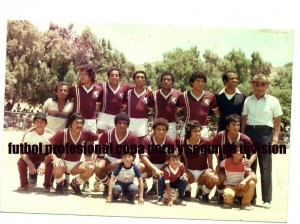
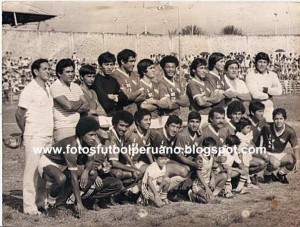
 

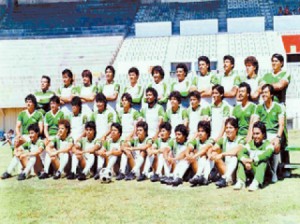
Real Madrid (Camana, department Arequipa) – 6th with 1 point.

Cienciano (Cusco, Cusco) – 5th with 4 points,

Juventud La Joya (Chancay, Lima) – 4th with 4 points,

Barcelona Surguillo (Lima, Lima) – 3rd with 7 points,

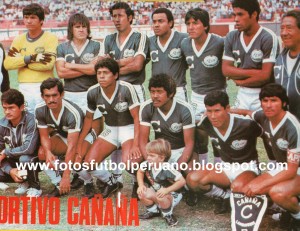
Deportivo Canana (Lambayeque, Lambayeque) – 2nd with 7 points, and

Sport Pilsen (Guadelupe, La Libertad) – 1st with 7 points.

Big success for Sport Pilsen – promotion to First Division. Unheard of winners, which, judging by the name, were tightly connected with a beer brewery. Since one of the strongest Peruvian clubs was also connected with brewers – Sporting Cristal – the next year promised a beer derby.

Colombia

Colombia. The champion came out of complicated formula – first was the Apertura or Copa de la Paz championship. It was followed by Clausura or Torneo Nacional. Then a bonus table was made – the top teams in each championship got bonus points – which were very strange: from 1 whole point down to 0.25 point. And after that the top 8 teams played a final championship – Octagonal Final, where the bonus points were counted and the end of this smaller championship was effectively the final table and the winner in it – the champion of Colombia. As in many similarly complicated championships, there were teams strong in the first half of the year and others preferring to reach top from late in the year, when it was truly important.

Apertura had no true final, but ‘extra series’, where the top teams of the original two groups in which the league was split, played 2 more games – it was odd: not a full round-robin tournament, but the after the two extra games there was final mini-table.


Atletico Junior got 1 point in the extra series, DIM Medellin – 2,

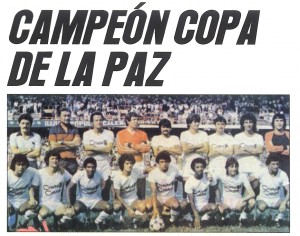
Millonarios – 2 points, and Once Caldas – 3. This extra points made Once Caldas the winner.

Once Caldas – the winner of Apertura/ Copa de la Paz.

The final four also got bonus points, according to their final place – Once Caldas – 1 point, Atletico Junior – 0.75, DIM – 0.50, and Millonarios – 0.25 points.

Campeonato Nacional promptly followed and it final table in way was important only for the bottom 6 places this year – the top 8 still had to play.

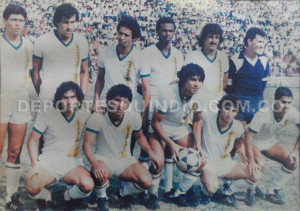
Deportes Quindio finished last with 13 points.

Cucuta Deportivo – 13th with 14 points.

Atletico Bucaramanga – 12th with 18 points. Dark period for the club, which fans prefer not to remember.

Deportes Tolima – 11th with 19 points. A big drop from the succesfful previous season to insignificance.

Once Caldas – 10th with 24 points. Apparently, everything was spent in the Apertura and the second half of the year was just woolgathering.

Union Magdalena – 9th with 24 points. ‘Didi’ Alex Valderama was still more famous than young boom Carlos ‘Pibe’ Valderama, but no matter – the team was weak this year.

That was final for the above teams – the top 8 were going to the final championship, so only the winner of Clausura should be mentioned now:

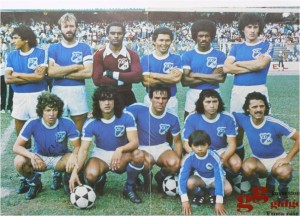
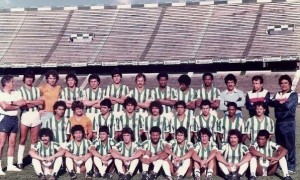
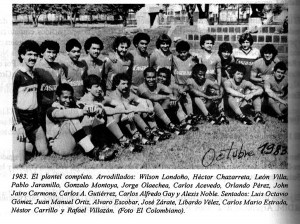
Atletico Nacional, 1st with 37 points. Standing from left: Jorge Lagomarcino (preparador físico-q.e.p.d), José Luis Brown, Hugo Lorenzo Carrabs Finno, Sergio”Bocha” Santín Spinelli, Luis Fernando Suárez Guzmán, Santiago”Sachi” Escobar Saldarriaga, Luis Fernando López Yépes, Guillermo Claudio”Tanque” La Rosa Laguna, Víctor Emilio Luna Gómez, Jaime Night Agamez, Fabio Alberto”Gallina” Calle González, Anibal”Maño” Ruíz (asistente técnico) Luis Alberto Cubilla Almeida (director técnico-q.e.p.d).

Middle row: Víctor Jaramillo, Carlos Alberto Aristizábal Correa, Silvio”Chino” Padilla, Juan Jairo”Andino”Galeano Restrepo, Pedro Enrique Sarmiento Solís, Álvaro “Polo” Mondragón, José Ignacio Maya Peña, Ricardo Amado”Gandhy” Rodríguez Asprilla, Jhon Jairo López Yépez.

Sitting in front:Carlos Alberto Maya Peña, César Augusto”Cucharita” Cueto Villa, Carlos Alberto”Ilustre” Ricaurte Daza, Gabriel Jaime “Barrabas” Gómez Jaramillo, Aparecido Donizette Oliveira “Sapuca”, Carlos Mario Vanegas, Javier “Pillo” Cardona, Hernán Darío”Bolillo” Gómez Jaramillo, Manuel Asisclo”Triciclo” Córdoba Aguilar.

Since Colombian players were not familiar names back then, only their coach deserves a note – the great Uruguayan star Luis Cubilla made rarely successful transition from player to coach – he practically ended his playing career with success and immediately won a title as a debutant coach. And continued to win – now he was in Colombia and led Atletico Nacional to first place in Torneo Nacional.

Now the bonus table was completed – Atletico Nacional got 1 bonus point, Amercia – 0.75, Millonarios – 0.50, and Atletico Junior – 0.25 points. That is, the top 4 teams according to the final table of Clausura/Torneo Nacional. Two teams got bonus points from both Apertura and Clausura – Millonarios and Atletico Junior, but it was hard to tell how strong they really were – true strength was to be displayed in the Octagonal Final and something in the vicinity of 1 extra point did not matter all that much. What mattered was to play really strong in the last 14 games of the year.

DIM – Deportivo Independiente Medellin – did not play very well the whole year and finished 8th with 7.50 points.

Deportivo Cali – 7th with 9 points.

Independiente Santa Fe – 6th with 12 points.

Once Caldas… should not be here, but it was. Who knows why.

Deportes Pereira was 7th in Torneo Nacional and they should have been playing in the Octagonal. Unless Once Caldas was allowed as champions of Apertura – any other explanation would be fishy. Anyhow, Once Caldas was entirely unimpressive – 5th with 14 points.

Millonarios was steady through the whole year, but no more than steady… 4th with 16.75 points. Standing from left: Moises Pachón, José Daniel Van Tuyne, Alcides Savedra, Nolberto Molina, Arnoldo Iguaran, Wilmer Cabrera.

Front row: Norberto Peluffo, Alejandro Esteban Barberón, José “Cheché” Hernández, Carlos Ángel López, Alonso “Pocillo” López.

The big name here was the Argentine Jose Daniel Van Tuyne, but he was hardly enough for success.

Atletico Nacional managed just 3rd place – not bad, but unable to keep up with their earlier success. Unlucky too – they lost 2nd place on worse goal-difference.

Atletico Junior (Baranquilla) ended 2nd with 19 points, but better goal-difference placed them above Atletico Nacional. By now, Europeans hardly remembered the Argentine stars of the first half of the 1970s, but aged Daniel Carnevalli and Carlos Babington were still good enough to keep their current club strong.

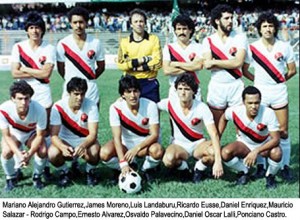
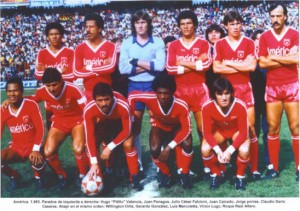
When it came to playing just when it mattered most, nobody knew it better than America (Cali). For the most of the year they kept themselves among the favourites, but did not do more. But when the Octagonal started they pushed up. And won. The final table does not show it well – America was 1st with 19.75 points, less than a point ahead of the competition. But remember that the top three teams all carried bonus points. America was not overwhelming champion, but if bonus points are voided, they were still first, for they won most points in the final tournament.

Since winning was already just routine for America, better take another look at the victorious squad and say no more.