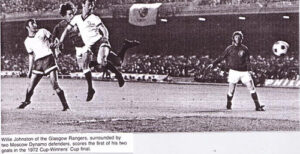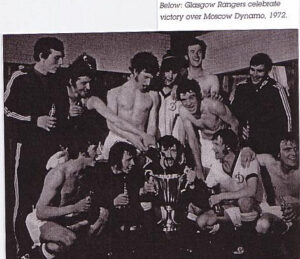
The next level of international football – the European club tournaments – will be slightly changed here: the European Champions Cup will be last. The Cup Winners Cup was a Scottish triumph: Glasgow Rangers won their only European club title. It was sweet – Celtic dominated the Scottish league for so many years, the Old Firm were becoming desperate. Finally, the gloom was over. At least, if one was Rangers fan… for the final was somewhat tainted: Rangers faced Dinamo (Moscow), the first Soviet club to reach European final. There was a bit of irony in it: Lev Yashin was still a player of the team winning the Soviet Cup in 1970 (because of their one-year season, the Russians were unable to field their cup winners in the same year, but actually the next – so, Dinamo started the 1971-72 Cup Winners Cup, reaching the final in 1972, almost two years after winning the domestic cup). He retired in 1971, and the greatest goalkeeper of all time missed the greatest international success of his club.
Rangers was leading 3-2 a minute before the final whistle of the final and its fans rushed on the field to celebrate. In the chaos, the referee ended the match. The Russians protested – they, and not only they, felt the rules were breached and Rangers were made winners unjustly. Political discrimination, fumed the Soviets. But UEFA sided with the referee – the time left of the match was negligible and there was no reason to think the Russians would have equalized, left alone scoring two goals, during the few seconds left. Rangers got the cup, but for puritans of the game taint remained. It was felt that the fans effectively helped their team to get the cup. The pitch invasion also left a bitter taste of different nature – security. It was still cheerful and harmless crowd, yet, it was dangerous and intimidating event. Football hooliganism was just becoming noticeable and in the next years became severe and growing problem. As for me, I have no clear opinion: at that time it was common crowds to invade the pitch to celebrate with their team. It was traditional. I was also glad that the Russians lost the final – I never supported Soviet team for political reasons. In purely football terms – hard to say. What difference few seconds could make? It was not like Dinamo player was in a position to score when the final whistle came. More or less, I felt the Russians used formal reason to protest, hoping the result to be annulled and the match replayed. Rather weak protest, though.
Final, Nou Camp Stadium, Barcelona, 24 May 1972, att 35000
Rangers (2) 3 Dinamo Moscow (0) 2
23′ 1-0 R: Stein
40′ 2-0 R: Johnston
49′ 3-0 R: Johnston
60′ 3-1 DM: Estrekov
87′ 3-2 DM: Makovikov
Rangers
McCloy; Jardine, Johnstone, Smith, Mathieson; Greig, Conn, MacDonald,McLean, Stein, Johnston
Dinamo Moscow
Pilgui; Basalayev, Dolmatov, Zykov, Dolbonosov (Gershkovich); Zhukov,Baydachny. Yakubik (Eshtrekov), Sabo; Makhovikov, Yevryuzhikhin

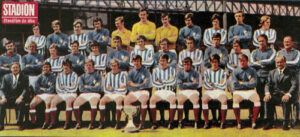
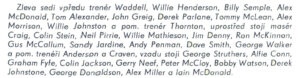 Thanks to Igor Nedbailo for Stadion team photos!
Well, the other finalist and moments from the final:
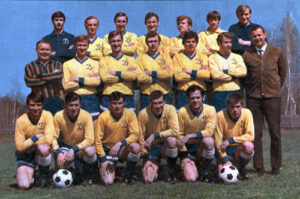
 An interesting team this vintage Dinamo: Yashin already an administrator; talented, but ill-fated Bajdachny, who died in car crush not long after the final. Both goalkeepers eventually played for the national team – Pilguy already in 1973. Very promising Gershkovich, Eshtrekov, and Kozhemyakin – but never becoming more than a promise. Old fox of legendary status – Josif Sabo. A somewhat quite player in 1972, but almost ten years later top goalscorer of USSR championship – Andrey Jakubik. And a coach who became a legend, but not with Dinamo – Konstantin Beskov. Lastly, yellow jerseys are not typical Dinamo colours (they played with familiar white and blue against Rangers).
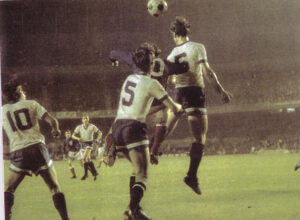 From British perspective, Dinamo played ‘bravely. From Soviet perspective – naturally, they were better than Rangers, but the referee plotted against them. According to the pictures, looks like Dinamo played mostly in defense. Not true, really.