Albania

Albania, behind her own impenetrable curtain, was dark enigma at that time. Nothing came out (and nothing came in) – in the sporting aspects: occasional international game was the only glimpse of Albanian sports, including football. Final tables was practically the whole information. Even today the period is dark – few pictures emerged. One thing was known, though: Albanian football was weak. The top league was going to be enlarged for the next season – from 12 to 14 teams – so only one club was relegated in 1977-78 and three clubs were promoted.

Of course, promotion concerned the best three in the Second Division.

Besa (Kavaje) won the second division – champions in their own right.

Besa was joined by Besëlidhja (Lezhë) and Naftëtari Qyteti Stalin. Nothing really to tell about the best of second level football… except the third club with curious and possible only in Albania by the end of the 1970s name: this club was named and renamed.

It hails from the town of Kucove, was quite old by Albanian standards – found in 1926 – and was related to the petrol industry. Still exists, but ‘Stalin’ was dropped years ago.

Four clubs fought the battle for survival in the first division. The battle went to a play-off after the end of the regular season – Traktori Lushnjë and Lokomotiva Durrës escaped unharmed with 19 points each, but Labinoti Elbasan and Skënderbeu Korçë had only 18 . Skenderbeu had better goal-difference, but the Federation decided on play-off. The relegation play-off was dramatic, judging by the results – both legs ended scoreless. Over time changed nothing and penalty shoot-out followed.

Labinoti clinched 6:5 victory, double sweet for it was extracted in Korce, the home of Skenderbeu.

Skenderbeu, one of the oldest Albanian clubs, went down.

At the top of league something else happened – the clubs from Tirana, normally favourites, were out of the race for the title. 17 Nentori was actually 6th.

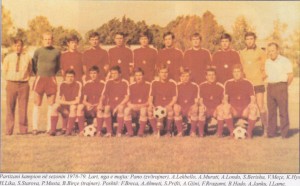
Partizani finished best – 3rd – yet, they were not contenders with their 25 points. Provincial clubs bested the capital city, something rare.

Luftëtari (Gjirokastër) with a point more than Partizani finished second, but they hardly challenged the champions. Yet, it was a great season for the club.

The most successful and perhaps the only provincial club traditionally rivaling the teams from Tirana won the titles.

VLLAZNIA (SHKODËR) won 10 matches, tied 9, and lost 3. Their goal-difference was 32-19. Best record in the league, naturally, but significantly so: it was difficult to beat squad – Luftetari, Dinamo (Tirana), and Flamurtari (Flore) ended with 6 losses. Partizani lost 8 matches – that is, 1/3 of the total 22 championship games. The defensive record of Vllaznia was best in the league, but strangely shared with the clubs at the very bottom – Labinoti and Skenderbeu also received just 19 goals. As for the attacking record, Vllaznia had no equals – only two clubs scored 30 goals: Partizani, a round 30, and the champions 32. Perhaps not an overwhelming champions, but still Vllaznia finished wit 3 points lead.

This was the 5th title for Vllaznia and 3rd in the 1970s, after 1971-72 ans 1973-74. Strong decade for the club, one of the consistently strong teams.

The Cup finals opposed Dinamo (Tirana), one of the regular favourites, but having relatively weak championship, against Traktori (Lushnjë). Traktori was not among the best Albanian clubs – quite old, founded in 1926, they had been renamed after Albania became Communist in 1945 and not only once. In 1958 they were named Traktori for the second time, but the ‘progressive’ name helped little. When playing in the first division, they were found in the lower half of the table. The club won absolutely nothing, except the Second League championship in 1960. Now they had a chance for a real trophy. And they tried hard – the first leg of the final ended 0-0. A very promising result, for the match was play in Tirana. Unfortunately, in the second leg Dinamo scored a goal and kept their fragile lead to the end. No miracle happened.

Dinamo (Tirana) won their 9th Cup.


Cyprus

Cyprus played her largest ever league – 16 teams. There were 15 the previous season and one more was added, as planned, bringing the league to the most common format. The motivation behind the reform was clear – big league meant more players playing more competitive matches. Thus, eventually the quality of the players should rise… never fully convincing argument, countered by exactly opposite proposition: small league concentrates the best players into few clubs, making each stronger and the best playing against the best must boost quality. At the end, neither argument is really convincing – in part because they leave lower levels of football pyramid inadequate. In Cyprus, the situation was very much alike in Finland, Iceland, other small and not populous countries: tiny town and villages often had more than one club, which dispersed talent widely without making most clubs stronger. Paphos had two first division clubs – APOP and Evagoras – for instance. Larnaca had three. So Limassol. Plus the derby of the exiles – Famagusta, in the Turkish part of the island since the civil war partitioning the country in the 1960s, had two clubs in the league, Anorthosis and Nea Salamina, both homeless and temporary borrowing location in the Greek part. Their situation is still the same in the 21st century. Such league was obviously depending on momentary form of any club, here the picture differed than the one in the Scandinavian states: Cyprus traditionally had two dominant ‘super-clubs’ – Omonia and APOEL. Nicosia ruled and the enlargement of the league became immediately counter-productive: more championship games simply meant more easy wins for the top two, making the gulf between them and the rest of the league bigger, not smaller. Lastly, the enlargement of top flight decreased the number of relatively good teams bellow – the fact that only one club was relegated and only one was promoted from the second league pretty much recognized the desperate situation. It also decreased even temporary ambitions for most clubs: small enough, now they were satisfied just with staying in the league – and now it was easier: only one spot was dangerous and with many games between relatively equal teams, it was not very difficult to achieve mediocre security. The relative parity was represented well in the final table: there was no clear outsider, every club was able to get many points, but the more familiar names still got more… the last in the league ended with exactly half the points of the 4th. But they also lost the battle for survival by a single points and two more clubs barely escaped (APOP and Evagoras – the teams from Paphos finished 13th and 14th). Digenis Akritas Morphou were lucky – 15th with 19 points.

Halkanoras Dhali got the short stick – 18 points placed them last and relegated. An young club, founded in 1948, Halkanoras were absolutely unknown – Dali or Dhali is the name of their home, either a village near Nicosia, or outskirts of the capital. There presence among the best was brief and due entirely to the enlargement of the league – they played a grand total of 2 seasons there, coming in in 1976, when the league was enlarged from the traditional 14-club format to 15, and relegated the next year. Never to return…

Poor Halkanoras was to be replaced by the Second Division winners:

Omonia (Aradippou). Slightly better than Halkanoras, but not much… a typical ‘in between’ club, which meandered between first and second division, never lasting long in top flight, but still too good for the lower level. Not exactly a club adding quality to the top league.

Above Halkanoras the teams were spread gradually, climbing up a point or two, and reaching the ‘climax’ with Pezoporikos (Larnaca) at 3rd place.

Bronze medals were a success, no doubt about it, but it was strictly domestic success – Pezoporikos prevailed over clubs more likely to finish on the podium – Paralimni and Anorthosis – and triumphed over city rivals Alki and EPA, but was not for a second threatening the real favourites – with 37 points, they were 4 points behind the silver medalists.

Which were familiar, usual, predictable, expected… APOEL (Nicosia). The bulk of the league did not bother APOEL for a second, but… they had a weak season, unable to challenge their arch-enemy. APOEL ended 10 points behind the champions.

It was not even two-horse race – Omonia was overwhelming.

22 wins, 7 ties, and a single loss. 77-15 goal difference. Omonia had no rivals.

It was even pointless to count their titles anymore… the team was full of Cypriot national team players, led by the great goal-scorer Kaiafas – but the names meant nothing outside Cyprus. It was just the best team on local scale.

As good as Omonia were, they were unable to win a double – Omonia did not reach the Cup final. APOEL did and also AEL (Limassol), otherwise having a dismal season (12th in the league).

There was no doubt about the desire of AEL to win and they fought bravely, but the opposition was not only classier – APOEL had their own ambitions, especially when they were not able even to challenge Omonia in the championship. AEL distinguished themselves by losing minimally – only 0-1. A final, but not a cup…

As for the winners – they were not overwhelming winners, but still got the cup. True, the final was dragged into overtime and it was very difficult to score, but eventually they scored the golden goal.

APOEL saved the season – cups still counted back then. Not just a small compensation for not even running for the title. Difficult victory, but a victory, bringing them back to relative parity with Omonia. The old status quo remained unchanged – the big clubs from Nicosia dominated the Cypriot football. Of course, APOEL had a good number of national team players, but they had no player like Kaiafas – that is, no player known outside the island. Perhaps that was the whole difference between the two enemies and it was huge difference… at home.

Iceland


First signs of improvement in Iceland – few players appearing in foreign championship. Scotland, Denmark, it was not much yet. Icelandic players really built reputation in the 1980s – these were still tiny first steps. As a whole, Icelandic football was becoming sturdier, tougher, but still very easy to beat. As for domestic championship, they loved their football on the island and the small clubs playing in small leagues were at least not in peril similar to other small continental clubs. Ups and downs were frequent, of course – typical for fairly even amateur leagues.
KR Reykjavik won the second league. One of the most successful Icelandic clubs, they had some hard time, dropped to second level, but now were coming back. The oldest Icelandic club, founded in 1899, was not to stay down for long.

Second placed and also promoted were Haukar Hafnarfjördur.

Haukar were insignificant, compared to KR Reykjavik – moving up to first division was big achievement for them. Not bad anyway – just try to find their home town on a map… and Haukar was not the only club in Hafnarfjördur either. It is a miracle that a place like that can have a club at all – yet they had more than one. Haukar was found in 1931 and is much better known for its handball team, not for their football section. Sweet season – even in mild-mannered Iceland it was a matter of pride to better one’s city rivals.

For Haukar went up and at the same time FH Hafnarfjördur finished 9th in first division with 10 points. Were they able to get a point more, a village derby would have been played in 1979, but no. FH were relegated. Having 3 points more than the last team was no consolation.

UB Kopavogur were dead last. They had one more victory than FH – 3 in total – but 7 points was the worst league record. One of clubs rarely playing top level football – more or less, naturally did not last long and went down.

Reykjavik, the capital city, was represented by 4 clubs in first division, and except Trottur, these were traditionally successful clubs – Fram, Vikingur, and Valur. Yet, it was not a race between the ‘big boys’ from the capital. Fram and Vikingur were weak this year; Trottur – just happy to escape relegation. In fact 8 of the 10 league members were not even close to the favourites – the bronze medalists, IB Keflavik finished 9 points behind the 2nd placed. Enourmous gap, considering that it was achieved after only 18 championship games.

It was not surprising to see IB Keflavik high in the table, but in reality they were their almost by default – just having a point more than others.

It looked like a two-team race, but it was not – the silver medalist were superior to the rest of the league, scored more goals than anybody else – 47, lost only 2 matches… and finished 6 points behind the champions. Not contenders at all – rather, staying alone: much stronger than the league and much weaker the real contenders.

IA Akranes got the silver, but may be it was just a bit weaker season. The club was one of the strongest Icelandic clubs in the 1970s and won the title in 1977.

Thus, only one club was left – Valur Reykjavik.

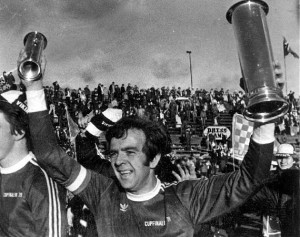
Not surprising at all to see them at the top – the club already won 15 titles. They were consistently strong – the first title was won in 1930, their last – in 1976. Valur won championships in every decade and perhaps the 1950s were their weakest, for they won only once, in 1956. There was drought between 1967 and 1976, but clearly it was over. Valur did not lose a single match this season. A single tie prevented them from finishing with perfect record of straight wins. Their defense was impenetrable – only 8 balls crossed their goal-line. Their strikers were second-best in the league – only IA Akranes scored more, but not much more: 47 to Valur’s 45. Absolutely dominant champions. Such supremacy suggests a double…

Valur reached the Cup final, where they faced the second best this year, IA Akranes. Given the supremacy in the league, the final was not to be big deal. Perhaps… IA Akranes had their own ambitions and pride, they won 1-0. No double for Valur, but what a success for IA: they won their very first Cup!

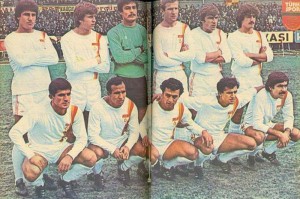
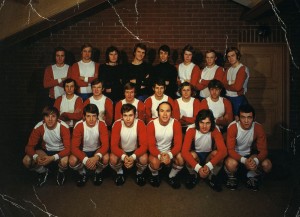
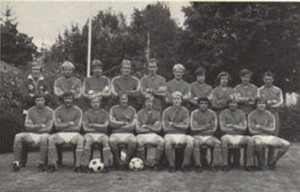
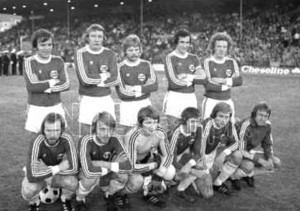
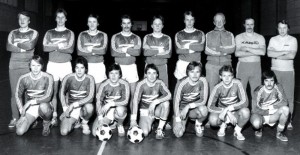
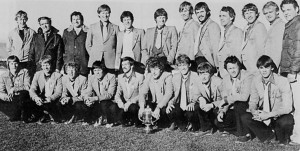
Historic vintage for IA Akranes, but the names are a bit of a mystery… Sitting, from left: K. Thordarsson, Stefansson, Hakonarsson (?), Sveinsson, Gudjonsson, G. Thordarson, Olafsson, Einarsson (?), Sigurdsson (?), Hardarsson (?).

Standing: Valtisson (?) – administrator, Alfredsson, Halgrimsson (?), Akselsson, Petursson, Thorbjornsson, Engilbertsson (?), Bjornsson, Gundlandsson (?), Halldorsson, Kirbie (?) – coach.

Some national team players here, some familiar names – but one cannot be sure, for Icelandic names are quite the same – Petursson, Gudjonsson, Thordarson, so many have such names and were some of present here becoming well known professionals in Europe, or not, cannot be easily established. But no matter – IA Akranes more than compensated for not having been contenders this year: first ever Cup is a great achievement.


Finland

Finland was arriving at inevitable changes – the old amateur system was beginning to crack. It was increasingly difficult to maintain teams – the financial pressures were getting stronger and stronger. And the sad process of disintegration took place: clubs merging or giving up competitive football, some were changing names as part of restructuring, all desperate attempts to keep the game afloat, which are still at work. As a result, from a time distance Finnish football is very puzzling – unfamiliar names and hard to tell what is the relation of the old clubs to the contemporary ones. One thing is certain – many cities, rather small, had more than one club playing in the best two divisions back in the 1970s. Oulu had 2 clubs in first division and one in second. Kokkola – one in first and two in second. Turku – 2 in first division. So had Kuopio. Lahti – one in first and one in second. Mikkeli was the same. Helsinki, the likeliest city to have more than one club at top level, had 2 in first divison – less than much smaller towns. It was clear that most of the ‘redundant’ clubs will disappear – and they did. Ikissat (Tampere) merged with TaPa under entirely new name – Ilves. This club won promotion to the first division this season. KIF (Helsinki) changed its name to Kiffen, although the club itself remained KIF, as if deliberately – to confuse foreigners. SePS (Seinäjoki) also renamed itself to Sepsi-78. More footnotes are in order, unfortunately, but for the moment changes seemed to work: Sepsi-78 tried hard to win promotion to first division, finishing 3rd in the Second Division. 4 points ahead from the 4th, MP Mikkeli. Not a small advantage in 12-club league, but quite short from promotion too – the winners finished 3 points clear of Sepsi-78.

The top two spots were decided on goal-difference – two clubs ended with 31 points. KTP Kotka got the second place, enough to return to top flight.

The newly formed Ilves (Tampere) clinched first place, immediately showing ambitious teeth. Aparently, the combined strength of two clubs worked: Ilves started with a title. A second division winners, but still a good beginning. As for KTP, probably they were not disappointed by the season either, for they still won promotion.

First division was divided into 4 groups of teams – a curious partition of small 12-club league, but most teams were secure no matter what: two clubs were hopeless outsiders from the start of the season – even their combined record was only good for the last place.

OTP Oulu was last with 6 points. They won just one match… A relatively young club, founded in 1945, it was already doomed – the neighbours OPS were older, having bigger fan base. And Oulu had other clubs too… the agony was long, but there is no OTP today: in 2002 they plus few other clubs merged into AC Oulu.

A point better than OTP was Kiffen. They had twice the number of victories of OTP – two.

Kronohagens Idrottsforening (abbreviated KIF) are old – formed in 1908. As most continental clubs, it is all-sport club and the football section is just one among many. In the ancient past, KIF won three titles – back in the 1910s. By the 1970s it was no longer a force – not in Helsinki, let alone Finland. They changed the name to Kiffen, as fans called it anyway, but the big change brought nothing… they were relegated. 7 points were 10 points short from safety. The drop continued – Kiffen exists still, but can be found in Third Division.

With outsiders so weak, the rest of the league had nothing to worry about. Four clubs seemingly just went through the motions. Three more – TPS Turku, OPS Oulu, and MiPK Mikkeli – just distanced themselves from the rabble, building a 5-point advantage by the end of the season, but had nothing to do with with the title: they were also 5 points behind from 3rd placed club. Three clubs competed for the title and at the end 2 points separated the champions from the bronze medalists.

Haka Valkeakoski finished 3rd, not a surprise – they were usually strong in the 1960s and 1970s, one of the more familiar names in Europe, for they often played in the European cups.

KPT Kuopio finished second with 32 points – a point better than Haka, and a point away from the title.

This was the best so far season of Kuopion Pallotoverit, as their full name was – or Koparit, as they were also known. They played quite regularly in first division, but also were no strangers to relegation. A great season, but this is a club not to be found today… they disbanded in 1990.

The title was clinched by a point – HJK Helsinki finished with 33 points. Thanks to winning most matches in the league – 13. They did not excell in anything else – KPT Oulu lost the same number of matches, 2; TPS Turky scored more goals than the champions – 57 to HJK’s 52; almsot half the league had better defensive record than the champions, including the 10th placed Pyrkivä Turku. HJK received much goals than their pursuers – 29. Hada allowed 19 and KPT only 15. But no matter – HJK enjoyed the final victory.

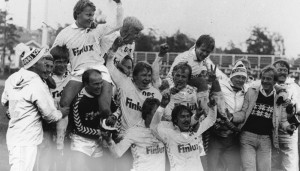
HJK were not exactly ‘the big, dominating club’ of Finnish football, but were consistently strong and often winning trophies. So, one more… as for the squad, the names mean very little: Jouko Soini, Atik Ismail, Adil Ismail, Juha-Pekka Laine, Risto Salomaa, Dan Högström, Martti Holopainen, Ari Lehkosuo, Matti Kinnunen, Eero Virta, Juha Dahilund, Pasi Rautiainen, Henry Forssell, Jorma Virtanen, Olli Isoaho, Kalle Niemi, Miikka Toivola. Two foreign names here – Atik and Adil Ismail, most likely naturalized immigrants, for the amateur Finnish clubs had no means to import players. Shirt sponsorship was already common – an obvious effort to bring some cash to the clubs. Good for the boys, though – winning a championship counts.

The Cup final opposed Reipas Lahti to TPS Kuopio. An excellent season for TPS – they were at the top at both championship and cup. Perhaps the best season ever, but… without a trophy. The Cup final was two-legged – Reipas won 3-1 the first match and tied the second 1-1. The best season of TPS meant no trophy – twice second, twice coming very close to winning, but no. Still, given the history of the club – a big success.

In the 1970s it was quite normal to see Reipas winning something or at least coming close to winning. Strong years of the ancient club, founded in 1891. They were weak in the championship this year, finishing 9th, but won the Cup. A purely historic record remains today: neither of the 1978 Cup finalists exists now.


Northern Ireland

Northern Ireland – the second oldest league in the world, but what a sorry state… Obscurity. Twelve semi-professional clubs competed in closed league, no promotion and relegation, and hardly any decent players. There was much ups and downs, yet, the league was more or less dominated by the two ‘big clubs’ from Belfast – Linfield and Glentoran. Belfast was represented by few other clubs – Crusaders, Cliftonville and Distillery – but they played smaller role. Even the big clash between Catholics and Protestants was more likely to happen in Glasgow, not in bullet ridden Belfast. And nothing really new happened on Northern Irish stadiums this year. Ballymena United was the absolute outsider – last with 10 points, but nothing to worry about since there was no relegation to a lower division.

Up on top – not much either.

Glenavon (Lurgan) were 3rd – comfortably third, 3 points ahead of the next pursuer, but not even dreaming of higher place – they finished 6 points behind the silver medalists. Which meant only one thing: no UEFA Cup for Glenavon – Northern Ireland had only single allotment.

Second place meant playing international games, however briefly. It was taken by usual suspects – Glentoran.

The squad is only a matter of record, as ever, but the season was not very strong – Glentoran were much stronger than the rest of the league, but were not contenders. Except for the derby, they did not challenge Linfield.

So it was a one-horse race. Linfield lost a single match during the campaign. They had no rivals. Won 19 out of 22 total matches, outscored the league by far – 65 goals. The second best was Glentoran with 59.

Linfield finished 6 points ahead of their rival and collected their 31st title. But it was not all – the champions also reached the Cup final. The other finalist was curious one: Ballymena United, the weakest team in the league.

A relatively young by Irish standards modest club, founded in 1928, Ballymena United never won anything. A club normally found in the lower half of the league table – the only thrill the local derby with Coleraine. A dismal season, suddenly compensated by progress in the Cup. Ballymena had a chance… before the match was played. They lost 1-3.

They lost, predictably, but they lost to the champions and thus, as Cup finalists, got to play in the European Cup Winners Cup. Bit success for the lowly club. But this is almost everything to be said about the ‘Braidmen’ – dissatisfaction and increasingly sinking reputation of the Cup Winners Cup were based on participants like Ballymena United. The other thing which should be mentioned is the the clubs kit – perhaps the first club in Northern Ireland using shirts advertisement.

As for the winners, it was their 31st Cup. A curious parity – 31 titles and 31 Cups, won at the same time.

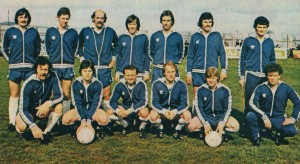
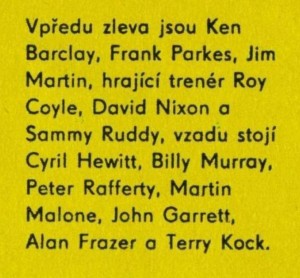
A double, supremacy in everything, record numbers of wins – such achievers are usually legendary. And perhaps this squad is legendary in Belfast. But nowhere else… it is modest, anonymous team. Few players appeared for Northern Ireland, but left no lasting memories. Perhaps Peter Rafferty is the best example – the star of Linfield played only few matches for the national team and did not attract the interest of English or Scottish clubs, even those of lower divisions. The crème of Northern Ireland never played at home, it is easy to draw conclusion about the strength of the supreme champions.

Norway


Norway, modest as ever, but not without intrigue. The Cup final opposed Lillestrom SK and Brann.

Lillestrom, led by their wonderful star Tom Lund, prevailed – 2-1 – and won one more trophy. The strongest years of the club continued.

The championship was a bit different than usually – Norwegian football had no overwhelming favourites, teams appeared quite equal, but this season the 12-club league split into three distinct groups. Three clubs fought their own battle at the bottom, trying to reach the save 10th place. Molde FK were the lucky ones at end with 12 points. The previous year they were at the top of the table, but such changes of fate or strength were common. At least Molde escaped relegation. By a point – the other two clubs finished with 11 points each.

Having better goal-difference, Lyn (Oslo) finished 11th. No matter – relegated they were. One of the oldest clubs in the country, founding member of the Football Association of Norway in 1902, champions and Cup winners, but all was history and quite ancient history too. The last success was the double in 1968. The decline of the club representing upper middle class was not temporary – it turned out to be long and painful. The relegation was not even the worst moment, but rather an early signal that Lyn was permanently losing its leading position. Perhaps to the joy of their city rivals, Valerenga, the working class club.

Last finished the opposite kind of club like Lyn.

Steinkjer FK had no glorious past, not even memorable one. The club played rarely and briefly in first division. Old they were, founded in 1910, but their existence was marked by a single triumph: the second place in 1961-62 championship. Soon they was back in second division and after ten years there they were finally promoted in 1977. 1978 was not good at all – this happened to be the last time Steinkjer played top league football. Outsiders…

Six clubs occupied the middle of the table – relegation was not a concern (the weakest of the group finished 6 points ahead of Molde), not disturbing the leaders either (the gap between 3rd and 4th place was 5 points). Only Brann deserves mentioning of this group – they reached the Cup final and also they were the top scoring team in the league with 52 goals. They finished 5th.

The last group battled for the title. Two familiar contenders – Viking (Stavanger) and Lillestrom, perhaps the best Norwegian clubs of this decade. No surprise seeing them on top. The trird club, although familiar name, was a surprise. IK Start (Kristiansand) were not often at the very top, so bets were on the obvious rivals. Viking finished 3rd with 31 points. Above them ended Lillestrom thanks to better goal-difference. The champions had 2 points more – 33 – and they were the underdog: Start. True to their name to the finish.

One more old club – Start was founded in 1905 – but nothing more. Regular members of the first league, sometimes among the best, but so far not a single trophy. And may be Viking and Lillestrom did not take them seriously, given Start’s history. May be the other contenders were preoccupied with fighting each other and did not pay attention to the dark horse. Whatever it was, Start collected point after point and at the end had the most.

First time champions! Such squads are usually remembered and called legendary… unfortunately, Norwegian players meant nothing outside their home country. No names… but champions! Well done. Yet, they were unusual – lower levels of world football were marked by high scoring at that time. Norway was not an exception as a whole – her champion was, though. Given the numbers, Start appeared clearly defensive-minded team. Their strength was at the back – they received only 13 goals in 22 championship games. The next best record was 22 – shared by Lillestrom and Viking. But the attack… Start scored just 30 goals. Only three clubs scored less – the relegated Lyn and Steinkjer, and the 7th placed Bryne. Yet, Start won the most matches this championship – 13. Strong defense paid out.

Wales


Wales, an anomaly not only on the British isles – ancient clubs, one of the earliest official tournaments in the world – the Welsh Cup was played in 1877-78 for the first time – and no championship. The Cup itself was organized differently than anywhere else – English clubs were also allowed to participate and won it on five occasions, but we are not talking here of Manchester United, Arsenal, or Liverpool, but of small clubs playing in lower divisions or outside the professional leagues. Thus, the authority of Cup was not very commanding. Welsh football was really based on 4 teams – the national team and the three professional clubs playing in the English leagues. Yet, Wales was represented in the Cup Winners Cup by their current winner – and, lacking a championship of its own, not represented in any other European club tournament. Given the peculiar circumstances, it was logical that the professional clubs would dominate the Cup and among them Cardiff City was the best known and the highest ranking – they were currently in Second Division, Wrexham – in Third, and Swansea City in Forth. Wisdom tells that Cardiff City were practically without competition, but ‘wisdom’ in football is dubious thing.

Cardiff City were historically the best Welsh club with some considerable success. Presently, they were down on their luck – they finished 19th in the English Second Division, barely escaping relegation by a point – but still were the highest placed Welsh club. Yes, they were in decline for some time and the other two professional clubs were rising – Wrexham won the Third Division this year and Swansea City was third in Forth, thus earning a promotion to Second – but Cardiff was the obvious choice. Alas, reality was different – they did not reach the final. Nor Swansea City which already started perhaps the best period of existence, leading them to First Division in few years.

Wrexham reached the final and the other finalist was Bangor City. Ancient club, founded in 1876, distinguished by two ‘firsts’: they won the inaugural season of the Welsh Cup and also in first edition of the UEFA Europa League (this, however, happened much later than the year presented here).

Bangor City also played in the very first Welsh championship in 1922 – yes, there was Welsh championship, but it was amateur or semi-professional, and not representing the Welsh Federation internationally, mat be because the top clubs played in the much better English leagues. And not only that: there had been various Welsh leagues – Bangor City was founding member of 7 such leagues before the 20th century ended. Which one was ‘the league’ was impossible to tell again pretty much to the end of the century. Anyhow, Bangor City, semi-professional at best, reached the final and had a good chance of winning the Cup for a forth time. The last time they won it was 1962 and the last time they played at the final was in 1973.

But it was not to be – Bangor City lost both legs of the final – 1-2 and 0-1 – not by much, almost equal to the rising professionals against them, but ‘almost’ brings no satisfaction. Wrexham won.

Wrexham won the Cup, as they did so many times during their long history. Their crest says 1873, but the club was founded even earlier – in 1854. One of the oldest clubs in the world and the oldest in Wales. Their Welsh names is Clwb Pêl-droed Wrecsam – it is much safer to stick to Bangor City, it seems. Long history, but the club is not famous – just one small professional club, normally playing in the lower English divisions. They excelled in the Welsh Cup, though and won it more than anybody else. The current victory was not easy, but still a victory.


A very good year for Wrexham – champions of the Englsih Second Division, earning promotion to higher league, winning the Welsh Cup.


Ireland the Cups

The two Irish cups did not bring surprises.

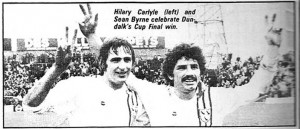
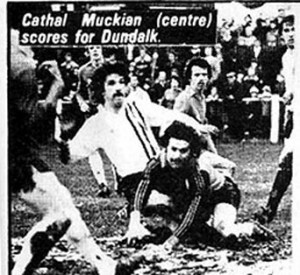
Dundalk won the League Cup. A compensation for otherwise weak season – they finished 11th in the league. The victory was not easy at all – the final ended at 2-2 tie. The replay was exactly the same – 2-2. Penalty shoot-out clinched the victory, but perhaps the losers deserve the final word: they were Cork Alberts. The short history of the club under this name makes them successful in peculiar way – two mid-table seasons in first division and cup final. That is all… and 1977-78 is the best ever season.

The FA Cup final opposed Sligo Rovers, having a good spell at that time period, to Shamrock Rovers, a traditional powerhouse in Irish football. Both clubs were ambitious to win, especially because they had relatively weak championship.

Sligo Rovers, champions very recently, were entirely out of the race for the title this year. So, the Cup was most desireable. They fought… they lost 0-1.

One more trophy collected by Shamrock Rovers, familiar story, season finished well after all.

Happy winners, whoever they were… as every other Irish team, Shamrock Rovers had no known players. Oops, not true – Johnny Giles was there, fresh from a spell Philadeplhia Fury, USA. A really big name in the Irish league, a star player of Manchester United, Leeds United, captaining the Irish national team for years. Surely he was making a big difference… except that he was 37-years old… the Irish predicament: big names played in Ireland only at the end of their careers, if at all. Giles stayed with Shamrock Rovers until 1983, which is quite a verdict on the strength of the Irish league: elsewhere was and is absolutely unlikely a player to kick the ball in first division and for a leading club when over 40.


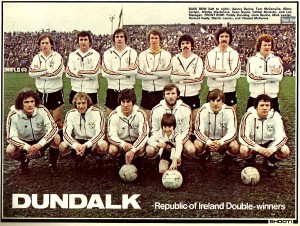
Republic of Ireland The Championship


Republic of Ireland – one more season barely noticed outside the country. Since there was no second division, promotion-relegation was done in a way peculiar for the British Isles: election. Others decided if and which club meets the criteria for playing top flight. Given the usual strength of second leagues everywhere, the method chosen for promotion did not really matter – lower division clubs were seldom strong addition to the best. Even when ‘the best’ were not much, as it was traditionally the case of Ireland. There was no escape from the predicament: all better Irish players went to English and Scottish clubs at early age and hardly ever came back. This season was no different The elected newcomers were Galway Rovers and Thurles Town. They promptly occupied the very bottom places in the league and settled there – Thurles finished last with 10 points, winning just a single match. Galway were 15th with 16 points. The 14th placed Cork Celtic had 22 points – the newcomers were much weaker than anybody else, giving some indirect idea how difficult was promoting teams to first division even by election: they were simply no good.

Perhaps the only interesting thing was the case of Cork Alberts – they finished 9th, but such a club had played only two years in first division. Previously they were known as Albert Rovers. Change of name often suggests trouble… the new name did not last either, changed to Cork United and the club sunk back into obscurity. The city of Cork clearly was not able to support more than one club – and Cork United disappeared entirely, after merging with Cork Celtic.

So, the season was meaningful only at the top of he league – 5 clubs scrambled in the contest for the title. Waterford finished 5th with 39 points. Shamrock Rovers, one of the traditionally stronger Irish clubs, ended 4th with 40 points and losing bronze medals on goal-difference. Drogheda United clinched 3rd place. Second were Finn Harps with 42 points.

A very young club by the standards of the British Isles – they were formed in 1954. For those speaking Celtic, the name of the club is Cumann Peile Chlairsigh na Finne, and for non-supporters – ‘yo-yo club’, for their only regularity is moving between first and second tier of Irish football. However, they became ‘yo-yo club’ after 1990, and the 1970s were more or less their glory days. 1977-78 was one of their strongest ever – they came close to a title, losing the race by 2 points. They were also the club winning most matches in the league – 19.

Here they are – the pride of County Donegal. No name rings a bell, but success is success. Especially when happens so rare and the club will soon start its long-lasting decline.

The champions were familiar and ancient – Bohemian FC (Dublin).

There is no relation, but the club is mostly known combined with the other Bohemians, from Prague. The name is attractive, hence the clubs were often mentioned together. Of course, in Celtic their name is Cumann Peile Boitheamaigh, but commonly they are called just Bohemians. Founded in 1890, as a club from this region should be. They were traditionally strong force in Irish football, winning so far 6 titles. They were good this year – lost only 3 matches, scored 74 goals – the most by far in the league, and had the second-best defensive record. They were not really dominant, though – with 44 points, they were 2 points ahead of Finn Harps and the other pursuers were close too.

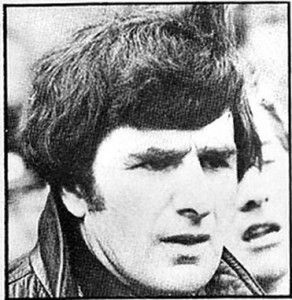
7th title, but perhaps the only memorable thing about that team is the wild – or bohemian – look of Ryan. True to name.

Denmark The Cup

The Cup final was a drama rarely seen not only in Denmark. Esbjerg had really great season – second in the championship and Cup finalists. No doubt, they were eager to win something. But so were their opponents of Frem. One of the traditionally successful Danish clubs, now down on their luck… mid-table was probably hearting and in need of remedy. Good or bad, strong or weak, neither opponent was giving up. The final, played in front of 12 700-strong crowd, finished 1-1. A replay… now the audinece dropped to… 1 807 fans. One of the reasons replays were becoming increasingly unpopular was just that: people were not showing up to see a replay. As for the game, it also finished 1-1. A third match was scheduled, leaving the problem with replays wide open – the gates improved to 2 300, but this was nothing near the attendance of the first match. Drama and suspence were rether tiring for the fans… and drama it was to the very end… 6-5 after overtime and penalty shoot-out.

BK Frem won. Very old club, founded in 1886, and relatively strong in the past, but the Cup was not their forte. So far, they had won it only once – in 1956. After that year Frem went into a long dry spell, winning no trophy. At last they won again – their second Cup.

The squad is typically anonymous, but the club managed to win the dramatic final. The victory may have been important in another aspect – Frem had quite a few rivals in Copenhagen (B 1901, B 1903, B 93 played in first division as well as Frem) and success almost surely meant survival – in a long term, literally: none of those names exists today. Frem went into bankruptcy too… Yes, it looked fine at the moment – the Cup more or less ensured that the jeans makers ‘Lee Cooper’ will continue to use Frem’s jerseys for their adds, but how long even Copenhagen was able to support old-fashioned clubs with small fan base? As it was, 1978 was almost the last gasp of Frem – from the distance of time, the Cup winners should be more appreciated perhaps.