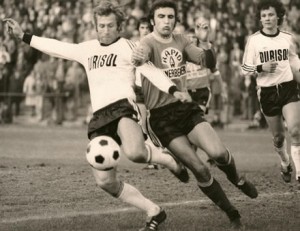
After the awards – those exiting the game. The retirement of Johan Cruyff… the news came out largely in relation to the coming World Cup finals. In Holland it was strongly felt that he was needed and although he already quit the national team, he was asked again. To the interested journalists Cruyff announced not so much his refusal, but his retirement. It was the typical enigmatic talk of the big star, leaving much for interpretation and ‘misunderstanding’… it was remembered what the star said back in 1974 after the end of the World Cup finals: that he was to retire in 1978. Cruyff was quick to remind those who did not remember too and it looked like he was true to his word… But no such thing was hinted during the just finished season in Spain – the announcement was made ‘out of the blue’ by Cruyff and not in Spain, but in Holland. To his retirement he added another reason for ending whatever debate there was about him playing at the World Cup: Argentina was far away, he was tired, needed quality time with his family, sunny beach to relax with wife and kids. The political opposition to the rule of the Argentine Junta was speculated on – Holland was close to refusing to participate and the issue was not so much brought to Cruyff, but cited as a possible reason – he did not deny so convenient reason, leaving many to think his refusal was noble… but when pressed what he meant by retirement, Cruyff ‘qualified’: ‘ a kind of semi-retirement’. What exactly was that, was left open for interpretations and possible denials by Cruyff with the convenient ‘lost in translation’ argument. It was brought to the surface that he firmly stated his refusal to play for Holland because of retirement only after the Dutch Federation refused to use kits made by his own firm. Speculations that if Michels was hired a Dutch coach, not Happel, Cruyff may have said ‘yes’ sound plausible – pigheaded Cruyff knew that very likely to clash with equally pigheaded coach and Happel was most likely to win. In any case, Happel showed no enthusiasm for Cruyff and made no effort to recruit him. The situation with Barcelona was similarly dark: the club said nothing about potential retirement of its greatest star and made no comments during the big Dutch debates – it was not even low-key retirement, but rather as if nothing was happening at all. Very likely relation between the club and the player were sour at that time, possibly Cruyff wanted to stay, but for more money, and the club had different view. May be Cruyff was hoping to the end – the mysterious ‘semi-retirement’ sounded as an open door… if Barcelona suddenly invited him to play or coach… then Cruyff certainly was going to change his tune. He was only 31 years old and had no heavy injuries – his age alone made his ‘retirement’ suspect… As for wanting to spend time with his family and relax on the beach… well, he spent the World Cup finals not on the golden sand of Palma de Mallorca with his wife and children, but as a TV commentator of the finals, together with Brian Clough. After all, summer is long, business first, family vacation – later… So far, it looked like he was waiting for an offer and a very particular offer. Such did not come and retirement appeared to be real – especially when his farewell match was announced. Cruyff’s testimonial remains as one of the strangest and ill-spirited tributes ever and also one more enigma, mystified with time. On November 7, 1978 Ajax and Bayern met and the match ended 8-0 for Bayern. No testimonials end in this way – they are friendly matches with many goals and loughs, celebrating a great player. 5-5, 5-4, 4-3 – such are the results and the veteran is allowed to score a few. These are not serious matches, everybody knows that, and they are focused on the departing player. Nothing like that happened in Amsterdam.
First, the choice of Bayern was suspect. The whole thing was somewhat hastily organized – it was announced almost before the match started. Time was ill chosen – testimonials are normally played when regular football is not played, mostly after or before season. Late fall and winter are avoided in order of having festive atmosphere and crowds to come. November was strange time… the opponent was also strange: Ajax vs Barcelona was the normal combination – between the two clubs Cruyff played for. It was said that Cruyff wanted precisely that, but Barcelona was not available. The plausible reason for declining the invitation was that early November is very busy time for Barcelona – the Spanish championship is played, getting hotter by the weak, and also the European club tournaments are in progress, but not yet at their most difficult rounds, so almost certainly Barcelona was playing still and concerned with advancement. Timing was inconvenient, but also an easy excuse: there were no big statements from Barcelona in the news. No Barcelona player or official went to Amsterdam. The testimonial was hardly mentioned in Spain – may be the relations between the club and Cruyff were truly sour at that time. Another option for testimonials is a match between a club and a national team – Ajax vs Holland was meaningful choice, perhaps playing half-time for each side, perhaps various former teammates appearing. Such is the usual course, but the national team was not the last opponent… may be more than Barcelona the Dutch national team was unwilling to bid farewell to the great player: he alienated the Federation and many players so mush so that perhaps there was no point for even imagining such a match. The timing again clearly prevented another usual option: Ajax vs the World. Active players were busy with the season and the time was too short even for retired players to arrive in Amsterdam. After Barcelona’s refusal, a ‘second choice’ was found – Bayern. They accepted and arrived… there nobody from Ajax waiting for Bayern at the airport. The team was placed in dismal third-rate hotel. The Germans were infuriated from the start. Later Paul Breitner explained that Gerd Muller, Sepp Maier, Branko Oblak, and he decided to allow Johan Cruyff to shine regardless the disrespectful treatment of Bayern. Other accounts state the opposite – that the Germans were so outraged, they decided from the beginning to play for real and Breitner and the other senior players made the decision. Things did not improve at the beginning of the match: Ajax completely ignored Bayern and the crowds greeted the Germans yelling ‘Nazi Schweinhunden’. According to Breitner, he and the other senior players still tried to convince their teammates to let Cruyff shine and enjoy his testimonial. Neeskens, however, things the opposite: quite recently he said that ‘there are no friendlies for the Germans’, citing this match. Nowadays, it is said he was speaking from experience, from playing in this ill-fated ‘tribute’. Myth grows with time… but a look at the surviving footage of the benefit shows very cold atmosphere.
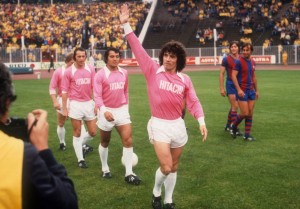
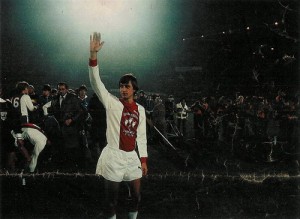 That is what a farewell match is all about – focused on the retiree. Cruyff in the centre of everything… the photo kind of suggest that.
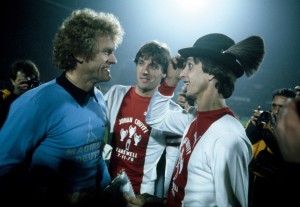 The ‘opposition’ greeting the man of honour, players smiling and sharing few jokes before the start. Maier was almost the only German player with friendly attitude before the match towards Cruyff… the gifts were small, if any.
Then the match started and Bayern trashed Ajax…
7 november, 1978, Ajax-Bayern 0-8 (0-2).
Scores: 2. Muller 0-1, 41 Rummenigge 0-2, 48. Breitner 0-3, 57. Rummenigge 0-4, 58. Breitner 0-5, 67. Muller 0-6, 73. Breitner 0-7, 75. Rummenigge 0-8.
Referee: Beck.
Attendance: 48.799.
Ajax: Schrijvers (70. Jager); Meutstege (46. Meijer), Zwamborn, Krol, Everse (9. Arnesen/46. Schoenaker); Erkens, Cruijff (85. Clarke), Lerby; Ling, Kaiser, Tahamata.
Bayern : Maier; Niedermayer, Schwarzenbeck, Augenthaler, Horsmann; Durnberger, Breitner, Rausch (46. Jol), Oblak (Reisinger); Muller, Rummenigge.
Where to begin? Not only Neeskens did not play, as is often claimed today, but not any of the Cruyff’s teammates from the great days of Ajax, except Rudd Krol. He was the last of the great team still playing for Ajax and since it was the current team of the Dutch, his presence was unavoidable. Let suppose those who were still active players were either busy or not allowed to go to Amsterdam by their clubs… a convenient explanation of the absence of Neeskens, Suurbier, Haan, G. Muhren… but some were already retired, not restricted by club or schedule, and they were absent too… no Stuy, no Swart… no Piet Keizer (the similar name above is the 18-years old Ruud Kaiser, at his first professional season and not yet a regular). One cannot help, but remember how pissed off was Kaizer by the ‘transfer saga’ in 1973, when Cruyff said he was staying, then he was leaving, until alienating everybody in Ajax. Keizer was openly happy when at last Cruyff moved to Barcelona and expressed no friendly feelings whatsoever. There is good reason to think that no former Ajax players was invited to the benefit and none came on his own. Other great Dutch stars did not appear either – it was just the current Ajax under their current coach Cor Brom, a team, which had no direct relation with Cruyff, save Krol. On the pitch, it was clueless team – visibly, no real effort was made, just a terrible performance. It looked like the team had no idea what to do with suddenly included Cruyff and his presence even destroys the flow of the team. Against clueless Ajax, Bayern appeared much too strong, but the goals scored one after another give weird impression: as if it is a testimonial of some of the German players and they are let score because of that easily. One sided match in which Cruyff faded entirely, overwhelmed by Bayern. Even his replacement – the grand moment of such matches – was casual… he just stepped out in the 85th minute and Ray Clarke, the English player of Ajax, who just arrived in the summer from Sparta (Rotterdam) took his place. Sad looking, if not openly disgusted Cruyff left the field… almost too late, compared to thousands of fans, he departed much earlier.
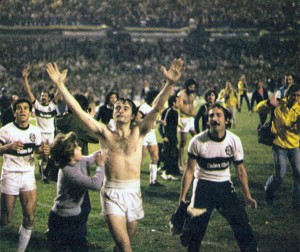
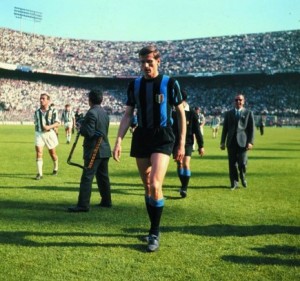
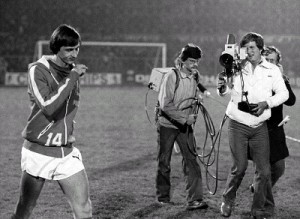 Cruyff went to the bench of Ajax, sat down and immediately lit a cigarette, the last image of him this night. His smoking was not a secret at all, yet, it was a curious picture of him smoking at the bench. The camera wants to focus on him, but… it was unbecoming for the a great sports hero to be shown like that, so the camera moves away, then cmes back, and moves away again. Funny, but hardly a tribute… the most memorable picture is another one:
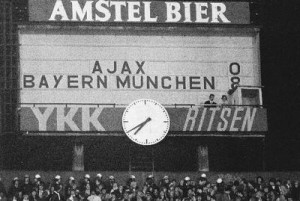 This is the moment of Cruyff’s exit… the disgrace of 0-8 weights heavily, taking away everything from Cruyff. At the final whistle enraged fans through sitting cushions at both teams – some celebration…
After the match it is said that Frantisek Fadrhonc, the former coach of Holland, went to Bayern’s dressing room to ask bitterly why they did this. This moment is usually pointed out in current retrospective writings on the match – if Fadrhonc was really at the stadium, one has to bow to him in respect: it was Fadrhonc who had to endure for years Cruyff’s big mouth. Cruyff often refused to play for Holland. He often spoke negatively of Fadrhonc. To a point, the demotion of Fadrhonc for the 1974 World Cup finals, when he was reduced to mere tourist, was masterminded by Cruyff. Fadrhonc had every reason not to be present this evening – if he was, then he was much bigger man than Cruyff. The Dutch were outraged and remained so to this very day – for years, mostly their view was presented. Curiously, Cruyff said nothing… Yet, with time, the Germans were asked about their side of the story. They had to be asked: the disgrace of this match begged some explanation and demanded at least apology. The Germans were embarassed, but did not really see themselves as guilty. The situation was and is quite impossible – they are blamed for ruining the testimonial and even they are clearly not feeling guilty, some excuses still had to be made. With time, it is even difficult to really believe them, for their words are entirely based on memory and memory is often choosy… Franz Beckenbauer condemned Bayern, saying that of he was there such thing would have never happened. Easy for him to say – he was not involved, playing for Cosmos (New York). Breitner agrees that it was a shame and claims that he and the other big stars of Bayern tried to put the game into normal course, but he blames others, mostly the Dutch. He said that Ajax was entirely disrespectful to Bayern, the fans were entirely hostile and provocative, the younger players of Bayern were too infuriated to listen to reason, and Ajax did not make even an effort to stop German attacks. What was Rummenigge to do, when he was left again and again alone in front of the net? Nobody ever tried to stop him… and he scored three goals, he cannot miss every shot, it would have been a mockery. Well, Rummenigge had no chance, but to score, says Breitner, conveniently not mentioning the three goals he scored. Gerd Muller climas pretty much the same, adding another Dutch fault: nobody told Bayern to take it easy. Fine, but he also adds that Bayern never played ‘easy’ – they always played seriously, no matter what kind of match (conveniently forgetting the serious accusation that Bayern ‘faked’ two European Supercup finals, just going through the motions, using some reserves, and seemingly not interested). Personally, still added Muller, he was conditioned from early age to play only at his best, seriously, for a win… thus, somehow stating that even if Bayern were asked to ‘fake’ the match, it was impossible – conditioning is hard to change at a moment notice. ‘Wounded pride’ was also a factor – the stupid and degrading Dutch behaviour towards Bayern easily evoked the old humiliation – in 1973 Ajax destroyed Bayern 4-0 and not in a friendly, but in the ¼ finals of the European Champions Cup. It was not forgotten in Munich, certainly not by the direct victims, of which there were plenty in Amsterdam (Muller, Maier, Breitner, Schwarzenbeck, Durnberger). Under the circumstances, the thought of taking revenge was more than a thought… Muller usually points that out too… Breitner also claims that Bayern always played seriously, so it was up to Ajax to recognize that and respond in kind. They did not, so who was there to blame? Why Bayern? The game unfortunately supports the German view – Ajax is clueless, clearly not making even a half-effort. Martin Jol, the Dutch player of Bayern at the time, and now a famous coach, remembers the match bitterly: he felt awful, as a Dutch, to be part of that, and felt ashamed and sorry – to tears! – for Cruyff. But once again, this is ‘memory’ – Jol’s opinion nowadays. Back in 1978 he said nothing. Rather, the opposite of what he says today: he replaced Rausch for the second half, when 6 of the 8 goals were scored. May be had no choice? Plausible… a player following coaches instructions, nothing depends on him… but it was still a friendly, it was already clear that the match deteriorated into humiliation, not a tribute, and Jol could have refused to take part. It was not all that difficult to excuse himself from playing, but he did not. Rummenigge, the most outraged and not wanting to ‘take it easy’, according to Breitner, offered no explanation, but curiously, as a big boss in Bayern today, he signed the ‘politically correct’ apology addressed to Ajax (and the media – perhaps largely to the media) a few years back. Nobody thinks the letter an apology, but just a PR act. Bayern playing the game of the day… Whatever was said in all that years following the weird match, one thing is clear: it was ill-thought affair and Ajax managed to provoke Bayern. The testimonial of Cruyff was as scandalous as his career had been – and ‘lost in translation’… Yet, it was sad match, he deserved at least something more joyous, something focused on him, some tribute.
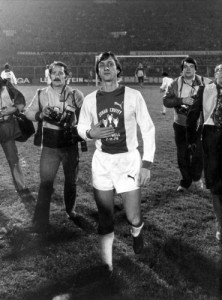 Cruyff exited football almost as an anonymous extra… and at this moment it looked real. His testimonial finally convinced the doubters that he really stepped down. His exit left sour taste… one of the greatest and most adored players was out, it was sad to think we will never see him on the pitch.
But one should have never forget that Cruyff was sneaky… the retiree was not retired for long. Soon he came back and stayed for many more years in the game. Soon it was clear what he meant by his enigmatic ‘semi-retirement’: a good offer. It came from the USA, so once again the slippery wording of Cruyff was not entirely untrue: after all, playing in NASL was more ‘a semi-retirement’ than actual active playing. A few ‘guest appearances’ or ‘demonstration games’ at first fitted into ‘semi-retirement’ just swell. Then – a regular contract, then back to Europe… Cruyff tricked the football world once again – announcing his retirement, playing his ‘farewell match’… and actually retiring years after. What a lovely fake.
 Not an young club – founded in 1926 – it was insignificant, so promotion was a rare moment of success. It was unlikely to establish itself among the best, let alone to become a force, but still a success for the modest club from a town written both Strovolos and Strovolou. Of course, from today’s point of view the promotion is strange: there is no such club nowadays – not playing football anyway. There is strong basketball team instead.
 Nothing new, then… 9th title for Omonia, but also very significant 6th in a row – big dominance of Omonia, constant champions, a rare run of so many consecutive titles. There was no stopping Omonia.
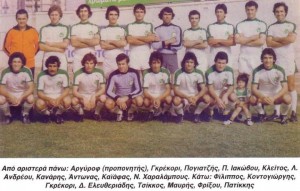 Unchangeable champions – what more to say. Nothing… largely because the players made any sense only in Cyprus. Coached by the Bulgarian Petar Argirov, one of the many Bulgarian coaches, who worked in Cyrpus in the 1970s and 1980s, and having the biggest Cypriot star Kaiafas to score goals. The only known name abroad.
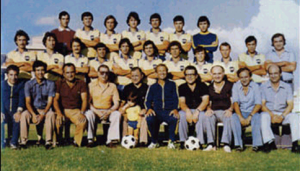 Not an easy victory, but – 11th Cup and second in a row. At the end, it was the same as ever… Omonia with the one trophy and APOEL with the other.