Bulgaria Second Division Southern Group

The Southern B Group was judged weaker than the Northern one – few former First Division members played there and all of them were in decline for years, not a factor at all. Thus, Minyor (Pernik), just relegated from the top league, was seen as sure winner. The rest of the league appeared very similar – the better teams had between one and three known former first division players, generally aging ones – enough for ‘solid’ performance, but not for aiming at promotion. Minyor was struggling in the fall, when finished 4th – 4 points behind the leader – but there was no fear: better than the rest, they were surely to end on top.

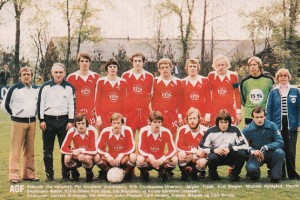
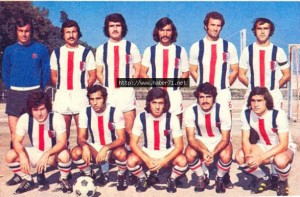
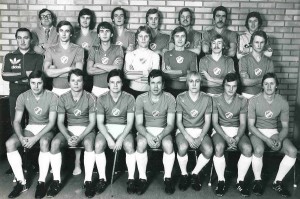
No matter what they did, Minyor were to be champions: sitting from left: G. Ganev, I. Todorov, B. Evtimov, G. Yordanov, V. Bankov.

Middle row: D. Kontev – coach, F. Filipov, A. Divyachky, S. Nikolov, B. Dushkov, V. Naydenov, S. Malinov, Y. Ikonomov – masseur.

Third row: V. Boyanov, A. Slavov, E. Banchev, G. Manolov, Y. Christov, Y. Katrankov.

Minyor was a mirror image of the better clubs of the Northern B group: a core of solid players carried it on so far since 1970. They were dangerously aging – Evlogy Banchev (31), Georgy Yordanov (30), Slavy Malinov (31) – or already reached their peak – Angel Slavov. The team leaders were pretty much alone, though – the other experienced players were rejected by their former clubs – Ganev, Evtimov, Naydenov. They were no leaders, but run of the mill players. And no great talent completed the squad – Boyanov was perhaps the best of the rest, but it was already clear he was not to be a star. Experienced, but rather ordinary team, depending on few old stars. The only exception was a boy not on the photo: the 17-years old winger Mario Valkov. He debuted with a bang and was the only one seemingly capable of replacing the old leaders. But… he was not to last in Pernik. Minyor was clearly unable to even start meaningful rebuilding, but the squad was experienced enough and obviously better than the rest of the league. On paper – yes. In reality Minyor was unable to win – they did not improve much in the spring, adding 24 points to the 22 earned in the fall. With that Minyor finished second. They were not contenders even for a second – the winners left them 9 points behind. So much for surety of predictions.

The winners were one of those clubs never expected to win – veterans of Second Division football, a staple really there, normally found in the upper half of the table. A typical second league club – just happy to play there and never aiming higher. The club did not recruit for more than second league stability, so it was a typical squad – a bunch of vastly experienced club veterans, some youngsters with exactly second-league potential, and two or three former first division players with fading names. The very making of the squad did not suggest any ambition old or new. But this very squad finished first in the fall with 26 points. It still did not look not serious… rather, in the kingdom of the blind the one-eyed was king. Behind were one similar club – Dimitrovgrad – and one surprise – Trakia (Novy Krichim) was third, a club more often playing Third Division football. The top three clubs were expected to drop down in the spring and Minyor to take the first place. But… only Trakia, a tiny club even by second division measures, dropped. The league was quite weak and no big changes happened in the spring: Dimitrovgrad finished third. May be the fall leaders were just caught by the inability of others to gather points, may be they developed some appetite for success – at the end, the fall leaders finished 9 points ahead of everybody: 22 wins, 11 ties, and 5 losses. 55 points, the best attack – 67 goals, the best defense – 27 allowed, most wins in the league and especially impressive number of losses – the next best were Minyor, losing 10 games – twice as many! The champions were overwhelming on paper. The name is Haskovo, a club named after their home city in South-Eastern Bulgaria.

Sitting, from left: Valchan Vassilev, Zhivko Gospodinov, Dimitar Dimitrov, Yordan Kichekov, Lyudmil Mikhalkov, Kostadin Latinov, Ivan Slavov.

Middle row: Petar Aleksiev -coach, Ivan Grudev, Dimitar Zarev, Krassimir Yakimov, Roussy Delchunkov, Pavel Pavlov, Svetlin Cholakov, Atanas Atanassov – assistant coach.

Third row: Dimitar Tekhov, Rossen Stratiev, Toshko Yanev, Valentin Marinov, Nikola Kordov, Saly Shakirov, Lyuben Lyubenov, Nikola Kostov.

This was the biggest success of the club founded in 1957 under the name ‘Dimitar Kanev’ so far – champions of Southern Second Division and confidently so. Not exactly a Cinderella story, but… the squad was hardly good for top league football. Relatively young team, depending mostly on typical second division players and following the pattern of most second-leaguers: two or three well known names, getting old. The left winger Latinov was the local star and one of the best strikers in the second division for years, already 30 years old. Nikola Kordov was the key figure in defense – at 32, his best years were gone. He was part of the strong Beroe (Stara Zagora) team circa 1967-1973 and was even included in the national team a few times, but injuries and age moved him to Haskovo. Yordan Kichekov was similar – although younger, 27 years old, his best years were already behind him. Five years back he was considered one of the most promising young players in the first division. Then he played for Trakia (Plovdiv), but the promise was not fulfilled – he lost his starting place, moved to Lokomotiv (Plovdiv) and eventually moved again – and down – to Haskovo. The trio shined in Haskovo and made a difference, but it was in the second division. For top flight new players were urgently needed, if Haskovo wanted to survive. As they were, they were not going to last, therefore, the best was just to enjoy their victory and promotion.

Bulgaria Second Division Northern Group


The Bulgarian Second Division was perhaps very large at this time period – 40 clubs divided in two groups of twenty each. The possible advantage was the number the games played per season, theoretically strengthening the players. The other advantage, more realistic, was the opportunity for stronger teams to correct mistakes, sluggish start, and generally to succeed at the expense of smaller and weaker clubs. The biggest disadvantages was in building of truly competitive teams – the better players tended to be dispersed through the league – roughly 2 per team on average. Smaller league provided for concentration and ultimately leading to stronger teams, especially those aiming at the top level. The current format more or less reduced ambitions – a relatively good player would join small club which surely had no money for strong squad, but was able to pay generously one or two players, who were classy enough to keep the club in the second level without even playing at the top of their abilities. Laziness was practically encouraged – three clubs were relegated in each group, so the bulk of the league felt secure. As for ambitions… only few clubs, generally former members of the top league from big cities had them.

The Northern B group was considered tougher – four teams were expected to fight for the first place and promotion: Dunav (Rousse), Etar (Veliko Tirnovo), Spartak (Pleven), and possibly Yantra (Gabrovo). All were quite recently members of first division, Etar and Dunav played at the UEFA Cup tournament just a few years back. At half-season the prediction rung through – only Yantra was out of the race at 7th place and 8 points less than the leaders. Etar was 4th with 25 points; Spartak – 3rd with 26, and Dunav was 1st with 28. Second was Bdin (Vidin),also with 28 points and a relative suprise – they were not considered potential champions, yet, they had strong 1976-77 season, when they finished 3rd. However, not a single club was overwhelming – rather, all had big problems. Dunav, just relegated from First Division, was getting weaker, not stronger – in the winter break they lost their star player, the well known and occasionally included in the national team centre-forward Nikola Christov, who scored 20 goals in the fall. He moved to CSKA (Sofia). The rest of the Dunav was similar to Etar and Spartak… a core of few aging well known players, supported by younger group lacking quality. It was a case of clear need of rebuilding, but it was neither radical, nor well thought. Spartak appeared a better recruiter, but still the team underperformed. The exception was Bdin – they had aging, very experienced team. No stars – only two players were relatively known: the midfielder Mumdzhiev, who about 5 years back was even called to the national team. Since then he was going downhill and after leaving Lokomotiv (Sofia) settled in Second Division. The goalkeeper Topchev was the other relatively known player – he achieved even less than Mumdzhiev: once upon a time he was recruted by CSKA, but was never a starter. His spell with CSKA was not long and similar short and insignificant spells followed, until he settled in Bdin. The core of local stars was completed by veterans, who were constant feature for ‘ages’. Great they were not, but had enormous experince, knew second division football in and out, and eventually popped up at the top of the league at last.

In their home city Vidin, Bdin may have been seen as a possible cnadidates for promotion, but not elsewhere – the team benefited largely by its experience, but had no first division potential. The grizzled veterans knew how to overcome most of the small second division clubs and to maintain consistency in such a league, but nothing more. In the spring they were no longer strong – Bdin finished second, but 5 points behind the winners. They lost the same number of matches as the champions – 9, but won significantly less games – 21 to 26. To a point, the even performance of Bdin kept them at top – the other favourites had either fall or spring weak half-season.

Dunav (Rousse) was very weak in the spring – they added only 17 points to their 28 at the end of the fall. Without Christov their attack was suddenly toothless – Dunav scored 47 goals in the fall and measly 18 in the spring. And they finished 4th… just a point above Yantra, which improved somewhat in the spring, but was unable to compensate for their weak fall and finished 5th.

Third ended Etar, a team which on the surface appeared to be doing better rebuilding than the others. By now only two of the old strong team remained – the goal-keeper Petar Petrov and the sweeper Stefan Chakarov. As many second-division club, some players with first division experience, but unable to establish themselves in their former clubs, were recruited more or less as a starting point for a new team – Rabchev (Botev Vratza), Nenchev (Slavia), Tabakov (Sliven). Young talent completed the team – some coming from Etar’s youth system, some from other second division clubs. In theory, the new team was largely ‘promising’ – may be unfinished yet, but deemed strong enough for winning second division.

The 1977-78 vintage: standing, from left: Semko Goranov- coach, Ruzhdy Ahmedov, Kadir Belaliev, Nikolay Kotzev, Ilia Marinov, Miroslav Gospodinov, Boyko Dimitrov, Krassimir Yakimov, Kiril Rabchev, Stefan Chakarov, Petar Petrov, Ivan Nenchev, Ilia Tabakov, Georgy Velinov-assistant coach.

Sitting: Stefan Donev – team doctor, Vassil Daskalov, Petko Tzanev, Krassimir Traykov, Georgy Iliev, Krassimir Kalchev, Nikola Velkov, Ivan Angelov, Vladimir Daskalov, Petar Shabakov – masseur.

Compared to what have been lost, the newcomers clearly lacked quality lacked – since 1974 Etar lost Georgy Vassilev (retired), Stefan Velichkov (CSKA and later – Spartak Plaven), Ivan Petrov (Pirin Blagoevgrad), Stoyan Kotzev and Stefan Grozdanov (Balkan Botevgrad), Sasho Kostov (Lokomotiv Sofia). The lost veterans were included in national team formations, Velichkov was regular at the 1974 World Cup finals. All, except Kostov, but he was Bulgarian champion this very season with Lokomotiv. Chakarov was soon to depart as well… Of the new team only Rabchev had significant long-term contribution and only Boyko Dimitrov made a respectable career. The team appeared strong on paper, but in reality… third place. However, the year was significant in retrospect: two names very well known around the world debuted:

Krassimir Balakov, on the left, and Trifon Ivanov, circled on the right. Well, they debuted for the boys team of Etar… so nothing to change the fate of the first team. The small boys so far established themselves in the boys team – nothing to suggest yet they would be world famous: most talented kids hardly even reach junior teams…

At the end Spartak (Pleven) outsmarted the competition: the team was sluggish in the fall, but maintained a place among the best – they were 3rd, 2 points behind the leaders. In the spring Spartak improved slightly when the competition stumbled. Spartak added 29 points to their 26 from the fall, but the teams found its rhythm and scored a lot: 40 goals. Gradually they took the first place and build their lead, finishing 5 points ahead of the next pursuer, Bdin. Spartak was rather even in both half-seasons and this was the right approach – the big, and therefore, forgiving league benefited those with stable, if not very exciting, form. The rest paid a heavy price for slowing down in the spring, or – in the case of Bdin – having experience, but lacking vigor because of oldish squad.

Happy champions, returning to First Division: sitting, from left: Tzvetan Kamenov, Krassimir Lazarov, Roumen Christov, Petko Todorov, Blagoy Krastanov, Aleksandar Benchev, Nikolay Romanov.

Middle row: Ivan Pankov, Tzvetan Krastev, Tony Dzhefersky, Lyudmil Tanchev, Dimitar Vladimirov, Nazim Mehmedov, Vassil Minkov.

Third row: Mircho Urukov, Ivo Bratanov, Dimo Dimov, Stefan Velichkov, Stoyan Georgiev, Harry Kazakov.

Spartak was the same as the other favourites: a cluster of old, experienced players, who have been regulars for years, aided by mixed bunch – some home-grown youngsters, some good second division players, recruited from elsewhere, and few former first division players, who were unable to establish themselves in their previous clubs. The core consisted of Todorov, Dimov, Urukov, Mehmedov, Minkov, Lazarov, Bratanov – aging all, except Lazarov and Bratanov. Those two were bright promising players a few years back, but obviously already reached the limit of their potential. The big difference came from three players recruited in the last two years – Stefan Velichkov, the 28-years old full back, who came from CSKA and who was national team regular not long ago. The second was the central defender Dzhefersky – he was a big promise as a junior, but partly because of injuries he never established himself in his original club, Levski-Spartak. Now, 24 years old, he was entirely forgotten and had to make a second start. The third one came in the summer of 1977 also from Levski-Spartak – the 27-years old centre-forward Krastanov. He was clearly not the striker Levski-Spartak needed, played rarely and impressed no one. Krastanov was well known in the second division, where he played before moving to Levski, but at first he was not considered great addition to Spartak. Yet, the three newcomers fitted well and gradually became the leading players of the team – which was exactly what was needed: new leaders to replace old and over the hill ones. The club still needed stronger midfielders, but this was for the future. The ‘now’ was sunny: return to First Division.


Romania – the Cup

The Cup final was more representative of the parity at the time than the standard ‘different logic’ of cup tournaments: the finalists were not among the championship leaders, but strong in their own way nevertheless. Universitatea (Craiova) was 6th this year, but they were formidable force in the 1970s, so no surprise they reached the final. The other finalist was further down the championship table – Olimpia (Satu Mare) were 13th. But they were tough opponent and once at the final, naturally wanted to win. Still, the classier team prevailed – Universitatea won 3-1.

Tired winners, not having strength left for smiles. But the Cup was theirs, in the hands of Sorin Cartu, not a star, but called ‘brilliant’ this day.

One may feel sorry for the losers – Olimpia (Satu Mare) are one of the oldest Romanian clubs, founded in 1921. But… they rarely played in First Division, especially after the Second World War. The reason was largely lack of money. They managed to get promotion in 1973-74 and more or less settled in the top division – in the lower part of it, but they stayed. 1977-78 was their finest season ever – for the first time in their history they had a chance to win a trophy. Unfortunately, they lost… and such a run was never repeated again. Thus, this counts as the best year of Olimpia and their playing at the Cup final – their biggest success.

The winners added one more trophy – their third in total. They also repeated their success of the previous year, winning the Cup for a second time, but in two consecutive years.

1970s were the best years of the club – they established themselves as steady favourites, won the championship a few years back, then the Cup in 1976-77 and now again. Along with Steaua, Dynamo, and Arges – one of the leaders of Romanian football and there were no signs of decline. Universitatea was staying strong, winning trophies, and most likely going to win more. Good for football too – this ‘students’ club established a permanent challenge to the ‘big’ clubs from Bucharest. The capital was no longer dominant, but had to share with the ‘provincials’.

Romania

Romania – may be the football played was not very good, but the championship was one of the most tightly competitive in Europe in 1977-78. No overwhelming leaders, no ‘segments’ in the table – the difference between the 3rd and the 17th was only 8 points. Goal-difference determined final places for many clubs, including those at the very top. Everything and anything was possible this season. The only exception was FCM Resita, an early outsider settled at the very bottom. They finished last. At 17th place was Petrolul (Ploesti) with 30 points – 10 more than FCM Resita, but 2 less than FC Constanta. Petrolul still won 11 matches and scored 41 goals – not bad for a club at the bottom of the table. FC Constanta took 16th place because of worse goal-difference – they and Politehnica (Iasi) had 32 points each. Unlucky, FC Constanta – 14 wins in 34 championship games was not bad at all. Their goal-difference was also not bad for a team at the bottom of the table – negative, of course, but not elsewhere clubs with similar result were more likely to be in mid-table, not in the relegation zone: 42-49. But… Politehnica (Iasi) finished with positive goal-difference – 43-39. Something extremely rare for a 15th placed club. A goal-difference better than the 9th placed CS Targoviste (28-33) and the 8th placed Corvinul (Hunedoara) (44-43), and equal to the 7th placed Jiul (Petrosani) – 53-49. And this unusual goal-difference saved them from relegation: FC Constanta, Petrolul, and FCM Resita went down.

Yet, the relative parity was just relative – the traditional leaders still stayed at the top of the table. None appeared to be in crisis, plummeting down, except Rapid (Bucharest), already in the Second Division. Universitatea (Craiova) finished 6th and Dynamo (Bucharest) – 5th, but they were not far away from the medalists – rather, they lost the race by a hair to either luckier, or more concentrated adversaries.

With 38 points, Sportul Strudentesc (Bucharest) finished 4th.

The ‘Students’ were notoriously up and down club, but they had a good spell at that time, enjoying larger role in Romanian football.

Politehnica (Timisoara) clinched bronze medals – they also finished with 38 points, but had better goal-difference than Sportul Studentesc. Also, they were the surprise story of the championship.

An old club, Politehnica traditionally played a minor role, often playing in the Second Division. Thus, they were expected to be found somewhere in the lower half of the table, most likely lucky to escape relegation, or, if having ‘strong’ season – to be in the comfort zone in mid-table. The club was established in 1921 and went through name changes – CSU, Stiinta – until their current name came along in 1966-67. It was traditionally attached – and run by – the Polytechnic Univerisity of Timisoara. A ‘students’ club – one of the 4 ‘students’ clubs playing in the Romanian First Division that year. To be among the leaders and win medals was unheard of, so they pleasant surprise not only for their fans. Their sudden rise deserves one more look:

The team was not much, but they a star – Dembrovschi. May be enthusiastic year, may be solid and experienced squad, but they played well. It was the best ever season of Politehnica. It was their their very first medal. It was great – and remained great, for so far this season was not neither bettered, nor matched. The best ever season of the club.

Arges (Pitesti) finished second with 41 points. The 1970s were perhaps the strongest years in the club’s history and there was no end of them yet. Along with Sportul Studentesc, Arges won the most matches this season – 18. But in attacking minded and tough Romanian league wins went hand in hand with losses – 11. May be this, may be their a bit weak strikers placed them second – on goal-difference.

For those following Romanian football at the time the squad was familiar for some time. Led by one the best Romanian players in the 1970s Dobrin. Tough luck… Arges lost the title just by few goals.

Exciting race to the end with two clubs finishing with equal points. Scoring – not defense, for both candidates ended with equal number of balls in their nets – 49 – clinched the title. The champions were more than familiar – Steaua (Bucharest). One more title for them.

Difficult victory, thanks to their strikers, scoring 75 goals – Arges scored 15 less! May be Steaua undererformed a bit, for certainly they had the best squad in the league with about 10 national team players – but all is well when ends well. Steaua repeated their success of the previous year – two consecutive titles and the selection pretty much was a promise for a third in a row. No major changes – the squad was the same as in the year before, but it was not an aging team. Their still young coach Emerich Jenei perhaps should be credited with the success in the last second: he was not the famous Jenei yet, but already making a difference.

Hungary the Cup

The cup was won by Tatabanya. But this was not the Hungarian Cup – it was the winter cup provided by the sports magazine Kepes Sport. A novelty of that time – winter indoor tournaments were popular around Europe, largely to provide some semi-competitive football during the pause between fall and spring halves of the season, partly to help preparations for the spring.

Here are the winners – another feature of such tournaments was that otherwise weak clubs often performed well. No wonder: reserves and new players were tried and the rules varied. It was not futsal at all. With time these tournaments faded away and practically disappeared, so this note is mostly for the sake of history.

As for the real Cup, Ferencvaros and Pecsi MSC reached the final. For the ‘peoples club’ it was a chance to salvage the disastrous season. For Pecsi MSC too… they were in decline for some time, sinking to the lower half of the table. Once upon a time the club from Pecs was stronger, but not in the 1970s – so a rare opportunity to win a trophy, to restore pride. In the championship Pecsi MSC was worse than Ferencvaros – they finished 13th – and their squad was way weaker, but such things hardly matter at finals. Stakes were high – the ‘peoples club’ had to come back somewhat in a season dominated by the arch-enemies, the Army and the Police. In the same time the ‘provincials’ really wanted the noses of the hated big boys from the capital, robbing the provinces all the time. Intriguing rivalries. Perhaps they were not just on paper, perhaps the opponents were not all tha strong, but the final ended in a tie. In the overtime Ferencvaros prevailed 4-2.

One more Cup for Ferencvaros and season saved. Or may be not? The winners look not too happy…

The finalists did their best… and lost. Unfortunately, Pecs had no real argument – apart from their goalkeeper Katzirz they had no classy players. Ferencvaros had a very weak year, but still it was a squad full of former and current national team players.

This squad, led by Tibor Nyilasi, was good for a double. So the names suggest… yet, it ended only with the Cup, and the trophy was won with difficulties. It was better squad than Honved’s and probably at par with Ujpesti Dosza’s, but… lucky just to salvage this season. For some reason Ferencvaros never really soared in the 1970s. May be they were psychologically weak. May be there was always some missing key ingredient. At least they won the Cup – for the 14th time! And a real Cup, not like Tatabanya’s.

Hungary I Division


No joy at the bottom of First Division.

SZEOL (Szeged) dropped out from the survival race and finished last with 18 points.

Top row, from left: Himmer István – coach, Hevesi ?, Hojszák István, Forgách Jajos, Holler Ferenc, V.Tóth Mihály, Pataki Tamás – masseur.

Middle row: Kádár Lajos, Szalay István, Kozma III Zoltán, Birinyi István, Kőműves Mihály, Hágelmann Endre, Zámbori Mihály.

First row: Kozma II György, Újhelyi István, Garics György, Nagy István – captain, Jerney István.

For SZEOL relegation was hardly a surprise… a season better forgotten quickly.

The battle for escaping 17th place lasted to the end – Raba ETO and Szekesfehervari MAV Epone survived. Down went Kaposvari Rakoczi, a club rarely playing first division football anyway.

Just like Szeged, Kaposvar was not to be missed… the usual case of weak clubs. Up the table the big surpise was Ferencvaros at 9th place – the team lead by Nyilasi was supposed to be fighting for the title, not to sit indifferently in the middle of the table. Why the sudden slump is hard to tell, but Ferencvaros did not master a really strong squad in the 1970s. Always something missing.

Above them finished Tatabanya – one of the usual mid-table clubs and very unlikely company for the most popular Hungarian team, Ferencvaros.

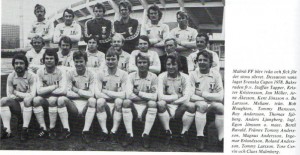
Apart from nice picture in the snow, Tatabanya had a few good players – Csapo was included in the national team for the World Cup finals. Quite different squad than Ferencvaros with their 11 national team players (of various years). Yet, Tatabanya was bested by a team normally ranking even lower – Dunauivarosi Kohasz or just Dunaujvaros, as they were usually called outside Hungary.

Dunaujvaros finished 7th, but the real success story was another club.

The group competing for bronze medals included Vasas, MTK, and Videoton. Vasas, still running strong, finished 5th.

Not bad really – as good as Vasas were in those years, they had no chance of getting enough classy players. 5-6 was the maximum – the club had them, but they were not enough.

Videoton, the second club representing Szekesfehervar, finished 4th, missing third place by 2 points. They were the success story – only 3 years ago nobody heard of them, but Videoton not only established itself in first division, but suddenly was among the very best. And not just for a year – the club was apparently ambitious. They were still building – hence, 4th this year. It was clearly a team with a future.

Third row, from left: Kovács László, Baranyi László, Nagy III János, Garamvölgyi, Kovács József:

Middle: Burcsa Győző, Szalmássy, Fejes, Czeczeli Károly, Nagy II János.

Bottom: Végh Tibor, Májer Lajos, Csongrádi Ferenc, Jankovics Sándor, Szabó József.

No big names here and may be this was the key for their development – the big clubs not tempted to steal from them. The club name on their shirts also curtailed the general rule of no sponsor adds in Estern Europe: since ‘Videoton’ was also an industrial firm, it was advertisement witout formally advertising anything.

The old, famous MTK clinched the 3rd place. A strong season, something rare in the 1970s for the club, which was not even MTK – after a merger with another club in 1975, they were MTK-VM, or MTK-Voros Meteor.

MTK were similar to Vasas in a way – unable to recruit enough strong players. They had even smaller number of stars than Vasas, but it was a solid and experienced squad. And MTK had interesting kit too – the Adidas stripes were in the middle of the jersey.

At the end the battle for the championship was the typical East European duel between the Army and the Police – Honved vs Ujpesti Dosza. Honved, finally strong after years of decline, built an young squad and perhaps that was the whole difference: it was wise to get the players of tomorrow, but they were not consistently strong yet. Honved displayed the best defense, allowing only 22 goals in 34 matches, but they lost 6 games nevertheless. They lost the title by a single point.

A good, but not exceptional squad, still in need of few strong additions. Times changed… the biggest stars were playing for other clubs and there was no way to be ordered to join Honved, like it was in the 1950s. Pinter and may be Kozma were the leading players now, but the competition had better ones.

So Ujpesti Dosza returned to the top, winning one more title. It was not an easy victory, but still the the team lost only 2 matches and won 19. The champions scored astonishing number of goals – 95. Their defense was leaky – 46 goals received – but it was clear that attack was the weapon of choice. The rivals ended with 50 points and Ujpesti Dosza managed 51.

One more title, but this time a bit surprising success – Ujpesti Doza showed signs of decline in the previous 2 seasons. The squad was old – as a squad rather than actual age of players. Most names were around since the beginning of the 1970s and most of them reached the limits of their potential around 1975. It could be said that only Fazekas and the young star Torocsik were doing great by now. In truth, this squad should have been going down the table and fast – it managed to return back on top instead. Experience helped, of course, and it was not ‘dead’ team by no means, but it was not enough for revival. Perhaps the true reason was their coach Pal Varhidi. Perhaps it was the great form of Fazekas and Torocsik, lethal strikers. Perhaps it was because the league was relatively weak and the rivals did not have well shaped teams. No matter what and why, Ujpesti Dosza won.

Hungary II Division


Difficult for evaluation season in Hungary – on one hand the country qualified for the World Cup finals and had pleasant national team. A group of talented players, some running strong for years like Balint and Fazekas, others just nearing their peak and rapidly getting recognition in Europe – Nyilasi and Torocsik. On the other hand the improvement was slight, the number of quality players limited, and no Hungarian club was truly impressive when really tested – that is, in the European club tournaments. A glance at the final table shows strange fragmentation – 2 clubs competed for the title. Behind them a group of three contested third place. Another segment of 4 clubs belonged to the upper half of the table and bellow them a lower half consisting of 5 clubs. At the bottom 4 clubs tried to escape relegation – one gave up early. Every segment appeared preoccupied with itself and unconcerned with anything else. Practically every club stayed where they usually were – hardly any surprises, except for the sudden slide down of Ferencvaros. Videoton was practically the only club rising – they soared the previous season and now confirmed that they were not one time wonder.

Second Division was any different – the 20-team league had its group of clubs meandering up and down and they were the likeliest favourites: Dorog, Komlo, Debrecen, Salgotarjan, Bekescsaba. The rest was insignificant. If anything, the second division was telling one unusual thing: big concentration of clubs belonging to one city in the top levels of national football – Budapest had 6 clubs in first division plus another 5 in the second. Of course the difference between Vasas and Volan SC was great, but at least in Eastern Europe there was no other country with so many clubs from the capital in the two top tiers. Apart from England, and to a point Greece and Turkey, there was no such concentration in Western Europe too. Anyhow, the bulk of the league was not really up to a serious task. Three clubs competed for two promotional spots. Debrecen finished third, losing the race by a point. Above them finished a strange club – Vasas Izzo.

Their logo gives 1899 as year of foundation, but the club is quite a mystery – names were changed frequently as well as the location. Technically, a Budapest club – at least in 1977-78. Not to be confused with the other Vasas of the same city: this one was entirely unrelated club. Hardly known, moved from one industrial ‘sponsor’ to another, amalgamated now and then with other clubs, but never successful. Occasionally appearing in first division, never staying long enough to get notice. This season they got ambitious – either that, or had some money – and finished second.

About the squad hardly anything can be said – as a Budapest club, very likely they had some aging players, arriving from better clubs. Some names sound faintly familiar, but those are also very common Hungarian names – could be just familiar names, but not the same players known from elsewhere. But the fate of small clubs is similar everywhere – whatever talent emerges is quickly scooped by the bigger clubs and old and tired veterans arrive to play their last season or two. A strong team cannot be built this way. Promotion, however, was possible now and then – and this season Vasas Izzo had a squad good enough for that.

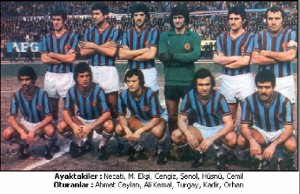
The champions finished with 56 points – 2 more than Vasas Izzo. Their name is mouthful and confusing. Confusing, because it is often abbreviated to STC. The full name is Salgotarjani Torna Club, but it is popularly written either STC or Salgotarjan. As many Hungarian clubs the name was changed often… so it was STC this year, but on the logo it is different.

So, let’s stick to ‘Salgotarjan’ for now – a club,which often played in first division, hence, eager to return. They managed to do that. Not a overwhelming winners, yet, the strongest – best attack, second best defense, most wins, only 5 matches lost. Stable, competent.

Salgotarjan also had some descent players, particularly Szoo, whose presence explains why they won, but does not explain why the club sunk to second division. Well, not anymore… at least not the next season.

The newly promoted were not exactly strong – they were most likely just to try to survive in the near future and Vasas Izzo in particular. Joy was to be momentous.


Scotland

As for the winners, they need no introduction – Glasgow Rangers. Same old, same old… for it was more than winning the title – Rangers won everything this season, repeating 1975-76. They won the Scottish Cup, beating Aberdeen 2-1 at the final. Earlier, in March, they won the League Cup, prevailing over Celtic in overtime 2-1. The victory was sweet largely because it left Celtic empty-handed, finalizing one of their weakest seasons. Perhaps the most interesting note about this clash was Celtic’s goalscorer – the centre-defender Johannes Edwaldson. An Islandic import, who joined Celtic in 1975 – at times when Islandic players were entirely unknown. On top of everything Edvaldson was the son of Baltic Nazi refugee, fleeing there at the end of Second World War and changing his name. Most certainly Edvaldson was not a Roman Catholic, which makes his recruit strange – Celtic were a bit more lenient than Rangers, but still religion was very strong force in the 1970s. As for Rangers – only good Protestants played with blue shirts and no chance for anybody else. For many – the very reason they kept winning.
Wonderful season, collecting all trophies, but nothing overwhelming – Rangers prevailed, but did not dominate. May be because it was familiar squad for quite some time. Good players, some club legends, but not exceptional. Outside Scotland the boys were not so impressive. Some of them were getting old. It was experienced team, but already past its prime and running on inertia. To a point, this was their last great year – yes, they were going to win a few more trophies, to stay at the top of Scottish football, but… this was their last championship title. The club had to wait almost ten years for the next one. However, it was perfect ending.

Scotland

Scotland at its forth ‘reformed’ season. Hardly the game improved. May be their were some benefits in terms of financial stability, but one sure result was rapidly becoming clear fragmentation of the clubs – a small core of ‘big’ clubs, located in Glasgow, Edinburgh, Dundee, and Aberdeen, followed by small fry just happy to reach or stay in Premier League, and the rest – rabble, relegated to the lower half of First Division and the Second Division. Scottish football was always dominated by two giants, yet, in the past various others were able to hold their ground, to win a trophy here and there – the days of relative parity were obviously gone. The constant massive exodus of talent reduced the local championship to almost nothing, reforms or no reforms. Perhaps the only excitement came from shuffling – some ‘better’ clubs went down in the initial reduction of the premier division and so far unable to return to their ‘rightful’ place. To a point, that was the intrigue in the second tier: three clubs competed for two promotional spots. The rest of the league played no role… even at the bottom the outsiders accepted early their fate. Dumbarton finished 4th with 49 points. 7 points ahead of the 5th… and 8 points behind the 3rd. This result speaks enough for the whole league. Dundee finished 3rd – they fought, but luck was not on their side, missing promotion for a second consecutive year. Dundee scored astonishing 91 goals in their 39 championship games, but they ended a point short. Heart of Midlothian and Morton clinched 58 points – Dundee finished with 57. The Hearts were ‘mistakenly’ down there – relegated the previous year, they immediately earned promotion back to Premier League. Not overwhelmingly, but expedient enough. Another club bested them on better goal difference – Morton.

Happy champions, no doubt, but not much otherwise. Their glory days were in the misty past and the ‘new history’ already put a stamp on the club: happy to win the second division and earn promotion. Time played its other joke on the club too – ‘Morton’ means almost nothing today: in 1994 the club officially became Greenock Morton. Retroactively, this name appears in statistics publsihed today – but it was just Morton in the real 1977-78. Going up, hoping to stay up.

Morton and Hearts were going to take the places of outsiders: just like in the second league, the bottom of the Premier League was uncontested…

Clydebank ‘reserved’ the last 10th place early kept any possible challengers away – they earned measly 19 points in 36 games. Lovely slogan on their shield, but… neither ‘labore’, nor ‘scientia’ helped.

Ayr United was better only when compared to Clydebank – they soared 5 points above the last team. In the same time they ended 6 points behind the 8th placed St. Mirren. The new league format quickly sifted out the ‘unfit’… Ayr United was steadily going down the table the previous two seasons and Clydebank, promoted in 1977, did not survive at all. Not even faintly competitive.

The other ‘newcomer’ from 1976-77 was a ‘success story’…

St. Mirren finished 8th, that is, just above the relegation zone. They left Clydebank and Ayr United in the dust. Yet, in the same time they were 3 points behind the 7th placed Partick Thistle. The club was joyous and considered the season very strong.

Here are the heroes of survival, minus one. A prime example of the new reality… only three years ago St. Mirren was steady member of First Division. True, not a strong team, most often found in the lower half of the table, but regulars. Now they were boasting just for playing top flight football – and escaping relegation was ‘success’. Many a club was to discover new ‘pride’, but as the things were, St. Mirren played well. They really improved. They were building hope. And it was because of a man not on the picture above – a young coach, called Alex Ferguson. He lifted the club from second league and everybody was happy. This Ferguson was ‘mysteriously’ sacked in May 1978… as it turned out, the club discovered that the promising coach sneakily negotiated with Aberdeen. Hearing that, St. Mirren fired him at once for breach of contract. Ferguson considered he was wronged and brought St. Mirren to tribunal. He lost his case. The whole story did not attract any attention – some mischief done by roguish young unknown.

Much more interesting was what happened to venerated Jock Stein. Celtic had abominable season. The decline was going on for some time already, but still Celtic ended with a double the 1976-77 season. And the next year they really sunk… not a single trophy, but the worst was the championship – they finished 5th in the 10-club league! And they had almost 20 points less than their arch-enemy Rangers. It was their worst ending since 1964-65, when they were 8th in the old 18-team league. Jock Stein was asked to resign… he did, on the understanding that he was going to take honorable administrative position in the club for which he contributed so much for so many years. It was not what the club had in mind and Stein resigned entirely. He was thinking retirement – but was persuaded to change his mind and work for a few more years. But not for Celtic – a glorious era ended with him.

Familiar names finished above Celtic – Hibernian was 4th, more or less, normal place for them. Strong enough to be counted among the best, but still not really strong to challenge the best. Hibernian bested Celtic by a point, but were still 3 points behind the bronze medalists.

The team was nothing special – may be descent, but no more than that. Something else is more interesting – perhaps Hibernian were the first club in Scotland and England to use shirt adds. Early birds surely and it will be interesting to find out on what legal grounds they did that: British football resisted sponsor’s names, but there were subtle differences between English and Scottish approaches – and the Scottish were more adventurous and ‘progressive’.

Shirt adds did not help Hibernian – Dundee United outpaced them with their ‘classic’ plain shirts and grabbed 3rd place.

Those were strong years for Dundee United – after surviving, at the expense of their city rivals, the tribulations of the new reduced league, they quickly went up. 4th in 1976-77, now 3rd. Unfortunately, this was not a squad with a potential for greater things – rather, it was clear that they will stay in secondary position: whatever good players emerged will quickly move to English clubs, or the Scottish grands. Third place was the most this squad would do – they were entirely out of the race for the title.

A two-team race for first place – Glasgow Rangers vs Aberdeen. The leaders were clearly above the rest of the league – Dundee United was left 13 points behind and the combined losses of the top two were still less than those accumulated by the third placed: 10 vs 12. Two points were the whole difference between champions and silver medalists. The contenders lost 5 matches each and the difference. Aberdeen had the best defensive record, Rangers – the best attack. And attack was the decisive factor: Aberdeen tied more games than Rangers, hence, winning two less. They finished second.

Aberdeen was rising – 3rd place the previous year, now second, barely missing the first. The squad was not exactly full of stars, even potential ones, but it was solid enough and working well. Perhaps the new league format suited Aberdeen best, for the small league made the club attractive destination for players omitted by the English clubs and the two Scottish grands, but otherwise good or at least promising – players, who would have stayed in smaller clubs in the big old league, but now had to chose between first and second division football. Aberdeen was going up, that was the whole point, though. Of the squad, perhaps the most interesting name was Jim Leighton – the young goalkeeper was rising along with the team and soon was to be much more than just promising new name. He was to be familiar name for a long, long time. As for the club, this was their best year since 1971-72, when they finished second for the last time. Not just matching their old success, but besting it, for back then they finished 10 points behind the champions. Now they almost won.

Czechoslovakia The Cup

The Cup did not go to Prague either – Jednota (Trencin) won the Slovak Cup and Banik (Ostrava) the Czech one. These winners met to decide the winner of the Czechoslovak Cup this year, a bit unusual final, suggesting the decline of some big clubs and the unfinished shape of others. Jednota clearly suggested the decline of Slovak football – the club was lowly in the Slovak pyramid and for them to soar that high mostly meant a confirmation of the sorry state of Slovan, Spartak, Inter, even the Kosice clubs.

Jednota – meaning ‘Unity’ – was nothing special: they had their ‘normal’ season, that is, struggling to remain in first division. They finished 11th, almost the best they ever did when playing top level football at all. As Cup finalists, they were the underdog… and although they fought bravely, they lost 0-1. The modest club came close to winning a trophy, but, however sad, it was almost inevitable they were to remain empty-handed – the opposition was classier.

Banik had uncharacteristically weak championship season for 1970s were arguably the best years in the history of the club. Slipping down to 10th place was a big disappointment for a squad at its prime. But it was not looming crisis – the team played in the Cup tournament, winning the Czech Cup and thus playing at the Czechoslovakian final. Class and wounded pride combined for a small 1-0 victory, but victory nevertheless.

Second cup for Banik! More than saving the season – they ended with a trophy. And the team was still rising – if Knapp, Vojacek, and Michalik were familiar well established names, Licka, Rygel, Cermak, Radimec, Nemec, and Sreiner were rapidly rising young players. But perhaps the happier of them all was Frantisek Schmucker – the 38 years old veteran goalkeeper, once upon a time a silver World Cup medalists, was already coming to the end of his career. True, he was a reserve, but what cloud be better than ending one’s playing days with a victory. Evzen Hadamczik made his name at this time as coach – unfortunately, he never became really famous coach: illness and work stress drove him to suicide in 1984. But he was happy fellow in the spring of 1978 and his team still had good things coming.