Portugal II Division

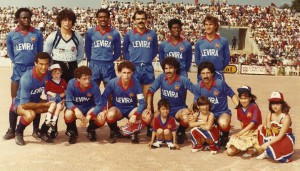
Portugal, second level. Promotion was most important. Plus the fate of Os Belenenses, relegated for the first time in history.

Os Belenenses, in its darkest time, failed to reach promotion. That deep crisis and no end to suffering.

Others were not successful too.

Leixoes in Zona Norte,

Uniao Madeira and

Lusitano Evora in Zona Sur.

So, the successful ones – in general, former first division members climbed up, Exceptions were rare.

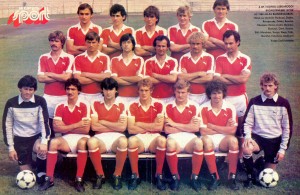
Farenze won the championship of Zona Sup and moved up.

Penafiel was promoted from Zona Norte. Nothing out of ordinary so far – just clubs constantly meandering between first and second division.

The winner of Zona Centro was different:

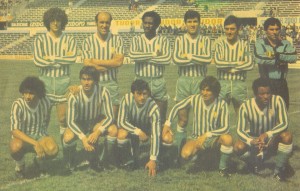
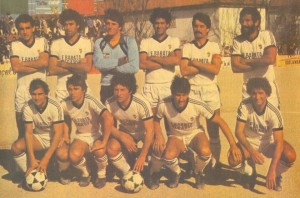
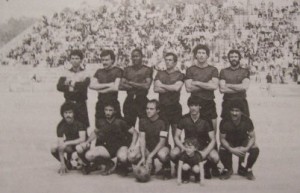
RD Agueda. They had very strong previous season and finished 3rd, which left them outside promotion. But it was safe to expect them playing well this season too. They did and won the championship. This was their finest season ever and Agueda was going to debut in the top league the following season. Huge achievement for a small club.

Scotland the Cups

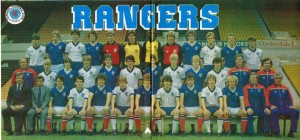
Scottish Cups brought the final touch of disappointment for Rangers and its numerous fans. Championship was clearly out of the question almost from the beginning of the season, but there were hopes to compensate with a cup. Glasgow Rangers reached both cup finals, so at least one trophy… better two.

Large amounts were spent on reinforcing the squad before the season, including for signing the Swedish national team player Robert Prytz, and… nothing at the end. Rangers lost both finals – to Aberdeen in overtime 0-1 and 1-2 to Celtic. Miserable season from start to finish.

Not so for their opponents: to a point, it was absolutely fare – the three strongest Scottish teams ended with a trophy each. They were equally strong during the year, that was why the final results were fare.

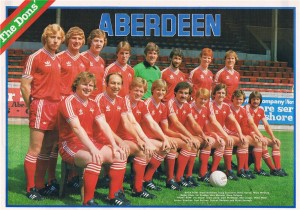
The Dons extracted 1-0 win in overtime over Glasgow Rangers and got the F.A. Cup. It was second F.A. Cup in a row, won over the same opponent, but may be even sweeter this time, for they also eliminated Celtic in the semi-finals. Aberdeen ruled and the world getting familiar with one Alex Ferguson.

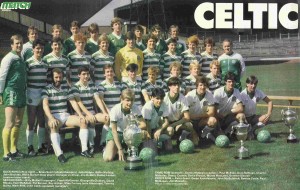
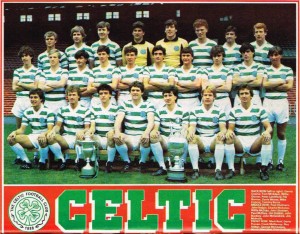
Current form hardly ever affects the clash between arch-enemies Celtic and Rangers. Either clubs always wants to win and victory stays on its own no matter what else happened. Tough, rough, often dirty – the classic derby. Celtic prevailed 2-1, thanks to goals by Charlie Nickolas and Murdo MacLeod, and won the Scottish League Cup. It was sweet – not only the season was saved with a trophy, but the League Cup evaded Celtic since 1975 – nice to win it again after all that years. But all was nothing compared to important victory against Rangers.

Scotland I Division

There was good reason to be doubtful of the Division 1 winners – once promoted, they did not fare well in the top league. Alarming tradition settled down: newcomers were too weak. Far too weak…

Kilmarnock, just promoted from Division 1, was the big outsider – last with 17 points.

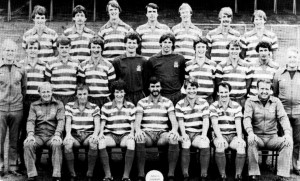
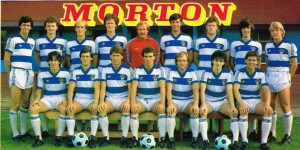
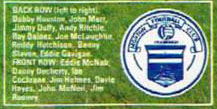
Greenock Morton was admired for its heroic efforts to beat the odds, but grim reality was stronger: the big problem of Scottish football was money. The lack of money. The club openly admitted that only the fee West Ham United paid for acquiring talented young defender Neil Orr saved them bankruptcy. And the only way to avoid bust was selling players… which resulted in very weak squad. Capable of earning only 20 points… 9th place and relegation.

Perhaps Motherwell were quite happy to witness the troubles of Greenock Morton – that practically guaranteed them survival this year, but the Division 1 champions of 1981-82 had nothing fresh and promising to offer: 8th with 27 points. All they could do – not just this season but surely in the next too – was trying to escape relegation.

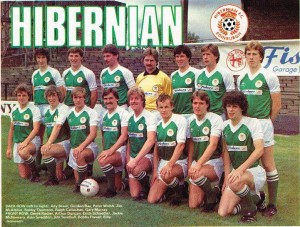
Which was also the concern of Hibernian, reduced to shambles in the recent years, even playing second level football in 1980-81. Now they finished 7th with 29 points and the future was looking bright either.

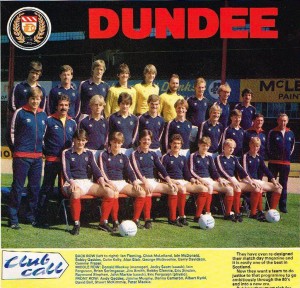
Dundee ended 6th with 29 points – only goal-difference placed them above Hibernian, but there was difference. Like Hibernian – even earlier than them – Dundee went into big crisis. Eventually, the club reacted with reorganization and new programs, but there were no positive results yet. There was optimism for the future, though – based on the implemented changes.

St. Mirren – 5th with 34 points. Not a squad worth mentioning, but strong enough for solid mid-table season. Consistent team – 5th the previous year, 4th in 1980-81, 3rd in 1979-80. It was clear the squad would not go any higher and to think of a title was absurd, but for a small club to be out of danger and solid in the middle was quite an achievement.

Glasgow Rangers – miserable and weak. 4th with 38 points. After 1978 Rangers was decline and that was that.

So, 6 teams were nothing to brag about – but the battle for the title was exciting and it was rare tough battle too: three teams from start to finish, divided at the end by one point and goal-difference.

Aberdeen was unfortunate, taking 3rd place with 55 points and worse goal-difference than Celtic. They had the best defensive record in the league, but scoring was much weaker than their opponents’. But there was neither disappointment, nor dark mood – just the opposite. They lost the title, but there was nothing to be ashamed of, for they won other and bigger trophies in their best year ever.

Celtic was perhaps angry at themselves: smaller club would have been quite happy with a season, which put them so close to the title. After all, if they had one point and 2 goals more, they would have been champions – but they ended only 2nd , above Aberdeen on goal-difference. Well, for a club like Celtic anything but victory is a disaster. Perhaps coming so close and losing the title made the disaster bigger and graver.

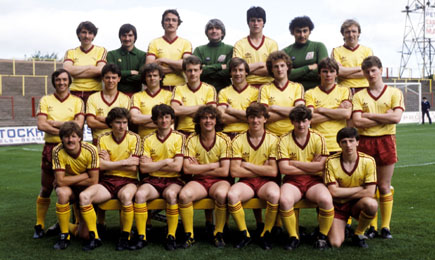
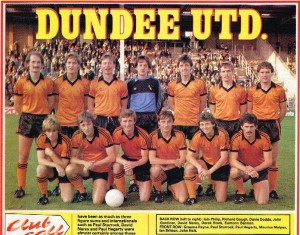
Just the opposite feeling in the Dundee United camp – edging traditionally stronger opponents in such close and tough race was more than great. Wonderful last minute victory and titles come rarely in the hands of Dundee United. More cherished because of that. More cherished, because Aberdeen conquered Europe this year. More cherished that Celtic was left behind. 24 wins, 8 ties, 4 losses, 90-35 goal-difference, and 56 points. Celtic and Aberdeen won more games, but they also lost more than Dundee. The champions scored – together with Celtic – most goals in the league. However, they had better defensive record than mighty Celtic – only a goal less received, but better. Only a point more than their rivals, but more. May be the strongest squad in their history too: Sturrock, Narey, Hagarty, Malpas, Gough, Dodds, Britton were enough for a title at the end. However, the group was not enough to ensure long dominance – and club and fans knew it in their hearts. Rare triumphs should be enjoyed fully and in earnest.

Scotland II Division

Scotland – nothing much in the second tier, Division 1. With the exception of the outsider Queen’s Park, most of the teams were modest and equal.

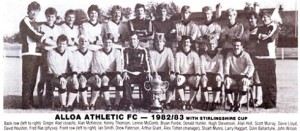
Alloa Athletic was typical example – they finished 6th with 39 points. Not bad at all for a newcomer from Division 2, but otherwise nothing special. Local pride, at best.

Four teams were clearly better than the rest, but the final table gives the illusion of tough and competitive race between them – in reality, only two teams battled. The other two – Clydebank, 3rd and Partick Thistle, 4th were not actual candidates for promotion.

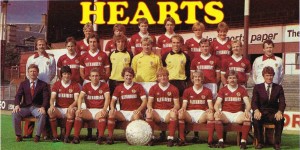
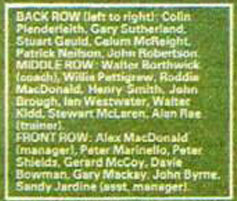
Despite the words of caution of manager Alex MacDonald, everybody in Scotland considered Heart of Midlothian premier division team just playing out time in Division 1. They were going up, surely. Sandy Jardine was the big man, leading the squad, but there were few more strong players, so the Hearts were looked at with serious optimism. Eventually, they did not disappoint – got promoted, but finished 2nd with 54 points. So, some doubts remained – they missed promotion by a point the previous season; now they missed first place also by a point.

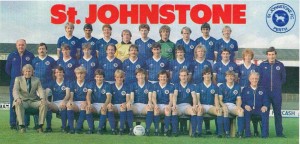
The great years of St. Johnstone were only nostalgic past now and hardly anyone thought they were coming back. There were hopes, of course, but nothing to compare the boys from Perth to Heart of Midlothian – they were ‘part-timers’ after all. But sturdy and ambitious this year, leading the league most of the time. And finishing 1st at the end with 55 points. Which was great. But there were also doubts – despite having the most dangerous striker in the league, the ‘Perth Saints’ were outscored by 6 teams, among which was Raith Rovers, 10th in the final table. Were they strong enough to stay in the Premier Division was serious question – but for the future. For the moment – lovely victory of the underdog.

Switzerland

Switzerland revealed great discrepancy, likely leading to new reformation of the championship – teams, unable to compete at top level, but also teams too weak to make sense in the second level. FC Rüti Zürich ended with only 5 points there. FC Ibach finished with 13 points. FC Bern, 14th, had 21. The extremely weak bottom was not compensated by few strong teams at the top – in fact, there was a single leader, dominating the championship and two teams kind of fought for second place. The rest was far behind.
FC La Chaux-de-Fonds won easily with 48 points.
FC Chiasso trailed behind with 43 points, building 3 points difference with their only rival, CS Chenois. So, these two teams were promoted. Both played First Division before, but their new return was hardly an optimistic point – the top league displayed big weaknesses.
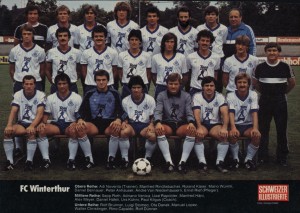
Winterthur earned only 10 points this season, naturally finishing last. Above them was the other outsider with 12 points – FC Bulle. With teams taking the relegation spots firmly, the rest of the league was at least comfortable, if not competitive: FC Aarau was 14th, but hardly in real danger during the season – they were good enough for 20 points.
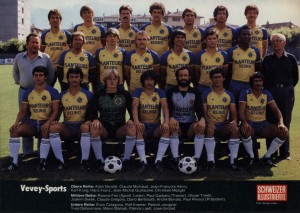
Vevey-Sports was 12th with 22 points. For them, it may have been a good season – just staying in the league, which did not happened often, was great. Otherwise it was worrisome: 5 teams, in safety just above relegation zone, hardly displayed any class.
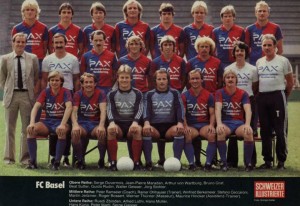
Of this insignificant group the performance of FC Basel was actually alarming – traditionally one of the strongest Swiss clubs now was reduced to shambles, ending 11th with 25 points. Compared to them Young Boys appeared somewhat going up after years of shaky play.
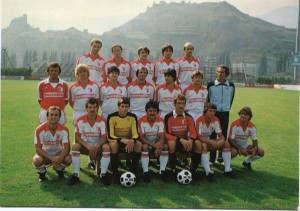
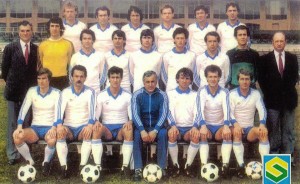
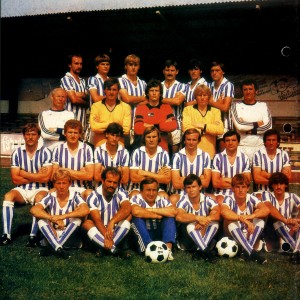
Third row form left: Heinz Reinhard (superintendant), Jürg Arm, Michael Wagner, Mario Signer, Francois Mollard, Manfred Schmied, Charly Zwygart, Fredi Häner (Masseur)

Middle row: Walter Eichenberger, Franz Peterhans, Martin Weber, Bert Theunissen (Trainer), Bernard Brodard, Jörg Schmidlin, Rolf Rebholz.

Sitting: René Müller, Maurizio Jacobacci, Jean-Marie Conz, Roland Schönenberger, Marco Zbinden, Kurt Feuz, Bruno Buchli.

9th place with 30 points – solid mid-table. Nice… except that 7 teams could be described as ‘solid mid-table’ teams this year and none was able to come even close to the the favourites. Including the best of this group, which finished 3rd .
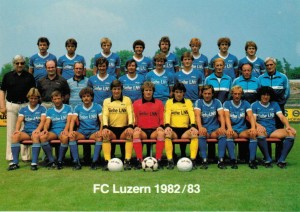
FC Luzern was 8th with 31 points.

FC Sion – 7th with 35 points.

Lausanne-Sports – 5th with 37 points.
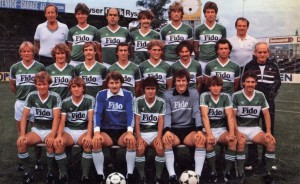
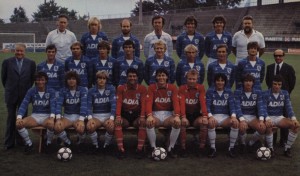
St. Gallen was more than happy, winning bronze medals this season. Third row from left: Helmuth Johannes (Trainer), Gerhard Ritter, Christian Gross, Georg Rudics, Jerzy Gorgon, Beat Rietmann, Hanspeter Wirth (Trainer-Assistent).

Middle row: Manfred Braschler, Armin Bischofberger, Zdenek Urban, Modesto Haas, Peter Germann, Angelo Amonini, Renato Hächler, Cäsar Widmer (Masseur).

Sitting: Vladimir Yakovliek, Martin Gisinger, Bruno Hafner, Metin Stengör, Bruno Huwiler, Paul Friberg, Martin Frei.

Great season for a rarely finishing that high, but often playing in the lower division, but let not make mistake about it: not for a second they challenged the favourites. St. Gallen was rather more stable and may be a bit luckier than few other similar clubs. Unfortunate predicament – Switzerland had tiny pool of good players. A team with one or two foreigners, playing well at the moment, would propel itself above most league members. But whoever concentrated more Swiss good players in its roster would be far above and entirely out of reach. So, Basel and FC Zurich lost their competitive edge for whatever reasons and St. Gallen took advantage. Cannot blame them, but theirs was not a team to win a title. Not now, not tomorrow. Servette (Geneve) and Grasshopper (Zurich) were miles above the other clubs, practically reducing the season to fierce battle between themselves. The clashed at the Cup final – the game ended 2-2 after overtime and had to be replayed. This time Grasshopper won 3-0.

Both teams run shoulder to shoulder in the championship and at the end Grasshopper prevailed by a point.
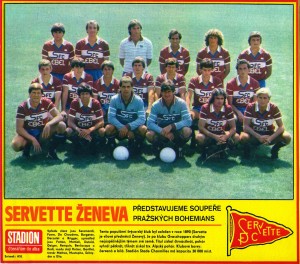
Servette lost twice – it was dramatic failure, for they so close to winning. However, the only team had to worry about during this year was Grasshopper – St. Gallen and the rest of the league were left far behind. At the end the gap was 8 points.
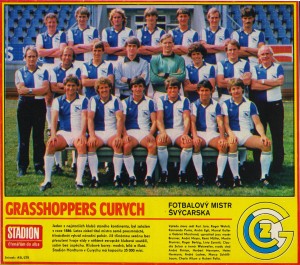
As for Grasshopper, this could have been easily their best season in history. It was not only that they had the biggest group of Swiss finest players and aging, but still inspiring Austrian Jara – Raimondo Ponte came back from his brief and not particularly great spell with Nottingham Forest, adding more class. But Ponte was not world class – the other addition was world class: the great West German coach Hennes Weisweiler. May be getting too old and a bit behind the newest trends, but still famous and revered. May be not good enough for a big German or Spanish club, but just fine for smaller fry, like Grasshopper. And he quickly tuned the team and extracted the best of generally decent squad. A double. But there was more to it – Grasshopper did not win the Swiss Cup since 1956! Imagine the joy and the relief. This squad was clearly ready to stay on top for quite some time – so let correct a mistake the Czechoslovak editors made with the name of one player: Charly In-Albon, not Albon, as written. Unusual name to be sure, but this mistake is not mere trifle – In-Albon will pop up frequently as member of this strong squad, as Swiss national team member, finally – and more recently – as a good and respected coach.
Romania the Cup

But there were three fronts for Dinamo and Universitatea, not two – and one cannot be all that certain that Dinamo multitasked better than Universitatea. Dinamo was eliminated in the Cup tournament, Universitatea reached the final. Their opponent was Politehnica (Timisoara), trying hard to compensate for their disastrous championship season. It would have been nice to win the Cup, but one of the seasonal outsiders, finishing relegated, was unable to win – they gave their best, may be more than their best, but lost 1-2.

Unlucky at the final, but objectively Politehnica had no winning team. Still great attempt, but just like two years earlier the Cup was out of their hands at the end.

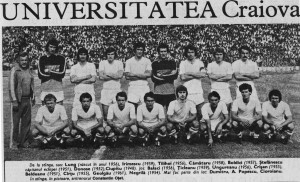
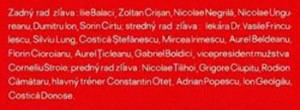
Universitatea (Craiova) confirmed that it was one of the two leading Romanian clubs, no matter which one of the two big Bucharest clubs was leading presently, they rivaled it. Not an easy victory, but still it was a season with a trophy. Stefanescu, Lung, Ungureanu, Balaci, Negrila, Camataru – a strong core of national team players, used to winning and leading their teammates to the next success. So far, their 4th Cup.

Romania I Division

First Division had familiar around Europe finality: 2 outsiders, a bulk of 11 fairly equal teams, largely concerned with escaping relegation during the year, 2 solid teams, which were not strong enough to tackle the title race, and three favourites. FC Constanta was last with 20 points – usually, the club is known as Farul, so the new name was confusing a bit.

Politehnica (Timisoara) was a big disappointment – they had good strong seasons recently, looking like finally stabilized and going to play more significant role in the championship. But suddenly they dropped down and finished 17th with measly 24 points.

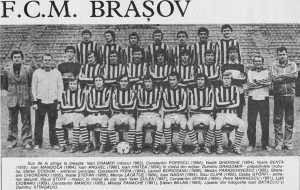
The third relegated team was also a bit of a surprise – unlike FC Constanta and Politehnica, they fought for survival, but failed, finishing 16th with 29 points. What was unpleasant surprise was that – FCM Brasov normally was a solid mid-table club. Presently, they had interesting squad, which included sometime national team goalkeeper Dumitru Stingaciu and bright young winger, soon to become world-famous – Marius Lakatus. And such a squad was going to second division, when typical candidates for relegation like Chimia (Ramnigu Vilcea), Politehnica (Iasi), and CS Targoviste (Targoviste) survived.

Not only that, but Politehnica (Iasi) enjoyed may be their best season – they finished 10th. Yes, 32 points was only 3 points more than what relegated FCM Brasov had they got 10th place only because of better goal-difference, but as a rule of thumb Politehnica played rarely in the top league and when they did, they hardly lasted longer than a season.

Petrolul (Ploesti) performed as usual, as most of the league members – nothing extraordinary: 12th with 32 points.

And so it went up to 5th place – Corvinul (Hunedoara) topped the bulk with 34 points, taking 6th place. For them, a club similar to Politehnica (Iasi) that was the strongest and most successful period. Rubbing shoulders with the best – kind of. Kind of, for they just bellow mighty Steaua, but still 4 points behind.

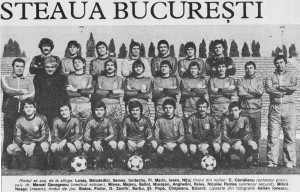
Steaua (Bucharest) was lowly 5th with 38 points, entirely out of the championship race. Understandably so – it was shaky period of changing generations and rebuilding was not finished yet. There were still remains of the old guard – Sames, Iordache, Anghelini – and the new blood was only too young – Belodedici, for instance. Team in transition, hence the results.

Arges (Pitesti) still preserved their leading position established during the 1970s – they finished 4th with 40 points. But it was clear they were slipping down – no longer title contenders and the squad was hardly promising.

Sportul Studentesc (Bucharest) was running strong – this year they were title contenders, but finished 3rd with 44 points. Perhaps the squad was less interesting than their kit – hardly a team compatible to Steaus, Universitatea, and Dinamo, but combative more than enough. As for the kit – depends on individual taste: for some an interesting and rare black-and-white hoops, for others – prison garb.

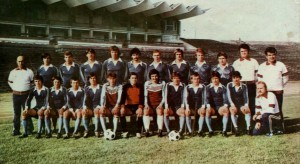
Universitatea (Craiova), the strongest and most consistent of the provincial clubs, continued to challenge the clubs of Bucharest: they won most games this season – 20. Also scored most goals – 66. Alas, it was not enough and they ended 2nd with 46 points. Three short of a title. Perhaps their international duties were too much… perhaps the team was not deep enough. Perhaps they were too adventurous and, risking, lost too many games – 8. But it was not bad finish – they remained very strong.

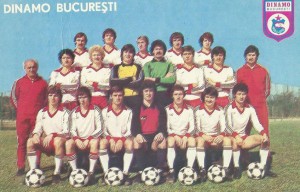
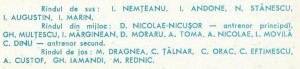
Familiar champion, then. Dinamo (Bucharest) repeated their success of the previous year – surely, they were the leading Romanian club in the early 1980s. Seemingly, able to avoid a crisis of generational change – Moraru and Andone were aging, but younger talent was painlessly blended – Rednic. Dinamo also played well in Europe, so, unlike Universitatea, fighting on two fronts was not affecting their form. 11th title.

Romania II Division

After almost Romanian football almost disappeared from sight in the 1970s, it was coming back into focus. Clubs in the European tournaments at first, notably Dinamo (Bucharest). The comeback was not yet fully pronounced, so even some big stars of the decade were already playing, they were unknown yet to the world – too young. Apart from that, it was business as usual and in the lower levels may be nothing really interesting was boiling. Of course, small clubs attract little interest and the three leagues of the Second Division were full of such.

Progresul (Corabia)

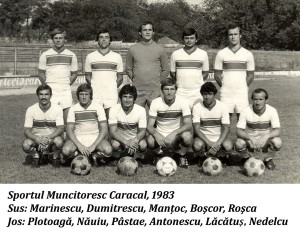
Sportul Muncitoresc (Caracal)

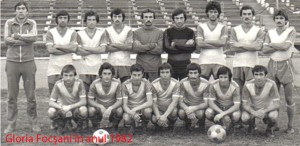
Gloria (Focsani) – the typical second division dwellers, which hardly could hope to move up. In general, former First Division members occupied top positions and aimed at promotion. So, the winners of the three leagues, correspondingly promoted to the First Division were familiar names – at least two of three. Dunarea CSU (Galati) looked like newcomer, although they played first division football occasionally.
Rapid (Bucharest) was the most famous of the second division winners – hopefully, the comeback was expected to be permanent, hopefully, restoration of former strength possible. At least the first step was done – return to top flight.

The third winner was a bit confusing: usually it is written FC Baia Mare, not a famous club, but long-time first division member, which, like Rapid, recently experienced some hardship. Now they were coming back, but the name of the promoted team was FC Maramures. Same club, same city, yet it was confusing, for often it was written with the old more familiar name The alternation of the names was a problem – one reads Maramures and can’t fing such club in the league, or the other way around. That aside, good look to the winners in the next season.
Hungary the Cup

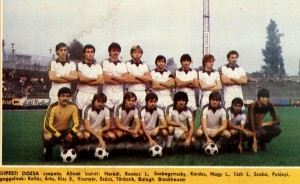
Budapest had to compensate with the Cup – the final was traditional derby, contested closely to the end of the match. Ujpesti Dozsa prevailed over Honved 3-2.

Quite a disappointement – arguably, Honved had the best team at the moment, lead by rapidly developing into major star Lajos Detari. That is, the best of Hungarian football of the 1980s was concentrated in the Army team. Yet, there was something mssing – something small, but making a difference between losing and winning. So close to victory, but ending losing both in the championship and in the cup tournament.

Objective strength rarely matters in big derbies and otherwise weak Ujpesti Dozsa was highly motivated and up to the task of beating stronger Honved. Under the circumstances, it was wonderful achievement – this squad would not be compatible to the great one, dominating the 1970s Hungarian football. It was struggling team in a process of hit and miss rebuilding. Andras Toroscik was leaving, there was no visible leader to take after him, no other major star. Objectively, Ujpesti Dozsa was the underdog – not a force in the championship, much weaker than Honved. It was great to see them win the Cup from such standpoint. From a historic perspective… it was banal: one more trophy, nothing new.

Hungary I Division

First Division was divided into one outsider, 9 equal teams, generally fighting to eascape relegation, two stand-alone teams, and three competing for the title.

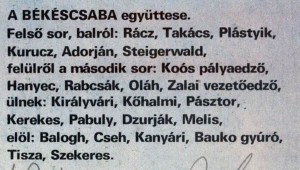
Békéscsaba gave up early and apart from their nice and unusual kit, there was nothing to be sorry for them: they finished 16th with 17 points.

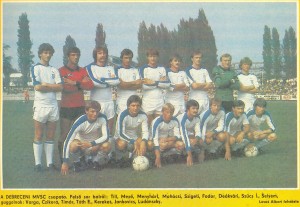
Debreceni MVSC, or DVSC, as the team appears more often in statistics, lost the battle between 9 clubs – they finished with 25 points, as two other teams, but they ended relegated on worse goal-difference.

Pécsi MSC took the 14th place, safe for one more first division year.

Videoton had strange weak season, also finishing with 25 points – but positive goal-difference. By now , they were considered one of the stronger teams in the league and in fact had their best squad, the one which made waves in Europe just a few years later, so it was unexpected flop.

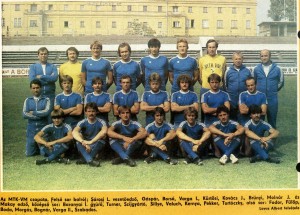
MTK-VM was 12th with 26 points, the worst of the Budapest clubs, but once-upon-a-time mighty club was struggling for quite some time, so nothing new.

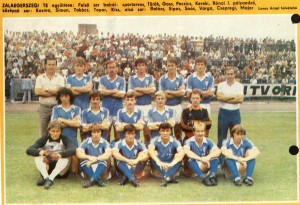
Zalaegerszegi TE, a mouthful of a name, usually abreviated to simple ZTE, took the 11th place also with 26 points – their usual lowly position.
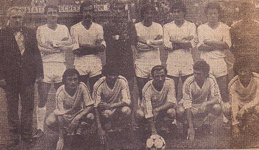
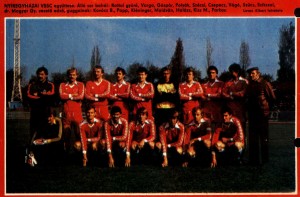
Nyiregyhaza VSSC was likely pleased with their final standing – 10th place was almost significant achievement. They just a point above relegation zone and ended in midtable thanks to better goal-difference, but it was fine.
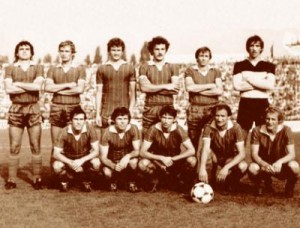
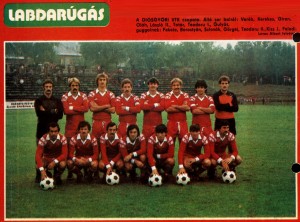
Diosgyory VTK – 9th with 27 points. Their usual.

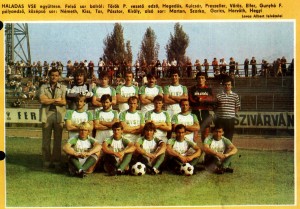
Haladas VSE – 8th with 28 points. Like Diosgyor – escaping relegation was just fine, ending above 10th place – a bonus.

Vasas was 7th, but their position was a bit misleading: on the surface, the club appeared to be where it usually was – in the upper half of the table. But they no longer had a team similar to the one of the 1970s and it was relegation, not medals, the real concern this year. Three points above the 15th-placed and ahead of Haladas only on goal-difference.

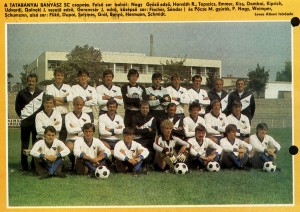
With 29 points, Tatabanya – or Tatabanya Banyasz SC – topped the group of equal clubs. 6th place was great, even if achieved more by good luck than by actual strong performance. It was amazing that Kiprich, already among the top stars of the country, did not move to bigger and stronger club.

Ujpesti Dozsa – 5th with 32 points. Weak season, but not unexpected one – rebuilding was not going well so far, so there were no chances for another title. Yet, they were stronger than most of the league members and their only concern was building a new team – which surely was not going to be based on the star Torocsik: it was certain he will go to play abroad soon.

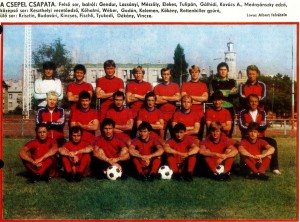
Csepel enjoyed a strong spell – their last, in fact. Having a few strong, although hardly first rate stars, kept them going. Good selection, well balanced squad, but not a title contender. 37 points was much more than the rest of the league, including Ujpesti Dozsa, was capable of – it was also far less than what the best three clubs were able of. So, comfortable 4th place – great for a club traditionally the weakest among the big Budapest representatives.

And lastly the strongest – they finished divided by 2 points, so the battle for the title was fierce.

Honved, the most defense-minded of the leaders, finished 3rd with 42 points. Perhaps they should have been more daring.

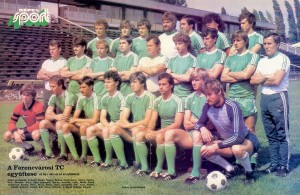
Ferencvaros finished 2nd with 43 points. They had the leakiest defense of the top trio – in fact, 6 teams had better defensive record than them this season. If Honved dared to attack more, Ferencvaros needed the opposite to win the title. May be so, but the final table is final and they were 2nd. And Tibor Nyilasi was surely going to play abroad – a bad news for the future.

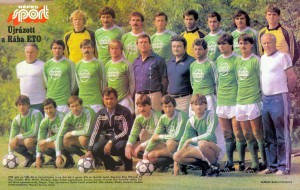
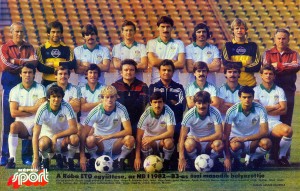
Raba ETO (gyor) prevailed with 44 points and triumphed as the Hungarian new champions. 19 wins, 6 ties, and 5 losses – just a tiny bit better record than their rivals’. Second-best difense in the league – 37 goals allowed, only Honved managed less. Best attack and by far – 82 goals scored; Ferencvaros was distant second with 73. So – joy and happiness.

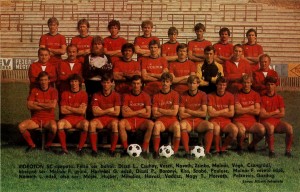
May be not the most outstanding squad, but well balanced and having a few national team players. May be taking some advantage from the relative shakiness of the traditional leading clubs, but who can blame them? They won a tough race, also sygnifying the end of the dominance of the Budapest clubs – in the 1980s provincial teams became powerful enough to fight the capital. It was second consecutive title, won with more difficulty than the the one in 1981-82, but confirming than Raba ETO was not one-time wonder. A total of 3 titles to date.