European Player of the Year

The European Footballer of the Year. This was a bit predictable: Italy won the World Cup and Paolo Rossi was the hero of the winning team. By the end of 1982, he was already the top scorer of the World Cup finals and voted best player at the finals. So… to be number 1 in Europe was expected. And he won the trophy practically unchallenged: with 115 points. Second was Alain Giresse (France and Girondens Bordeaux) with 67 points. Third – Zbigniew Boniek (Poland and Juventus) with 53.
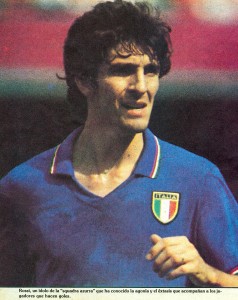
Well, Rossi was king and considering the troubles he went through in the recent years, it was nice to see him at the very top. But… practically, Rossi triumphed thanks to just 2 games. True, he played vital role, particularly in scoring the goals which made Italy champion of the world – and that counts a lot.
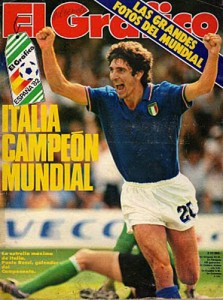
Pictures like this one were fresh and influential.
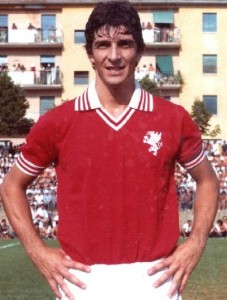
However, it was pictures like this one, which made Rossi a big star and rightly so. But this one was already old and almost forgotten photo of his days with L.Vicenza. Back than he scored a plenty. Now, he was playing for Juventus, where it was difficult to score so many goals – the competition was very harsh. Among so many stars it was difficult to distinguish Rossi and he was not exactly the key player of the team. Unfortunately, scorers and particularly scorers in important finals get the glory and journalists are slaves of glory. Rossi, then… even when others had much stronger overall season: Platini (9th with 5 points), Antognoni (11th with 3 points), Pezzey (12th with 2 poinst), Breitner (15th with 1 point). Yes, none was world champion. And none won much this year. All that counts at the end is winning… one may play great football, but without a victory nobody cares. So Rossi was the best of all with his two matches.
The Golden Shoe


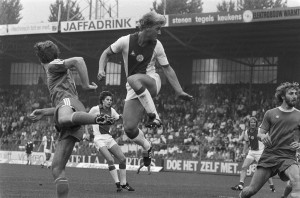
The Golden Shoe. The European top scorer for 1981-82 was Wim Kieft with 32 goals.

Born in 1962 and playing for Ajax, Kieft brought new hopes for Ajax and Dutch football in general – a new talented generation seemingly was emerging. But the Golden Shoe was already a misleading award – weaker championship had better chances to elevate a goalscorer. Kieft followed Kist, who won the award not long ago. That was promising. But… neither Kist, nor Kieft became truly great stars.

Finland


Finland. Two-phased championship, designed with the aim to improve the quality of the game, but as every such design there were problems. Well known problems: the first phase counted only for qualifying to the second phase – 8 out 12 league members. The last 4 went to promotion-relegation phase with the top 4 of Second Division. The top 8 teams carried half of their 1st phase points to the final phase – and here was the problem. 7th placed in the first phase KPV Kokkola had 25 points – 4 less than the winner of this phase, TPS Turku. Halving the points reduced the difference to 2 points. The whole first phase was quite meaningless and a clever club would play just well enough to qualify to the final stage, when the competition would be already tired from spending too much effort in the first phase. And that was seemingly the case in Finland this year: HJK Helsinki, 5th in the first phase, and Kuusysi Lahti, 6th, stepped up in the 2nd phase, but the leaders of the 1st phase, TPS Turku and Koparit Kuopio (formerly KPT Kuopio), were no longer competitive. At the end Kussysi prevailed and won the title.

The city of Lahti was no stranger to success, but the club was Reipas, not this one. Kuusysi was new club – or kind of new club. Its roots were old, but 1969 was the most important year. At that time the name was Lahti69 and it is difficult to figure out what exactly this club was: a brand new one, an off-shoot of Reipas, taking off on its own, amalgamation of other clubs or remains of other clubs. The name was odd and was quickly changed to something more palatable… or well, so it looks just because it is letters and looks like name. Who knows Finnish isn’t fooled – it is just that instead of numbers 69 is written with letters. The new boys did well in their short history – established themselves in the top league, sometimes playing better than Reipas, which showed signs of decline. However, nothing spectacular so far…

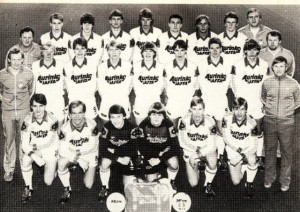
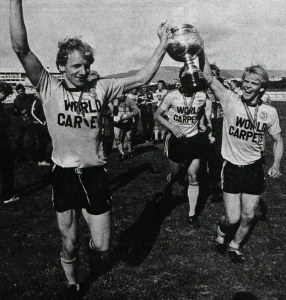
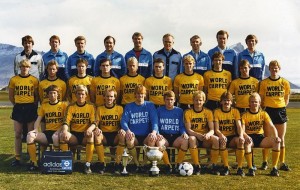
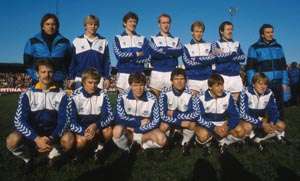
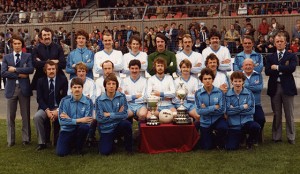
The squad means nothing to almost anybody, but it is historic nevertheless: these boys made Kuusysi champions for the first time. Did they take advantage of the championship formula or were they even a bit lucky no longer mattered: the young ‘underdog’ won. At the same time Reipas was playing in 2nd Division (won promotion this year, after finishing 2nd in the promotion-relegation tournament).

The Cup final opposed Haka Valkeakoski to KPV Kokkola.

Haka won 3-2 and got their 7th Cup.


Luxembourg


Luxembourg. The winners of Second Division were US Rumelange. Stade Dudelange was 2nd and both teams were promoted. It was wonderful season for US Rumelange – they almost reached European spot.

Spora Luxembourg was last. May be a bit of a surprise, but they were weak. So was Jeunesse Hautcharage, which finished 11th thanks to better goal-difference. The lowest teams finished with 10 points each, plummeting down to second division. With 14 points Olympique Eischen was safe – 10th place was almost a success for them.

Jeunesse Esch/Alzette finished 3rd with 29 points.

Progres Niedercorn was strong, but unable to repeat their success of the previous year – 2nd this time, 4 points behind the champions. 32 points.

With 36 points Avenir Beggen was confident winner. One more title for them.

The Cup final opposed the Second Division champion US Rumelange to 4th placed Red Boys Differdange. A good opportunity for US to make a double and to become one of the underdogs playing in the Cup Winners Cup. Red Boys had relatively good season in the top league, but winning the Cup was their true chance for success. US put the good fight, came close, but the objectively stronger first division team tampered their ambition.

Red Boys prevailed 2-1 and the Cup was theirs. Well done.

Albania

Mysterious Albania. Terribly difficult to found pictorial material, among other things – even now. KS Traktori (Lushnje) won the Second Division championship – on goal-difference. KS Skenderbeu (Korce) was 2nd and both teams were promoted. Worth noticing that both teams were relegated the previous season – together they were returning to top flight right away.

KS 24 Maji (Permet) was the absolute outsider, finishing last with 13 points. KS 31 Korriku (Burrel) was 13th with 20 points. Relegated both, just like they were promoted together the year before. Up the table nothing much until the very top – no shifts of power. KS Dinamo (Tirana) was 3rd with 32 points, KS Flamurtari (Vlore) – 2nd with 33 points. The champion was a bit of surprise, however.

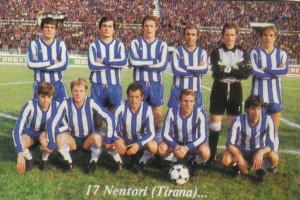
May be not a photo of this season, but at least from the period. KS 17 Nentori (Tirana) was confident champion with 37 points – 4 more than the 2nd placed. 15 wins, 7 ties, 4 games lost, 42-15 scoring record. It had been a long wait – 17 Nentori failed to win the championship since 1970! This was their 11th title, including the 6 titles won by their predecessor SK Tirana in the 1930s. However, they were still the 3rd most successful Albanian club, trailing behind Dinamo and Partizani.

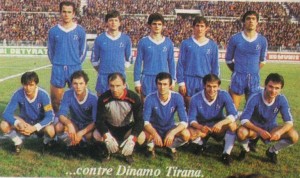
A chance for a double – 17 Nentori reached the Cup final, facing KS Dinamo (Tirana). Dinamo won the first leg 1-0. 17 Nentori won the second leg 3-2. The rule of away goals made Dinamo the winner.

Like the photo above – may be not from this year. Dinamo won its 10th Cup. Only Partizani had higher record – 11 Cups.

Malta

Malta. The smallest league in Europe – only 8 teams. Two relegated, though. Insignificant as it was, this season was historic. On the field – nothing to catch attention really. Zebbug Rangers and Rabat Ajax finished at the top of Second Division and were promoted.

Gzira United was the big outsider in the outsider land: they finished the season with a single point, losing all games but one. Senglea Athletics was the other relegated from First Division – 7th with 10 points. The rest was uneventful – there was a single dominant team and no other came close. Sliema Wanderers was 2nd with 18 points: 8 points less than the champions. And they had amazing record – 12 wins and 2 ties. Not even one match was lost – Sliema lost 4 games, for instance. 36-7 scoring record! Yes, the league was small, weak, and the championship consisted of only 14 rounds, but such dominance was rare and especially in small leagues – hard to achieve. Hibernians was really formidable champion. And there dominance was completed with the Cup – at the final they won over the 2nd best team, Sliema Wanderers, 2-0. A double.

Fantastic season, but even such dominant year would not be historic one for a club familiar with success – this was 6th title for Hibernians and their 5th Cup. But they never had a double before. Or after… so, it was the best ever season and remains so: the only time Hibernians won a double. One day they may win another double.

Iceland

Iceland. Trottur Reykjavík confidently won the II Division.

They lost just a single match, won 12, and received only 8 goals – the best records this in both I and II Divisions.

Thor Akureyri was 2nd with 23 points – 5 less than Throttur. Both teams were promoted.

KA Akureyri – 10th with 14 points, and Fram Reykjavík – 9th with 15 points, were relegated from I Division. Valur Reykjavík lost 2 games for using illegible player – they were awarded to Valur’s opponents, but the consequences were mild – Valur was strong and 4 lots points did not endanger it, but not strong enough to worry about lost title – they finished 5th after penalties, otherwise would have been 3rd. Now 3rd was KR Reykjavík, which managed to tie 11 of total 18 championship games – only 2nd division Fylkir had more ties this year – 12. ÍB Vestmannæyjar ended with silver medals and 22 points.

23 points were enough to win the championship and Vikingur Reykjavík achieved that after 7 wins, 9 ties, and 2 losses. They scored 25 goals, receiving 18 in the same time. Vikingur got second consecutive title and their 4th in total.

The Cup final opposed ÍB Keflavík to ÍA Akranes and Akranes prevailed 2-1.

The Cup was theirs, which was great.

IA Akranes had long strong presence in Icelandic football, becoming one of the recognized Icelandic clubs in Europe, but usually they won the championship. So far, they had just a single Cup in their trophy room, so it was much desired second Cup victory.

Norway


Norway. What came to the world’s attention was little, as always – more or less, the final table. But Norwegian football was vast.

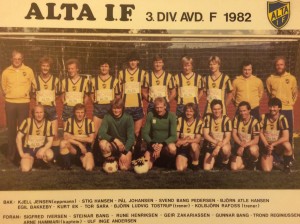
A glimpse of the depths: Third Division Alta IF.

Anyway, top level football was the only really important thing. The highest division was still small, 12 teams, two of them directly relegated and one going to promotion/relegation play-offs. Thus, second level comes to the surface and the end of this season was remarkable: Fredrikstad was 10th and went to the play-offs to meet the second division candidates, Steinkjer and Eik. Eik, to the world, was the same as already mentioned Alta IF – entirely unknown. Looked like Fredrikstad would not have any trouble keeping its place among the best. But they lost their opening match at home against this very Eik and although they won – away – the match with Steinkjer, it was not enough. Eik took full advantage of their home game against Steinkjer, prevailing 2-1. In fact, the unknown team already knew the result of Fredrikstad vs Steinkjer and needed only a tie.

This was the biggest success in the history of the club. Eik IF was founded in 1928 and represented Sem municipality. So far, they played in total obscurity and most certainly were pleasant surprise, going to debut in the top league the next season.

As for the rest of Second Division:

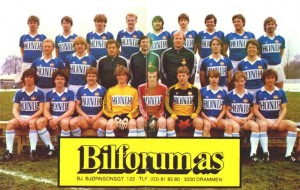
Strømsgodset Drammen failed to win promotion, but

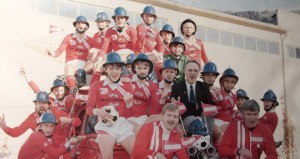
Brann was successful.

Molde finished last in First Division with 16 points.

Sogndal was 11th , also with 16 points. These, plus Fredrikstad, were relegated.

Start survived – 9th with 20 points.

At the more important higher end of the league nothing really dramatic happened. Lillestrom ended 3rd with 25 points and Bryne bested them by a point to finish 2nd and earn the sole Norwegian spot in the UEFA Cup.

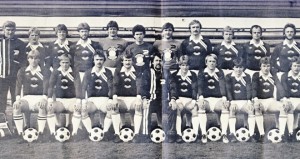
Viking (Stavanger) practically had no challengers this season, winning the championship with 29 points from 11 wins, 7 ties, and losing 4 games. 39-24 was their scoring record. Three points difference hardly suggests dominance, but remember that Norwegian league was small and fairly equal. Viking won their 7th title.

The champions had no chance for a double, for they did not reach the Cup final. The finalists were technically lowly teams – Molde, which was last in the championship, and 2nd Division Brann. Brann (Bergen) prevailed 3-2 and won the Cup.

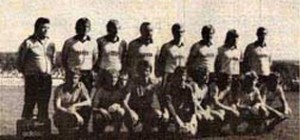
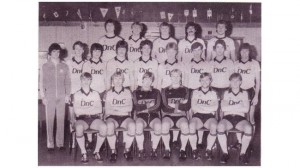
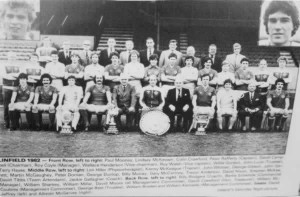
Second row from left: Oddvar Løkkeberg (assistant coach), Thor Åge Johansen, Paul Danielsen, Bjørn Erik Brandt, Nils Espen Eriksen, Stein Norstad, Geir Andre Johannesen, Tore Strand, Terje Rolland, Neil MacLeod, Ingvar Dalhaug.

Sitting: Arne Møller, Asgeir Kleppa, Øyvind Pettersen, Kjell Rune Pedersen, Arve Mokkelbost (coach), Geir Austvik, Hans Brandtun, Finn Krogh, Geir Midttveit, Magnar Heggen.

Their 5th Cup! Also, it is always nice to see lower division team winning a trophy – and inevitably contributing to the fall of the Cup Winners Cup…


Northern Ireland


Northern Ireland. Hardly anything unusual or spectacular here. High goal-scoring – the championship per game average was 3.265. FC Bangor was last this season with 9 points, but that hardly meant a thing – apart from very weak season for the club – for the there was no relegation. Closed league – same teams played year after year between themselves.

Ballymena United was 7th with 20 points.

FC Coleraine got bronze medals with 31 points.

Glentoran was unable to win consecutive title, finishing 2nd with 33 points.

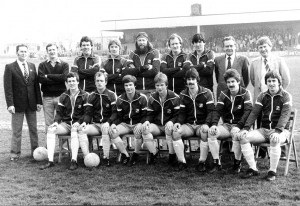
And Linfield came on top, as many times before and hardly challenged, with 37 points. 17 wins, 3 ties, and just 2 lost games. 59-19 was their scoring record. Linfield also reached the Cup final and their prevailed over FC Coleraine 2-1.

A well deserved double this year.


Cyprus

Cyprus – its football jumped up in the 1980s. It was not a sudden and impressive jump, but improvement eventually was noticed around mid-80s. However, the development did not manifest in any changes in the clubs status – the strong remained strong, the outsiders remained outsiders.

Alki (Larnaca) and Aris (Limassol) topped the Second Division and earned promotion.

The First Division was divided into four groups – three outsiders, 7 lower-positioned teams, 3 clearly stronger teams, but not as strong as to be able to challenge the sole leader, and one singular dominant favourite. In the final table everything was very familiar. Evagoras (Paphos) was hopelessly last with 13 points, nothing surprising. Keravnos (Strovolos) and APOP (Paphos) fought head to head for survival – both finished with 19 points and APOP clinched the safe 12th position on better goal-difference. So, Evagoras and Keravnos were relegated as expected to be.

The next group, the mid-table teams, were pretty much equal.

Paralimni was typical example – 8th with 23 points. Once the danger of relegation was out of the picture, there not a care in the world. At the top of this group finished AEL (Limassol) – 5th with 28 points.

Apolon (Limassol), APOEL (Nicosia), and Pezoporikos (Larnaca) fought not for the title, but for silver and bronze, all ending with 34 points. Goal-difference decided final positions – Apollon was 4th and Pezoporikos, perhaps the pleasant surprise of the season – second.

And at the top, without any competition, was the usual suspect – Omonia (Nicosia).

20 wins, 4 ties, only 2 matches lost, 61-9 scoring record, and 44 points – Pezoporikos was 10 points behind. Omonia was absolutely and completely dominant – they also reached the Cup final. Apollon (Limassol) was the other finalist and put mighty fight – the match ended 2-2 and replay was scheduled. And that was all… Apollon managed one match, but the replay was too much for them – Omonia destroyed them 4-1. A double and no need to even count… winning was routine.

One may argue that the improvement of Cypriot football was largely done by Bulgarian imports – coaches in the 1970s and now players too. Cyprus was prime destination for Bulgarian export – it may not have been wise to sell cheaply by the bulk, but since the players were all veterans it was the easiest, if not very lucrative or reputation-building market. Old stars, at the end of their playing days, were still good enough to make a difference in Cyprus. Even a joke was made – if Atanas Mikhaylov managed to drop a few kilos and slim himself to, say, 120 kilos weight, his second division club may escape relegation. It was a joke and it was not – those in better shape helped their new teams to stronger performance, absolutely true for Omonia. The club employed Bulgarian coaches since the early 1970s and Vassil Spassov was currently in charge. The aging midfielder star Bozhil Kolev was added as a player and Omonia remained dominant, even more so. And other Bulgarian players were employed during the 1980s.