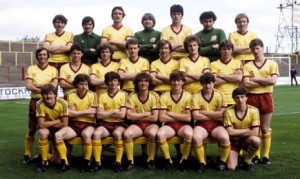
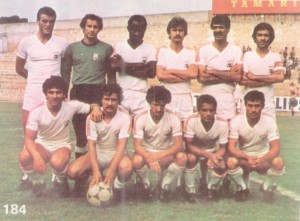
Czechoslovakia II Division

Czechoslovakia. Second division was still divided into Czech and Slovak leagues, the champions promoted. The Slovak League was won by ZVL Zilina.

Constantly moving up and down, now it was up again. Too strong for second level, too weak for the first.

The Czech league was a battle between three clubs far stronger than the other 13 teams.

Sklo Union Teplice once again failed to return to top flight – they ended 3rd with 43 points. Another former first division member finished 2nd with 44 points – Skoda Plzen. A point ahead of them was a club which never played first division football:

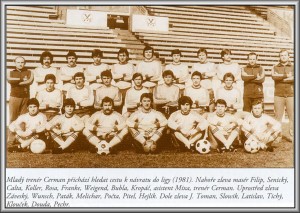
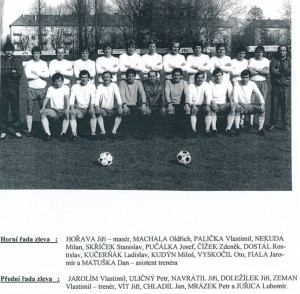
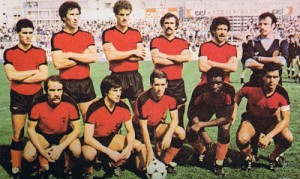
Sigma ZTS (Olomouc) clinched promotion with 45 points from 20 wins, 5 ties, and 5 losses. Their best season to date.

Switzerland the Cup

The Swiss Cup final apposed FC Sion and Basel – on the surface, not a brainer, bur a bit unusual, for neither club had a strong year. Wisdom suggested to bet on Basel… tradition and experience, and wounded pride were on their side. But they lost 0-1.

Basel finished the year with nothing. However, it was more an accident than going down.

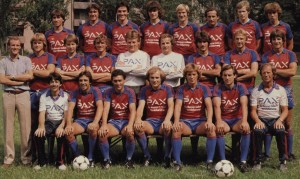
FC Sion – what a great season they had! Second row from left: Richard, Bitz, Cernicky, Valentini, Karlen, Lopez, Pittier, Cucinotta, Moulin.

First row: Schnydrig, Luisier, Balet, Brigger, Bregy, Fournier.

Normally a modest team, Sion had very promising championship and won the Cup. Hardly a great squad, but they had a few experienced leading players – Cucinotta and Bregy, for instance. And a curious case: Marian Cernicky. Born in 1953, he played between 1972 and 1978 for his native club Lokomotiva (Kosice) in Czechoslovakia. Then he disappeared, which nobody noticed, for his was not a rather ordinary name in the sport. But he resurfaced in 1979 with Sion’s jersey – given that Czechoslovakia started exported players in 1980 and only over 28 years old at first, most likely he was run away. But he settled well in Sion and played until 1983. A rare, but well deserved success for club. And their 4th Cup.

Switzerland I Division

First Division or Nationalliga A. Back to 16 teams and 30 rounds. Five teams were way above the rest of the league. At the lower end nothing really strange happened. FC Chiasso was last and FC Nordstern (Basel) was 15th – and relegated. One of the three newcomers finished 14th with 19 points – FC Bulle. Safe at the moment, although safety came with only 2 points leverage.
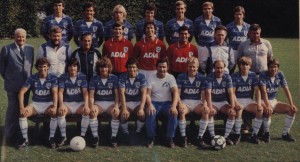
Lausanne-Sports finished 13th with 20 points. Standing from left: Urs Bamert, Christian Rytz, Robert Kok, Stéphane Crescenzi, Robert Ley-Ravello, Yves Mauron, Pierre-Albert Tachet.

Middle row: George Suri (Präsident), René Prior (Pfleger), Frankir Séchaye (Torhüter-Trainer), George Favre, Jean Claude Milani, Joseph Varquez, Pierre Milliquet (Pfleger), Richard Dürr (sportl. Direktor)

Sitting: Marcel Parietti, Gérard Castella, Pierre-Albert Chapuisat, Georges Diserens, Charles Hertig (Trainer), Claude Ryf, Didier Cavin, John Dario, M.Batardon
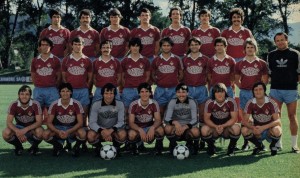
AC Bellinzona – 12th with 21 points. Third row: Mauro Lazzarotto, André Schär, Claudio Tedeschi, Reto Zanolari, Claudio Viel, Claudio Degiovannini, Roberto Leoni,

Middle row: Carlo Lucchini, Guido Rossi, Ivan Parini, Mirko Bullo, Arno Rossini, Marco Rossini, Francesco Monighetti, Alfio Genini, Milovan Beljin (Trainer)

Crouching: Tarcisio Ostini, Sandro Maccini, Mauro Benzoni, Patrizio Cerutti, Giorgio Mellacina, Massimo Faqetti, Roland Weidle.
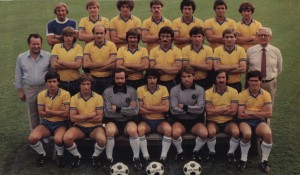
Vevey-Sports, the second newcomers, did fairly well – 11th with 23 points. Top row: Paul Garbani (Trainer), Claude Michaud, Karl Küng, Jean Francois Henry, Jean-Michel Guillaume, Christian Matthey, Claudio Negroni

Middle row: Roland Frey (Coach), Olivier Tinelli, Bernard Karlen, José Grobet, Rolf Kramer, Dario Bertoliatti, Hans Franz, Paul Rinsoz (Präsident)

Sitting: Enzo Colagioia, Alain Nicolet, Mario Malnati, Yves Debonnaire, Claude Kühne, Franco Marchi, Patrick Lätt.
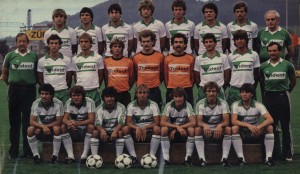
St. Gallen – 10th with 25 points. Third row: Roger Corminboeuf, Martin Gisinger, Jörg Althaus, Jerzy Gorgon, Beat Rietmann, Peter Hafner, Roman Steinemann

Middle row: Cési Widmer (Masseur), Helmuth Johannsen (Trainer), Rolf Günter, Kurt Bauer, Reto Graf, Roberto Böckli, Markus Brühwiler, Norbert Senn, Gerhard Ritter, Hanspeter Wirth (Ass.-Trainer)

Sitting: Martin Frei, Walter Schlegel, Metin Sengör, Christian Graf, Armin Bischofberger, Zdenek Urban, Paul Friberg.

The only interesting thing about this team is Jerzy Gorgon – the fearsome Polish defender, a hero of 1974 World Cup, helped his new club as best as his aging legs could. A mysterious case… Gorgon was in the Polish squad for the 1978 World Cup in Argentina. After that he disappeared from sight. Much later it came out that he went to – or stayed in – Argentina, where he was ‘unlucky’. There is no evidence he ever played there and may be speculated that he just run away, hoping for a contract. If so, it was rather unusual – Polish players have been permitted to play abroad for years and he was the right age for that. South America was unusual destination for an European players anyway. At last he moved back to Europe and got a contract with St. Gallen in 1980.
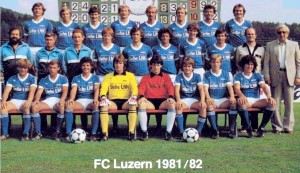
FC Luzern – 9th with 27 points.

FC Basel – a weak season: 8th with 28 points.
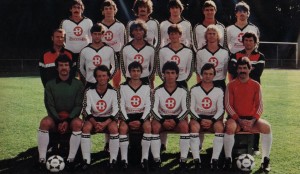
FC Aarau finished 7th – ahead of FC Basel not even on better goal-difference, but just because they scored more goals. The best placed of the three freshly promoted teams.Third row: Alfred Herberth, Agapios Kataverdis, René Fritsch, Martin Müller, Ernst Schmocker, Heinz Gloor

Middle row: Paul Stehrenberger (techn. Leiter), Rolf Osterwalder, Rudolf Zahner, Armand Da Costa, René Rietmann, Paul Fischli (Trainer)

Sitting: Max Richner, Roger Hegi, Fritz Siegrist, Thomas Tschuppert, Max Zehnder, Ernst Bleiker.
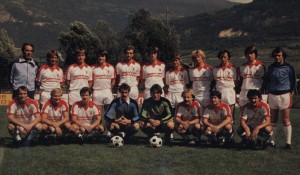
FC Sion was 6th with 31 points. Second row from left: Roger Panchard (Coach), Franco Cucinotta, Jean-Claude Flury, Michel Yerly, Léonard Karlen, Alain Balet, Erwin Schnydrig, Marian Cernicky, Jean-Claude Richard, Olivier Moulin, Jean-Claude Donzé (Trainer)

First row: Fernand Luisier, Jean-Paul Brigger, Georges Bregy, Pierre Pittier, Claude Bitz, Bernard Perrier, Pierre Valentini, Alvaro Lopez.

With them the bulk of the league ended.
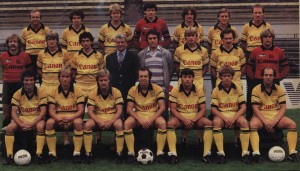
Young Boys was 5th with 39 points. A stand alone team, far stronger than most of the league, yet, far weaker than the top four clubs. One could say something was missing… something quite important and without it, Young Boys would not be truly competitive. Third row: Fredy Häner (Therapeut), Jürg Arm, Jörg Schmidlin, Francois Mollard, Martin Brügger, Kurt Feuz

Middle row: Karl-Heinz Fattler (Assistenz-Trainer), Hanspeter Bickel, Rolf Zahnd, Hansruedi Baur, Marcel Flückiger (Sportchef),Bert Theunissen (Trainer)

Sitting: Bernard Brodard, Winfried Berkemeier, Walter Eichenberger, René Müller, Martin Weber, Roland Schönenberger, Jean-Marie Conz, Marco Zbinden, Franz Peterhans, Köbi Brechbühl.
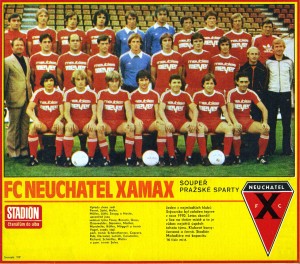
Neuchatel Xamax FC – 4th with 45 points. Rising team, but not yet ready to concur the league. Missed medals by a point, but may be the most promising team this year.
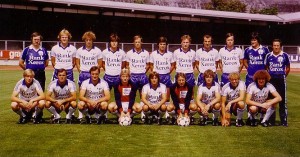
FC Zurih – 3rd with 46 points. Lost silver on worse goal-difference, but maintained its leading position in Swiss football.
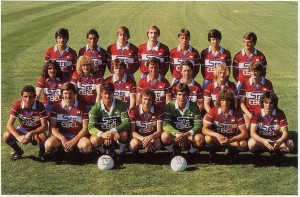
Servette (Geneve) clinched silver medals on better goal-difference and also scored most goals this season. Still running high – and the squad tells why. Third row: Valentini, Mustapha, Geiger, Gavillet, Dutoit, Favre, Elia.

Middle row: Coutaz, Pleimelding, Mathez (Ass), Pazmandy (Trainer), Girod (Coach), Zwygart, Bizzini

First row: Radi, Seramondi, Burgener, Guyot, De Choudens, Schnyder, Decastel.

A handful of Swiss stars plus Pleimelding, a French veteran.
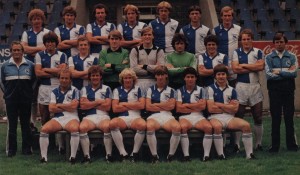
But as good as Servette were, Grasshopper was much better – they lost only 2 games, tied 7, and won 21. 72-24 goal-difference. 49 points – 3 more than Servette and FC Zurich. Top row from left: Richard Bauer, Kurt Jara, Renato Hächler, Heinz Hermann, Herbert Hermann, Marco Schällibaum, Charly In-Albon

Middle row: Hans Brunner (Masseur), André Egli, André Fimian, Martin Brunner, Roger Berbig, Jacques Gurtner, Livio Zanetti, Claudio Sulser, Timo Konietzka (Trainer)

Sitting: André Meyer, Roger Wehrli, Hans-Jörg Pfister, André Ladner, Marcel Koller, Gabriel Marchand.

The experienced German coach Timo Konietzka lead them to victory, but he was not to last. The veteran Austrian big star of the 1970s Kurt Jara was perhaps no longer up to Spanish or West German football, but was good enough for Swiss championships. And Grasshopper were champions again – as many times before: their 18th title.
Switzerland II Division

Switzerland – one change for this season: a new re-organisation of the championship. Going back to the standard formula – two leagues of 16 teams each, no more promotion/relegation tournament. The top 2 of Second Division going up and the last 2 of First Division going down.

The new-old formula affected more the second level than the first – few teams were really aiming promotion, all of them former first division members. Nothing to be done… Switzerland, although financially stable, had no big football following and clubs were thrifty anyway. So more or less FC La Chaux-de-Fonds, CS Chênois , FC Wettingen, and FC Winterthur competed for the two top spots. At the end two teams were clearly stronger than the rest.
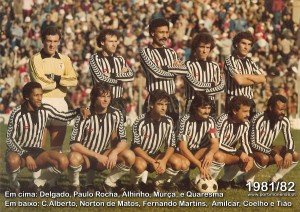
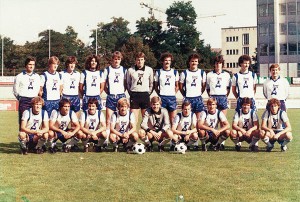
FC Wettingen built 4 points lead from CS Chenois, but still was unable to win the league. They finished with 44 points and had the best defensive record, losing only 3 games. Did not matter much – they won promotion.

FC Winterthur clinched the first place with 45 points. Standing from left: Adi Noventa (coach), Urs Kühni, A. Meyer, André Hagenbuch, Sepp Roth, Ota Danek, Adriano Venica, Uwe Rapolder, Manfred Häni, Daniel Haefeli – Paul Kilgus (Teambetreuer).

First row: Manfred Riedlisbacher, Luigi Stomeo, M. Zanelli, Rolf Dünner, Walter Christinger, R. Brunner, Roland Käser, Manuel Lopez, K. Hartmann.

As second division teams go, not a mind-blowing squad. 19 wins, 7 ties, 4 losses and 65-25. A point better than Wettingen and Second Division champions – a trophy is a trophy.

Scotland the Cups

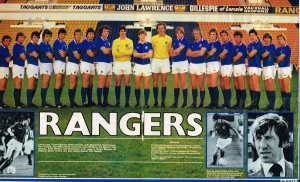
No Celtic at the finals of the cups. Glasgow Rangers, though, had a good chance to get both cups. At the League Cup final they triumphed, beating Dundee United 2-1.

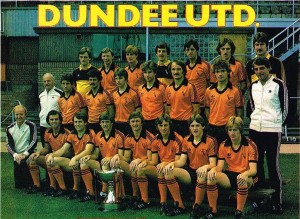
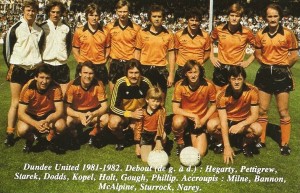
Splendid period for Dundee United, having one of their best ever squads. But, unfortunately, they lost.
Glasgow Rangers was experiencing rather weak period, which was to continue for some time, but this was not a club to lose, no matter in what shape. The League Cup was in their hands, may be the FA Cup just as well…
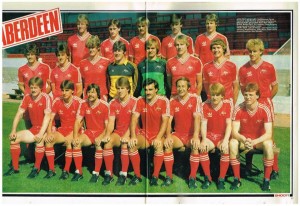
No luck there – Rangers met rapidly progressing Aberdeen and managed to keep its chances: regular time ended 1-1. But in the overtime Aberdeen destroyed them with 3 unanswered goals. Aberdeen – 4, Rangers – 1.

Aberdeen lost the title, but won the FA Cup, which was great for keeping the momentum. So far, they were 2nd and lost the FA Cup final in 1977-78, 4th in 1978-79, champions and League Cup finalists in 1979-80, 2nd in 1980-81, second and FA Cup winners in 1981-82. It was not just young exciting team by now – the squad was solid and experienced as well, going up and up. And think about the coach, still young and climbing the ladder.

Scotland I Division (continued)

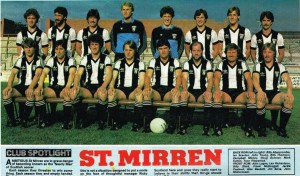
St. Mirren did well this season – 5th with 37 points.

Dundee United – 4th with 40 points.

Glasgow Rangers – out of the championship race, but still too strong for the rest of the league: 3rd with 43 points.

Aberdeen – running strong, but lost the title by 2 points. Second with 53 points.

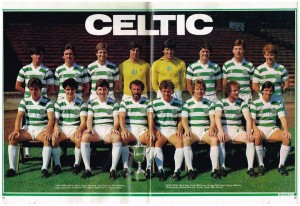
Celtic added another title. Difficult victory, but theirs after 24 wins, 7 ties, and 5 lost games. 79-33 goal-difference and 55 points.


Scotland I Division (partial)

Premier League. One thing really: back in 1975 the league structure was reformed in hope if making professional football more equal and competitive. But the result was questionable – the new 10-team league still remained divided with 2-3 teams clearly above the others and, more alarmingly, there were always very weak outsiders. One team in the first years, but the pattern already settled for 2, the relegation number. That meant a huge gap between first and second level on one hand and also forming just a modified status quo: nobody doubted the supremacy of Celtic and Rangers, but practically all other bigger clubs eventually settled for secure and uneventful existence, knowing that relegation is no threat. The sifting was generally financial: bigger clubs had more, the smaller had less and less chances to generate sufficient income and, therefore, to build and keep strong enough squad. And that was that, considering the big handicap of having the English leagues next door – whoever was even a bit above average went to play there and Scottish leagues were left with leftovers. Even the leading clubs. So, the 1981-82 produced nothing new…

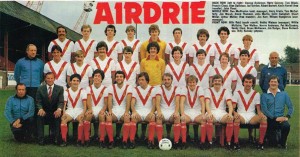
Airdrieonians was dead last with 18 points.

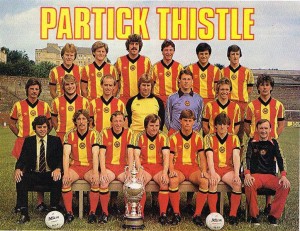
Partick Thistle ended 9th with 22 points. Those were the relegated teams.

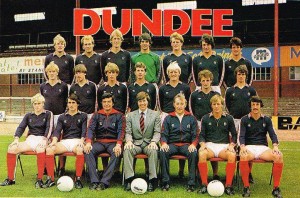
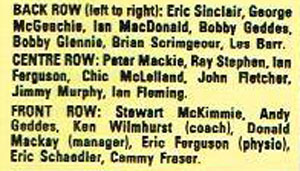
Dundee was safely 8th with 26 points.

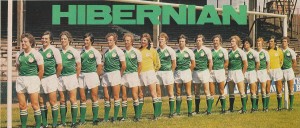
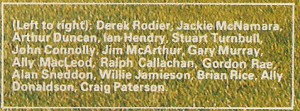
Hibernian was 6th with 36 points. Like Dundee, Hibernian suffered from the shock waves of the reformed league, but now, after coming back from second level, things seemed different: they and Dundee were big enough clubs to play top level football indifferently – too weak to claim a title, too strong to fear relegation.

Scotland

Scotland. Not much to say about deep down –

Alloa Athletic clinched 2nd place in Division 2 (third level) on better goal-diference.

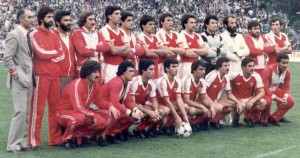
Clyde was unchallenged leader. Both teams were promoted.

At the end of Division 1 (second level) finished Queen of South, last, and East Stirlingshire, 13th. They went down. Nothing much up the table until the very top.

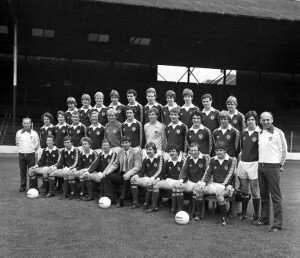
Heart of Midlothian lost promotion by a point, ending 3rd.

Kilmarnock bested them with 51 points and moved up.

Like in the third level, only one team was leading all the time. Motherwell was way above the league, finishing with 61 points from 26 wins, 9 ties, and losing just 4 games. 92-36 goal-difference – they were the highest scoring team in all Scottish leagues this season. Promoted, of course.

Portugal the Cup

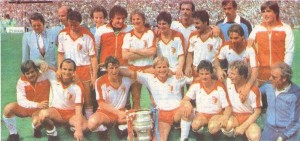
The Cup final opposed Sporting Braga to Sporting Lisbon. The difference of class was obvious – Sporting won 4-0 and collected the trophy.

A nice effort of Sporting, but it ended with predictable loss. Still, it was fine – Sporting got to play in the Cup Winners Cup.

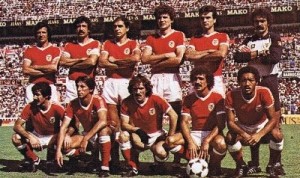
Standing from left: Eurico, Jordao, Ferenc Meszaros, Virgilio, Inacio, Oliveira.

First row: Lito, Carlos Xavier, Barao, Manuel Fernandes, Nogueira.

A supreme season, finished with a double. Making the total record of Sporting 16th titles and 11th Cups. The team was good – Jordao, Eurico, Meszaros, to name the best known – but still it was not exceptional squad not only by European standards: even in Portugal had been much stronger squads. But nothing to shun the joy – a good spell for Sporting after years of playing second fiddle, if not even third, started with the beginning of the 1980s. The rewards? Two titles and a cup in three years.

Portugal I Division

The championship was interesting – three teams competed for the title and 9 in danger of relegation. A historic moment at the bottom end, if relegation is something to be kept in memory. Nine out of 16 league members in danger of relegation is not something to brag about, but that was the case this season – three teams directly relegated and one going to promotion/relegation post-season tournament.

UD Leiria finished last with 20 points. They earned just 1 point on the road, losing 14 away matches.

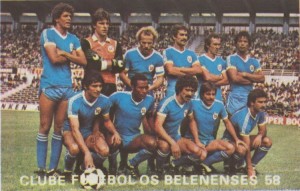
Os Belenenses was 15th, ahead of Leiria only on better goal-difference. This was the ‘historic moment’: back in 1834 Belenenses, along with Sporting, Benfica, and FC Porot co-founded the Portuguese league. They were among the ‘big’ clubs for a long time and won trophies. One of the big four… but after mid-1960s the club started to fade away and the unstoppable decline reached its logical conclusion: relegation. For the first time Belenenses was relegated. For the first time one of the original founders was relegated. And, looking at the broad picture, Belenenses is still the only one of the original big four relegated – perhaps this dubious record will be unchallenged forever.

CAF Viseu was 14th with 23 points, the third team directly relegated.

FC Penafiel, also with 23 points, was 13th on better goal-difference. They still a chance to keep their place in the top division – if winning the promotion/relegation tournament. They finished 2nd in it and according to the statistical notes, they were safe. Then the 1982-83 season started without them… Down they went after all.

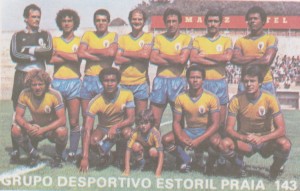
GD Estoril-Praia survived – 12th with 24 points.

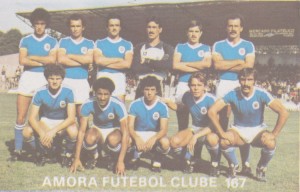
Amora FC was also lucky – in safety with 24 points. Better goal-difference placed them 11th.

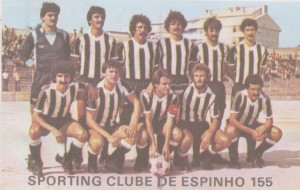
SC Espinho – 10th with 25 points.

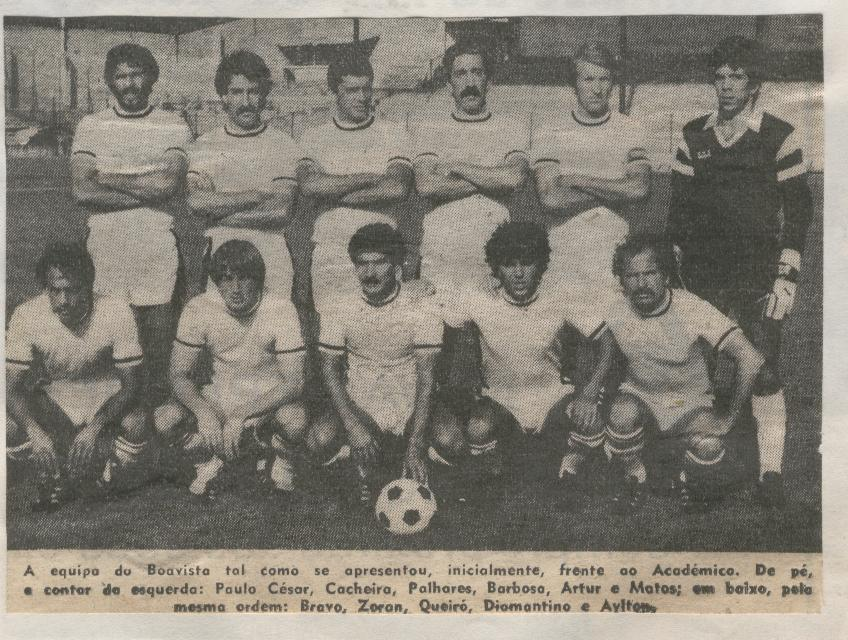
Boavista – 9th with 26 points. Perhaps never in big danger of relegation, but so close. Their good spell seemingly ended and they returned to ‘normal’ – closer to the bottom than to the top. Not a bad team, but…

Vitoria Setubal – 8th with 28 points. Almost perfect mid-table record – 9 wins, 10 ties, 11 losses. Typical for them, nothing new.

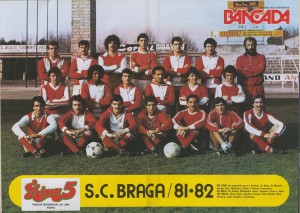
SC Braga – 7th with 30 points. Like Setubal, solid mid-table team, having its usual season.

Portimonense FC – 6th with 32. Now, this small club had wonderful season, finishing unusually high.

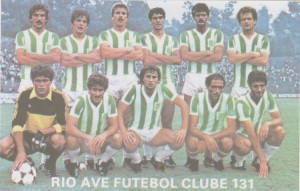
Rio Ave FC – 5th with 34 points. Like Portimonense, they had surprisingly strong year, but also like Portimonense, they did not have the team and money to stay high in the league for long.

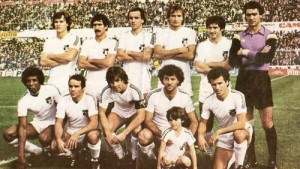
Vitoria Guimaraes – a stand-alone team. With 38 points they were way above the bulk of the league, but also far behind the favourites. 4th place was, however, right and typical. Standing from left: Blanker,Tózé,Barrinha,Nivaldo,Ramalho,Damas.

First row: Mundinho,Ferreira da Costa,Abreu,Festas,Gregorio Freixo.

Aging former national team goalkeeper Damas was the only recognizable name. Curiously, Vitoria did not win even a single match away – their road record was 10 ties and 5 losses.

And the usual suspects battled for the title – at the end, 3 points separated the winners from the bronze medalists.

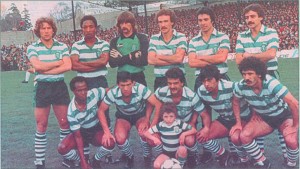
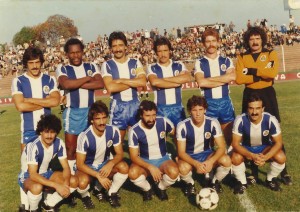
Standing from left: Gabriel, Freitas, Rodolfo, Teixeira, Romeu, Fonseca.

First row: Jaques, Albertino, Fernando, Jaime Magalhães, Costa.

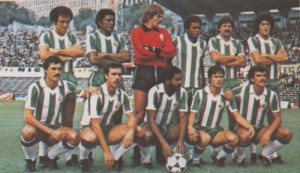
FC Porto settled at 3rd place with 43 points and the best defensive record this season – they allowed only 17 goals in their net.

Benfica – 2nd with 44 points. They won the most matches – 20, but lost the most among the top teams – 6.

Sporting Lisbon clinched the tile with 46 points. Standing from left: Eurico, Jordão, Manuel Marques (enfermeiro-massagista), Meszaros, Carlos Xavier, Jaime Lopes (chefe do departamento de futebol), Virgílio, Freire, Nogueira, Esmoriz, Fidalgo, Allison, Dr. Alfaiate (médico).

First row: Ademar, Inácio, Barão, Manuel Fernandes, Bastos, Mário Jorge, Lito, Marinho, Oliveira, Marinho (treinador adjunto).

19 wins, 8 ties, and only 3 matches lost. 66-26 goal-difference. Wonderful victory. Their English coach Malcolm Allison must be credited for it.