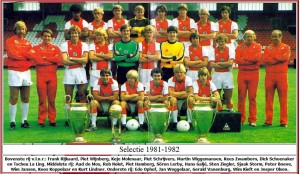
Portugal II Division

Portugal. Second Division – three groups of 16 teams each, the last 4 relegated to third divisions. As promotion, it was complicated this year. The group winners were directly promoted, but they also played a mini-tournament deciding the Second Division champion. The second-placed of each group plus the 13th of First Division participated in a promotional play-off – and here the confusion. According to the final standing the top 2 of this tournament were promoted. However, the promoted teams were only three… The 13th of First Division finished second in the play-off tournament and kept its place among the best. The winner, however, did not go up – either there was a final match between, deciding who gets promotion, or the play-off meant nothing. Anyway, the easy stuff first.

Zona Norte. Five teams competed for the top places and at the end two teams finished with equal points – 41 each.

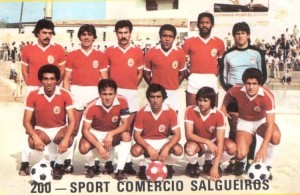
Salgueiros was placed 2nd on worse goal-difference and went to the promotional play-off.

Varzim was first – 17 wins, 8 ties, 5 losses, 59-18. Supreme goal-difference: +41, compared to +24 Salgueiros had.

Zona Centro. Three teams battled for the top 2 spots, two of them finishing with equal points, so again goal-difference decided the winner. Hm, not the goal-difference after all…

Academica Coimbra was strangely 2nd – 18 wins, 10 ties, 1 loss, 59-13 goal-difference. That is, +46 – their rival had only +34… and finished ahead of Academica. The numbers don’t make sense: one match is missing in the Academica’s record – 29 instead of 30. They either did not play one match for some reason, or lost 2 matches, not one.

Strangely, Alcobaca GC, virtually unheard of club, won the group and the only reason could have been that they won more matches than Academica – 21 to Academica’s 18.

Zona Sul. Two teams really competed this season, so no problem here – they did not finish with equal points.

Farense was 2nd with 39 points.

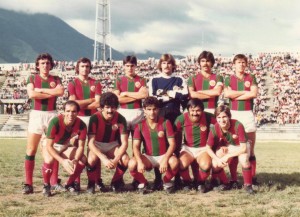
Maritimo (Funchal) – 1st with 42 points.

The zonal winners went to the championship play-off and here Maritimo proved strongest and won the mini-league with 2 wins and 1 loss and better goal-difference: +4. They were the Second Division champions. Varzim also won twice and lost one match, but had only +2 goal-difference and finished second. Alcobaca lost all their matches, but it did not matter at all – the three zonal winners were already directly promoted to First Division.

The confusing promotional play-off had 4 participants: the three 2nd placed in the zones – Salgueiros, Academica, and Farense, plus Penafiel, the 13th in First Division. Salgueiros won the tournament with 7 points and, curiously, negative goal-difference. Penafiel was 2nd with 6 points and better goal-difference than Academica, also with 6 points. Varzim was last with 5 points. And according to the final table Salgueiros and Penafiel were promoted – or, in the case of Penafiel, kept its place in first division. That they did and were not mentioned further. But Salgueiros was not in the list of promoted clubs this year… However, Salgueiros played in the First Division the next season and Penafiel – not.

Yugoslavia the Cup

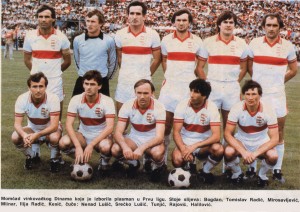
Dinamo had a good chance for a double this year – they reached the Cup final. Crvena zvezda was the other finalist. An exciting clash of opponents fueled by ambition and having a long history of rivalry. The final ended 2-2 and a replay was scheduled. The second match was won by Crvena zvezda 4-2 and the Cup was theirs.

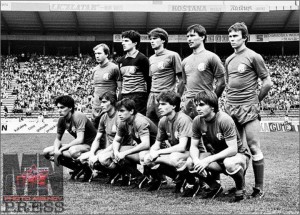
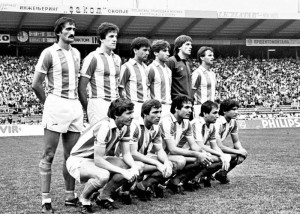
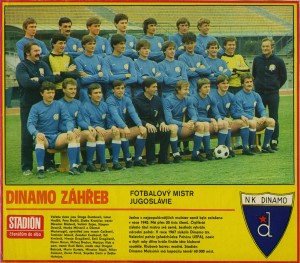
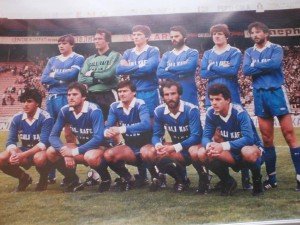
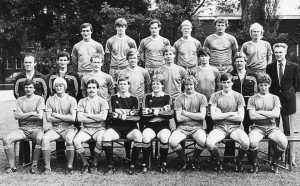
The losing finalists. Standing from left: Velimir Zajec, Tomislav Ivković, Zvezdan Cvetković, Srećko Bogdan,Dragan Bošnjak.

First row: Edi Krnčević, Snješko Cerin, Zlatko Kranjčar, Emil Dragičević, Marko Mlinarić.

Dinamo was unable to win a double and the reason was perhaps not enough experience – the team was young.

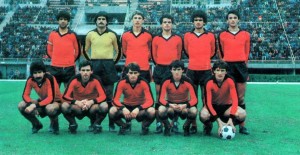
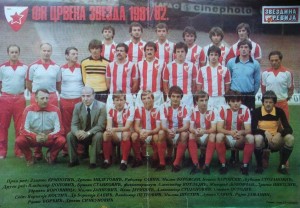
Crvena zvezda without a trophy is unthinkable. They saved the season by winning the cup.

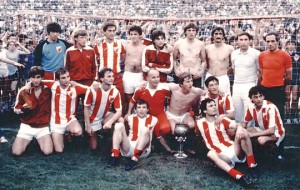
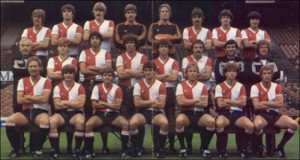
Standing from left: Zdravko Borovnica, Slobodan Janković, ?, Boško Djurovski, Dika Stojanović, Zlatko Krmpotić.

First row: Vladimir Petrović, Miloš Šestić, Dušan Savić, Rajko Janjanin, Milko Djurovski.

Crvena zvezda had much stronger and more famous squads than this one, but still it was a team full of national team players, plenty of experience, and lead by a great star – Vladimir Petrovic. Ambition was never lacking, so Crvena zvezda prevailed.

Yugoslavia I Division

Top flight. First division was divided into 3 groups – 2 outsiders, 3 favourites, and the bulk of 13 teams fairly equal and not concerned with either first place, or relegation.

NK Zagreb – last with 19 points.

Teteks (Tetovo) – 17th with 23 points. Both teams relegated.

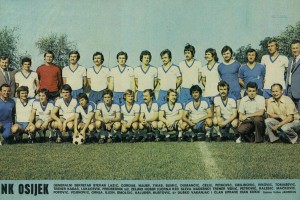
Osijek – 16th with 29 points.

OFK Beograd – 15th with 30 points. Their decline was seemingly unreversable.

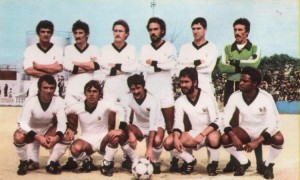
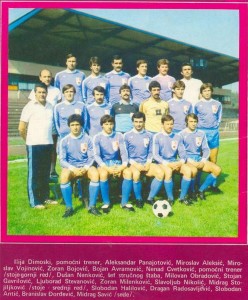
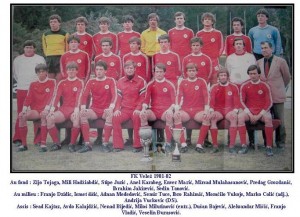
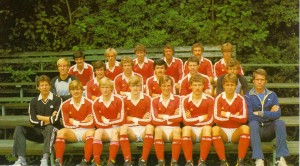
Vardar (Skopje) – 14th with 30 points, but better goal-difference than OFK Beograd. Standing from left: K Dimitrovski, Georgiev, Bankovic, Gruevski, Jovanovski, V. Dimitrovski.

Crouching: Ringov, Odzakov, Zdravkov, P. Georgievski, Savovic.

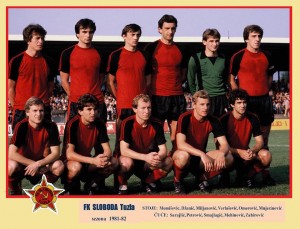
Sloboda (Tuzla) – 13th with 31 points.

Rijeka – 12th with 32 points.

Radnicki (Nis) – 11th with 32 points. After their sudden ascent, they dropped back to their usual position in the league. Good years for Radnicki, but evidently they were not capable to handle both European and domestic tournaments. No surprise: the team was not really strong and a small team had no chance of improving it – good players were more likely to leave, not to come.

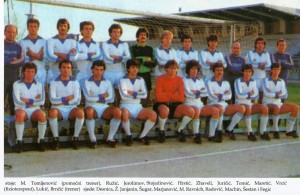
Vojvodina (Novi Sad) – 10th with 32 points. Standing from left: Šuica, Dimitrić, S. Marić, Mićović, Zovko, Jablan, Ćirić.

First row: Novaković, Z. Marić, Vujadinović, Ilić, Pejović.

Olimpija (Ljubljana) – 9th with 33 points.

Buducnost (Titograd) – 8th with 34 points.

Velez (Mostar) – 7th with 36 points.

Partizan – 6th with 37 points. Stagnation.

Zeljeznicar (Sarajevo) – 5th with 38 points. Rapidly coming back to the top of the league, but not ready yet to concur.

FK Sarajevo – 4th with 39 points. Like their city rivals, in good shape and ahead of them. Standing from left: Pašić, Handžić, Radeljaš, N. Vidaković, N. Ferhatović, Hadžibegić

Crouching: Vukičević, S. Melić, Kapetanović, Hadžialagić, Janjoš.

That was the bulk. On top – familiar names, the usual suspects, but… there was no big battle for the title.

Hajduk (Split) – 3rd with 44 points. Lost silver medals on worse goal-difference. Consistently strong squad, but this year was not great.

Crvena zvezda – clinched 2nd place, but there was no pleasure: the title was entirely out of reach.

Dinamo (Zagreb) was unquestionable champion – 20 wins, 9 ties, 5 losses, 67-32, 49 points. Hajduk had sturdier defense and Crvena zvezda better scoring record, but Dinamo finished 5 points ahead of them. Perhaps not the most balanced team even in their own history, but Dinamo had arguably the most exciting players at the moment: Zajec, Kranjcar, Cvetkovic, Mlinaric, and Deveric. Hadzic, Mustedanagic, and Bosnjak were not to be underestimated either.

Their 5th title and first after 1957-58 – the long wait was over at last. The building of this team started a few years back and finally the true rewards came. Credit to their coach Miroslav Blazevic, the next generation of talented Yugoslavian coaches was making itself more and more present. A squad so strong Dinamo did not have since mid-1960s and they joined again the best clubs in the country. Sweet victory – it was great to be ahead of fellow Croatians Hajduk (Split), not to mention ahead of Belgrade’s clubs.

Yugoslavia II Division

Yugoslavia. Second Division was important mostly for the question of promotion. Two grous of 18 teams each, as ever. Winners go up, last 2 of each group relegated. Naturally, former first division members are seen as the heavy-weights and by this suspect measure Second League East was seemingly stronger, having Bor (Bor), Napredak (Krusevac), Trepca (T. Mitrovica), Pristina (Pristina), and Sutjeska (Niksic) playing there. But it was entirely different club which dominated the league this season: Galenika (Zemun). They never played any significant role in Yugoslav football before.

Standing from left: Čelar, Dujkovic, Živković, Banković, Nikolovski, Milinković.

First row: Ljalja, Brkić, Santrač, Lacmanović, Pavičević.

Galenika won the championship and was promoted for the first time in their history with 43 points. They won 18 games, tied 7, and lost 5. 56-20 goal-difference. Six points ahead of the nearest pursuer, Trepca. Fantastic success. Which happened mostly thanks to two veterans, who joined the club in 1980 – the goalkeeper Ratomir Dujkovic (b. 1946), who arrived from NK Osijek, and the all-time Yugoslavian First Division and OFK Beograd goal-scorer Slobodan Santrac (b. 1946). The center-forward came from Partizan (Beograd).

Second League West. One team withdrew after the first half of the season – Svoboda (Ljubljana) – so the league ended with 17 teams. Borac (Banja Luka), Celik (Zenica), Spartak (Subotica), Proleter (Zrenjanin), and Iskra (Bugojno) were the potential candidates for promotion, but none succeeded. In fact, three teams competed for the first place and two of them finished with equal points. Celik (Zenica) was 3rd with 38 points. Spartak (Subotica) and Dinamo (Vinkovci) ended with 40 points and goal-difference decided the winner.

Dinamo (Vinkovci) clinched first place with +46 goals – Spartak had only +24. Dramatic, but well deserved victory – 18 wins, 4 ties, 7 losses, 70-24, and 40 points. Dinamo (Vinkovci) won promotion.

USSR the Cup

The Cup tournament was very short this year, practically squeezed into 3 months. The final was played on May 9 – seemingly, celebrating the victory of the World War II, but the real reason most likely was preparation for the World Cup, which affected the whole first half of the 1982. Including the final… It was between Torpedo (Moscow) and Dinamo (Kiev). One goal was scored in the final and by a defender.

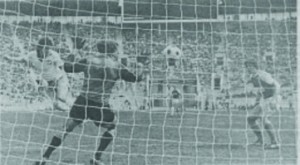
Sergey Baltacha scored the only goal in the 34th minute.

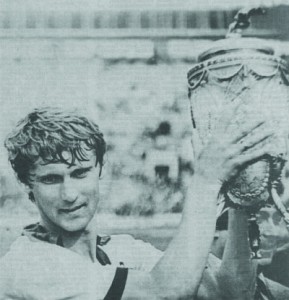
Thanks to that, Dinamo (Kiev) won and captain Leonid Buryak proudly lifted the Cup.

The final brought little comments: Kiev’s victory was acknowledged as ‘victory of the competent football’. Which translates into tough and not exciting match, in which classier Dinamo clinched a victory thanks to grit. Nothing new… their robotic football, oriented only on winning by whatever means, was noted and criticized for some years already. Too pragmatical and calculating. But good things have to be written about winners, so there.

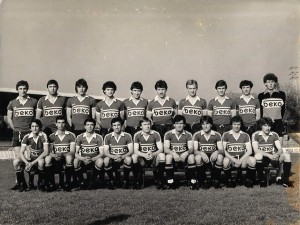
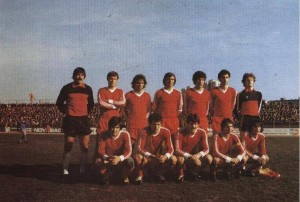
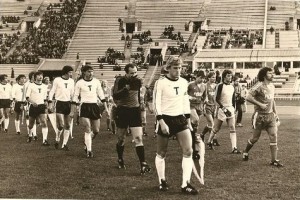
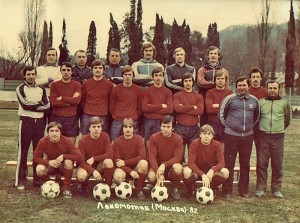
Torpedo (Moscow) – the photo of them is from the fall of 1982, when they played against Bayern in the Cup Winners Cup – was good enough for a minimal loss. No wonder: they had solid team, mostly made of players with experience, but also players who clearly reached the limits of their potential and ambitions – Prigoda, Susloparov, Petrakov, Redkous, Polukarov, Shaveyko, Galayba, Gostenin. Former national team players, who never established themselves as first-rate stars, eventually settling for comfortable mid-table life. The only curiousity was their goalkeeper – two brothers defended the gates at the final – Vyacheslav and Viktor Chanov. The older, Vyacheslav, played for Torpedo. Both were current national team players and remained so for a number of years. But the curse… they started in Shakhter (Donetzk), backing up the starter Degtyarev. Unfortunately, he was always in great form and included in the national team. The brothers had no chance and obviously had to move out – the older, Vyacheslav joined Torpedo and finally started playing regularly, almost at 30 years of age. And reached the national team, once again to compete not only with his younger brother, but largely to keep the bench of reserves warm… for at the same time emerged Rinat Dassaev and there was no question who will play for more than 10 years. As for why Torpedo and not the actual Cup winners played in the Cup Winners Cup in the fall of the same year, the reason is the spring-fall format of USSR’s championship. In the European Champions Cup played the champion of 1981 – that was Dinamo (Kiev). The Cup, however, was decided in May 1982, so the 1982 holders played in the Cup Winners Cup – in this case, the losing finalist, since Kiev played in the other tournament.

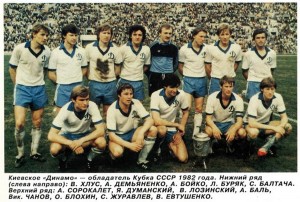
And the Cup winners. Standing from left: A. Sorokalet, Ya. Dumansky, V. Lozinsky, A. Bal. Viktor Chanov, O. Blokhin, S. Zhuravlev, V. Evtushenko.

First row: V. Khlus, A. Demyanenko, A. Boyko, L. Buryak, S. Baltacha.

Winners, but also this squad is a testimony of the ‘lost’ first half of the season, because of the national team. Bessonov, Khapsalis, Ratz, and Oliferenko (obscure name, but he was voted among the 33 best players of the year) did not play at the final. It was a team mostly made of reserves. Veremeev played in the first half, but this year the veteran was practically a reserve player. Against a team like Torpedo, the reserves were just enough – but in the long run of the championship points were lost exactly in the first half of the season and that was costly at the end. In any case, it was still unsatisfying team – Lobanovsky was still searching and shaping. A whole bunch of this team was not going to be a part of the great Dinamo circa 1985: Sorokalet, Lozinsky, Dumansky, Zhuravlev. Veremeev was going to retire. Buryak was not going to last, getting into big conflict with Lobanovsky. Oliferenko, Khlus, and Boyko became an empty promise. But one problem was already solved – goalkeeping, with the arrival of Viktor Chanov. He was only 23 years old, so there was nothing to worry for many years. And deeply in the team and out of sight yet was Mikhaylichenko, only 19. Baltacha was already moved to defense and it worked – the new team was getting in shape, only not finished and ready yet. Yes, Baltacha was the hero of the Cup final, but not of the season – for the first time in Soviet history a defender scored a hat-trick this season: Yury Kurnenin of Dinamo (Minsk) did it against Kayrat (Alma-ata).

USSR I Division


First division. Five teams exceeded the permitted number of ties, thus losing points, but none suffered from it – all were in mid-table. As a whole, the rule worked – the number of ties was reduced, but the more attacking approach did not increase significantly the scores. There was no hopeless outsider, but also there was not a great favourite – the league was fairly competitive. The three big favourites did not have a great year, largely because their coaches and players were preoccupied with the national team for about half of the championship. And because of that it is hard to judge the championship, except for those teams in decline. At the bottom finished usual suspects – Kairat (Alma-ata) was last with 24 points and relegated once again.
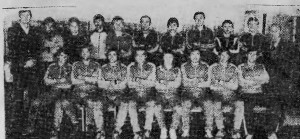
Kuban (Krasnodar) finished 17th with 27 points and was also relegated. True, they lost on goal-difference, but the club made the cardinal mistake of smaller clubs suddenly finding themselves among the best: Kuban was a typical mid-table second-division club for years: the most of the squad was not much and safety was achieved by recruiting 2-3 veterans with solid biography. It was enough to keep them out of trouble in the lower level. It was even enough for promotion. Combined with enthusiasm, it was enough for a year in top flight. But it was not enough for longer run – Kuban did not improve its squad, but once again recruited 2 veterans – the former national team goalkeeper Pilguy from Dinamo Moscow and the defender Buturlakin from Torpedo Moscow. Did not work… this time there was no survival. In the last round they visited their direct competitor Neftchi (Baku), which was 2 points ahead. Kuban won 3-2, equalized the points, but goal-difference still favoured Neftchi. Goal-difference? Actually, wrong… it was not decisive factor, but seemingly the number of wins – Neftchi had worse goal-difference by far, but finished with 10 wins. Kuban had 9. Neftchi survived… for now.

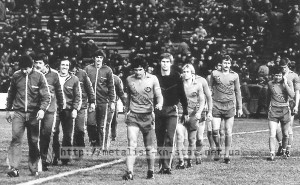
Down on their luck: CSKA (Moscow) – 15th. All Army clubs were weak at this time.
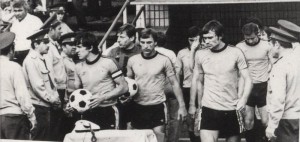
Shakhter (Donetzk) – 14th. Looked like Shakhter was going into decline and the reason most likely was too many Ukranian clubs in first division, some on ascent. Shakhter more or less lost its position as the second Ukrainian club, which affected its ability to recruit new quality players. The competition was more attractive.

The third team obviously in rough shape was Dinamo (Moscow). The decline was noticed long time ago and so far there was no sign of coming out of it. Internal conflicts were blamed for that – Aleksander Bubnov left the club after the end of the season because of that. Generally, the recruitment policy was wrong – for years Dinamo was not able to find worthy players: they actively recruited players, but somehow they were not as good as thought, did not blend together. 11th this year.

The newcomers were not spectacular, but did what was more or less the maximum expected from the freshly promoted: to survive. Somewhere in the lower half of the table. Torpedo (Kutaisi) ended 13th. The only remarkable thing about their performance was that 2 players scored almost all of their goals – Megreladze 18 and Dardzhania 11.
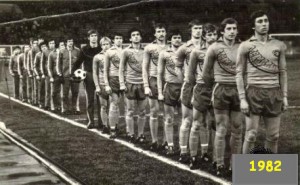
Metallist (Kharkov) ended 12th.

Dnepr (Dnepropetrovsk) – on the left of Metallist (Kharkov) – was 9th. Midtable position did not suggest that this team will play major role of Soviet football to the end of USSR.
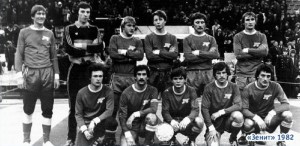
Zenit (Leningrad) – 7th. Like Dnepr, solid season, but nothing special yet.
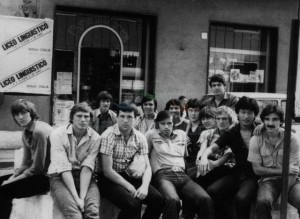
Pakhtakor (Tashkent) – here touring Italy – had excellent season, one of the surprise performances this year: 6th. The top scorer of the championship came from them – the veteran midfielder Aleksander Yakubik, 32-years old former Dinamo (Moscow) player, scored 23 goals. Back in 1979 he was sent by Dinamo to help Pakhtakor after its entire team died in aircrash. Over the hill, that what Dinamo thought – but Yakubik became essential part in the rebuilding of Pakhtakor and now Dinamo was 11th, Pakhtakor – 6th.
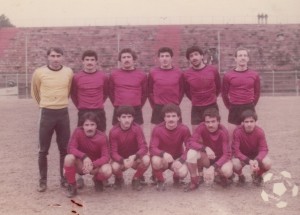
Ararat (Erevan) – 5th with 38 points. They were even leading for awhile in the first part of the championship. May be coming back to glory?

And finally the best. Dinamo (Tbilisi) and Spartak (Moscow) both ended with 41 points.
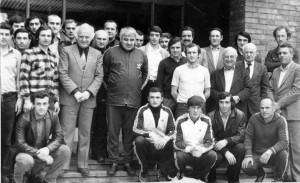
Dinamo (Tbilisi) – 4th and empty-handed, seemingly because of worse goal-difference.
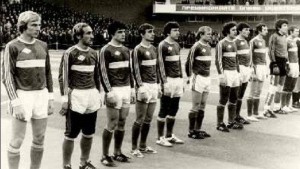
Spartak (Moscow) got the bronze medals. From left: S. Shavlo, V. Grachev, G. Morozov, F. Cherenkov, V. Sochnov, E. Gess, A. Kalashnikov, I. Vishnevsky, Yu. Gavrilov, R. Dassaev, O. Romantzev.

Both teams suffered from the same problem: the national team. They lost points in the first half of the championship and were unable to recover. Rinat Dassaev later confessed that near the end of the championship, when it was clear Spartak cannot win the title, the team lost interest. There was something else – neither team was very deep. Take away the key players and they were quite ordinary. Dinamo was getting old as well. A heavy price was paid just because USSR played at the World Cup.

But the race for the title was breathtaking even after Dinamo and Spartak were left behind. Shoulder to shoulder to the end, 1 point was the fragile lead for at least a month. Both leaders played their last round away and their opponents were far from easy – Spartak and Ararat. Both leaders won by a single goal, 4-3 in Moscow and 3-2 in Erevan. The fragile lead was preserved and Dinamo (Kiev) lost the title.
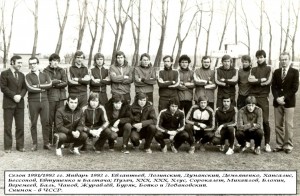
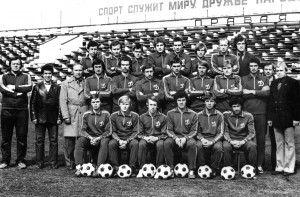
Dinamo (Kiev) back in January 1982 training in Czechoslovakia. Crouching from left: Evlantyev, Lozinsky, Dumansky, Demyanenko, Khapsalis, Bessonov, Evtushenko, Baltacha.

Second row: Puzach – assistant coach, ?, ?, ?, Khlus, Sorokalet, Mikhaylov, Blokhin, Veremeev, Bal, Chanov, Zhuravlyov, Buryak, Boyko, Lobanovsky – coach.

Well, the best squad in the country… but they started poorly, thanks to the national team preparations, and really came back to convincing performance in the second half of the season. They climbed up, trailing closely the leader – 1 point behind. Unfortunately, this 1 point was still there when the dust settled. Dinamo overcome strong resistance of Ararat and won their last game – but so did their rivals.
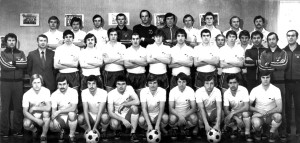
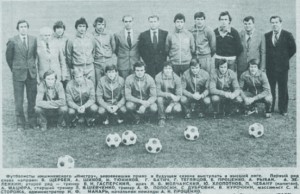
Dinamo (Minsk) – brand new champions of USSR. Third row from left: Aleksandr Voynakh, Sergey Borovsky, Yury Trukhan, Grigory Tzyrkunov, Yury Kurbyko, Mikhail Vergeenko, Lyudas Rumbutis, Igor Kriushenko, Aleksandr Alekseychikov, Yury Pudyshev.

Middle row: Eduard Malofeev – coach, Leonid Garay – team chief, Andrey Zygmantovich, Yury Kurnenin, Valery Melnikov, Georgy Kondratyev, Andrey Sosnitzky, Igor Kulchenko, Yury Popkov, Anatoly Panteleev, Viktor Shishkin, Pavel Rodnenok, Roman Levkovich – team leader, Leonid Arzamastzev – assistant coach, Vassily Dmitrakov – doctor.

Front row: Igor Belov, Petr Vassilevsky, Sergey Aleynikov, Aleksandr Vanyushkin, Sergey Gotzmanov, Genady Kobrenkov, Igor Gurinovich, Aleksandr Prokopenko, Viktor Sokol.

Surprise winners and first time champions. The only 9th club becoming Soviet champions and the second non-Russian or Ukrainian. 19 wins, 9 ties, 6 losses and 63-35 goal-difference. 47 points – one more than Dinamo (Kiev), a fragile lead, which was preserved in the last few rounds. Lets start with negative points: Dinamo (Minsk) did not have the team to really compete and if the big favourites were able to concentrate on the championship from start to finish, it was unlikely Dinamo finishing even among the top three. Two matches practically decided their victory – the very last match Dinamo played and made them champions was away match against Spartak (Moscow). They won 4-3. But Dassaev later said that Spartak, already having no chance to reach even second place, was disinterested. They did not play in earnest. It was possible Spartak decided to help Minsk only to deprive Kiev from the title – already the main rivalry was between Spartak and Dinamo (Kiev). Earlier Dinamo (Minsk) visited their namesakes in Moscow and won 7-0. Dinamo (Moscow) was heavily criticized for their utter disinterest in this match, but their terribly toothless performance was blamed on internal problems. This was true and it was also true that Dinamo (Moscow) had awful year, but… both teams belonged to the Police/KGB system. In this pyramid Dinamo (Moscow) stayed on top. Dinamo (Kiev) already played independently, but Minsk was subordinate and there were ‘hot’ relations between the two clubs: two of the key players of Minsk were sent years ago from Moscow – Kurnenin and Pudyshev. To help the usually weak ‘cousin’. After the fall of USSR it was revealed that the Belarussian KGB played key role in the great season of the club. It was very possible Dinamo (Moscow) helped by losing 0-7 at home. However, accusations were never made – unlike the case of Zarya (Vorosholvgrad) ten years earlier, which title was almost openly rumored won with bribes even in Soviet time. So, it is just a suspicion – ill supported, but still there.

On the positive side – nobody ever denied that Dinamo (Minsk) played well. They were something fresh and rare: dedicated to attractive attacking football. Moreover, Dinamo participated in rare exciting race shoulder to shoulder to the very end of the championship, preserving fragile 1 point lead – and their rival was mighty Dinamo (Kiev), a very hard and intimidating opponent. There was no denying that Minsk improved a lot – they had there only second national player in history, Sergey Borovsky, and three more players – Aleynikov, Zygmantovich, and Gotzmanov – who played big part in Soviet football of the 1980s. If Minsk is compared to Zarya (Voroshilovgrad), the surprise champions 10 years earlier, there was one huge difference: Zarya was clearly one-time wonder. None of their players established himself in the national team (Onishtchenko came from Dinamo Kiev and returned to Kiev right after the champion season – he was Kiev’s star really) – this was not the case of the stars here: all four players made their names with Minsk and largely this very season. But they became stars in the true sense. As a whole, it was well deserved victory and if the opponents parcically missed half of the year, concentrated on national team duties, that was not a foul of Dinamo (Minsk): after all, who was to blame that at least two of the big clubs were not deep enough and their reserves were not strong enough. If one is suspect of the Minsk victory in Moscow against Dinamo, then consider the equally suspect 5-1 victory of Kiev in Tbilisi at the same crucial time of the championship – once again, two teams belonging to the Police/KGB system, only with ‘Southern flavour’. Dinamo (Tbilisi) played unusually weak and clueless match at home against Dinamo (Kiev), just the same as Dinamo (Moscow) against Dinamo (Minsk). Anyhow, the kind of football Minsk played was recognized as nice and fresh. The squad was found not particularly great, but experienced and motivated. The biggest credit went the coach – Eduard Malofeev (or Malafeev, as he often spelled after 1986-87). He was young coach and a star player in the 1960s – the first and only national team player Dinamo (Minsk) had before Sergey Borovsky of the champion squad. He was really up and coming coach, eventually becoming one of the top Soviet coaches and successfully leading the national team. So the positive changes came thanks to him.
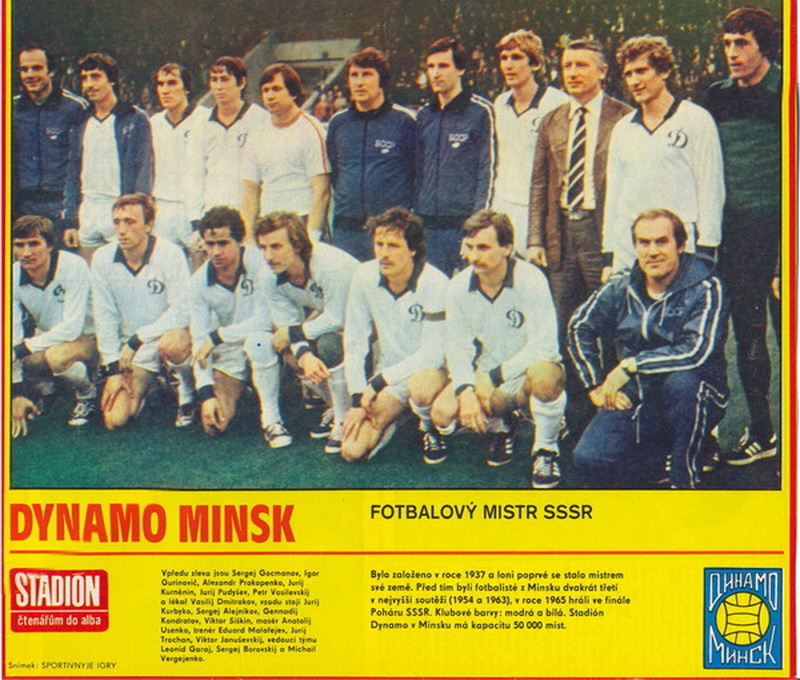
One more photo of the new champions – here right after their last match with Spartak. The logo is wrong, but never mind. First time champions deserve more than one picture, especially if they open the door for significant changes. Yes, they did that – the rest of the 1980s witnessed a few more newcomers to the big scene, making the stale and dull Soviet championship suddenly competitive, exciting, and unpredictable.
USSR II Division

Second Division. That it was significantly inferior to the top level was nothing new, but now it appeared even weaker: at least 8 clubs were historical nobodies. Half of the republics of USSR had no representative at all and technically it was a championship of Russia ( 9 teams) and Ukraine (7 teams). Lituania, Georgia, Moldova, Latvia, Uzbekistan, and Tadzikistan had one team each. At a glance, the championship showed the general decline of the clubs of the Army system: the highest placed was 10th. As ever, the candidates for promotion were few and high above the rest and a good chunk of the league was only concerned with escaping relegation. The sedated mid-table clubs were still very happy with their state of affairs. Scoring was low, ties were the result of preference, although the limits imposed made everybody a bit more attacking-minded: only 4 teams went above the limit and lost points and the higher number of ties was 13 – in the past it was normal for a team to tie half of their championship games. The other positive side was the race for the two promotional spots: 5 teams went head to head, an almost unheard of number. Typically, there were 2-3 teams way above indifferent league. Two hopeless outsiders at the bottom. And one a bit better.

Spartak (Kostroma) ended last with 17 points. SKA (Kiev) second to last with 20 points. SKA (Odessa) ended 20th with 34 points. These three were relegated.

The three newcomers for the season managed to sit themselves in mid-table: Dinamo (Kirov) – 15th, Rotor (Volgograd) – 14th, and Daugava (Riga) – 8th.

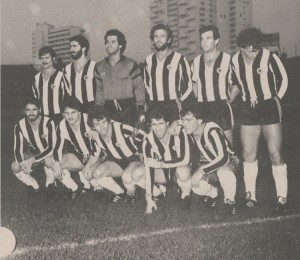
Dinamo (Kirov). Just keeping a place in Second Division equaled success.

Dissapointing season for some of the potential candidates for promotion: Tavria (Simferopol) – 13th, SKA (Rostov-on-Don) – 11th, and SKA Karpaty (Lvov) – 10th. The eternal mid-table teams played as ever… Metallurg (Zaporozhye) – 12th, Pamir (Dushanbe) – 9th, and Shinnik (Yaroslavl) – 7th. Zarya (Voroshilovgrad) seemingly was joining the ‘mid-table teams’ – they finished 6th, but were not aiming at promotion at all. Looked like Zarya settled for a long live in Second Division.

Interesting was only at the very top – five teams finished divided by only 2 points. Fakel (Voronezh) was 5th with 54 points.

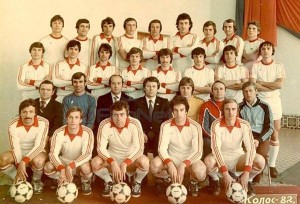
Lokomotiv (Moscow) bested Fakel on goal-difference. Both teams exceeded the limit of ties and lost a point each – if there was no lomit, they would have been ahead of the third place, but still unable to get promoted.

Kolos (Nikopol) ended 3rd with 55 points. A raising team, keep an eye on them in the future. Lost promotion by a point, but it was very strong season well finished.

The promoted succeeded just by a point – the two top teams finished with 56 points and goal-difference decided their final position.

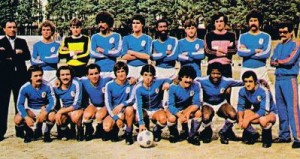
Nistru (Kishinev) was 2nd and going up. No doubt, a great success – they played first division football before, but very briefly. Top level was not exactly on their minds since their relegation in 1975. From this almost forgotten first division season just about 2 players remained: the captain Pavel Chebanu and Ivan Karas. Nistru settled for mid-table comfort without a care or ambition on mind for so long, the first big problem was to shake the team out of apathy. Which was aggravated by internal tensions. The squad was not particularly interesting – like every typical mid-table team, it was experienced and solid, but not first class. Like the goalkeeper Kurochkin – a good second-level player, but for a long time just that: bellow first league keeper and satisfied with that. Of course, there were talented and promising players like the goal-scorer Grigory Batich, but how long would be before he decided to fall asleep? To keep him awake meant to go up – either the whole team or he alone to transfer to first league club. One clearly positive thing this year was scoring: Nistru depended on defense for years, following ‘the wisdom’ of a mid-table club: get the point and then there is nothing to worry about. This year Nistry scored the most goals in the league: 67. Well done, but… the big test was still in the future: the squad was not strong.

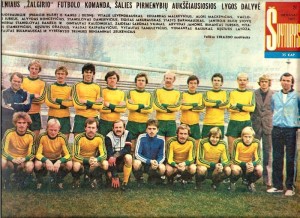
Thanks to better goal-difference Zhalgiris (Vilnius) became the champion of Second Division. It was quite of a surprise: they played first division football once upon a time, but so long ago hardly anyone remembered. For years they were entirely out of mind, playing in the Third Division – practically forgotten team. Unknown. Coming finally back to Second Division a couple of years back, they were generally expected to go down rather quickly. Yes, Lithuania, made mostly of Zhalgiris players, was pleasant surprise at the last Spartakiad – the all-USSR ‘olympic games’ – but it was not a tournament most people paid attention to and republics like Russia and Ukraine did not bother to select their best players for it. Lithuanian players in First Division could have been counted on the fingers of one hand and there was not a single star among them. Lithuania was a backwater of football… Zhalgiris had unknown players, unknown coach… it looked like a freak accident. May be pure chance. Lucky to go up, only the be relegated immediately – what else to expect from a team made only from local guys with unpronounceable names. Well, it was all wrong, just wait and see.

USSR III Division

USSR. A very difficult season for assessment. It was not normal and the results of it somewhat contradicted the general impression of ascending Soviet football. On one hand there was new champion and tremendous battle for the title to the very last moment – something rare in USSR. On the other hand the leading clubs were unconvincing. As a whole, the impressions were positive, but they went hand in hand with harsh criticism of the national team. The championship was affected by events having nothing to do with it – if it was another country, that is. In a nut shell, half of the season was concentrated on the preparation of the national team for the 1982 World Cup, then the actual event, and after that – on analyzing what happened what happened and why, culminating with the change of the national team coaches. After that Brezhnev died. Somehow the championship was secondary for the most of the year – literary so, for the coaches of Dinamo (Kiev), Spartak (Moscow), and Dinamo (Tbilisi) also coached the national team and were preoccupied with it. And the national team was largely made of players from this three clubs, thus they had to play with substitutes quite a few games. No wonder the championship became the year of the ‘dark horse’. Usually, in similar cases, some otherwise ordinary team pops up from the back, but, as a rule of thumb, such teams are one-time wonders. The new Soviet champion was not that, yet, how good they really were? There were various records set this year and most of them went to the side of the positive. This much in a nut shell. The rest was familiar, but needs reminding: there were limits to the tied games – 10 in First Division and 12 in Second Division. Going above the limit brought no points. The rule affected Second Division. The Cup final was in May, which tremendously shortened the tournament, but USSR often changed the date of the final – now the reason was seemingly the World Cup, but there was one difficulty: it was practically impossible to amalgamate Cup and championship in evaluating the season: the Cup was no real indication for the strength of a team, for everybody reached best form after May. Lastly, the Second Division was reduced from 24 to 22 teams. Two clubs changed names – in Lvov Karpaty and SKA amalgamated into SKA Karpaty, and in Dzhizak Buston was renamed to Zvezda (Star).

The Third Division brought very little attention – there was no much anyway, but this year it was reduced to almost nothing. No surprise, really – many clubs, but what kind of clubs? Some eventually climbed out of obscurity later in the 1980s, like

Niva (Vinnitza) and

Gomselmash (Rostov-on-Don).

The biggest name was Krylya Sovetov (Kyubyshev)

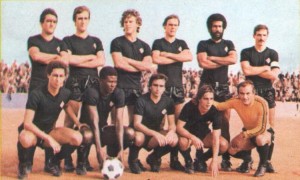
Dark period for a club just a few years earlier playing in the First Division.

But all that was immaterial – the only important thing was the promotional tournament. The massive Third Division was divided into 9 zones and the champions went to play-off for the three promotional places. At this final stage they were divided into 3 groups of 3 teams each, playing 2-leg round-robin. Former Second Division members were the favourites, pretty much as ever before – four clubs. The final tournament went almost as expected:

Group 1: Tekstilshtik (Ivanovo) 2 1 1 5-4 5

Spartak (Ordzhonikidze) 1 2 1 5-4 4

Kotayk (Abovyan) 1 1 2 3-5 3


Group 2: Dnepr (Mogilev) 3 1 0 9-3 7

Dinamo (Samarkand) 2 0 2 8-7 4

Bukovina (Chernovtzy) 1 0 3 5-10 2


Group 3: Kuzbass (Kemerovo) 3 1 0 9-3 7

Shakhter (Karaganda) 1 1 2 4-5 3

Lokomotiv (Chelyabinsk) 1 0 3 2-7 2

Kuzbass and Tekstilshtik returning to Second Division and Dnepr – a debutante. The promotion of Kuzbass was important not only because the team was considered the strongest among the candidates – Vitaly Razdaev was playing there. Already the top all-time scorer of Second Division with 161 goals. Already becoming a legend. It was great that he would have chance to increase his numbers and also it was interesting: he was unreachable scorer already, yet, he missed a few second division seasons.

Dnepr (Mogilev) was also interesting: first, because they were the first club from Belarus promoted to Second Division. So far, only one Belarussian club played at this level – Dinamo (Minsk) – but they came from First Division. But 1982 was Dinamo (Minsk) year and with Dnepr promoted it looked like Belarussian football finally came to live.

Holland the Cup

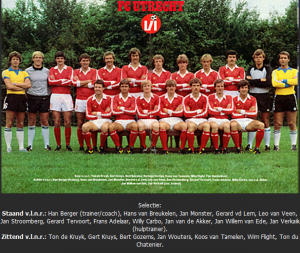
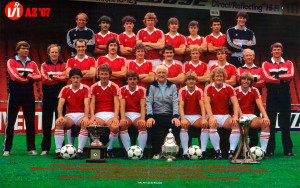
The Cup final was unique: the only time ever it was played in two legs. FC Utrecht and AZ’67 reached the final. In the first leg, played in Utrecht, the hosts won 1-0. It was fragile lead, considering the team AZ’67 had. In Alkmaar Utrecht was utterly destroyed – AZ’67 won 5-1. Once again the Cup was theirs.

Although FC Utrecht enjoyed a good spell at that time, it still had quite insignificant and limited squad. Nothing to be done about it… a small club had no chance. Hans van Breukelen and Jan Wouters were going to be snatched by the big clubs. Playing at the final was the highest FC Utrecht could climb.

AZ’67 (Alkmaar) was still in great shape – far stronger than FC Utrecht, they won second consecutive cup, making it their third. In short time this team won 1 championship and 3 cups, an excellent achievement. However, the greatest period in AZ’67’s history was coming to an end. Money was the big reason: it was clearly impossible to keep Metgod, Spelbos, Kift, Peters, Hovenkamp, Arnz, Tol, Nygaard (Denmark) for long. Simply no way to compete with the big three of Holland and Italian, English, and Spanish clubs. Eddy Treytel was not to last either – too old already. But so far the boys were great, establishing the club among the best in the country. A lovely team, arguably the brightest Dutch team at that time.


Holland I Division

The decline of Dutch football was perhaps best pronounced this very season. And very likely it was the bottom: the national team did not qualify for the World Cup finals, not a single club was in great shape, and the championship was not competitive. In terms of ups and downs on club level, Feyenoord was clearly down. The pleasant surprise was the newcomer Haarlem. Apart from that even the top teams had plenty of problems. Most of the league was pretty much equal and was not concerned either with winning, or losing. Three outsiders at the bottom – De Graafschap, last with 12 points; FC Den Haag – 17th with 13 points; and MVV Maastricht – 16th with 23 points. Down and out.

PEC Zwolle finished 15th, but 3 points ahead of MVV, so they were not really in danger of relegation for a good chunk of the season. Standing from left: R. van Wijnen (fysiotherapeut), A. Raven, Y. Hamming, J. Hendriks, I. Wildenburg, R. Jans, G. van Moorst, R. Israel, A. van Geffen, trainer F. Korbach.

Sitting: G. Fuhler, R. Ijzerman, A. Booy, G. Visscher, C. Riemens, P. v.d. Hengst, J. Holshuysen, A. Kamstra, K. Drost, ass.trainer G. Verword.

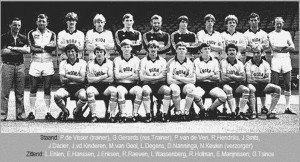
One good veteran often made the whole difference – with Rinus Israel PEC was weak, but out of trouble. Without such a player, MVV was relegated.

Twente was 12th with 31 points. Standing from left: J. Steenbeeke (verzorger), A. van Gerven, E. Bleuming, M. Jol, H. Snelders, F. Rutten, T. Dilling, J. Bos, A. Gritter, E. Drost (ass.trainer), S. Groener (trainer/coach).

First row: M. Sanchez Torres, T. Harleman, S. Lindsted, P. Leyenaar, R. Zondervan, A. Kila, J. Scheve, J. Cooke, F. Ronde en M. Mentink.

Good days over… nothing was left of the exciting team of the first half of the 1970s. Martin Jol and H. Snelders were the only strong players now and neither of them became a truly big star.

NAC Breda – 11th with 33 points. They played as ever – more a testimony of Twente’s decline than anything else. Standing from left: Jo Jansen (trainer/coach), Guust v.d. Borgt, Ton Lokhoff, Hans Neeskens, Fritz von Seydlitz, Ton van Eenennaam, Gerrie Damen, Anton Joore, Geert v.d. Wiel (verzorger), Dick Buitelaar (trainer).

Sitting: Koos Waslander, Martien Vreysen, Hans Heeren, Tom Smits, Ad Krijnen, Edy de Schepper, Ton Spranger, Jack de Kroon.

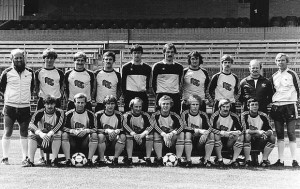
Roda JC – 9th with 36 points. Nothing new… Dick Nanninga was seemingly enough to keep them in the middle of the league.

FC Groningen – 7th with 37 points. Third row from left: Sip Bloemberg – Walter Waalderbos – Bert Mooibroek – Peter Houtman – Ronald Koeman – Leen Swanenburg

Middle row: Theo Verlangen (trainer) – John Visser (verzorger) – Eddy Bakker – Henk Veldmate – Karel Hiddink – Jan van Dijk – Jack van Loon – dr. Hoekstra (clubarts)

Sitting: Theo Keukens – Anne Mulder – Herman Dijkstra – Johan Tukker – Peter Leiseboer – Wim Schokker – Hans Boer – Bert Wiebing.

Not bad, generally speaking, but another typical mid-table club, also displaying the chronic problem such clubs had, have, and will have – young and promising Ronald Koeman here, but no chance to build a team around him – he was to go elsewhere instead. Having an young talent was more of a curse than blessing.

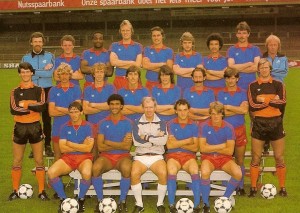
Feyenoord – 6th with 38 points. Rubbing shoulders with Groningen… and no wonder. Third row: Ben Wijnstekers, Luuk Balkestein, Ivan Nielsen, Joop Hiele, Ton v. Engelen, André Stafleu, Sjaak Troost, Stanley Brard.

Middle row: Vaclav Jezek (Hoofdtrainer), Mark Wotte, Karel Bouwens, Wim van Hanegem, Paul van der Blom, Jan van Deinsen, Clemens Westerhof (Assistent), Gerard Meijer (Verzorger).

Sitting: Richard Budding, Wim van Til, Hans Groenendijk, Johnny Jacobsen, Jupp Kaczor, Marcel van der Blom, Pierre Vermeulen.

A pale shadow of the wonderful team they were 10 years ago and nothing to hope for with such a squad. Van Hanegem was by far the most famous player here and he was ancient. Sure, there were few current national team players and few players eventually becoming familiar names like Dane Ivan Nielsen, but this was not a promising team at all. One may blame Vaclav Jezek for that – or not. The bitter fact: Feyenoord was not strong enough even for a currently weak Dutch championship.

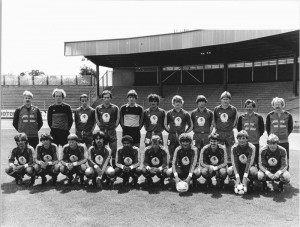
FC Utrecht – 5th with 39 points. Enjoying a good period, sure, but also they were a testimony of the general decline of Dutch football: without much of a team, Utrecht was able to climb up among the best. Even finishing above Feyenoord. Even achieving more than the big boys. However, Utrecht was unable to really compete.

The big and pleasant surprise: Haarlem was just promoted from Second Division and in their first season they finished 4th. Not just 4th, but clearly above most of the league – Haarlem finished with 42 points. This was fantastic, but… someone was noticed already. This someone Haarlem was unable to keep for long. It is ridiculous that a single player could be entirely responsible for the fate of a club, but wait a little – until Gullit moves away. A great season, though. Even if Haarlem was well bellow the top three.
Which were strongly divided as well. AZ’67 was 3rd with 47 point. As good as Haarlem was able to play, AZ’67 was just at another level. But as good as AZ’67 was, they were not good enough to challenge PSV Eindhoven. Which was not that good anymore… still stronger than the bulk of the league, but nothing more. 51 points. 4 more than AZ’67, but 5 less than the champions.
And coming to them, no point even to mention the name. No point to mention the number of this title either. Who else, but Ajax, the magic name. Just look at their record: 26 wins, 4 ties, only 4 matches lost. 117-42 goal-difference. They scored 117 goals! They left everybody else way behind. Fantastic season? Hmm.
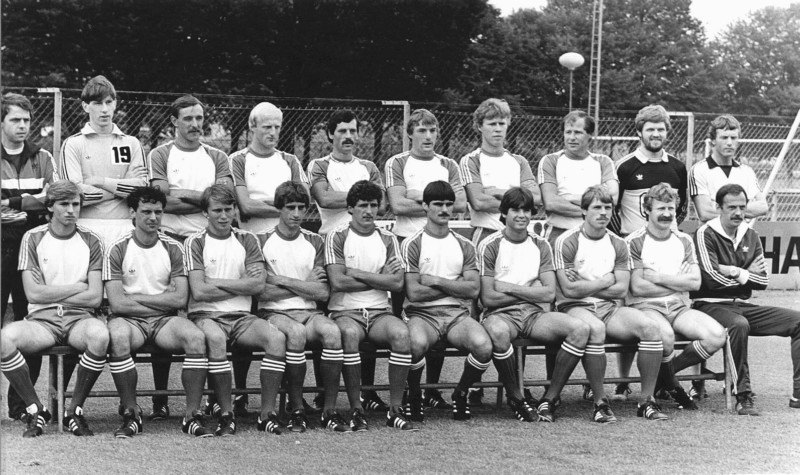
Let us take this title with a grain of salt. Superior this year, yes, but consider the weakness of their main rivals. And the decline of Dutch football as a whole. Compared to the others and particularly to the arch-enemy Feyenoord, Ajax was seemingly in good shape – Schrijvers, Jansen, Lerby, Kieft, Boeve, Schoenaker, La Ling, Ophof, Olsen, Vanenburg, Rijkaard. However… Olsen and Rijkard were only promising players at the time. Most of the others were not great stars. Lerby was not to stay for long. Schrijvers was old and even in his best years he was not exceptional goalkeeper. The key was perhaps Wim Jansen – already a veteran, he was the new recruit. The policy of Ajax after the end of the great team of the early 70-s was not very fruitful: they tried to keep afloat by buying strong, but not young, Dutch players. This helped them to stay at the top of Dutch league, to maintain its leading domestic position. But there was no new great team emerging and this team was not promising in the long term either. That is, nothing happened so far – clearly, there was not to be a strong team made around Lerby. The search was still to go on – the hope would be to create something around Rijkaard and Vanendurg. Eventually. For the moment – just stay on top at home and add domestic titles.