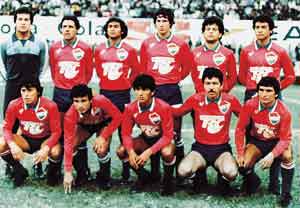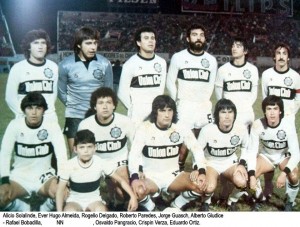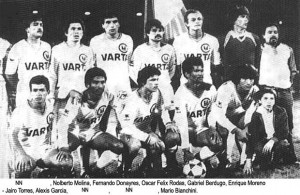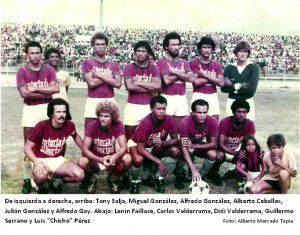
Chile II Division

Chile. Changes in the first league format coloured the 1982 championship and need a few words. In 1981 the top league was made of 18 teams, but reduced to 16 for 1982 – which meant 5 teams were relegated and 3 promoted. But for 1983 the top league was increased to 22 teams – that meant 2 teams were relegated and 8 promoted. This automatically focuses on the Second Division championship and the criteria for relegation and promotion: otherwise the obvious discrepancies between performance in 1982 and the league members in 1983 would be foggy or whimsical at best. Both professional leagues had strange formula of the championship: there was a first stage, called Torneo Polla Gol, but also Copa Chile. And, just to confuse you entirely, it is called Campeonato de Apertura. The essential point of this first stage is that it had almost no importance for the second one – only the winner and the other finalist benefited from it: the winner carried 2 bonus points to the second stage, clearly name Campeonato Oficial, the losing finalist and semi-finalists – 1 point. That was all. But the dual championship had importance to the promotions for the next year, as it turned out. Campeonato Oficial was all final: it was standard league championship, no funky rules (in Torneo Polla Gol bonus points were given for wins with by 4 or more goals and no points for scoreless ties), the first in the final table was champion of Chile, and the bottom 2 (this season) – relegated. Simple… First and Second leagues had the same formula. There was a small addition to the First Division schedule, concerning the second Chilean representative in Copa Libertadores.

Plain calculation, however, suggests troubles with Second Division after such a big increase of the top league. It had 22 teams in 1982 and promotion of 8 left the league with 14. Two relegated from the top – 16. Clearly, relegation to Third Division and promotion from there would be affected to make the numbers, even if Second Division was slightly reduced (and reduction made no sense, if top league was so drastically enlarged). But in most countries, including Chile, the lower you go, the more difficult it gets to find not only competitive teams, but also financially able to play in higher divisions. So, economic measures were applied in the promotion/relegation process – and they were the real factor at the end, explaining why some clubs were suddenly playing higher division football the next year and others remained where they were before. The main criteria was attendance – ‘a good venue’ was the term used, but there was one more factor, seemingly, geographic – it affected promotion to Second Division. ‘Spread the game, cover the whole country’, was seemingly the idea. Promotion was complicated to no end, by introducing a final promotion/relegation tournament between 2 of the lowest in First Division and the 6th and 7th in Second Division. Endless fun… those teams lost and remained in Second Division and in the same time the ‘good venue’ rule promoted the 20th in the final table. Only one team was relegated from Second Division – the last, 22nd, in the final table: Talagante Ferro (Tallagante). With that, the name disappeared… the club was relocated to Santiago under the name Ferroviarios de Santiago.

So far so good? Keeping adding and subtracting? Makes 15 teams in the 1983 Second Division. Three more were promoted… but from where? They did not come via the Third Division championship. The newcomers were from the deep South of the country: Osorno, Valdivisa, and Puerto Montt. Geographic reasons… and Second Division was now 18-team strong. Let’s go back to the 1982 championship.

The final of Campeonato Apertura, or Copa Polla Gol, was reached by Everton and Colchagua. Everton won and got 2 bonus points. Colchagua and losing semi-finalists, Cobrasal and Trasandino got 1 bonus point and started Campeonato Oficial with this slight advantage. Did not help any… Colchagua (San Fernando) slipped to 16th place in the final table. Cobresal (El Salvador) was 6th. Everton (Vina del Mar) – second. Seemingly, only Trasandino (Los Andes) benefited from its strong first stage performance: thanks to the bonus point, they clinched 3rd place, finishing with equal points, but better goal-difference than Union San Felipe (San Felipe). Third place in Second Division… not much to brag about.

Fernandez Vial (Concepcion) was the champion of Second Division.
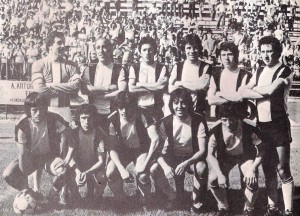
21 wins, 14 ties, 7 losses, 66-43 goal-difference, 56 points – one more than Everton. Champions, even of Second Division, matter. Strong year for the boys and going up to play with the best. To the envy of their local rivals…
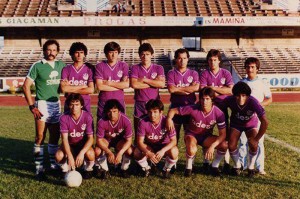
Deportes Concepcion (Concepcion) finished 11th and remained in Second Division.

Some other former First Division members were also unable to reach promotion:
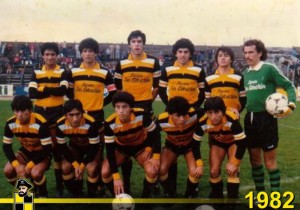
Coquimbo Unido (Coquimbo) finished 10th. Lota Schwager (Coronel) – 13th, Nublense (Chillan) – 14th, Ovalle (Ovalle) – 17th, the list may go on, but those were the general losers remaining in the Second Division. Should have played better: those, who did, moved up.

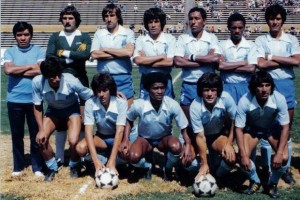
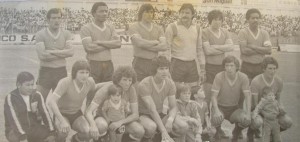
Along with Fernandez Diaz, the next 4 teams in the final table were directly promoted: Everton (Vina del Mar0 – 2nd, Trasandino (Los Andes) – 3rd, Union San Felipe (San Felipe) – 4th, and Antofagasta (Antofagasta) – 5th.
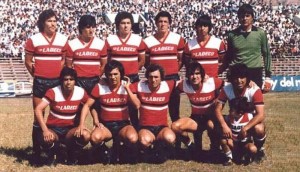
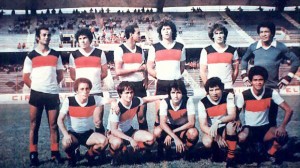
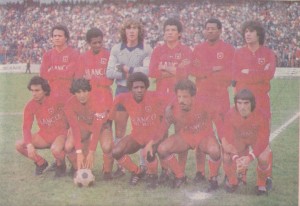
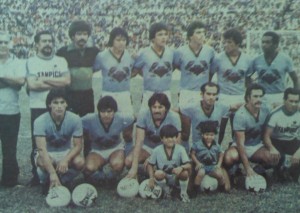
Lucky Antofagasta. Standing from left: Franklin López, Juan Balbontín, Gustavo Huerta, Eduardo Peralta, Julio Moya, Daniel Díaz.

First row: Navid Contreras, Héctor Olivos, Jorge Américo Spedaletti, Franklin Lobos, Jorge Luis Pons.

Lucky, because they finished 5th only on better goal-difference. But good season anyway – with 53 points, they were just 3 points behind the champions.

The 6th and the 7th went to the promotion/relegation tournament, but there were still three open spots in the new First Division – and now the ‘good venue’ factor was employed… it looks ridiculous: Huachipato (Talcahuano) finished 20th and under normal circumstances may have been relegated to the Third Division – but now they were promoted to the First. So were Green Cross (Temuco) – 15th in the final table.
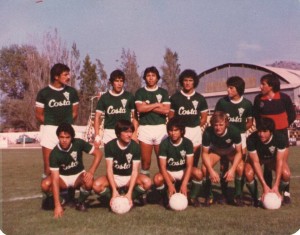
Santiago Wanderers (Valparaiso) was the third of this group – and the strongest: they were 12th. Good for those clubs, but it still does not make sense – all of them were in the lower half of the table. Others had stronger season – but never mind. Good luck to all promoted in the next season.

The real unlucky were Cobresal and Union Calera – they went to the relegation/promotion tournament, facing Union Espanola (12th in First Division) and Palestino (13th in First), lost, and remained in Second Division – when, without any extra work, Huachipato moved up. Weird. By the way, those, coming from First Division to play in the promotion/relegation tournament added to the weirdness: normally, they should have been save and not endangered by relegation. But that is for the First Division championship. One last thing for the future: not all promoted participated immediately in the 1983 championship: Green Cross and Huachipato joined First Division only at Campeonato Oficial and in many records is actually stated that they were promoted to top flight only after the end of 1983 Campeonato Apertura. Go figure…
 

Peru I Division

First Division played its 3-staged championship – it did not really matter how many members the top league had, for they were divided into 3 groups in the first stage. The top 3 teams of the Northern and Southern groups and the first 4 of the Metropolitan group moved to the semi-final stage and the rest – to the relegation group. No points were carried over to the next stage, so what only matters was qualification. Winners were more or less only for the record: Juan Aurich won the Northern group, Coronel Bolognesi – the Southern, and Sporting Cristal – the Metropolitan. At the end, the first stage may be meant most to Coronel Bolognesi – a club rarely winning.

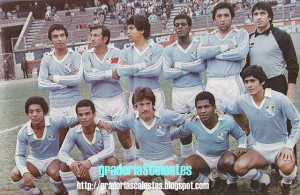
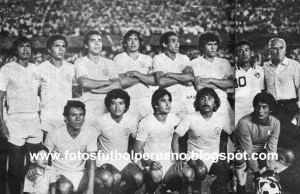
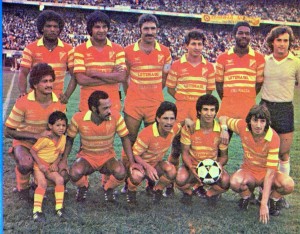
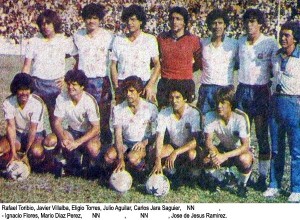
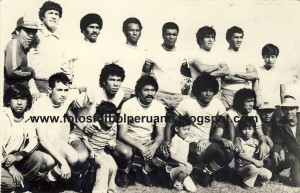
Coronel Bolognesi (Tacna). Standing from left: Oscar Vera, Alberto Sánchez, Reynaldo Bernaola, Carlos “Tito” Reyna, José Zevallos, NN.

First row: NN, Wilmar Valencia, Victorino Vicente, José “Camote” Vásquez, Roberto “Crítico” Zevallos.

The big losers were the Callao clubs – since they played in the toughest Metropolitan group, were they really weak or not hardly mattered: the big Lima clubs were there and life was tough. Atletico Chalaco and Sport Boys finished at the bottom.

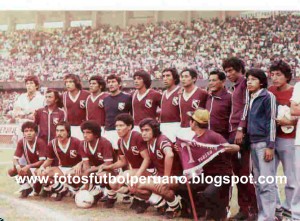
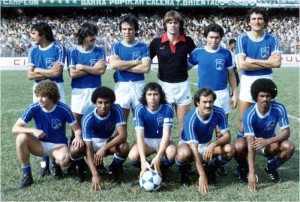
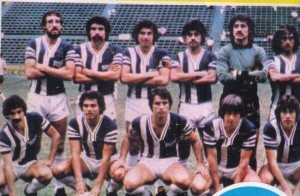
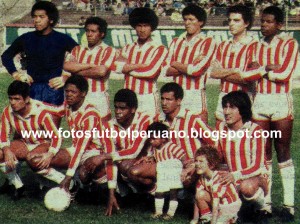
Atletico Chalaco finished ahead of local rivals Sport Boys – as if this was any consolation. The rivals were to meet again – in the relegation group. Standing from left: Chicho Espinoza, Augusto Prado, NN, NN, Javier Chirinos, Alejandro Pozú.

First row: NN, Alberto Castillo, Oswaldo Flores, Alberto Eugenio, Aldo Dueñas.

The semi-final stage was also a group tournament – the 10 qualified teams were divided into two groups and the top two of each moved to the final stage. Sporting Cristal was the big loser at this stage, finishing 4rd in Group A and thus eliminated.

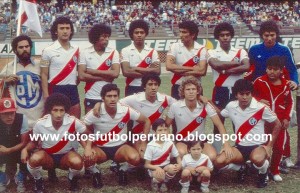
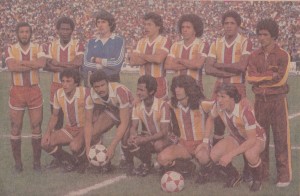
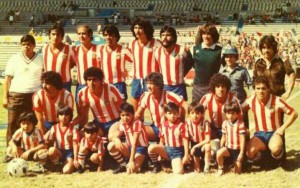
Sporting Cristal 1982, standing from left: Miguel Gutierrez, Alfredo Quezada, Ruben Díaz, Felipe Uculmana, Cesar Gonzales, Ramón Quiroga.

First row: Humberto Rey Muñoz, Eloy Ortiz, Luis Reyna, Luis Flores, Juan Caballero.

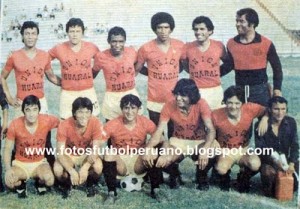
Union Huaral was may be unlucky – they ended 3rd in the same Group A, but just a point short from qualification.

Union Huaral missing the finals by a point, but still 4 points ahead of the more famous squad of Sporting Cristal.

And the final round-robin tournament: three teams from Lima – Universitario, Alianza, and Deportivo Municipal and single provincial club – Juan Aurich. Unlike the previous stages, the opponents here played only once against each other, so every match was important and, in the same time, lethal.

Deportivo Municipal was the weakest at the end – 1 tie, 2 losses, 2-4 goal differences. Standing from left: Juan José Sato, Percy Maldonado, Enrique Mendoza, Santiago Ojeda, Reynaldo Costa, Rodolfo Gamarra.

Crouching: Ricardo Gonzáles, Julio Argote, Eduardo Malásquez, Jaime Drago, Ever Negrete.

Juan Aurich finished 3rd, but only because they scored one goal more than Deportivo Municipal – 1 tie, 2 losses, 3-5 goal-difference.

Juan Aurich – not bad to be 3rd. May be. Standing from left: Alberto Párraga, José Navarro, Ronald Tello, Lizandro Navarro,  Cabrera, Rufino Bernales.

First row: Arnaldo Cadenillas, Alfredo Jáuregui, Percy Vílchez, Reynaldo Jaime, César Echeandía.

Alianza took the 2nd place, after winning 2 matches and losing 1. May be disappointed, but they qualified for Copa Libertadores, so the season was saved at least by that.

Universitario de Deportes was supreme when mattered most – 3 wins, 5-2 goal-difference.

Champions! Standing from left: Hugo Gastulo, Raúl García, Freddy Ternero, Germán Leguía, Samuel Eugenio,  Eduardo Aguilar, Dr. Jorge Alva, Roberto Scarone – coach.

First row: Rodolfo Chávarry, Juan José Oré, Percy Rojas, José Cañamero, Eusebio Acazuso.

Universitario was just near enough to the top in the earlier stages – 3rd in the first one, and 2nd in the 2nd stage – but at the last one they were supreme. A fine season.

At the same time another battle took place – in the relegation group every team fought for survival. Or, at least to avoid relegation play-off. Not much of a battle, actually: Deportivo Junin (Huancayo) was much weaker than the rest and finished at the dreaded last place with 3 points. Alfonso Ugarte (Puno) was 5th, just above Deportivo Junin, but with 9 points. But Deportivo Junin survived, winning the play-off – and seized to exist. At least as a name – it was changed to Huancayo FC for 1983 season.

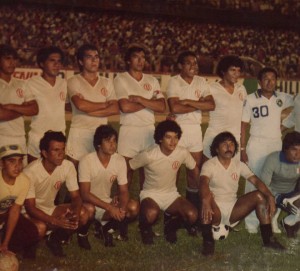
One more look at the champions – the pale sand-colour jerseys of Universitario confusing the lenses and looking white. 16th title – but their first since 1974. Thanks to their Uruguayan coach Roberto Scarone too.

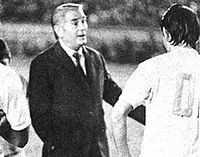
A famous player once upon a time, he was perhaps more famous as a coach – for he was at the helm of Penarol (Montevideo) when they won Copa Libertadores in 1960 and 1961 and the Intercontinental Cup in 1961. He did not coach after 1975, but came back in 1982 and finished his coaching career honourably – as a champion. Wise choice of Universitario – Scarone coached them when they won their last title in 1974 too. The magic was still there – Scarone returned them on the path of success after the lean years.


Peru II Division

Peru. The complicated Second Level championship was won by the little known Gonzales Prada. Good for the general record, but the club was not promoted. Instead, Atletico Torino (Tallara) won promotion.

Standing from left: Luis Vitonera, René Seminario, Ricardo “Morro” Valladares, Walter Valladares, Carlos “Pay” Peña, Dioses.

First row: NN, Freddy “Avispa” Peña, Francisco “Paco” Montero, Félix Suárez, Humberto “Toby” Correa.

A nice return to the top division, but the ‘why’ is a bit obscure: there was no relegation this year in the First Division, because it was extended to 17 teams for the next championship. Either the decision for extension was made late, or there was still relegation, but after a play-off. A relegation tournament was played in the top league, there was a loser, and it played a play-off against Atletico Torino. But no… the play-off was played: between Deportivo Junin, last in First Division and the winner of the Amateur Departamental Champion of the region to which Deportivo Junin beloneged – Castilla. Deportivo Junin won 5-0 and 2-0, and kept its top flight place. So… why Atletico Torino moved up and the Second level champion Gonzales Prada did not is a mystery. Most likely, money was the reason: only first division clubs were called ‘professional’ and the rest of Peruvian football was ‘amateur’. Financial regulations may have been the decisive reason – Atletico Torino was a professional club. Others may have been been short on cash. The vast number of Peruvian clubs were and are unknown to the world – as it is generally with lower-level clubs in every country. Clubs like

Deportivo Anda Aucayacu and

Deportivo Cantolao kicked the ball in the vast lower levels, hidden from the world’s attention. Atletico Torino was another thing altogether – and went up to its more familiar grounds and opponents.

Paraguay

Paraguay. The winner of Second Division, and promoted to the First, was Atletico Colegiales.

An interesting club: it was found in 1977 by the Zacarias family, owners of the chain of bookstores ‘El Colegio’ (‘The College’), and promptly named after their enterprise. The name of the club roughly means ‘the Students’ and to this very day a Zacarias chairs it. The location was nothing much – they hailed from 4 Mojones, Lamba municipality, Asuncion – a humble neighbourhood in a city full of old and popular football clubs. Finances were always limited, but the club generally did well enough. So far, it was a success: promoted to Second Division in 1979 and now, in 1982, won promotion to the top league – absolute beginners in every sense, but impressive ones. And good luck to them in the next season.

The top league had no surprises.

Cerro Porteno was out of the picture, failing one more season.

So was Sportivo Luqueno – and may even its supporters did not notice that Jose Luis Chilavert debuted this year.

Nacional finished 2nd – not bad, but still short of success. Standing from left: Raúl Navarro, Héctor Fariña, Oscar Cardozo, Luis García Siani, Ricardo Pérez, Francisco Carmona.

First row: Máximo Almada, Francisco Alcaraz, José Domingo Paniagua, Gustavo Fanego, Rene Vazquez.

Almost no need to name the champions – Olimpia. 5th consecutive title and also familiar squad – so familiar, that it is even difficult to distinguish the picture of this year from those of the previous. They easily mixed and confused even the club’s historians. One of the most impressive periods in the history of the club, a period not only of domestic dominance, but also of international success, putting them on the world map and making then at least known to fans around the world.


Colombia

Colombia. Still closed league. America (Cali) won the Apertura, the classic-league format of the first stage. Deportivo Cali was 2nd, 1 point behind. Both teams qualified for the semi-final quadrangulars.

Toprneo Finalizacion followed – the league divided into two 7-team groups, each to play the baffling number of 21 games. America (Cali) won Group A, trailed by Deportivo Pereira. Deportes Tolima was 1st in Group B, followed by Millonarios.

As often was in South America, the records make little sense: what was supposed to mean ‘semi-final quadrangulars’? And what was the meaning of ‘Torneo Finalizaion’? The next and final stage was ‘Octagonal final’ – a mini-league of 8 teams. Playing twice against each other. America and Deportivo Cali already qualified to the final tournament from the Apertura. They also finished 1st and 4th , Deportivo Cali, in the second stage. Judging by the finalists, the 2nd, 3rd , and 5th placed in Group A qualified to the final tournament, plus the 3 top-placed teams in Group B.

In such scheme, Once Caldas was seemingly victimized: they were 4th in Group B – higher placed than Independiente Medellin, 5th in Group A. True, if Apertura is taken into consideration, Independiente Medellin had better overall record. Yet, it makes little sense to advance a team only because higher placed teams already qualified.

Two of the teams unable to reach the final tournament:

Union Magdalena with very young ‘Pibe’ Valderama and

Cucuta Deportivo. Standing from left: Julio Niebles, Álvaro Contreras, Oscar Ortega, Eduardo Carrillo, Sergio Rodolfo Santín, Alfredo Griego. Crouching: John Jairo Restrepo, Daniel Godoy, Oscar Orlando Sierra, Adalberto Perrout, Sergio ‘el checho’ Angulo.

So, to the last tournament. Atletico Junior finished 8th and last and last, sharing the same 11 points with two other teams – Independiente Medellin, 7th, and Atletico Nacional, 6th. Deportivo Cali was 5th with 13 points.

Strong season for Deportivo Pereira – 4th with 14 points.

Millonarios ended 3rd with 15 points. Standing from left: Moisés Pachón, Pocillo López, Cheché Hernández, Alberto Pedro Vivalda, Nolberto Molina, Miguel “Nano” Prince. First row: Norberto Peluffo, Jair Abonía, Carlos Ángel López, Ernesto Díaz, Arnoldo Iguarán.

Excellent season for Deportes Tolima – 2nd in the most important final tournament with 17 points, thus qualifying to play in the Libertadores Cup. Standing from left: Hugo Gallego, Américo Quiñónez, Fredy Clavijo, José Flórez, Gustavo Mendoza, Francisco Maturana.

First row: Evaristo Isasi, Aparecido Donisette de Oliveira “Sapuca”, Janio Cabezas, Víctor Hugo del Río, Heberto Carrillo. The world eventually became very familiar with Francisco Maturana, but years later, when he was coaching Colombia.

And lastly – the champions, finishing with 20 points from 8 wins, 4 ties, and losing only 2 matches. 22-14 goal diffrences. Who else, but America (Cali). Standing from left: Víctor Hugo “Káiser” Espinoza Patiño,Heberto Quiñónez,Julio César “Gato” Falcioni Capdevilla,Juan Edgardo Caicedo Vargas, Luis Eduardo “Hombre de hierro” Reyes Portocarrero, Osvaldo Héctor Damiano Gozza.

Crouching:Juan Manuel Bataglia Melgarejo,Gerardo Sabino González Aquino,Víctor “Rápido” Lugo Ortíz,Juan Bautista “Martillo” Penagos Escobar, Roque Raúl Alfaro.

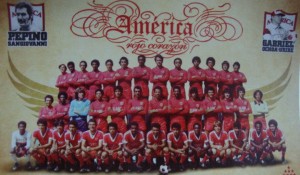
Here they are – the full squad of the new, but very familiar champions of Colombia. Huge squad for that years, but such was South America.

Something interesting happened this season: an European player appeared. True, not for the first time, but it was still extremely rare for Europeans to play in South America.

Dragan Pavlovic joined Santa Fe – not the first Yugoslav to play for the club, but unlike the legendary Dragoslav Sekularac, Pavlovic was obscure player whose career cannot be easily traced. Yet, Pavlovic instantly stamped his mark – he was one of the top scorers in this championship with 16 goals and, more importantly, scored the fastest goal in the history of his new club: against Millonarios, he scored in the 21st second of the game. A picture of him is difficult to find, but his name stays. He eventually moved to play largely indoor soccer in the USA and now is head coach of the youth system of Ajax Chicago.

Bolivia

Bolivia. Primero de Mayo (Potosi) won the single promotion for the next season – a success for the small club, no doubt. For the city too, for otherwise they would have been without first division team in 1983.

Relegation was decided at the first stage of the championship, a normal league format. Independiente Unificada (Potosi) finished last – 14th – and was relegated. The first 8 teams at this stage moved to the second one, divided into 2 groups. The top two of each group went proceeded to the semi-finals.

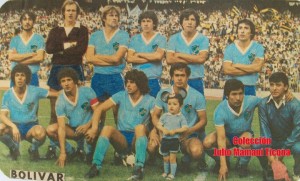
Bolivar (La Paz) won the first stage with 41 points – 5 ahead of Blooming (Santa Cruz). Good start, but what mattered was still ahead and it was not uncommon strong teams at the openings to fail later in South America. And this Bolivian season was typical to championship with complex formulas: Jorge Wilstermann (Coachabamba) and Oriente Petrolero (Santa Cruz) jumped into high gear, after having mellow first stage – J. Wilstermann was 6th with 28 and Oriente Petrolero – 4th with 30 points. Now they won their groups, J. Wilstermann followed by Bolivar in Group 2 and Oriente Petrolero by Blooming in Group B.

The Strongest (La Paz) were perhaps the big losers this year: 3rd in the openinh stage and 3rd again in Group A of the second stage. Out of the race.

J. Wilstemann eliminated Blooming in the semi-fianls: 2-0 and 0-0. In the other clash Oriente Petrolero and Bolivar exchanged 2-1 home wins and had to play a third match. Now Bolivar prevailed 2-1. Thus, the final was between the teams coming from Group B – which gave Jorge Wilstermann some edge in theory.

In practice, Bolivar won 2-1 its home match and everything had to be decided in the second leg on hostile Cochabamba. Bolivar managed a 1-1 tie and became the 1982 Bolivian champions.

May be a bit unlucky, Jorge Wilstermann, but finishing second was fair overall: they were not impressive in the first stage, tactically depending on the next rounds.

One more title for Bolivar and well deserved too, for they were consistently strong during the whole year and played well in every stage.

Ecuador

Ecuador played its usual complicated championship – ‘primera’ and ‘segunda etapa’ – the top 2 teams of each going to the final tournament. Two teams were relegated after the first stage, replaced by the corresponding winners of the Second Division of the first stage. But there was a difference this season: the league was going to be increased to 14 teams, so there were no relegated teams this year at all – the winners of first stage of the Second Division moved to First Division for the second stage, thus increasing it to 12 teams, and the winners of the second stage moved to top league for the next season, making the league 14-team strong.

El Nacional (Quito) won the ‘Primera etapa’ with 23 points. LDU (Portoviejo) clinched second place on better goal-difference. Both teams had to worry only for the final tournament from this moment. Second Division had its own winners, joining the ‘Segunda etapa’ of First Division:

Deportivo Quevedo won the first stage of Second Division and

Aucas (Quito) was second. Going a bit ahead, neither club was particularly strong for a surprise, but they also did not have to fret over relegation.

The ‘Segunda etapa’ of Second Division was won by

Manta, with America (Quito) finishing second – well done for both clubs, moving to the top league at least for the first stage of 1983. Just for the record, two teams unable to emerge from Second Division:

Macara, and

Deportivo Cuenca.

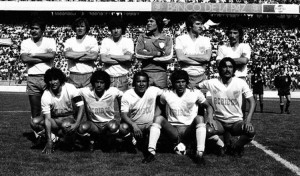
Deportivo Quevedo did quite well for a newcomer in the second stage of First Division – they finished 6th with 23 points. This may be not a photo from 1982, but at least is from this successful period of the club. Note the numbers: the great Ajax (Amsterdam) of the early 1970s is usually credited as a pioneer of permanent individual numbers higher than 11, but South Americans used individual numbers may be earlier – their inspiration was North American sports, hence, the numbers were often unusually high for a soccer team (24 and 35, for instance).

At the bottom, just like in the first stage, was Everest (Guayaquil). Terrible season for them – 12 points in the first stage and 10 in the second: their combined record was worse than the record of Deportivo Quevedo in their one stage!

The other big losers this year were Emelec – 4th in the first stage and 8th in the second stage – and Deportivo Quito.

Deportivo was 5th in the first stage, but sunk to 11th place in the second.

On the opposite way was 9 de Octubre (Milagro) – 8th in first stage, but climbing to 2nd place in the second stage – and qualifying, may be surprisingly, to the final. Barcelona ( Guayaquil) won the second stage.

The final round-robin tournament was between Barcelona, 9 de Octubre, El Nacional, and LDU (Portoviejo). After every team played 6 matches, there was no champion:

1. El Nacional 6 3 1 2 13-8 11

2. Barcelona 6 3 1 2 8-11 11

3. LDU 6 3 0 3 10-9 8

4. 9 de Octubre 6 2 0 4 7-10 4

Only in South America a team with negative goal-difference may win a title… normally, Barcelona should have been 2nd and done for, but here only points count and since they were even, a final play-off followed. Barcelona won at home 4-2. El Nacional bested them in the second leg – 3-0. Barcelona was still second and still had a chance to be a champion: again goal-difference did not count and third match was scheduled. And only now justice prevailed – and with a vengeance! El Nacional destroyed Barcelona 3-0.
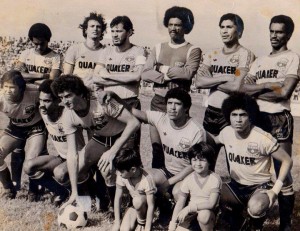
Barcelona was second, it was not their year and also their final place was fair. On the other hand, football was robbed by a great curiosity: a team consistently second and even shaky looking by its results could have been a champion.

Deserving champions, second and first rows from right to left:

It was not an easy victory, but El Nacional did their job – they reached the final stage after winning the opening stage of the championship. Having nothing to play for in the second stage, they still performed well, finishing 3rd. Won the final tournament, but still had to go through difficult play-offs and won 2 of the three matches. Good year and 6th title!

Venezuela

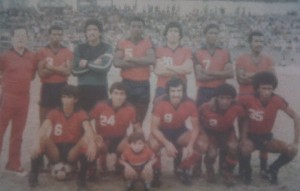
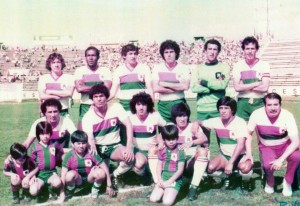
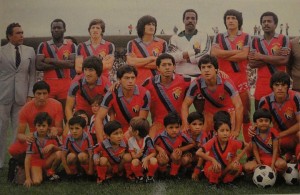
Venezuela. The Second Division was won by Mineros de Guayana.

Mineros was promoted, which was great for them.

First Division played their usual championship of two phases. Was it known in advance, or decided later is unknown, but the league was reduced to ten teams in 1983 – hence, 3 teams were relegated after the end of the 1982 championship. Valencia FC, 12th and Deportivo Portugues, 11th, were last in the league and their relegation is understandable. The third club out is a mystery: Deportivo Galicia was 7th after the initial first phase with 24 points. Even if there was second phase for the lower half of the league their relegation makes no sense: they were far superior to the others and if any points were carried over to the final stage, they would have escaped. So it was either second stage starting from scratch and Deportivo Galicia suddenly lost from, or other reasons – financial irregularities, or something else. No matter – they were out.

The newcomers this year played well: Petroleros del Zulia (Maracaibo) was 8th after the first stage and, if there was second stage, they at least escaped relegation. Atletico San Cristobal did much better – after the first stage they were 3rd, only 2 points behind the winners.

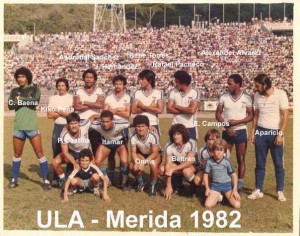
ULA (Merida) won the first stage with 29 points – 12 wins, 5 ties, and 5 losses.

Estudiantes (Merida) was 2nd with 28 points.

The to 6 proceeded to the final stage, but not carrying any points from the opening. Equal terms for everybody, all starting with 0. Now the picture was different – only 2 teams maintained their from from the first stage – Deportivo Italia finished last – 6th. They were 5th after the opening stage. Estudiantes lost steam and instead of competing for the title, they finished 5th. ULA was in the race, but also lacked the strength of the first stage – they ended with 10 points, but dreadful goal-difference, which placed them 3rd. Portuguesa FC, 6th at the first stage, pushed forward at the final, but ended 4th. The other team going ahead was Deportivo Tachira, 4th in the first stage. Now they tried hard to win, but finished second – having the best goal-difference, though. 11 points they got from 3 wins 5 ties, and 2 losses. A point better were the newcomers – Atletico San Cristobal won 3 matches, tied 6, and lost only one. 12 points made them champions.

What a story! The club was founded in 1980 and in 1982 was already champion of Venezuela.

Rarely debutantes won titles and hardly ever 2-years clubs, but if we look from the distance of time, the success may be assessed differently: 1981 and 1982 stay alone in the history of the club – their only two victories: one time 2nd Division champions and one time 1st Division champions in succession. Most likely, it was a case of money poured down recklessly to satisfy local pride. After that money dried out perhaps, the expensive players drifted away, and that was that – one short flashy period, never to be repeated again. But it was great anyway – in 2 years climbing from nonexistance to the national title.

NASL

NASL story was rapidly coming to an end. It was scraping at the bottom – indoor tournaments were used as a way to stay afloat, but the league was crumbling. Seven clubs folded at the end of 1981 – Atlanta Chiefs, Calgary Boomers, California Surf, Dallas Tornado, Washington Diplomats, Minnesota Kicks, and Los Angeles Aztecs. Players were still coming from all around the world, but the transfers were no longer big exciting news. Rules were modified a bit, but even that was seemingly a last effort to accommodate FIFA demands rather than luring American public to the stadiums. 14 teams played in the championship, divided into three divisions and collecting the weird massive points under the elaborated league system, which practically rewarded every move with a point – it was always weird to the eyes of Europeans and South Americans, but now was grotesque: the rapidly declining league had teams finishing the first stage of the championship wit points ranging from 93 to 203. Anyhow, the championship was played until it reached the final in September 1982, played at Dallas. The ‘Soccer Bowl’82’ attracted less than 23 000. New York Cosmos and Seattle Sounders contested it – the most successful NASL club and one stable club, which seemingly managed to put strong roots. Jumping ahead in time, it was a West Coast phenomena – three clubs managed to establish some following and stability,which helped them through the lean 1980s and 1990s: Seattle Sounders, Portland Timbers, and Vancouver Whitecaps. All of them had no major competition in their cities – no baseball, American football, basketball, and hockey teams taking public attention away (Seattle had basketball and Vanvouver – hockey, but soccer survived as second most popular sport). The approach of the competitors was also different: Cosmos, true to its name and New York, always had truly international squad with huge names; Sounders depended entirely on British players. To a point, Sounders were better organized, but Cosmos always had plenty of talented players, who even in their old age were capable of prevailing over compact, but less imaginative squads. And Cosmos won – 1-0, Chinaglia scoring the winning goal in the 30th minute.

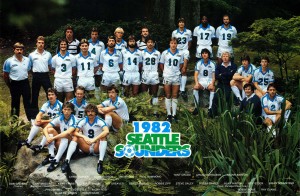
Sounders did well, but not well enough and the squad perhaps shows why: British based, as ever, but rather impoverished by now: Alan Hudson was just about the biggest name in the squad and he had a double role: playing assistant manager.

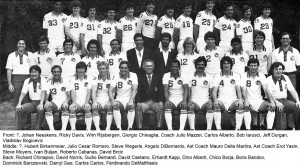
Cosmos was much heavier – but it always was: Chinaglia, Carlos Alberto, Neeskens, Rijsbergen, Bogicevic, Buljan, Romero, Cabanas. Compared to any other club in the league, very strong – yet, a few years back the list of great names was much longer: the end was coming, it was clear.

Mexico I Division

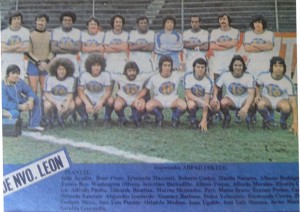
The First Division played the usual format: the league was divided into 4 groups of 5 teams at first and the top two of each group moved to the next direct-elimination stage. The two teams with least points in the first stage were to play the relegation play-off. Atlas and Tampico were the unlucky ones and their fight for survival was tight: each team won its home leg 1-0, so a third match had to be played in San Luis. Only now Atlas managed to survive, winning 3-1.

Tampico lost and was relegated. May be. There is always a big may be in Mexico.

The losers of the first stage were:

UNAM – 4th in Group 1 with 38 points.

Cruz Azul – 3rd in Group Group 2 with 43 points, unfortunately missing the play-offs on worse goal average.

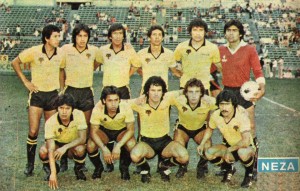
The winners, going ahead were: America and UANL from Group 1, Univerisdad de Guadalajara and Deportivo Neza – Group 2, Zacatepec and Atletico Espanol – Group 3, and Atlante and Monterrey – Group 4. Was it a normal league, Atletico Espanol and Monterrey would not have been going ahead – Atletico Espanol earned only 33 points and Monterrey – 40. Cruz Azul had 43, Puebla – 41, and Atletico Potosino – also 41, which placed them 4th in the strong Group 2. But the division of the league into 4 groups often favoured otherwise weaker clubs.

In the quarter-finals earlier results did not matter, of course. Atlante eliminated Atletico Espanol.

Monterrey was eliminated by America.

Zacatepec was eliminated by Deportivo Neza, and

Universidad de Guadalajara lost to UANL. UANL was the only team not losing a leg – they went ahead with a tie and a win, all the others depended on aggregate goal difference after losing one leg and winning the other (the home one).

In the semi-finals a single goal decided the winner in the first pair:

Deportivo Neza lost the home leg 0-1 to Atlante and managed a 0-0 away, but that was the end of them.

One goal decided the other finalist too:

America lost the first leg 0-2 and won their home leg 1-0, which was not enough.

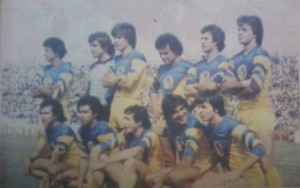
Thus, the final was between UANL and Atlante. UANL won 2-1 at home, then Atlante prevailed 1-0 and the match went into overtime. Nobody scored and the title had to be decided by penalty shoot-out. Only now UANL prevailed 3-1.

Atlante came close, but was unlucky to lose on penalties in front of home crowd. Such is life… the club had three stars,who helped, but also were disappointed at the end: the Argentinians Ruben Ayala and Ricrado La Volpe, and the Brazilian striker Cabinho, who already was a legend in Mexico.
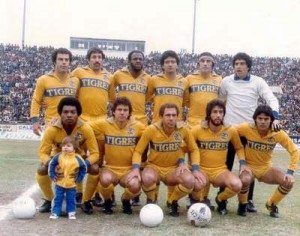
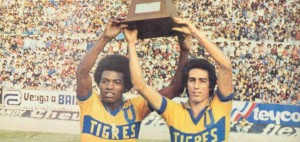
Joy in the other camp – Universidad Autonoma de Nuevo Leon, known as Tigres.

One can say the boys were lucky, but their record during the season argues differently: if it was a normal league, Tigres would have been 4th after the first stage and only Atlante won more matches and scored more3 goals than them. They lost 10 games out of 38, but proved how shrewd and dedicated they were in the play-offs: 3 wins, 1 tie, and 2 losses. Atlante still had better record – 3-2-1, but their single loss was against UANL at the final and when it came to penalties, Lady Luck was not on their side. As a whole, UANL Tigres prevailed with the second-best record – not exactly just lucky.

Tigres delivered when mattered and won their second title. Their Uruguayan coach Carlos Miloc knew his job more than well – his career was a string of successes and he made Tigres a winning team.

Tigres may not have had players with the fame of Ayala and Cabinho, but they had major stars as well – the Peruvian striker Geronimo Barbadillo and the Mexican midfielder Tomas Boy were the leaders, the other key foreigners were experienced and helpful, although not such big names: the Urguyan defender Osvaldo Batocletti had already long strong career in Mexico and lesser known Brazilians Roberto da Silva and Geraldo Gonsalves helped as much as they could.