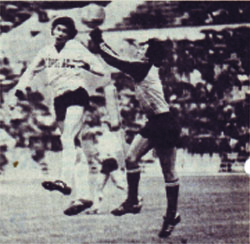
The quarterfinals for the European Championship were in the spring of 1972. Only two of the 8 teams did not play in the World Cup 1970 – Hungary and Yugoslavia. The draw played a cruel joke: England paired with West Germany and the weaker Hungarian and Romanian teams were to play against each other. Yugoslavia and USSR were considered equal and difficult to predict, and finally – Italy had the easiest lot against Belgium. The only ‘predictable’ ¼ final proved how unpredictable football is: Belgium eliminated Italy, after scoreless 0-0 at Milan, and 2-1 win at Brussels.
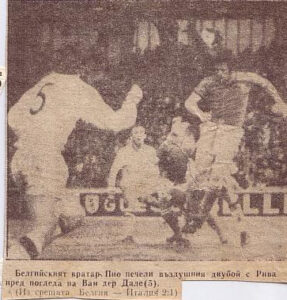 In front of Van den Daele (5), Piot wins the ball against Riva. Belgium won 2-1 and qualified.
Yugoslavia and USSR were considered equal, yet the Yugoslavs were slightly favoured, having the great left winger Dragan Djajic in their squad. But Yugoslavia were also known for underperforming at important tournaments. Scoreless 0-0 in Belgrade left possibilities open for both teams, however, with better chances for the Soviets this time. They won 3-0 – after the first goal the Yugoslavs, quite typically, collapsed.

A. Banishevsky (in white) scores the second goal in 74th minute in the Moscow’s second leg. Paunovic (in front of Banishevsky) is late and hopeless.
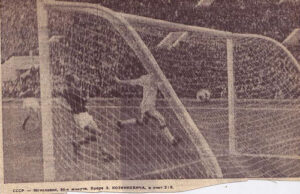
90th minute – E. Kozinkevich makes it 3-0. Kozinkevich, like Banishevsky, was a rarity in the Soviet squad – playing for small provincial club: Karpaty (Lvov) (see earlier posting). Banishevsky played for Neftchi (Baku).
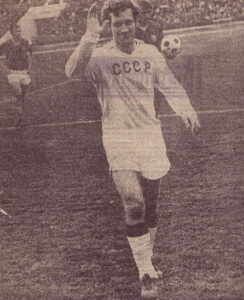 Russians to the ½ finals – Revaz Dzodzuashvili waives and smiles after the final whistle. Russians? Well, in terms of USSR. By today’s measure, not so – Dzodzuashvili is Georgian, Banishevsky – Azerbaijani (although an ethnic Russian), and Kozinkevich – Ukrainian.
Romania and Hungary, technically the ‘outsiders’, had to play three games until reaching a winner: 1-1 in Budapest; 2-2 in Bucharest; and finally Hungary outwitted their neighbours 2-1 at neutral Belgrade.
 A moment from the Bucharest leg: Nunweiler VI of Romania gets ahead of Szucz (Hungary, at the left). The Romanian playmaker was part of great footballing dynasty – he was the 6th (as his media name shows) Nunweiler gracing Romanian football. Alas, Hungary went ahead (they had players with Roman numbers attached to their names too.)
Hungary got some attention – there was some hope this new crop may have been a revival of the great 1950s… at least media articles give such impression:
 Hungary managing measly 1-1 against France in Budapest. The qualification group was barely won by the Hungarians.
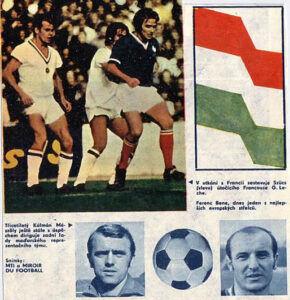
But some quality was quickly invented: at top, Szusz keeps an eye on Georges Lech (France). Bottom, left: Kalman Meszoly was considered the ‘conductor’ of Hungarian defense. Already 30 years old, Meszoly was not that impressive, as journalists suggested. He became coach of the Hungarian national team in the 1980s. On the right: Ferenc Bene – the leader of Hungarian attack, and the real star. He was supposed to be glorious continuation of tradition, stretching from Ladislao Kubala in the 1940s through Ferenc Puskas in the 50s, through Florian Albert in the 60s, and on, and on, through Bene… But he never reached the class of the legends. Today Bene is largely a club legend of Ujpest (Budapest), but not a legendary national player.
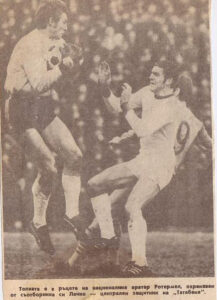 New kids to continue Hungarian glory: the goalkeeper Rothermel guarded by his club teammate Laczko in domestic league match in 1971-72 season. Their club – Tatabanya – was small one. Rothermel never became star goalkeeper – he was mostly second goalie in the national team. However, he was good enough to move to a better club – he became teammate of Ferenc Bene in Ujpest Dosza (Budapest), arguably, the best Hungarian club in the 1970s.
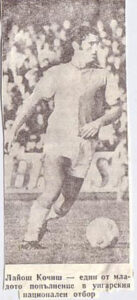 Lajos Kocsis, from Honved (Budapest), was considered one of the young hopes of Hungarian football. He was 25 years old in 1972, having played in the Olympics 1968, so it is hard to see why he was considered ‘a hope for the future’.
Contrary to journalistic prognostics, Rothermel did not play at the finals; Kocsis was replaced in the ½ final and was not fielded in the match for the third place; and Meszoly was not even in the squad at the final stage of the championship.